Author Archives: jzxadmin

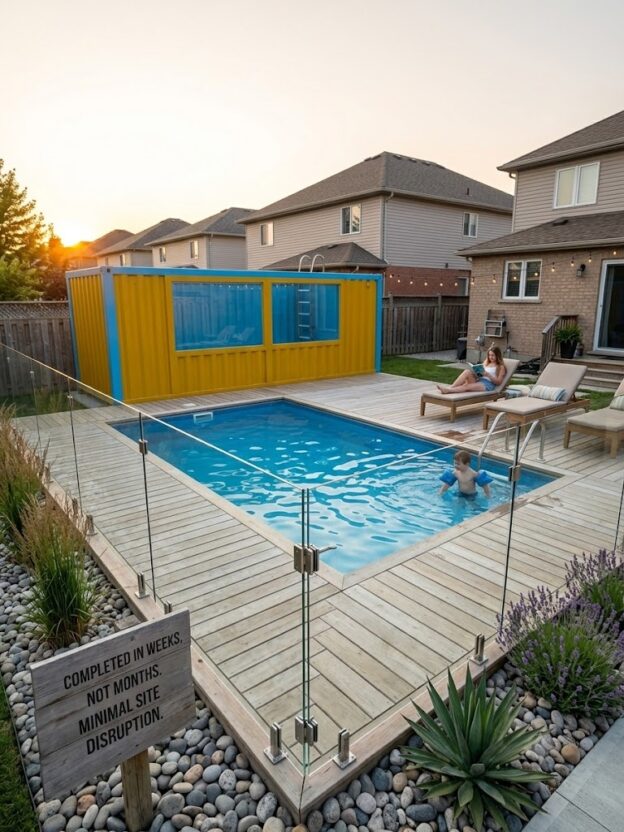
Container Pool for Real Estate Sales Centers and Show Villas

Container Pool for Real Estate Sales Centers and Show Villas

Container Pool for Real Estate Sales Centers and Show Villas: A Developer’s Guide

A sales center or show villa has one job: convince a buyer to sign before they walk next door to the competing project. Everything in it is built to sell a lifestyle that doesn’t exist yet, and a pool does more of that work than almost any other feature on the lot. The catch is that the sales center itself is temporary — most run 12 to 24 months before the site gets handed over for actual construction — so pouring a permanent concrete pool for a structure that’s coming down in two years rarely makes financial sense. That’s the specific problem developers bring to us, and it’s worth walking through how a container pool actually solves it.

Why Are Developers Adding Container Pools to Sales Centers and Show Villas?

Buyers are purchasing off a floor plan and a rendering, which is an abstract, hard sell. A pool at the show villa gives them something concrete to stand next to — water, a deck, a lifestyle they can picture themselves living, not just describing. Data on this is consistent across markets: pools are consistently cited as one of the features that most influences a buyer’s perceived value of a property, with realtor industry data putting the resale value lift at roughly 5-11% depending on region and market. A developer showing that lifestyle in person, rather than in a rendering, is selling the same emotional decision a listing photo tries to trigger — except the buyer is standing in it.

How Does a Pool Affect Buyer Perception During a Site Visit?

Site visits are short — most sales teams get 30 to 45 minutes with a serious buyer before they move on to the next appointment. A pool at the show villa does something a brochure can’t: it lets a family picture an actual afternoon in that space, kids in the water, parents on the deck. That’s not a marketing platitude, it’s the reason model home programs across the industry consistently invest disproportionate budget in outdoor lifestyle features relative to indoor finishes. A show villa pool works the same way a staged living room does, just for the exterior lifestyle a buyer is actually purchasing when they buy into a resort-style or family development.

Can a Container Pool Be Relocated After the Sales Center Closes?

This is the detail that makes container pools genuinely different from a poured alternative, not just faster to install. Because the shell retains its original corner castings and lifting points — built to ISO 668 container frame standards — it can be drained, disconnected from utilities, and lifted onto a flatbed for transport to the next project phase or a different site entirely. A poured concrete pool has none of this optionality; it’s demolished along with the rest of the sales center when the site is handed over for construction. For a developer running multiple project phases or multiple sites over several years, that relocation capability changes the entire financial picture — the pool isn’t a one-time marketing expense, it’s an asset that moves with the sales program.

How Long Does It Take to Install a Pool Before a Project Launch Event?

Launch dates in real estate marketing are rarely flexible — they’re tied to a pre-sale campaign, a press event, or a broker preview that’s already been scheduled and budgeted. Factory production for a standard show villa spec typically runs 4-6 weeks, plus freight transit, plus a few days for on-site placement and connection. Working backward from a fixed launch date, that predictability is worth more than it looks on paper: a poured pool build carries weather risk, inspection scheduling risk, and labor availability risk, any of which can push a completion date past a launch event that’s already been advertised. A factory-built unit removes most of that uncertainty from the critical path.

What Does a Show Villa Pool Cost Compared to a Permanent Amenity Build?

Per-unit, a container pool’s factory price can look comparable to or slightly above a rough concrete estimate. The comparison changes once you account for what happens after the sales center closes. A poured pool is a sunk cost — it gets demolished with the rest of the temporary structure. A container pool can be relocated to the next phase, sold to a buyer who wants a residential unit, or redeployed to a different marketing site, which means its real cost isn’t the purchase price, it’s the purchase price minus whatever residual value it carries into its next use. For a developer running a multi-phase project over several years, that math usually favors the container pool by a wide margin.

What Should a Developer Check Before Ordering a Marketing Pool?

  • Confirm the unit can be fully drained and disconnected for relocation, not just installed as a one-way fixture
  • Ask about crane and flatbed logistics for the eventual move — plan the exit before the launch, not after
  • Don’t skip barrier fencing and gate compliance because the pool is “just for marketing” — visitors and their children still access it, and the liability is the same as a permanent installation
  • Check lead time against your fixed launch date with margin for freight delays, not the optimistic case
  • Ask whether the supplier can match finish and coping style to the show villa’s design package, since this is a brand presentation piece, not a backyard afterthought

For the underlying structural and coating spec that determines how well a relocated unit holds up across multiple moves and sites,. And if a marketing pool is one of several ways you’re evaluating this product across a broader portfolio — alongside residential or hospitality use — the full picture is in container pool application. For background on how the broader modular and relocatable construction industry approaches asset reuse across projects, the ISBU Association is a reasonable independent reference.

Bringing It Together

A show villa container pool is doing marketing work, not just providing an amenity, and that changes how a developer should think about the purchase. The buyer perception lift is real and well documented across the wider real estate industry, the relocation capability turns what would otherwise be a sunk marketing cost into a reusable asset, and the fixed factory timeline protects a launch date that’s usually already locked into a broader marketing campaign.

Container Pool for Schools, Community Centers, and Recreation Facilities

Container Pool for Schools, Community Centers, and Recreation Facilities

Container Pool for Schools, Community Centers, and Recreation Facilities

A facilities director at a school district or a parks and recreation department doesn’t usually get to say yes to a pool project just because it would be nice to have. It has to clear a budget cycle, fit inside a construction window that doesn’t disrupt the school year, meet accessibility law, and survive a public bid process where every dollar gets questioned by a board or a city council. That’s a genuinely different buyer than a homeowner or a hotel GM, and the questions that matter are correspondingly different. Here’s what actually comes up in those conversations.

Why Are Schools and Community Centers Considering Container Pools?

The honest answer is usually budget and timeline pressure at the same time. A district that’s had a container pool closed for years due to deferred maintenance, or a rec center trying to add aquatics programming without a multi-year capital project, is looking at a poured pool build that can run 6-12 months and carry significant construction contingency risk. A container pool compresses that into a fixed factory build with a known price, which matters enormously when the funding source — a bond measure, a grant, a one-time budget allocation — has a use-it-or-lose-it deadline attached to it. Public buyers care less about novelty and more about whether the number they were approved for is the number they’ll actually spend.

Can a Container Pool Be Installed During a Single Summer Break?

This is close to a hard requirement for most school facilities projects — nobody wants a construction site next to an active campus during the school year, and administrators are rightly cautious about any project that risks bleeding into September. Factory production for a commercial-spec unit typically runs 6-8 weeks. If procurement starts early enough — purchase order issued in early spring, site prep scheduled to run in parallel with production rather than after it — delivery and installation before the fall semester is a realistic target many districts have hit. Where this goes wrong is almost always procurement timing, not the product: a purchase order that clears board approval in June leaves very little margin before a September opening.

Does a Container Pool Meet ADA Accessibility Requirements?

Yes, but only if it’s specified correctly from the start. Under the 2010 ADA Standards for Accessible Design, public pools operated by schools, park districts, and recreation centers are required to provide an accessible means of entry — a pool lift or sloped entry at minimum, with a second accessible entry point required for pools over 300 linear feet of pool wall. This has to be built into the unit’s design before it ships; retrofitting a lift or sloped entry onto a completed pool shell afterward is far more expensive and sometimes structurally awkward. When requesting quotes, ask explicitly whether ADA-compliant entry hardware is included in the base commercial package or priced as a separate line item — this is one of the more common gaps we see in initial RFQs from public buyers who assumed it was standard.

What Does a Learn-to-Swim Program Need From a Pool Facility?

If the pool is going to support instructional programming rather than just recreational swim, the requirements shift. Formal swim lessons are one of the more effective drowning prevention interventions available — research cited by the CDC’s drowning prevention guidance associates formal lessons with roughly an 88% reduction in drowning risk among children ages 1-4 — which is part of why school and community-based swim programs carry real public health weight, not just recreational value. Practically, that means the facility needs consistent water temperature control, a shallow instructional zone separate from any deeper section, filtration sized for continuous multi-class throughput across a full day rather than intermittent residential use, and a supervision and barrier setup that satisfies both general pool safety code and whatever student safety policy the district already has in place.

How Does a Container Pool Fit Into a Public Procurement or Bond Budget?

Public capital projects live and die on cost certainty. A poured concrete pool is typically bid as an open-ended construction contract, which means change orders are a real risk once excavation starts and the ground turns out to be rockier, wetter, or more contaminated than the initial site survey suggested — all of which routinely blow through a fixed bond allocation. A container pool is a manufactured product with a fixed factory price, which is a fundamentally different risk profile for a budget that has to be defended in a public meeting. It doesn’t eliminate cost variables entirely — freight, site prep, and utility connection still carry some variability — but the largest cost component is locked in before the project starts, which is usually the detail that actually gets a proposal approved by a board that’s been burned by construction change orders before.

What Should a Facilities Director Check Before Recommending a Container Pool?

  • Confirm ADA-compliant entry (lift or sloped entry) is built into the base quote, not an add-on
  • Ask whether the supplier’s filtration spec is sized for continuous multi-class instructional use, not residential-level throughput
  • Get a written production timeline that leaves margin against your fall semester deadline, not the best-case schedule
  • Confirm commercial-use compliance documentation (water treatment, circulation turnover) aligns with your state or local health department’s public pool code
  • Ask about warranty and maintenance support terms specifically for high-use public facility conditions, which differ meaningfully from residential use patterns

For the underlying structural and coating specification a public facility order should meet,  And if this is one of several use cases you’re weighing for your organization — alongside hospitality or residential applications — the fuller picture is in container pool application.

Bringing It Together

For a school district or a public recreation department, a container pool isn’t a lifestyle purchase, it’s a capital project that has to survive budget scrutiny, a tight construction calendar, and legal accessibility requirements all at once. The fixed factory price protects a bond or grant allocation from the change-order risk that sinks so many public construction projects, a well-timed order can realistically land inside a single summer break, and ADA compliance is entirely manageable as long as it’s specified up front rather than bolted on later. We’ve watched more than one district go from a closed pool that had been sitting empty for years to a reopened aquatics program in one construction season — that’s the kind of timeline public buyers rarely expect until they see it laid out this way.

If you would like to learn more about the specifications and details of our container pools, please feel free to contact us.

Container Pool for Hotels and Resorts

Container Pool for Hotels and Resorts

Container Pool for Hotels and Resorts: What Hospitality Buyers Need to Know

A hotel general manager or ops director doesn’t usually contact us because they read about container pools somewhere and thought it sounded interesting. They contact us because a competing property down the road just added a pool, the booking numbers moved, and now there’s pressure to catch up before the next high season — without shutting down half the grounds for three months to do it. That’s a specific, practical problem, and it’s worth walking through exactly how a container pool solves it, and where it doesn’t.

Why Are Hotels and Resorts Turning to Container Pools for New Amenities?

The pool itself sells rooms. A 2024 industry survey found that nearly 75% of travelers ranked pools and hot tubs among their top three most important amenities when booking a stay, trailing only complimentary breakfast — ahead of gym access, parking, or business services, according to VivoAquatics’ hospitality amenity survey. For a property without a pool, or with an aging one that’s become a maintenance liability, that’s a direct line to lost bookings. A container pool lets a property add or replace that amenity on a timeline measured in weeks of construction rather than a full season closed for renovation.

How Fast Can a Resort Add a Pool Without Closing for Renovation?

This is usually the question that matters more than price. Factory production for a commercial-spec unit typically runs 6-8 weeks, longer than a residential order because of the added filtration capacity and code compliance work. Add ocean freight transit, then a few days on-site for crane placement, plumbing tie-in, and final inspection. The property doesn’t need to fence off the pool deck or close guest access to the grounds for the months a poured concrete build would require — the disruptive part of the work already happened at the factory. For a resort trying to open a new amenity before peak season, or a hotel that can’t afford a multi-month closure of guest-facing space, this is often the deciding factor over the alternative.

What Certifications Does a Commercial Container Pool Need?

Commercial pools carry a heavier compliance load than residential ones, and it’s a separate track from the structural certificates that cover the steel shell itself. In the US, most local health departments model their commercial pool code on some version of the CDC’s Model Aquatic Health Code, which covers water treatment chemistry, circulation turnover rate, signage, and — depending on the jurisdiction — lifeguard or supervision requirements. This sits on top of, not instead of, standard barrier and fencing compliance. A buyer sourcing a commercial unit should ask the supplier directly whether the filtration and turnover rate specified meets commercial-use turnover requirements, not the lighter residential spec, since this is a common point where an underspecified quote fails final inspection.

Compliance Area Residential Spec Commercial Spec
Filtration turnover Every 6-8 hours Every 4-6 hours, often faster for high-traffic pools
Water treatment monitoring Manual testing, homeowner-managed Automated dosing and logging, often required by local code
Barrier/fencing Residential barrier code Commercial barrier code, plus signage requirements
Inspection frequency One-time at install (in most jurisdictions) Recurring health department inspections

How Many Guests Can a Container Pool Actually Handle at Once?

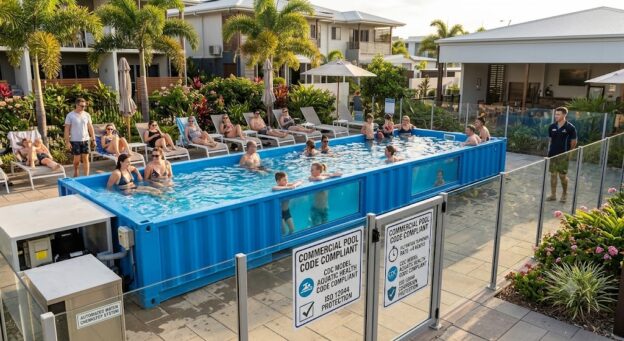
A 40ft unit fitted with commercial-rate filtration typically supports 15-20 simultaneous bathers comfortably, which covers most boutique hotel and mid-size resort peak loads. A 20ft unit is better suited to a smaller guesthouse or as a secondary plunge pool alongside a larger amenity rather than the primary pool for a property with meaningful guest volume. Larger resorts sometimes order two units positioned to feel like a single larger amenity, or work with us on a custom module — worth discussing early in the planning process rather than after the site layout is finalized.

What Does a Hotel Container Pool Cost Compared to a Built Amenity Pool?

The factory quote for a commercial container pool often looks high next to a rough estimate for an in-ground pool, and that comparison isn’t complete until the concrete alternative’s full cost is on the table: excavation, structural engineering sign-off, gunite, tiling, mechanical room construction, and months of contractor labor, much of it during a period when the amenity is earning nothing. Once landed cost includes both sides of that comparison, the gap narrows substantially, and the revenue captured during the extra months a container pool is already open often outweighs any remaining price difference. For a property, the real number to model isn’t unit price — it’s cost per week of the amenity actually being open and bookable.

What Should a Hospitality Buyer Check Before Ordering?

  • Confirm the filtration and turnover rate is spec’d for commercial use, not residential
  • Ask whether the supplier has previously shipped units that passed local health department inspection in your specific market
  • Verify the coating system is rated for constant commercial-traffic water immersion, not a lighter atmospheric-grade spec
  • Check crane access and site logistics at the property before committing to a delivery date tied to a season opening
  • Get the compliance documentation — material certs, weld inspection, coating spec — in writing before the deposit, not after

For the underlying structural and coating spec that a commercial-grade order should meet, see container pool specifications, built against the ISO 12944 corrosion protection framework. And if a hospitality pool is one of several applications you’re weighing — alongside residential or staff housing use — the full picture is covered in container pool application.

Bringing It Together

For a hotel or resort, a container pool isn’t really a product decision — it’s a timeline decision with a product attached. The compliance requirements are real and worth taking seriously, particularly the gap between residential and commercial filtration and turnover specs, but they’re manageable with the right documentation up front. What actually moves the needle is opening weeks or months sooner than a poured pool build allows, while guests are already booking rooms around the amenity that’s now on the property page. We’ve seen properties go from empty pool deck to a fully booked opening weekend faster than most GMs expect — that gap between “we need a pool” and “guests are swimming in it” is usually the whole business case.

container pool for gard

Container Pool for Backyard and Residential Use

Container Pool for Backyard and Residential Use: What Homeowners Actually Ask

Most homeowners who reach out about a residential container pool have already ruled out a traditional build for one reason or another — too slow, too disruptive, or the yard just doesn’t have room for a construction crew for three months. What they actually want to know is narrower than “tell me about container pools.” They want to know if it fits their yard, if it’s safe with kids around, and whether the price actually makes sense once everything is added up. This piece answers those questions directly, based on what we see repeated across residential export orders.

Why Are Homeowners Choosing Container Pools for Backyard Installations?

The short answer is speed and predictability. A container pool is built and pressure-tested at the factory before it ever reaches the property, so a homeowner isn’t gambling on weather delays, subcontractor scheduling, or a concrete pour that doesn’t come out level. The unit shows up, gets set on a prepared pad, gets connected to power and water, and that’s most of the work. For a growing number of buyers — young families who want a pool before summer, second-home owners who don’t want to manage a months-long local contractor relationship — that timeline difference is the entire decision.

There’s also a real estate angle worth mentioning. Homes with pools frequently command a premium in listings within warm-climate markets, and a container pool gets a property to that listing-ready state in a fraction of the time a poured pool build takes.

How Much Backyard Space Does a Residential Container Pool Actually Need?

This is usually the first practical question, and it has a straightforward answer:

  • 20ft unit: roughly 6m x 2.5m footprint, plus 1-1.5m clearance on each side for fencing, deck edge, and equipment access
  • 40ft unit: roughly 12m x 2.5m footprint, plus the same clearance allowance
  • Ground prep: a compacted gravel or concrete pad rated for the filled weight — for a 20ft residential unit, that’s typically several tonnes once full of water
  • Access route: a crane or forklift path wide enough to place the unit; this is worth checking before ordering if the property has a narrow side gate or a shared driveway

Most suburban backyards can fit a 20ft unit without reshaping the lot, which is a large part of why it’s the size ordered most often for single-family homes. For a full comparison of what changes structurally and in cost between the two sizes, see 20ft container pool vs 40ft container pool.

Is a Container Pool Safe for Families With Young Children?

A container pool carries the same safety profile as any residential pool — meaning the pool itself isn’t the variable, the barrier and supervision around it are. This matters because the numbers on residential drowning are sobering: drowning remains a leading cause of unintentional injury death among young children in the US, and most of those incidents happen at a private home rather than a public facility, according to CDC data on drowning risk factors. The single factor that shows up again and again in that research is inadequate fencing — no barrier, a gate that doesn’t self-latch, or a fence with gaps wide enough for a small child.

What this means practically for a container pool order: a compliant 4-sided fence with a self-closing, self-latching gate isn’t an optional accessory, it’s the single most important line item on the order. The reference framework most suppliers build against is the ANSI/APSP/ICC residential pool barrier standard, which sets minimum fence height and gate hardware requirements; many local building departments require proof of compliance before signing off on the installation. If there’s one thing worth double-checking on a quote before it’s approved, it’s this — not the tile color, not the coping style.

How Long Does It Take to Install a Container Pool at a Private Home?

Factory production for a standard residential spec typically runs 4-6 weeks. Add ocean freight transit time depending on the origin and destination port, then 2-5 days on-site for placement, plumbing connection, electrical tie-in, and fence installation. Door to door, most residential orders land somewhere in the 10-14 week range — noticeably shorter than the 3-6 months a poured concrete pool commonly takes once permitting, excavation, and weather delays are factored in. For a family trying to have a pool ready before a specific summer or a specific event, that difference is often the deciding factor over price.

What Does a Residential Container Pool Cost Compared to a Built-In Pool?

The factory quote for a container pool can look higher than a rough estimate for a concrete pool, and that comparison isn’t fair until the concrete pool’s full cost is on the table — excavation, rebar, gunite or shotcrete, tiling, coping, and months of site labor. Once those are included, the landed cost gap narrows considerably, and on sites with difficult ground conditions (rocky soil, high water table, tight access for excavation equipment), the container pool frequently comes out ahead. A homeowner comparing quotes should ask for an apples-to-apples number that includes site prep on both sides, not just the headline price of one against the other.

What Should You Ask a Supplier Before Ordering a Backyard Container Pool?

Question to Ask Why It Matters
What’s the shell steel thickness and coating spec? Determines longevity, especially in humid or coastal climates
Does the fence and gate meet my local building code? Required for occupancy sign-off in most jurisdictions
What’s the total door-to-door lead time, not just factory time? Freight and customs clearance often get left out of initial estimates
Is the site pad and crane access confirmed before production starts? Avoids a costly delay or redesign after the unit has already shipped

For the underlying engineering spec — wall thickness, coating system, filtration sizing — that a serious supplier should be able to answer without hesitation, see container pool specifications. And if backyard installation is one of several use cases you’re evaluating alongside hospitality or commercial projects. the broader picture is covered in container pool application.

Bringing It Together

A backyard container pool comes down to three honest questions: does it fit the space, is it safe for the people using it, and does the timeline and cost actually beat the alternative once everything is counted. For most suburban lots, a 20ft unit fits without reshaping the yard, the safety profile depends entirely on getting the fence and gate right rather than the pool itself, and the total cost — landed, not just factory price — often lands close to or below a comparable built-in pool once excavation and labor are included. If the goal is to get a family swimming this season instead of next, that combination is usually what settles the decision. We’ve watched enough of these go from quote to backyard splashing to know the details above are the ones that actually matter — not the ones that show up in a glossy brochure.

Why you import Custom Covered Bleachers?

Why import Custom Covered Bleachers That Actually Fit Your Field?

Type “custom covered bleachers” into Google and you’ll get two kinds of results: catalog pages selling vinyl covers you drape over an existing bleacher, and generic aluminum bleacher listings that mention “custom” in the title but offer no roof at all. Search a few sports facility forums and the complaints repeat themselves — a $400 vinyl cover that split down the seam after one windy season, a maintenance crew that has to pull the cover off before every home game and put it back after, parents asking the athletic director why there’s still no shade over the visitor side. None of that is really “custom covered bleachers.” It’s a workaround.

We build container grandstands for a living, so we’ve read a lot of these threads. Below is what buyers actually run into when they go shopping for real covered spectator seating, and where a container-based grandstand solves problems a vinyl cover or a standard aluminum stand can’t.

spectator stand container in china factory

Why Do Most “Custom Covered Bleachers” Searches Lead to a Dead End?

Two different products get lumped under the same search term. A bleacher cover is a tarp, usually PVC or vinyl, stretched over an existing frame to cut UV and rain exposure. It helps, but facility managers on r/AthleticDirectors and similar forums report the same failure points: grommets tearing out in gusts above 30 mph, covers that need to come down for winter storage, and a look that reads more “tarp over a truck bed” than permanent facility upgrade.

A covered grandstand is a different category entirely — a structure with an engineered roof that’s part of the build, not an accessory bolted on afterward. That distinction matters when you’re the one explaining the budget line to a school board or a municipal parks committee.

Temporary Bleacher Covers vs. Permanent Covered Grandstands: The Facility Manager’s Dilemma.


What Pain Points Keep Coming Up When Buyers Compare Suppliers?

  • ADA compliance is not one-size-fits-all. Wheelchair spaces, companion seating, and ramp slope requirements differ by state and county, so a stock design rarely clears local review on the first pass. The ADA National Network is the resource we point clients to when they need current, region-specific accessibility guidance before finalizing a layout.
  • Aluminum pricing moves the quote. Several suppliers note in their own buying guides that bleacher pricing shifts with raw material costs, which means a quote from six months ago is not a quote today.
  • Metal theft is a real line item. Facilities managers in several forum threads mention scrap thieves cutting up aluminum bleachers for recycling value — a risk that drops significantly once seating is a bolted, containerized steel structure rather than loose modular planks.
  • Load rating and code compliance get skipped in DIY quotes. Uniform load ratings typically run 85–100 psf for commercial bleacher structures, and everything should trace back to IBC. The International Code Council publishes the model codes most U.S. and many international jurisdictions reference — worth checking before you sign, not after.
  • Delivery logistics get underestimated. Standard bleachers ship on flatbed freight and need a loading dock or forklift; buyers frequently find this out only after the truck shows up.

Is a Container Grandstand a Smarter Way to Get Covered Seating?

A container grandstand starts life as a standard ISO shipping container — 40ft in our case — that unfolds or extends into a tiered, roofed spectator stand on site. That single fact solves three of the pain points above at once.

Shipping is by ocean freight in a standard container slot, not oversized flatbed cargo, which is where most international buyers lose money on freight surcharges. The roof is structural, not an add-on tarp, so it’s engineered into the load calculations from day one rather than stapled on afterward. And because the unit travels and stores as a closed steel box, there’s far less exposed aluminum for anyone to walk off with between installations.

Our 40ft container grandstand seats 63 spectators, built to the standard 18-inch seat allowance the bleacher industry has used for decades, with a welded steel frame and a covered roof section engineered for wind and snow load rather than draped over as an afterthought. If you’ve ever stood under an uncovered grandstand at 2pm on an August game day, you already know exactly what that roof is worth to the people sitting under it.

How Do You Calculate If 63 Seats Is Enough for Your Venue?

The industry math is simple: 18 inches per seat, multiplied by row length, multiplied by row count. A 40ft container converts to 480 inches of usable seating run — divide by 18 and you get roughly 26–27 seats per row before you account for aisle breaks and end posts, spread across the tiered rows that give you 63 total. For a youth league sideline or a mid-size school event, that’s usually enough without needing the multi-unit sprawl a traditional bleacher project requires when you’re trying to hit the same number.

If your venue needs more, container units scale by adding sections — you’re not redesigning a custom structure from zero for every capacity change.

What Should You Ask a Supplier Before You Sign the PO?

  • Can they provide stamped engineering drawings and load certification, not just a product photo?
  • What’s the corrosion warranty on the steel frame, and is the coating rated for coastal or high-humidity climates?
  • Does the roof design account for regional wind and snow load, or is it a fixed spec regardless of destination?
  • What’s the container’s on-site deployment time, and does that include a crew, or is it DIY assembly?
  • Can they add ADA-compliant wheelchair and companion seating to the layout before production, not after?

Facility standards bodies like the National Recreation and Park Association publish planning guidance for community sports facilities that’s worth cross-checking against any quote — it’s a useful gut-check on whether a supplier’s numbers are realistic for public-facility use.

Where Should You Actually Look for Container Grandstands?

Category Details
Product Type ISO 40ft shipping container that unfolds into a tiered, fully roofed grandstand
Seating Capacity 63 seats (standard 18″ per seat)
Seating Calculation 480 inches usable seating run → ~26–27 seats per row (before aisles)
Roof Integrated structural roof engineered for regional wind & snow loads
Shipping & Delivery Standard ocean container shipping (cost-effective for international buyers)
Installation Faster deployment from closed container box
Security / Theft Risk Low – bolted steel containerized structure
Durability Permanent welded steel frame with corrosion-resistant coating
ADA & Compliance Custom ADA wheelchair & companion seating integrated before production
Engineering Stamped engineering drawings & IBC-compliant load certifications provided
Customization Scalable by adding multiple units; region-specific load adjustments
Best Use Case Permanent covered spectator seating for schools, parks, and youth leagues
Key Advantages Structural roof, secure shipping/storage, reduced maintenance, easier compliance

Skip general bleacher retailers if covered, containerized seating is what you actually need — most of them are reselling standard aluminum stock and will quote you a vinyl cover as their “custom” option. Go directly to manufacturers who build container-based structures as a core product line, ask for factory verification and recent project photos, and request the engineering package up front rather than after deposit.

We build ours at GKC Pro specifically for export buyers who need a structure that ships cleanly, clears customs without oversized-freight headaches, and arrives ready to deploy rather than as a pile of parts and a hope the crew on-site can read the manual. If a 40ft, 63-seat covered grandstand is in the range you’re working with, that’s exactly the product we designed for this use case — worth a look before you settle for a tarp.

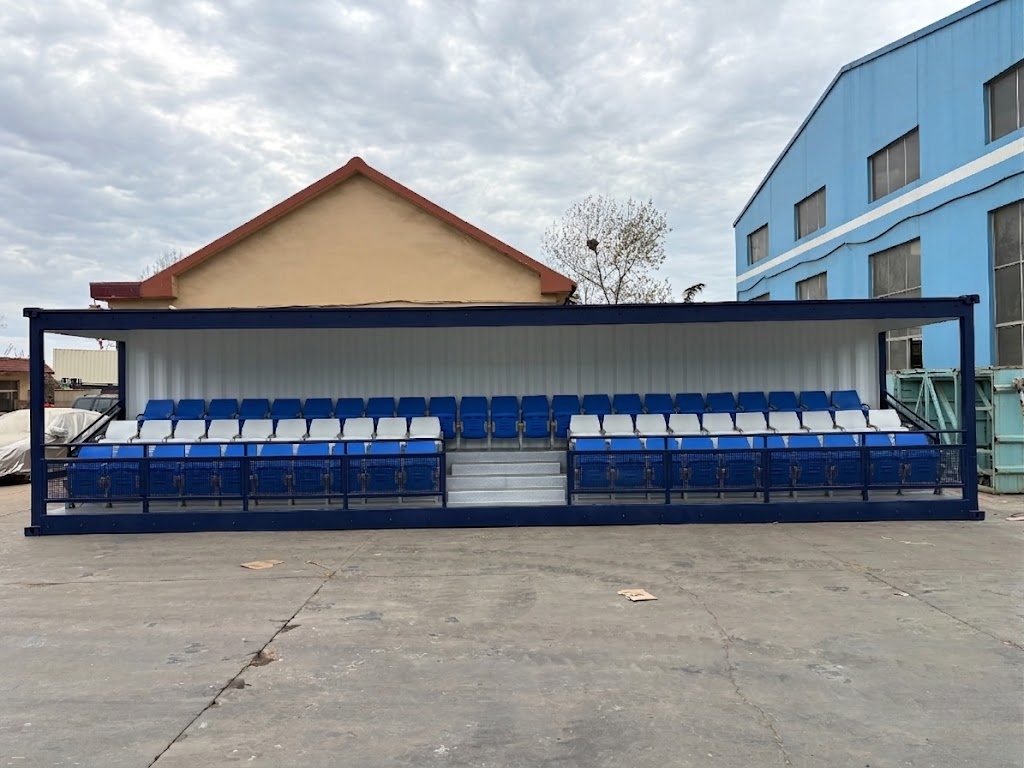
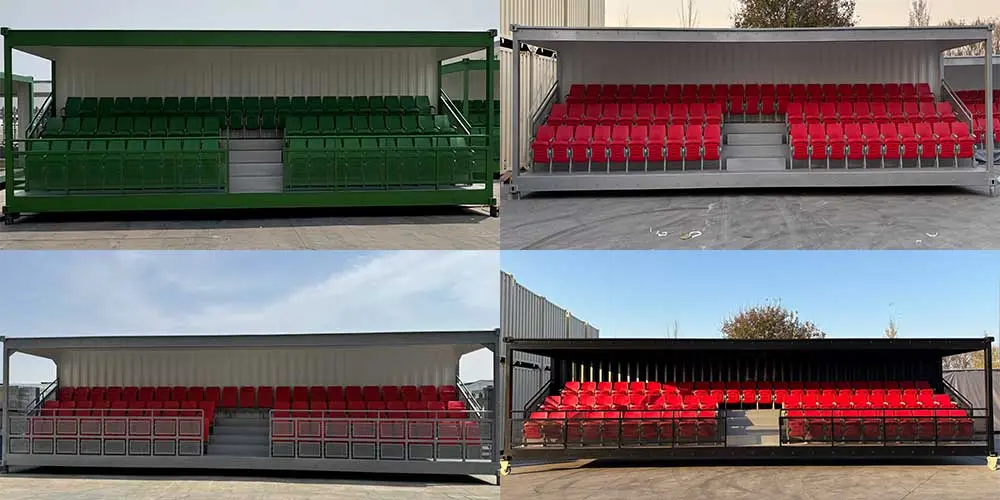
A cutting-edge container grandstand featuring an all-blue seating arrangement, designed to enhance the spectator experience at large events. With its sleek, modular design, it provides maximum comfort and a modern aesthetic for stadiums and arenas.

Container Grandstand Manufacturer: A Buyer’s Guide to Sourcing Quality Structures

Container Grandstand Manufacturer: A Buyer’s Guide to Sourcing Quality Structures

If you’ve spent any time requesting quotes for stadium seating, you already know the container grandstand market is crowded. Search “container grandstand manufacturer” and you’ll get dozens of listings that look nearly identical — same stock photos, same vague product descriptions, same “customization available” line at the bottom. Sorting out who actually builds these structures from who is just reselling them is the first real task in front of any buyer.

This guide walks through what separates a capable manufacturer from a middleman, using our own production of the 40ft container grandstand seat (63-seat configuration) as the reference point throughout. We’ll cover the four things that matter most once you get past the price quote: how the product is actually made, what manufacturing capacity really looks like on the ground, how quality gets checked before a container ships, and what past buyers say once the structure is installed and in use.

producing container grandstand

Why “Manufacturer” Is a Word Worth Verifying

In this industry, plenty of companies call themselves manufacturers on their website homepage and then subcontract the actual welding and fabrication to a third party they’ve never inspected. That’s not automatically a problem — some trading companies manage quality well — but it does change your risk profile. If something goes wrong with the steel frame six months after installation, you want to know whether you’re dealing with the people who built it or a middleman who has to relay your complaint to someone else.

A few direct questions tend to surface the truth quickly: Can they name the workshop location? Can they send unedited video of welders on the floor, not a five-second highlight reel? Do they know the wall thickness of the container frame off the top of their head, or do they have to “check with the factory”? None of this is complicated, but it does require asking before you commit a deposit.

What a 63-Seat 40ft Container Grandstand Actually Involves

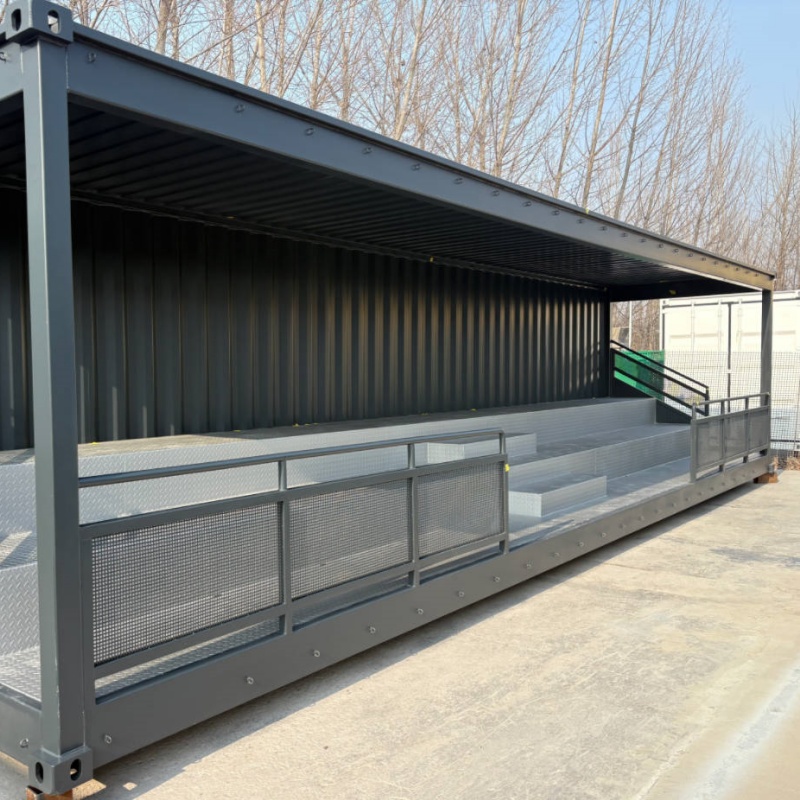
The 40ft container base is popular for a reason — it ships as a single standard unit, requires no on-site welding, and unfolds or assembles into a tiered seating block without heavy cranes at the destination in most configurations. Built out to 63 seats, the structure typically spans several tiers with a rear access stair and, depending on the buyer’s local code requirements, a handrail configuration along the open edges.

Sports clubs and school athletic departments tend to ask for this size when they need something bigger than a set of portable bleachers but don’t have budget or space for a permanent poured-concrete stand. Municipal buyers procuring for a community field often specify it too, since a container-based unit can be relocated later if the field layout changes — something a permanent structure can’t offer.

You can review the full technical breakdown — load ratings, steel gauge, tier rise and going, and container base dimensions — on our container grandstand technical specifications page, which is worth reading before you finalize a quote request so you’re comparing apples to apples across suppliers.

Production Process: From Steel Coil to Finished Container

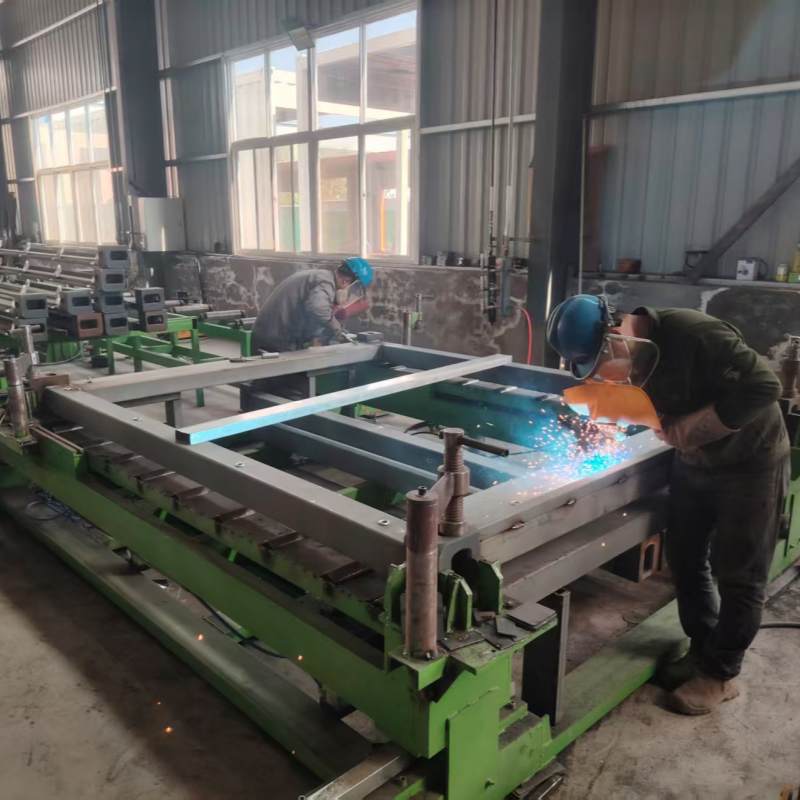
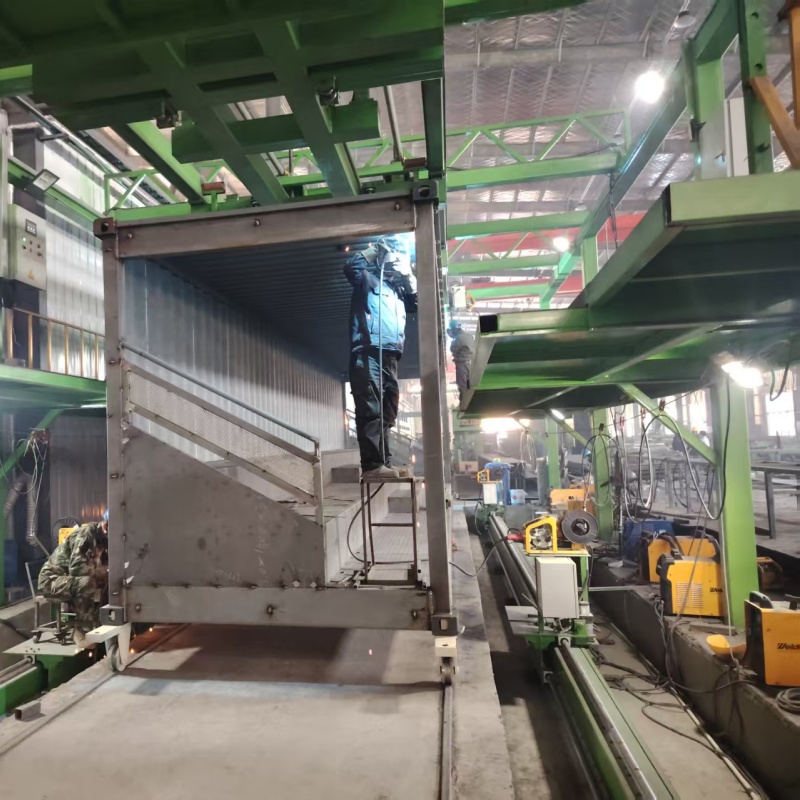
Manufacturing a container grandstand isn’t a single operation — it’s closer to four separate trades happening under one roof. Steel cutting and forming comes first, followed by frame welding, then surface treatment, and finally seating and safety hardware installation before the unit is loaded. Buyers who understand this sequence tend to ask sharper questions during factory audits, because each stage has its own failure points.

Structural steel for the frame gets cut to spec and formed before welding begins. Any manufacturer worth working with should be able to show mill test certificates for the steel batch used on your order — not a generic certificate from a different production run. Welding follows, typically done by certified welders working from engineering drawings rather than by eye. This is where a good structural design, ideally reviewed against the framework the American Institute of Steel Construction publishes for load-bearing steel structures, actually matters — a grandstand under dynamic crowd load behaves very differently from a static container.

After welding, surface treatment — sandblasting, priming, and a weather-resistant topcoat — protects against corrosion, which matters more than most first-time buyers expect if the unit is headed somewhere with high humidity or coastal salt exposure. Seating rows, handrails, and stairs go in last, followed by a full walk-through before the unit is packed for shipping.

For a detailed look at the individual production and QC stages, see our cluster article on the production process and workflow for container grandstands.

Manufacturing Strength: What Capacity Actually Looks Like

“Large-scale production capacity” is one of those phrases every supplier claims, so it’s fairly meaningless on its own. What actually matters to a buyer is simpler: can they hit your delivery date without cutting corners, and can they handle your specific configuration without treating it as an unfamiliar one-off.

Workshop size, welding line count, and how many container-based structures a factory ships per month are the concrete numbers worth asking for. A factory that has produced dozens of 40ft grandstand units will have already worked through the tolerance issues and assembly quirks that a newer operation is still discovering on your dime. We go into our own production footprint and equipment in more detail in the article on manufacturing strength and factory capability.

Quality Inspection: Where Buyers Get Burned or Protected

Quality control on a grandstand order isn’t a single sign-off at the end. It has to happen at each stage — raw material check, in-process weld inspection, and final pre-shipment inspection — because a defect caught after painting and assembly is far more expensive to fix than one caught at the cutting stage.

Weld inspection deserves particular attention. Structural welds on a seating frame carry real load once people are sitting and standing on it, and a visual check alone won’t catch subsurface defects. Reputable manufacturers reference recognized testing methods, and buyers with strict local code requirements sometimes request inspection aligned with standards published by ASTM International, a nonprofit standards organization widely used as a reference point for structural material testing.

We cover our own inspection checkpoints and the documentation we provide buyers — inspection photos, material certificates, and pre-shipment reports — in the article on quality inspection for container grandstands.

What Buyers Actually Say After Installation

Specifications and factory tours only tell you so much. The more useful signal, once you’ve narrowed your shortlist, is what past buyers report after the structure has been sitting in a field or stadium through a season or two of actual use — how the paint holds up, whether the stairs feel solid under a crowd, whether the supplier answered the phone when a bolt needed replacing.

We’ve collected feedback from several buyers across different regions and use cases in the customer reviews article, including a few comments on things that went less smoothly early on and how they were resolved — worth reading if you want a picture that’s less polished than a typical testimonials page.

⭐⭐⭐⭐⭐ “A Total Game-Changer for Our School Field!”
Reviewer: Athletic Director at a Private High School

“We needed to expand our stadium seating quickly before the new season, and traditional concrete construction was way out of our budget and timeline. These shipping container grandstands were a total game-changer. The modular setup took just a few days once the crane dropped them in. The canopy and railings feel incredibly sturdy and secure. Plus, the fact that we can relocate them in the future if the school layout changes is a massive bonus. Highly recommend!”

Review 2: ⭐⭐⭐⭐ “Great Flexibility, but Plan Your Logistics”
Reviewer: Event & Festival Coordinator

“We’ve used these container grandstands for multiple outdoor events now. Love the modern aesthetic and the fact that we can use the bottom container as a ticketing booth or storage space. It’s weather-resistant and holds up great against heavy crowd use. Just a quick heads-up for anyone buying: make sure your ground is perfectly leveled before delivery. Also, they are incredibly heavy (obviously), so don’t underestimate the crane and shipping costs in your budget.”

Where to Go From Here

If you’re evaluating a 40ft container grandstand seat with a 63-seat layout for a school, sports club, or municipal field, our 40ft container grandstand product  has current specifications, standard lead times, and configuration options. From there, the four cluster articles linked above go deeper into exactly how we build, inspect, and stand behind what we ship.

container grandstand safety options

Container Grandstand Safety: What Buyers Should Check Before They Sign

Container Grandstand Safety: What Buyers Should Check Before They Sign

Safety is usually the second question a buyer asks, right after price. And it’s usually asked the wrong way — “is it safe” isn’t really answerable with a yes or no. What buyers actually need to know is which standards the structure is built to, where the risk points are, and what the manufacturer has done about them. We get this question from stadium operators, school sports departments, and event companies alike, and the concerns are almost always the same three things: can it hold the load, can people get in and out safely, and will it hold up in bad weather.

Structural Load and Frame Safety

A container grandstand carries a different load profile than the container did as cargo. Once seating, decking, stairs, and a full crowd load are added, the structure needs to be engineered for concentrated live loads across the seating tiers, not just the distributed floor load a shipping container was originally rated for. This means reinforced floor framing, welded connection points rather than bolted patches, and a documented load calculation the buyer can actually request and review before manufacturing starts.

Steel connection design and coating specifications for structures like this generally follow guidance published by the American Institute of Steel Construction, which sets out the design tolerances most structural engineers reference when calculating live load capacity for exposed steel seating structures. If a supplier can’t produce a load rating or an engineering sign-off, that’s a gap worth pushing on before deposit, not after delivery.

Guardrails, Handrails and Fall Protection

This is where most safety complaints actually originate — not from the frame failing, but from a fall on the stairs or through a gap in the railing. A properly built container grandstand has continuous guardrails along every open edge, handrails on both sides of the stair sections, and railing infill spaced tightly enough that a small child can’t slip through. Stair nosing should be marked and slip-resistant, and stair rise-to-run ratios need to stay consistent through the whole run — inconsistent steps are one of the most common causes of trip injuries on temporary and semi-permanent seating structures.

Guardrail height, opening spacing, and stair geometry for bleacher-type structures are laid out in detail in the International Code Council’s bleacher and grandstand safety standard, which is the reference most venue safety inspectors use during walkthroughs. Asking a supplier whether their standard build meets this spec, rather than a general “industry standard” claim, tends to separate the manufacturers who’ve actually done the engineering from the ones who haven’t.

Seating Safety and Fire Rating

Seat material matters more than most buyers expect going in. HDPE and polypropylene seating should carry a self-extinguishing fire rating, meaning the material won’t sustain a flame if ignited by something nearby — a dropped cigarette, a flare at a match, whatever the venue’s real-world risk looks like. This is especially relevant for indoor-adjacent or covered structures where smoke has fewer places to escape. Fire performance guidance for assembly seating is covered under standards maintained by the National Fire Protection Association, and it’s reasonable to ask a supplier for a test report on the specific resin grade used, not just a general material spec sheet.

Seat anchoring is the other half of this. Tip-up seating needs to be through-bolted into the deck rather than screwed into a surface layer, and armrests should be checked for pinch points during folding — a small detail, but it’s the kind of thing that shows up in warranty claims if it’s skipped.

Site Conditions: Ground, Drainage, and Weather

A grandstand that’s perfectly safe on paper can still create hazards on site if the ground preparation is wrong. The unit needs to sit level, typically on compacted gravel or a poured concrete pad, with the frame fully supported rather than resting unevenly on a few contact points. Poor leveling puts uneven stress on the frame joints over time and can also cause water to pool under the structure instead of draining away, which becomes both a corrosion issue and a slip hazard around the base.

In wet conditions, stair treads and walkway decking need slip-resistant surfacing — diamond-plate steel decking is standard for this reason, and it should extend across the full stair run, not just the tread edges. If your venue sees regular rain or snow, it’s worth asking your supplier directly how the decking handles wet-weather grip, since this is one of the details that gets skipped on lower-cost builds.

How We Build Safety Into Our 40ft Container Grandstand

Our 40ft container grandstand, seating 63 people, is built with continuous perimeter guardrails, handrails on both stair runs, through-bolted tip-up seating, and diamond-plate anti-slip decking on all stairs and platforms. The frame is engineered for full concentrated crowd load across every seating tier, with structural details available on our container grandstand technical parameters page for buyers who want the full load specifications before they finalize a quote.

If you’re comparing this against other units for a stadium or club upgrade, our 40ft container grandstand product page has the complete configuration, seating layout, and safety compliance documentation.

Common Questions From Buyers

What safety standards should a container grandstand meet?

Look for guardrail and fall protection compliance referencing ICC 300, structural steel design following AISC guidelines, and fire-rated seating materials in line with NFPA guidance. Ask for documentation rather than a general claim of compliance.

Are container grandstand seats fire rated?

They should be. Reputable manufacturers use HDPE or polypropylene seating with a self-extinguishing rating, confirmed by a test report on the specific resin used rather than a generic spec sheet.

Is a container grandstand safe to use on uneven or wet ground?

Only with proper foundation preparation. The unit needs to sit level on compacted ground or a concrete pad, with drainage routed away from the structure and anti-slip decking on all stairs and walkways.

This infographic explains that a container grandstand has a two-tier lifespan: the structural steel frame lasts 25 to 30 years, while the seating system wears faster and requires refurbishment every 10 to 15 years. Essentially, buyers should budget for a long-term frame that will outlast one or two seating cycles, relying on proper drainage, routine inspections, and rain covering to reach its maximum service life.

Container Grandstand Service Life: What Buyers Should Actually Expect

Almost every buyer asks the same question during due diligence: how long will this actually last? It’s a fair question, and it’s also one that gets a vague answer more often than it should. Suppliers like to say “20+ years” without breaking down what that number actually covers. A container grandstand isn’t one single object with one single lifespan — it’s a steel structure paired with a seating system, and the two age at different rates. If you’re comparing quotes or planning a budget for a stadium, sports club, or temporary event venue, it helps to separate these two questions before you look at the total number.

Container Frame Lifespan

The frame is the part everyone assumes is permanent, and in a sense it’s not far off. A shipping container built to ISO freight standards starts life designed to survive stacking loads, ocean transport, and repeated handling, so the base steel is already overbuilt for a stationary seating structure. Once converted into a grandstand, the corrugated steel walls and floor structure are reinforced and the container is fixed in place rather than moved repeatedly, which actually reduces the fatigue stress it experiences compared to its original shipping role.

Under normal outdoor conditions, with a marine-grade primer, an intermediate coat, and a UV-resistant topcoat reapplied roughly every 5 to 8 years, a container grandstand frame holds structural integrity for 25 to 30 years. Coastal sites with salt exposure shorten that window unless the coating system is upgraded and inspection frequency increases. This lines up with published corrosion protection guidance from the American Institute of Steel Construction, which is the reference most structural engineers use when specifying coating systems and maintenance intervals for exposed steel structures.

What buyers sometimes miss is that the frame’s lifespan is directly tied to how the base container was sourced. A frame built from a heavily corroded used container, patched and repainted for a quick sale, will not hit the 25-year mark even with good maintenance. If a supplier can’t tell you the container’s prior cargo history and structural grade, that’s worth asking about before you sign.

Seating System Lifespan

Seats wear out faster than frames, and that’s normal — it’s not a defect, it’s just a different material category doing a different job. Most container grandstands use HDPE plastic seating, aluminum bench seating, or a mix depending on the tier and budget. HDPE holds up well against UV and impact but can become brittle in extreme heat cycling after 10 to 15 years without a UV stabilizer additive in the resin. Aluminum bench seating resists UV degradation entirely but is more sensitive to coastal corrosion at fastener points if stainless or coated hardware isn’t used.

In practice, we tell buyers to plan for one seating refurbishment cycle around year 12 to 15, whether that means reseating individual units or replacing full bench runs. This is standard across the bleacher and grandstand industry, not specific to container conversions — the seating replacement cycle is consistent with structural safety guidance published in the International Code Council’s bleacher and grandstand safety standards, which many venue operators use as a reference point for inspection and replacement planning regardless of the underlying structure material.

Buyers running events year-round, especially in hot or humid regions, tend to see seat wear closer to the 10-year mark. Buyers running seasonal venues, where the grandstand sits covered or unused for part of the year, often stretch that closer to 15 or even 18 years before seats need attention.

Maintenance Practices That Determine Actual Service Life

The gap between “worst case” and “best case” service life on a container grandstand usually comes down to three things: coating maintenance, drainage, and inspection discipline. Water pooling on the container roof or floor structure is the single most common cause of early corrosion we see reported by clients, and it’s almost always a drainage design issue rather than a material issue. A properly sloped floor and roof drainage system, specified at the manufacturing stage, prevents most of this before it starts.

Third-party structural durability data collected by the World Business Council for Sustainable Development on repurposed steel structures shows that scheduled inspection intervals, rather than material upgrades alone, account for the largest variance in structure lifespan across reused steel assets. That matches what we see in the field — two identical container grandstands, one inspected annually and one left alone for a decade, can end up five to ten years apart in usable structural life.

On the operations side, we usually recommend a monthly check-in once the grandstand is in active use — not a full inspection, just a walk-through to catch standing water, loose fasteners, or coating chips before they turn into rust spots. It takes an operations staff member twenty minutes and saves a lot of touch-up work later. During rainy periods, especially if the venue sees heavy or prolonged rainfall, covering exposed sections with tarps or waterproof sheeting is worth the extra effort. Container roofs and seating tiers that stay wet for days at a time are far more prone to corrosion at seams and fastener points than surfaces that dry out between rain events, so keeping water off the structure when it’s not in use matters more than most buyers expect going in.

If you want the full technical breakdown of coating specifications, load ratings, and structural tolerances for our container grandstand builds, that’s covered in detail on our container grandstand technical parameters page. It’s worth reviewing before you finalize a spec, especially if your venue sits in a coastal or high-humidity region.

Combined Service Life: What to Actually Budget For

Put together, here’s the realistic picture: a well-built, well-maintained container grandstand frame runs 25 to 30 years. The seating system inside that frame typically needs one refurbishment around the 10 to 15 year mark. So the honest answer to “how long does it last” isn’t one number — it’s a frame that outlives one or two seating cycles, assuming basic maintenance is kept up.

For procurement teams, this usually means budgeting the frame as a long-term capital asset and the seating as a mid-life maintenance line item, rather than expecting to replace the whole unit at once. It also means asking suppliers for coating specifications and seat material grade separately, not just a single “lifespan” figure on a spec sheet.

We build our 40ft container grandstands, seating 63 people per unit, with this two-tier lifespan in mind — reinforced frame construction paired with UV-stabilized seating that can be reseated without touching the structure. If you’re evaluating options for a stadium or club upgrade, our 40ft container grandstand has the full spec sheet and configuration options.

Common Questions From Buyers

How long does a container grandstand last?

The steel frame typically lasts 25 to 30 years with routine coating maintenance. Seating usually needs refurbishment or replacement every 10 to 15 years, since it wears faster than the structural frame.

Do container grandstand seats need to be replaced before the frame?

Yes, in almost every case. Seating materials are exposed to UV and foot traffic more directly than the frame, so most buyers plan for one or two seat refurbishment cycles across the life of a single frame.

What shortens the service life of a container grandstand the most?

Coastal or high-humidity conditions without a proper coating maintenance schedule cause the most damage. Skipped inspections, poor drainage design, and low-grade paint systems can cut usable frame life by a third or more.

Container Pool Application: This informative infographic showcases the versatility and utility of container pools across various applications and settings. The visual is divided into specific sections, each with a detailed description and illustrative image:

Container Pool Application: Where These Pools Actually Get Used

Container Pool Application: Where These Pools Actually Get Used

Understanding the container pool application helps buyers make better purchasing decisions.What they actually want to know is whether it fits their project. A hotel operator in Phuket is not asking the same questions as a real estate developer in Riyadh or a rental business owner in Florida. The steel shell, the modular build, the shipping logistics — all of that stays roughly the same. What changes is how the pool gets deployed, what standards apply, and what problems it needs to solve on site.

This page walks through the application scenarios we see most often from buyers sourcing container pools for export, along with the practical details that come up once a unit actually arrives at its destination.

Backyard and Residential Installations

Homeowners and small contractors are the entry point for a lot of container pool orders, especially in markets like Australia, the US, and parts of Europe where a traditional in-ground pool means months of excavation and a permitting headache. A container pool skips most of that. The unit ships assembled or semi-assembled, gets placed on a prepared pad or footing, and can be filled within days rather than weeks. The recurring question from residential buyers is about size—whether a standard 20ft or 40ft unit is actually usable for a family, or whether it feels cramped compared to a poured-concrete pool. We cover the dimensional trade-offs in more detail in our container pool size comparison guide, but the short version is that a 40ft unit gives enough swim length for lap use, while 20ft units work better as plunge or soaking pools. Residential installs also raise questions about local pool barrier and fencing requirements. Most jurisdictions that follow international model codes reference the ICC International Swimming Pool and Spa Code for fencing, self-closing gates, and alarm requirements, and buyers installing a container pool at a private residence still need to meet those local rules even though the pool itself arrives pre-built.

Hotels, Resorts, and Hospitality Projects

Hospitality buyers approach container pools differently than homeowners do. A resort or boutique hotel is usually adding a pool to an existing property—a rooftop, a courtyard, a strip of land between buildings—where structural load and space are already constrained. The appeal here is less about speed and more about being able to drop a finished pool into a space that was never designed to hold water. Rooftop and courtyard installs come with their own engineering questions: point loads on the structure below, drainage routing, and how the container’s steel frame distributes weight compared to a poured shell. We get asked about this constantly from hotel groups in Southeast Asia and the Gulf, where rooftop pools are almost expected at a certain property tier. Water quality compliance matters more in hospitality settings than residential ones, since these pools see rotating guests rather than one family. Operators sourcing filtration and treatment equipment for a hospitality-grade container pool generally look to standards like NSF/ANSI 50, which governs circulation, filtration, and disinfection equipment for public pools and spas. It’s worth confirming with your supplier that the pump and filtration package specified for a hotel unit is actually rated for the bather load you expect, not just the residential default.

Real Estate Sales Centers and Show Villas

This is a scenario a lot of first-time buyers don’t think about until a developer asks for it directly. Property developers use container pools as staging features—installed at a sales office or show villa to demonstrate what a finished amenity will look like, sometimes years before the permanent pool infrastructure goes in. The pool needs to look finished and photograph well, but it’s often relocated or removed once the sales phase ends. For this use case, buyers care less about long-term durability testing and more about finish quality, lead time, and whether the unit can be trucked to a second site later without major rework. If you’re comparing suppliers for this kind of project,

Rental operators—companies that install a container pool at a private event, a temporary beach club setup, or a seasonal pop-up—have a different cost calculation than a hotel or homeowner. The unit needs to survive repeated transport, setup, and teardown cycles without the shell warping or the plumbing connections failing. Buyers in this category ask us more about weld quality and frame reinforcement than about interior finishes, because the pool is going to be craned on and off a truck bed dozens of times a year. We’ve written separately about the cost-per-year math for this kind of repeat-use scenario in our container pool ROI breakdown, which is usually the first thing a rental business asks about before placing an order—how many events or seasons before the unit pays for itself compared to renting a fiberglass shell pool instead.

Schools, Community Centers, and Recreation Facilities

Public and semi-public buyers—schools, community associations, municipal recreation departments—tend to move slowly and ask a lot of questions up front, which is normal given that these projects usually involve a budget committee and a public bid process. The container format appeals here because it can be procured and installed within a single budget cycle, compared to a conventional pool build that might span two fiscal years including permitting. Because these are public-facing pools, water safety and treatment standards get scrutinized more closely. The WHO Guidelines for Safe Recreational Water Environments are a common reference point internationally for water quality parameters, and procurement teams sometimes ask suppliers to confirm the filtration and chlorination setup against those benchmarks before finalizing a contract. It’s a reasonable thing to ask for in writing during the quotation stage.

Coastal, Desert, and Extreme Climate Deployments

Environment is probably the single biggest variable buyers underestimate. A container pool installed in a humid coastal climate with salt air exposure faces a different set of stresses than one sitting in a desert compound with 45°C summer heat, or one deployed at altitude where nighttime temperatures swing hard. Coastal buyers ask us most about corrosion protection—coating systems, galvanization, and whether the steel frame is rated for a marine environment or just a standard export coating. Desert buyers are more focused on UV degradation of liner materials and how the pool handles rapid evaporation and heat expansion in the shell seams. We go through these environment-specific stress factors in detail in our environment performance guide, which is worth reading before you finalize coating and liner specs with your supplier, not after installation when a problem shows up. The base steel structure for any of these units still follows standard container dimensions and framing, which is why ISO 668—the international standard for series 1 freight container classification and dimensions—is the reference point most manufacturers build against, regardless of which climate the pool is ultimately shipped to.

Disaster Relief and Temporary Housing Sites

This is a smaller but real segment of the market—NGOs, relief agencies, and camp operators sourcing container pools or container-based water infrastructure for temporary settlements, worker housing compounds, or post-disaster recovery sites. Speed of deployment and ease of relocation matter more here than aesthetics. Buyers in this category are usually less concerned with tile finishes and more concerned with whether the unit can be shipped, installed, drained, and moved again within a tight timeline. Procurement for this use case often overlaps with broader humanitarian shelter standards. The Sphere Handbook on humanitarian standards is a common reference for agencies setting minimum requirements for water and sanitation infrastructure in displacement settings, even though it wasn’t written with container pools specifically in mind—it still shapes what these buyers expect from a supplier in terms of documentation and testing.

Matching the Application to the Right Spec

The mistake we see most often is a buyer ordering the same standard configuration regardless of where the pool is actually going. A rental operator doesn’t need hospitality-grade filtration, and a hotel doesn’t need the reinforced frame a rental business requires for constant relocation. Every one of these application types pulls a slightly different combination of finish level, filtration capacity, frame reinforcement, and coating system out of what’s otherwise the same base product. If you’re still comparing build quality between suppliers before deciding on a spec, our quality comparison guide breaks down what separates a high-end container pool build from a budget one, which is usually a more useful starting point than comparing price per square meter alone. Our full container pool product line covers standard configurations across these use cases, and our team can spec a unit around whichever scenario above matches your project.

Frequently Asked Questions

Can the same container pool unit be used for both residential and commercial applications?

The shell and frame are usually the same, but the filtration, water treatment, and safety fittings differ. A unit destined for commercial or public use typically needs higher-capacity filtration and documentation to meet local pool codes, so it’s worth telling your supplier the intended use before finalizing the spec rather than after.

Do container pools need different certification depending on where they’re installed?

Yes, in most cases. Residential installs usually just need to meet local fencing and barrier rules. Hospitality and public installations usually require compliance with recognized pool and spa equipment standards and local building codes, which can add a few weeks to the approval process depending on the jurisdiction.

How long does a container pool typically last in a harsh climate?

It depends heavily on coating quality and maintenance, not just the base steel. A properly coated and maintained unit in a coastal or desert environment can run 15-20 years, but a unit with a standard export coating pushed into a marine environment without additional corrosion protection will show problems much sooner.

Is it cheaper to buy a container pool for a rental business than to rent a traditional pool structure?

Usually yes, over a multi-season timeline, since the unit is reusable across events rather than rented per occasion. The payback period depends on how many events or seasons you run per year—our ROI breakdown covers the specific math buyers use to compare the two options.

Quick Summary: Where Container Pools Are Used

Container pool application are highly versatile. While the basic steel shell stays the same, the internal specs change based on where and how they are used.

Application TypeTarget Users / MarketsKey AdvantagesMain Considerations & RequirementsDifferentiating Specs Needed
Backyard & ResidentialHomeowners, small contractors (Australia, US, Europe)Fast installation, minimal excavation & permittingSize suitability (20ft vs 40ft), local fencing & barrier codes (ICC International Swimming Pool and Spa Code)Standard residential filtration, basic finishes
Hotels, Resorts & HospitalityBoutique hotels, resorts (Southeast Asia, Gulf region)Fits constrained spaces (rooftops, courtyards)Structural load analysis, drainage, high bather loadNSF/ANSI 50 rated filtration & disinfection, higher capacity equipment
Real Estate Sales Centers & Show VillasProperty developersQuick visual marketing asset, good photographyLead time, finish quality, future relocation capabilityHigh aesthetic finishes, transport-friendly design
Pool Rental & Event BusinessesRental operators, pop-up events, beach clubsReusable across multiple sites & eventsDurability under repeated crane/transport cyclesReinforced welds & frame, robust plumbing connections
Schools, Community Centers & Recreation FacilitiesPublic/semi-public entities, municipalitiesFits single budget cycle, faster procurementPublic bid process, water safety standardsHigher-capacity filtration, documentation for public use, WHO Guidelines alignment
Coastal, Desert & Extreme ClimatesInstallations in harsh environments worldwideModular & transportable to remote areasCorrosion (coastal), UV/heat expansion (desert), temperature swingsEnhanced coatings & galvanization, marine-rated protection, specialized liners
Disaster Relief & Temporary HousingNGOs, relief agencies, worker campsRapid deployment & relocationSpeed, ease of drain/move, minimal aesthetics focusBasic durable construction, alignment with Sphere Handbook standards

container pool market trend

Container Pool Trend: Market Growth, Future Development and Business Opportunities

Container Pool Trend: Market Growth, Future Development and Business Opportunities

The container pool trend is becoming one of the fastest-growing segments in the modular swimming pool industry. As a combination of prefabricated construction and modern swimming pool design, container pools are changing the way people build private and commercial swimming facilities.

Unlike traditional concrete pools that require long construction periods, complex excavation work, and high labor costs, container pools provide a factory-built alternative with faster installation, flexible applications, and lower project risks.

Driven by increasing demand for outdoor leisure spaces, tourism development, modular construction, and sustainable building solutions, container pools are gradually moving from a niche customized product to a mainstream option for residential and commercial markets.


1. Expanding Applications: From Private Backyard Pools to Commercial Projects

One of the biggest changes in the container pool trend is the rapid expansion of application scenarios. In the past, container pools were mainly considered a creative solution for individual users. Today, they are increasingly adopted by homeowners, developers, hospitality operators, and commercial project owners.

Growing Demand in Residential Markets

For residential users, container pools offer an easier way to create a private swimming and entertainment area without the complexity of traditional pool construction.

Many homeowners, villa owners, and property developers choose container pools because they provide:

  • Faster installation compared with traditional pools
  • Lower construction requirements
  • Flexible size options for different yards
  • Modern appearance suitable for contemporary homes
  • Easy maintenance and long-term operation

With the growth of backyard renovation, outdoor living, and family leisure consumption, container pools are becoming an attractive upgrade for private properties.

According to the Pool & Hot Tub Alliance, residential outdoor living continues to be an important driver of demand in the swimming pool industry.


Increasing Adoption in Commercial Projects

Commercial applications are another major growth area.

Hotels, resorts, camping sites, Airbnb properties, and outdoor recreation businesses are using container pools to improve customer experiences and create additional revenue opportunities.

Compared with traditional pools, container pools provide several commercial advantages:

  • Shorter project completion time
  • Lower initial investment
  • Easier transportation and relocation
  • Suitable for temporary or seasonal projects
  • Unique industrial-style appearance

For example, a resort can quickly add a swimming facility without waiting months for traditional construction. A campsite can install multiple container pools as premium accommodation facilities.

This flexibility makes container pools especially attractive in tourism and hospitality markets.


2. Product Innovation: Moving Toward Smart and Customized Solutions

The next stage of the container pool trend is not only about producing more pools but also improving user experience through technology and customization.

Smart Pool Technology Integration

Modern container pools are developing from basic swimming structures into intelligent outdoor systems.

Manufacturers are increasingly adding:

  • Automatic filtration systems
  • Water quality monitoring
  • Temperature control systems
  • LED lighting solutions
  • Remote control functions
  • Energy-saving equipment

These technologies help users reduce maintenance work and improve daily operation efficiency.

For commercial operators, smart pool systems also reduce labor requirements and improve management efficiency.


Customized and Modular Designs

Different customers have different space conditions and business requirements. As a result, customization has become a key direction in container pool development.

Future container pool solutions will focus on:

  • Different lengths and widths
  • Luxury exterior finishes
  • Integrated changing rooms
  • Customized pool decks
  • Different filtration options
  • Residential and commercial designs

The modular construction concept allows manufacturers to provide flexible solutions while maintaining factory production efficiency.

The growth of modular construction is also reflected in the wider building industry. Organizations such as the Modular Building Institute continue to promote off-site manufacturing as a way to improve construction efficiency and quality control.


3. Sustainability and Low-Carbon Development Become Important Trends

Environmental awareness is becoming another important factor influencing the future of container pools.

Recycling and Resource Efficiency

One reason behind the popularity of container pools is their connection with sustainable construction.

By transforming steel container structures into swimming facilities, manufacturers can extend the service life of existing materials and reduce waste from traditional construction methods.

Compared with conventional pool construction, factory production can also provide better control of material usage and reduce unnecessary waste.


Energy-Saving Pool Solutions

Future container pools will increasingly integrate energy-efficient technologies, including:

  • Solar heating systems
  • Energy-saving pumps
  • Improved insulation materials
  • Water-saving filtration systems
  • Smart energy management

These improvements match the global movement toward greener construction and sustainable outdoor products.

According to the U.S. Green Building Council, sustainable building practices are becoming increasingly important across global construction markets.


4. Global Market Expansion: Strong Potential for Export Business

Another important characteristic of the container pool trend is the rapid expansion of international markets.

Growing Demand in Developed Markets

Countries with strong outdoor living cultures are showing increasing interest in modular swimming pool solutions.

Key markets include:

  • United States
  • Australia
  • United Kingdom
  • Germany
  • France
  • Canada

In these markets, customers are looking for alternatives that provide premium outdoor experiences without the high cost and long construction time of traditional pools.


Emerging Opportunities in Tourism Markets

Developing regions are also creating new opportunities.

Countries in:

  • Southeast Asia
  • Middle East
  • Latin America
  • Africa

are investing heavily in resorts, outdoor tourism, and holiday accommodation projects.

For importers and distributors, container pools provide a new product category with strong market potential.

Chinese manufacturers are becoming important suppliers because they combine:

  • Competitive production costs
  • Complete supply chains
  • Custom manufacturing capability
  • Export experience

This creates opportunities for overseas distributors, swimming pool companies, and construction contractors.


5. Industry Development: Toward Standardization and Digital Manufacturing

As demand increases, the container pool industry is gradually moving from small-scale customized production toward professional manufacturing.

Future industry development will focus on:

Standardized Production

Manufacturers are improving production processes through:

  • Standard product models
  • Quality inspection systems
  • Modular components
  • Faster production cycles

Standardization helps reduce costs and improve delivery reliability.


Digital Manufacturing and Supply Chain Optimization

Digital technologies are also changing manufacturing methods.

Companies are adopting:

  • 3D design systems
  • Production management software
  • Digital quality control
  • Optimized supply chains

These improvements allow manufacturers to provide better products with shorter lead times.


Future Outlook of Container Pool Trend

The future of the container pool trend is closely connected with several global changes:

  • Growth of outdoor leisure lifestyles
  • Expansion of modular construction
  • Demand for faster building solutions
  • Development of sustainable products
  • Increasing international trade

Container pools are no longer simply an alternative swimming pool product. They represent a new approach to building recreational spaces with greater flexibility, efficiency, and commercial value.

For importers, distributors, and project developers, container pools offer an opportunity to enter a growing market with applications across residential, hospitality, tourism, and commercial sectors.

As technology and manufacturing capabilities continue to improve, container pools are expected to become a more common choice in the global swimming pool industry.