Container Grandstand Safety: What Buyers Should Check Before They Sign Safety is usually the second question a buyer asks, right after price. And it’s usually asked the wrong way — “is it safe” isn’t really answerable with a yes or no. What buyers actually need to know is which standards the structure is built to, […]
Safety is usually the second question a buyer asks, right after price. And it’s usually asked the wrong way — “is it safe” isn’t really answerable with a yes or no. What buyers actually need to know is which standards the structure is built to, where the risk points are, and what the manufacturer has done about them. We get this question from stadium operators, school sports departments, and event companies alike, and the concerns are almost always the same three things: can it hold the load, can people get in and out safely, and will it hold up in bad weather.
A container grandstand carries a different load profile than the container did as cargo. Once seating, decking, stairs, and a full crowd load are added, the structure needs to be engineered for concentrated live loads across the seating tiers, not just the distributed floor load a shipping container was originally rated for. This means reinforced floor framing, welded connection points rather than bolted patches, and a documented load calculation the buyer can actually request and review before manufacturing starts.
Steel connection design and coating specifications for structures like this generally follow guidance published by the American Institute of Steel Construction, which sets out the design tolerances most structural engineers reference when calculating live load capacity for exposed steel seating structures. If a supplier can’t produce a load rating or an engineering sign-off, that’s a gap worth pushing on before deposit, not after delivery.
This is where most safety complaints actually originate — not from the frame failing, but from a fall on the stairs or through a gap in the railing. A properly built container grandstand has continuous guardrails along every open edge, handrails on both sides of the stair sections, and railing infill spaced tightly enough that a small child can’t slip through. Stair nosing should be marked and slip-resistant, and stair rise-to-run ratios need to stay consistent through the whole run — inconsistent steps are one of the most common causes of trip injuries on temporary and semi-permanent seating structures.
Guardrail height, opening spacing, and stair geometry for bleacher-type structures are laid out in detail in the International Code Council’s bleacher and grandstand safety standard, which is the reference most venue safety inspectors use during walkthroughs. Asking a supplier whether their standard build meets this spec, rather than a general “industry standard” claim, tends to separate the manufacturers who’ve actually done the engineering from the ones who haven’t.
Seat material matters more than most buyers expect going in. HDPE and polypropylene seating should carry a self-extinguishing fire rating, meaning the material won’t sustain a flame if ignited by something nearby — a dropped cigarette, a flare at a match, whatever the venue’s real-world risk looks like. This is especially relevant for indoor-adjacent or covered structures where smoke has fewer places to escape. Fire performance guidance for assembly seating is covered under standards maintained by the National Fire Protection Association, and it’s reasonable to ask a supplier for a test report on the specific resin grade used, not just a general material spec sheet.
Seat anchoring is the other half of this. Tip-up seating needs to be through-bolted into the deck rather than screwed into a surface layer, and armrests should be checked for pinch points during folding — a small detail, but it’s the kind of thing that shows up in warranty claims if it’s skipped.
A grandstand that’s perfectly safe on paper can still create hazards on site if the ground preparation is wrong. The unit needs to sit level, typically on compacted gravel or a poured concrete pad, with the frame fully supported rather than resting unevenly on a few contact points. Poor leveling puts uneven stress on the frame joints over time and can also cause water to pool under the structure instead of draining away, which becomes both a corrosion issue and a slip hazard around the base.
In wet conditions, stair treads and walkway decking need slip-resistant surfacing — diamond-plate steel decking is standard for this reason, and it should extend across the full stair run, not just the tread edges. If your venue sees regular rain or snow, it’s worth asking your supplier directly how the decking handles wet-weather grip, since this is one of the details that gets skipped on lower-cost builds.
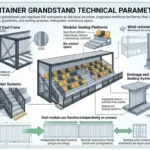
Our 40ft container grandstand, seating 63 people, is built with continuous perimeter guardrails, handrails on both stair runs, through-bolted tip-up seating, and diamond-plate anti-slip decking on all stairs and platforms. The frame is engineered for full concentrated crowd load across every seating tier, with structural details available on our container grandstand technical parameters page for buyers who want the full load specifications before they finalize a quote.
If you’re comparing this against other units for a stadium or club upgrade, our 40ft container grandstand product page has the complete configuration, seating layout, and safety compliance documentation.
Look for guardrail and fall protection compliance referencing ICC 300, structural steel design following AISC guidelines, and fire-rated seating materials in line with NFPA guidance. Ask for documentation rather than a general claim of compliance.
They should be. Reputable manufacturers use HDPE or polypropylene seating with a self-extinguishing rating, confirmed by a test report on the specific resin used rather than a generic spec sheet.
Only with proper foundation preparation. The unit needs to sit level on compacted ground or a concrete pad, with drainage routed away from the structure and anti-slip decking on all stairs and walkways.
Your email address will not be published. Required fields are marked *

 English