Author Archives: jzxadmin

quality container pool introduce

Quality Container Pool: What Separates a Ten-Year Shell From a Two-Year Rust Job

A container pool owner posts a photo every few months in online pool forums: rust bleeding through the paint around a window bolt or a skimmer return, usually somewhere between twelve and twenty-four months after installation. The steel itself isn’t the problem — weathering steel is built to handle exposure. What actually failed was a cut, a weld, or a seal that wasn’t done to spec before the container ever left the factory. If you’re sourcing container pools to resell, or specifying one for a project, “quality” isn’t a marketing word here. It’s a short list of things you can actually check — material grade, weld standard, and inspection records — before you sign off on a shipment.

What Actually Makes a Container Pool’s Steel “Quality” in the First Place?

The base shell for a container pool is Corten weathering steel, typically graded to ASTM A606 Type 4 — a minimum corrosion-resistance index of 6.0 under ASTM’s G101 guide, roughly six times better than plain carbon steel exposed to the same conditions. Wall panels run 1.6–2.0mm thick, corner castings are solid 12mm steel (that’s what actually carries the stacking and crane load, not the wall skin), and the floor cross members run 3–4.5mm. None of that changes once a container becomes a pool. What does change is the swim cavity itself — cutting into the shell removes part of that built-in protection, and what the factory does at the cut line is where quality actually gets decided, not the steel spec sheet. Run a hand along an uncut container wall and it’s smooth, faintly oily from the mill coating. Run it along a badly finished cut edge and you can feel the burr before you ever see the rust that follows it.

Full structural drawings and material specs for both container pool sizes are on the container pool product page, including where the cavity is cut relative to the corner castings and cross members.

Why Do So Many Container Pools Develop Rust Around the Windows and Returns?

It’s a pattern, not a coincidence. Complaints that surface in pool-owner forums almost never describe rust spreading across a flat wall panel — they describe rust starting at a bolt penetration for an acrylic window, or around a skimmer and return fitting, within a year or two of delivery. Both are points where the factory drilled through the coated steel skin. If that drilled edge wasn’t re-primed with a corrosion-resistant coating before the bolt or fitting went back in, moisture works its way behind the seal, and the first sign is a small rust ring nobody notices until the liner is pulled back. A properly finished unit re-coats every penetration immediately after cutting, before hardware goes back in — a step that adds minutes per hole and close to nothing in material cost, but it’s the first thing skipped when a factory is racing a shipping date.

How Do You Judge Weld Quality on a Container Pool Before It Ships?

Structural welds on steel fabrication are generally judged against AWS D1.1, the American Welding Society’s structural welding code for steel — the same code referenced across container home and container structure fabrication more broadly. One concrete benchmark: side-panel-to-rail welds are typically specified at a minimum 75% penetration, and a continuous weld bead along a cut edge holds up to water pressure in a way a stitched, intermittent bead won’t. None of this requires a metallurgy degree to check from photos — undercut (a groove eaten into the base metal next to the weld), visible porosity (small pinholes in the bead), heavy spatter, and inconsistent bead width are all visible defects a buyer or inspector can flag before a container is packed for freight.

What Does Real Quality Control Look Like Before the Container Leaves the Factory?

In practice, this means a pre-shipment inspection — through SGS, Bureau Veritas, Intertek, or a mid-tier specialist like QIMA — run against an agreed AQL sampling plan, usually priced at $150–$350 per man-day. What that inspection should confirm on a container pool specifically: a hydrostatic test (filled and held for 24–48 hours, checked for weeping at seams and cut edges) completed before packing, a photo report of the interior and exterior before loading, and the mill test report tying the steel back to its ASTM grade. None of this is unusual to ask for. It’s unusual for a buyer to actually ask, which is exactly why it’s worth asking.

Does the Pool Equipment Matter as Much as the Shell?

A well-built shell paired with an uncertified pump is still a liability for anyone reselling into a regulated market. Pool and spa equipment sold or installed in the U.S. is generally expected to carry NSF/ANSI/CAN 50 certification, which covers materials, chemical exposure risk, and performance validation for pumps, filters, and related components. If you’re finishing a container pool for resale, the equipment package deserves the same scrutiny as the steel — it’s the part a local inspector or end customer is most likely to ask about directly.

What Should You Ask to See Before You Pay a Deposit?

  • Mill test report confirming ASTM A606 Type 4 grade for the base steel
  • Weld inspection photos, or a report referencing AWS D1.1 practice
  • Hydrostatic test record — fill, hold, inspect — completed before packing
  • CSC plate and container serial number
  • Photos or video of the interior after cutting, before the liner goes in
  • A third-party pre-shipment inspection report if you’re ordering through an agent

Our container pool for purchasing guide includes the full document checklist we send with every order, along with what’s normal to request before the deposit and again before final payment.

“Quality” on a container pool isn’t a feeling — it’s steel grade, weld penetration, and inspection records, three things you can ask to see before any money changes hands. A shell built to those specs holds water for a decade or more with basic maintenance. One that skips them usually shows it within the first two years, and almost always at the same two spots: a window bolt or a return fitting. If you want the material certificates and inspection checklist for a specific order, ask for them upfront — a factory that’s actually doing the work won’t hesitate to hand them over.
20ft 40ft container pool price

Container Pool Price: What a 20ft or 40ft Unit Actually Costs

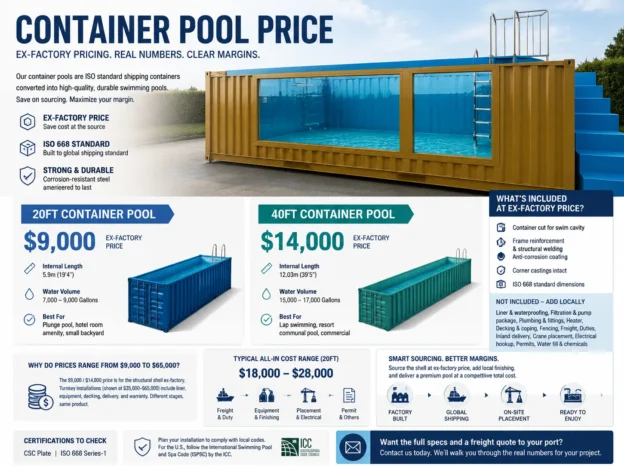
Search “container pool price” and you’ll find numbers scattered from $15,000 to well past $60,000 for what looks like the same product. Both figures are accurate — they just describe different stages of the same supply chain. Our 20ft container pool leaves the factory at $9,000. The 40ft version is $14,000. That’s the ex-factory cost for the structural conversion itself, before freight, equipment, and local finishing enter the picture. If you’re an importer, pool contractor, or hospitality buyer trying to work out where your margin actually sits, this page breaks down what’s inside that price, why the market spread is so wide, and what still lands on your invoice before the pool holds water.

20ft container pool price vs 40ft container pool price

20ft — $9,000 ex-factory. Internal length ~5.9m (19’4″), water volume roughly 7,000–9,000 gallons. Best fit for a plunge pool, a hotel room amenity, or a small backyard.
40ft — $14,000 ex-factory. Internal length ~12.03m (39’5″), water volume roughly 15,000–17,000 gallons. Best fit for lap swimming, a resort communal pool, or a small commercial project.

How Much Does a 20ft Container Pool Cost?

$9,000 ex-factory. A standard 20ft container measures roughly 5.9m (19’4″) long and 2.35m (7’8″) wide internally, with about 2.39m (7’10”) of usable height — dimensions set by ISO 668, the same classification used across the global container fleet. Once the swim cavity is cut into that shell, a 20ft unit typically holds somewhere in the 7,000–9,000 gallon range, depending on how much depth and deck space the buyer wants to keep. That size works well as a plunge pool, a cooldown pool for a gym or spa, or an amenity add-on for a boutique hotel room — situations where floor space is tight but the buyer still wants real water, not a kiddie pool. For anyone who’s stood next to one on a 35°C afternoon, the appeal isn’t complicated: cold water, small footprint, done in weeks instead of months.

How Much Does a 40ft Container Pool Cost?

$14,000 ex-factory — only $5,000 more than the 20ft unit, despite roughly double the steel, double the welding, and close to double the water volume. That gap says something about where the cost actually sits: the fixed labor — cutting the openings, reinforcing the frame, prepping the corner castings — doesn’t scale with length, so the second half of a 40ft container is cheaper to convert than the first. Water volume lands around 15,000–17,000 gallons at typical fill depth, enough for actual lap swimming rather than just cooling off. Buyers who choose the 40ft size are usually planning a resort communal pool, a rental-property amenity meant to show up in listing photos, or a small commercial installation where 20ft would feel cramped.

Why Does the Same Product Show Prices from $9,000 to $65,000?

Because past a certain point, it isn’t the same product — it’s the same container at two different stages. Our $9,000 and $14,000 prices cover the structural conversion: an ISO 668-spec container cut, reinforced, and sealed to hold water. What you’ll see advertised at $35,000–$65,000 installed on some U.S. pool company sites is a finished, turnkey system — fiberglass or vinyl lining, a filtration and pump package generally certified to NSF/ANSI/CAN 50, LED lighting, composite decking, delivery, and a multi-year warranty, all bundled into one number. Neither price is inflated. One is ex-factory for the shell; the other is retail for a complete backyard installation. The gap between them is where distributor and contractor margin lives — provided you know what to add and roughly what it costs.

What’s Actually Included in the Ex-Factory Price — and What Isn’t?

Included at $9,000 / $14,000: the container structurally cut for the swim cavity, frame reinforcement around the cut openings, corner castings left intact for standard handling, primary anti-corrosion coating on the structural steel, and standard ISO 668 dimensions so the unit still moves through normal freight channels.

Not included — add locally: pool liner or waterproof coating finish, the filtration, pump, and heater package, plumbing, skimmer, and return fittings, insulation, decking, coping and fencing, and ocean freight, duties, inland trucking, and crane placement.

Full dimensions, weight, and structural drawings for both sizes are on the container pool product  — worth checking before you finalize a freight quote, since container weight affects which shipping method makes sense.

How Should Importers and Distributors Price This for Resale?

A rough total-cost picture for a 20ft unit: $9,000 ex-factory, plus ocean freight and duty (this varies heavily by destination port and trade agreement), plus local finishing — liner, filtration package, crane placement (commonly $300–$800), an electrical hookup for the pump (commonly $200–$500), and a permit where one’s required ($200 to over $1,200 depending on jurisdiction). Add it up, and a finished 20ft unit often lands somewhere between $18,000 and $28,000 all-in — well under the $35,000–$65,000 that fully turnkey competitors charge for a comparable finished product. That spread is the margin a distributor or contractor is actually working with, assuming the shell is sourced at the ex-factory stage rather than paying someone else’s markup twice.

If this is your first order with us, our container pool for purchasing guide covers deposit terms, typical lead time, and how freight booking works from our factory to your port.

What Certifications Should You Check Before You Pay a Deposit?

Ask for the container’s original CSC (Convention for Safe Containers) plate and confirm the shell was built to ISO 668 series-1 dimensions before conversion — that’s what keeps it moving through normal freight and handling channels instead of getting flagged as an oversized or non-standard load at the port. If you’re finishing and reselling into a code-driven market like the U.S., plan the equipment and installation stage around local requirements. The International Code Council’s International Swimming Pool and Spa Code sets minimum rules for circulation, barriers, and equipment listing that a finished pool needs to meet regardless of where the shell was built. Installing first and checking code second is the single most expensive mistake we hear about from buyers reselling into the U.S. market — it’s a lot cheaper to plan for it upfront.

What Else Should You Budget for Beyond the $9,000 or $14,000?

  • Ocean freight — flat-rack or open-top, depending on how the shell is configured for shipping
  • Customs duty and port handling fees at destination
  • Inland trucking from port to job site
  • Crane placement, typically $300–$800
  • Electrical hookup for the pump, typically $200–$500
  • Water fill and initial chemical balance
  • Equipment package: pump, filter, and (optionally) heater
  • Liner or coating, decking, and safety barrier/fencing where required by code

The honest answer to “how much does a container pool cost” depends entirely on which stage of the supply chain you’re standing in. $9,000 for a 20ft unit and $14,000 for a 40ft unit are real, ex-factory numbers — not a low-ball figure meant to get you on a call. Add freight, equipment, and local finishing, and a well-run project still tends to land meaningfully below turnkey retail pricing, which is exactly where a distributor or contractor’s margin should sit. If you want the full spec sheet and a freight quote to your port, reach out — we’ll walk through the real numbers for your specific project, not just the two on this page.

container pool MOQ details

Container pool moq:Differences Based on the Quantity of Container Pools Ordered

Container Pool MOQ: Why a High-Ticket Product Lets You Order Just One

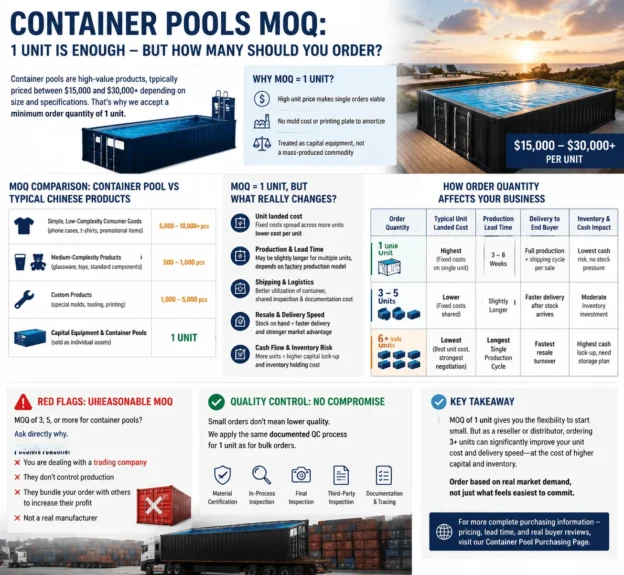
A container pool isn’t a $2 phone case or a $15 t-shirt — it’s a high-ticket item, commonly $15000-$30000 or more depending on size and spec, and that price tag is exactly why we accept a minimum order quantity of 1 unit. It’s not a special favor; it’s the same logic that lets a factory quote a single industrial machine instead of demanding a pallet of them. But “we’ll build you one” and “should you actually order one, or order for wholesale resale” are two different questions, and the second one has real consequences for profit, production timing, shipping, and how fast you can resell. Here’s how that comparison actually plays out, based on real listings, real sourcing data, and what changes once an order moves from a single unit to a wholesale quantity.

Why Does MOQ Even Matter When You Just Want One Pool?

Because for almost everything else sourced from a factory, one isn’t an option — and the reason usually comes down to price per unit, not product complexity. Standard consumer goods often carry MOQs in the hundreds or thousands specifically because they’re low-ticket items — sourcing guides tracking current China market data put simple, low-complexity products like promotional items at 10,000+ units, mid-complexity goods like glassware or plush toys around 1,000, and elaborate custom items with unique tooling anywhere from a few hundred to several thousand. A factory selling $2 items needs volume to make a production run worth setting up. A container pool flips that math: at $15000-30000 per unit, a single order already represents real revenue, which is exactly why we — and most legitimate manufacturers in this category — can accept a 1-unit MOQ without it being a loss-making accommodation.

What MOQ Should You Actually Expect for a Container Pool?

One unit, and that’s exactly the policy on our own container swimming pool for exporting — a single order is high-ticket enough on its own to justify building it. This shows up consistently across wholesale B2B listings for container pools industry-wide, and it’s worth confirming with any supplier you’re evaluating before you get deep into spec conversations — if a “manufacturer” tells you their MOQ is 3 or 5 units for a first order, that’s usually a sign you’re actually talking to a trading company padding an order to hit a minimum they don’t control, not a factory quoting their real production floor.

Why Is Container Pool MOQ So Different From Most China-Sourced Products?

The economics explain it cleanly. A factory’s MOQ on a typical product exists to spread fixed setup costs — custom molds, dyes, printed packaging, specialized tooling — across enough units that each one carries a sensible share of that upfront investment. A container pool doesn’t have that cost structure. There’s no mold being amortized, no print plate sitting idle after a 50-unit run. It’s closer to how the market treats other pieces of capital equipment: one industry guide on sourcing industrial filling machinery notes that this category is commonly quoted at a 1-unit MOQ specifically because it’s sold as an individual capital asset, not a consumable bundled into a production batch. A container pool sits in that same category — built and priced per unit, whether you’re ordering one or five.

  • Simple, low-complexity consumer goods: MOQ often 5,000-10,000+ units
  • Mid-complexity items (glassware, toys, standard components): MOQ often 500-1,000 units
  • Custom-tooled products (unique molds, dyes, printing): MOQ often 1,000-5,000 units
  • Capital equipment and container pools: MOQ commonly 1 unit

Does a Low MOQ Mean Lower Quality Control?

This is the fair question buyers should ask, and the honest answer is: it changes where the quality control burden sits, rather than removing it. On a 5,000-unit run, a factory’s defect rate averages out across a large batch, and a few percentage points of failure gets absorbed statistically. On a single-unit order, there’s no averaging — that one pool either meets spec or it doesn’t, and the entire quality outcome rests on that specific production team’s process discipline on that specific week. That’s exactly why a mid-production inspection and named material certificates matter more here than they would on a bulk consumer goods order, and why our own container swimming pool treats single-unit orders with the same documented QC process as a larger one, not a scaled-down version of it. The full quality verification checklist for a low-volume custom order like this is covered separately in container pool for purchasing.

Can You Negotiate MOQ on a Container Pool Order?

There’s not much room to negotiate downward from 1, since that’s already the floor. Where negotiation actually matters is on the other side — pricing and lead time both commonly improve once an order reaches 3-5 units, which is worth raising if a buyer already knows they’ll need a second or third unit within the next year, even if the first order is a single pilot unit. Base container costs also shift with the broader shipping market — Container xChange’s market reports track this — so a quote that felt firm three months ago may already be out of date by the time a second order comes up, in either direction.

How Does Order Quantity Actually Change Your Profit Margin?

The margin math here isn’t about a bulk discount on the pool itself so much as fixed costs getting split more ways. Crane mobilization at delivery commonly runs $300-800 regardless of how many units are on site that day — order three units for delivery to the same region and that fee splits three ways instead of landing on one pool’s budget. The same logic applies to inspection and documentation costs: a third-party pre-shipment inspection visit, export paperwork, and customs clearance work carry a largely fixed cost per shipment, so spreading them across multiple units lowers the per-unit landed cost meaningfully more than most first-time buyers expect. For a reseller planning to resell at a fixed retail price point, that per-unit cost reduction goes straight to margin — it’s real money, not a rounding error, once you’re moving three or more units through the same logistics chain.

Does a Bigger Order Actually Ship or Produce Faster?

Not automatically, and this is worth asking a supplier directly rather than assuming. A single container pool is already a full container load on the ocean leg — there’s no small-parcel consolidation discount the way there might be with cartons of smaller goods, since each unit needs its own vessel slot regardless of order size. Production is the variable that actually shifts: some factories run multiple pools through the same welding and coating line sequentially, which means a 3-unit order can take meaningfully longer start-to-finish than a single unit, not three times longer, but enough to matter against a fixed launch date. Other factories with multiple production bays can run units in parallel, finishing a 3-unit order close to the same timeline as one. Ask which model your supplier actually uses before assuming a bigger order automatically means a proportionally longer wait — the answer changes how you plan a launch date around it.

How Does MOQ Choice Affect Resale or Onward Sales?

This is the question that actually matters for a distributor or regional reseller, not just a single end-use buyer. Ordering one unit per confirmed sale keeps capital exposure low — nothing sits in a yard unsold — but it means every customer waits through a fresh 3-8 week production cycle plus freight before delivery, which is a real disadvantage against a competitor who already has inventory on the ground. Ordering 3-5 units ahead of confirmed demand ties up real capital and requires somewhere to store an unsold pool, but it lets a reseller fulfill the next sale in days instead of months, which matters a great deal in a market where buyers are comparing container pools against a built-in pool’s own (longer) timeline. There’s no universally right answer here — it depends on how confident the reseller is in near-term demand and how much capital they can afford to have sitting in inventory rather than turning over.

1 unit

    • Typical Per-Unit Landed Cost: Highest — fixed costs land on a single pool

    • Production Timeline: 3-8 weeks, single production run

Fulfillment to End Buyer: Full production + freight cycle per sale

3-5 units

  • Typical Per-Unit Landed Cost: Lower — fixed costs split across units

  • Production Timeline: May extend somewhat depending on factory line capacity

  • Fulfillment to End Buyer: Faster once inventory lands, if held in stock

6+ units

Typical Per-Unit Landed Cost: Lowest per unit, best negotiating position

Production Timeline: Longest single production run, plan around it

Fulfillment to End Buyer: Fastest resale turnaround, highest capital tied up

What Should You Watch For When a Supplier’s MOQ Doesn’t Make Sense?

Any container pool supplier insisting on an unusually high MOQ, or refusing to quote a single unit at all, deserves a direct follow-up question rather than a quiet walk-away. As one sourcing consultancy puts it, an MOQ figure is the output of a calculation a factory has run about whether an order is worth setting up their line for — and for a product with no batch tooling cost to amortize, there’s rarely a legitimate production reason for that calculation to land above one. A high MOQ on this specific product usually means one of two things: you’re talking to a trader without real production control, or the “factory” doesn’t actually run pools as a core line and is quietly trying to bundle your order with someone else’s to make it worth their while.

Bringing It Together

MOQ is one of the few genuinely buyer-friendly facts about sourcing a container pool — you can order exactly the one unit your project needs, priced and built the same way a five-unit order would be, without the padding most Chinese manufacturing categories require. But “you can order one” and “you should order one” aren’t the same question once resale is part of the plan: a single unit keeps capital exposure lowest, while three or more units lowers per-unit landed cost and shortens the wait a future customer faces, at the cost of tying up money in inventory and a longer single production run to plan around. Match the quantity to how confident you actually are in near-term demand, not to whichever number felt easiest to commit to on the first call. For the fuller purchasing picture — price, delivery timeline, and what real buyer reviews say — see container pool for purchasing.

container pool roi

Container Pool ROI:Are Container Pools Worth It?

Container Pool ROI: Does the Math Actually Work Out?

Container pool roi for business owners, this is one of the factors influencing the decision to purchase a container pool; after all, higher profits are essential for better business growth.

Every buyer eventually asks the version of this question that actually matters: not “is a pool a nice thing to have,” but “does this specific purchase make financial sense compared to the alternative.” We pulled real 2026 construction pricing, real vacation rental revenue data, and real resale value studies to answer that properly, because a container pool’s case falls apart fast if it only works on optimistic assumptions.

Is a Container Pool Actually Cheaper Than Pouring One?

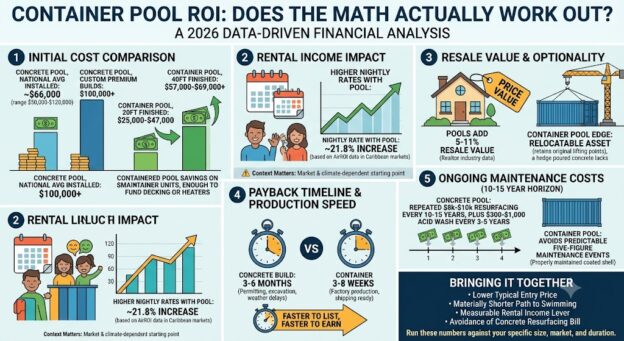
The 2026 numbers make this comparison more concrete than it used to be. A national average installed concrete inground pool runs around $66,000, with a typical range of $50,000-$120,000 according to current cost data published by Angi, and premium custom builds in some markets now start well above $100,000 before landscaping. A comparable container pool commonly lands at $25,000-$47,000 for a 20ft unit or $57,000-$69,000+ for a 40ft, fully installed — the exact spec and coating options we build into our own container swimming pool product line. That’s not a marginal difference on the smaller size — it’s a gap wide enough to fund a season of furniture, decking, or a heater upgrade with what’s left over. The comparison narrows on the largest, most heavily customized container builds, which is worth knowing before assuming the savings hold at every price point.

  • Concrete pool, national average installed: ~$66,000 (range $50,000-$120,000)
  • Concrete pool, resurfacing every 10-15 years: $8,000-$10,000 per cycle
  • Concrete pool, acid wash treatment every 3-5 years: $300-$1,000 per treatment
  • Container pool, 20ft finished: $25,000-$47,000
  • Container pool, 40ft finished: $57,000-$69,000+

Does a Pool Actually Move the Needle on Rental Income?

For anyone weighing this as a revenue decision rather than a lifestyle one, the data holds up better than the usual “pools are popular” claim. Research across Caribbean vacation rental markets found pools correlated with roughly 21.8% higher nightly rates than comparable listings without one, according to rental performance data compiled by Air ROI — that’s a real, measurable pricing lever, not a soft amenity benefit. It won’t move every market by the same amount; a lakefront cabin in a cooler climate isn’t the same booking pattern as a warm-weather short-term rental, so this number is a starting point for your own market research, not a guarantee to plug directly into a spreadsheet. The full picture on how quickly a rental property recoups that investment is covered alongside broader purchasing considerations in container pool for purchasing.

Does a Container Pool Add Resale Value the Same Way a Built-In Pool Does?

Realtor industry data commonly puts the resale value lift from a pool somewhere in the 5-11% range, depending heavily on region and buyer expectations in that specific market — a pool means something very different to a buyer in Phoenix than to one in Minneapolis. Where a container pool has a genuine edge over a poured one is optionality: because it retains its original lifting points, it’s a relocatable asset rather than a permanent structural improvement in some contexts, which matters if a homeowner might move within a few years and isn’t certain the next buyer values a pool the same way they do. That’s a real financial hedge a poured concrete pool simply doesn’t offer.

What Does the Payback Timeline Actually Look Like?

Lead time is a financial variable that’s easy to underweight. A container pool’s factory production commonly runs 3-8 weeks depending on customization, versus a concrete build that a growing share of 2026 cost guides now describe running 3-6 months once permitting, excavation, and weather delays are factored in. For a rental property trying to list before a booking season, or a family trying to get a summer’s worth of use out of a purchase, that timeline difference directly changes how many months the investment is actually earning its keep versus sitting as a construction site. Our own container swimming pool is built around that timeline specifically — a factory-tested unit that ships ready to install, not a project that starts from a hole in the ground.

What Ongoing Costs Should Actually Go Into the ROI Model?

Filtration electricity, chemical dosing, and periodic coating inspection run broadly comparable between a container pool and a traditional build of similar volume — this line item rarely swings the comparison much either way. Where the math genuinely separates over a decade is the concrete pool’s resurfacing cycle, commonly $8,000-$10,000 every 10-15 years, plus acid wash treatments every 3-5 years. A properly coated container pool shell, maintained the way any coated steel structure should be, doesn’t carry that same predictable five-figure maintenance event on the calendar. Over a 10-15 year ownership horizon, that’s a real number worth putting into a spreadsheet next to the upfront price difference, not an afterthought.

Bringing It Together

The honest container pool ROI case for a container pool isn’t “it’s always cheaper” — on the largest, most customized builds, the gap narrows. What holds up consistently across the real numbers is a lower typical entry price, a materially shorter path from deposit to actually swimming, a real and measurable rental income lever if that’s the use case, and the avoidance of a concrete pool’s predictable resurfacing bill down the road. Run those five numbers against your own project — size, market, and how long you plan to own it — before assuming the answer either way.

container pool for purchasing

Container Pool for Purchasing: Summary of Buyer’s importing Guide

Company pool Buyer’s Guide

By the time a buyer reaches this stage, the “is a container pool even a real product” question is already settled — what’s left is the harder part: getting a number they can trust, a delivery date that survives contact with reality, and a supplier who won’t disappear after the deposit clears. We pulled together real pricing across the market, real documented reviews, and real export logistics data to answer the seven questions that actually come up during procurement, not the ones a brochure anticipates.

Is a Container Pool Actually a Good Return on Investment?

For a rental property, the numbers are more concrete than “pools are popular.” One study of Caribbean vacation rental markets found pools correlated with roughly 21.8% higher nightly rates compared to listings without one — a meaningful lever in a market where the average US host earns somewhere between $14,000 and $44,000 a year, and top performers in premium markets clear well over $80,000. That doesn’t mean every pool pays for itself on rental income alone; it means the amenity moves pricing power in a measurable way, which is the actual question a rental operator should be modeling, not just “will guests like it.” For hospitality and residential buyers weighing cost against a poured alternative, the fuller breakdown — including landed cost and lead time as financial variables — is in container pool ROI.

What MOQ Should You Expect When Ordering a Container Pool?

This is one of the more buyer-friendly facts about this product category. Unlike most goods sourced from Chinese factories, where MOQ is often set in container-loads or thousands of units, container pool listings across wholesale platforms commonly show a minimum order quantity of a single unit. That’s a direct consequence of the product itself — nobody orders these in bulk for resale, they order one for a specific site. A supplier who can’t or won’t quote a single unit, or who tries to push a buyer toward a multi-unit order to “make it worth building,” is usually signaling they’re not actually set up for this product at the scale a typical buyer needs. The full picture on order flexibility and what to ask before committing is in container pool MOQ.

How Much Does a Container Pool Really Cost?

Real market pricing spreads wider than a single “starting at” number suggests, largely because finish level, filtration package, and site work all move the final invoice independently of the base unit.

  • 20ft, finished and installed: commonly $9000-13000 depending on liner, filtration, and finish
  • 40ft, finished and installed: commonly $13000-23000 often with a tanning ledge or secondary zone
  • Bare, unconverted container before any pool conversion work: roughly $3,000-$6,000, a reminder that most of the invoice is labor and equipment, not the steel box
  • Site work add-ons: crane placement commonly $300-800, electrical hookup commonly $200-500, plus pad, decking, and fencing

Base container costs also move with broader shipping market trends — Container xChange’s market reports track this — which is part of why identical specs can quote differently a few months apart even from the same supplier. The full pricing breakdown by size and feature is in container pool price.

How Long Does Container Pool Delivery Actually Take?

Production timelines across container manufacturers in China commonly run 3-8 weeks depending on customization and order complexity, before freight transit is even added. What buyers often don’t budget for is seasonal disruption — factories slow down significantly around Chinese New Year and Golden Week, and an order placed just before either holiday can slip by weeks without anyone doing anything wrong. A mid-production inspection, typically conducted once 20-30% of the build is complete, is worth requesting specifically because it catches spec errors — the wrong foam density, an incorrect fitting — while they’re still cheap to fix, rather than after final packaging when correction means delay, not just cost. Freight timing itself is worth checking against current benchmarks rather than assuming a flat number — Xeneta’s shipping index tracks how much ocean freight rates actually move month to month, sometimes sharply. The realistic total timeline, stage by stage, is laid out in container pool delivery date.

How Is a Container Pool Packaged for Export?

Packaging matters more for a container pool’s equipment than the shell itself — the pump, filtration components, and any electronics are what actually need protecting from a multi-week ocean voyage, since vessel vibration and humidity work on moving parts, fasteners, and welds the entire way. Any wood packaging or crating used has to meet ISPM 15, the international phytosanitary standard requiring heat-treated, marked wood packaging — shipments that skip this can be held or rejected at customs regardless of how good the product inside is. Equipment components should ship with vapor barrier protection and desiccants to control condensation, and cartons should be export-grade rather than standard retail packaging, since a thinner carton is a common, avoidable source of moisture damage on long transit routes. What to specifically request in writing before your order ships is covered in container pool packaging.

How Do You Verify Container Pool Quality Before It Ships?

The gap between a good factory and a disappointing one usually isn’t visible in photos — it shows up in whether the factory has documented quality systems at all. A factory operating under ISO 9001 quality management certification has a documented, auditable process for catching defects before they ship, rather than relying on a final visual check. For orders where the buyer isn’t physically present at the factory, third-party pre-shipment inspection — commonly handled by firms like SGS against AQL sampling standards — gives an independent check on weld quality, coating application, and dimensional accuracy before the unit is loaded, not after it’s already at the destination port and expensive to fix. This is worth the cost on any order where a buyer can’t send someone to inspect in person. The full quality verification checklist, including what to request at each production stage, is in container pool quality.

For the specific product line these purchasing details apply to, see our container swimming pool , and for how to evaluate and shortlist the factory itself before any of the above matters, see container pool manufacturer.

Bringing It Together

None of these seven questions exist in isolation — a supplier who’s vague on MOQ is often the same one who’s vague on warranty terms, and a factory that skips a documented quality process is the one whose delivery date slips without explanation. The buyers who move through procurement with the fewest surprises are consistently the ones who got ROI assumptions, MOQ, price breakdown, warranty terms, delivery milestones, packaging specs, and quality inspection points all confirmed in writing before the deposit went down — not the ones who trusted a glossy quote and found out the details later, usually the expensive way.

container pool safety

Container Pool Safety: What Actually Keeps People Safe, Not Just What Passes Inspection

Container Pool Safety: What Actually Keeps People Safe, Not Just What Passes Inspection

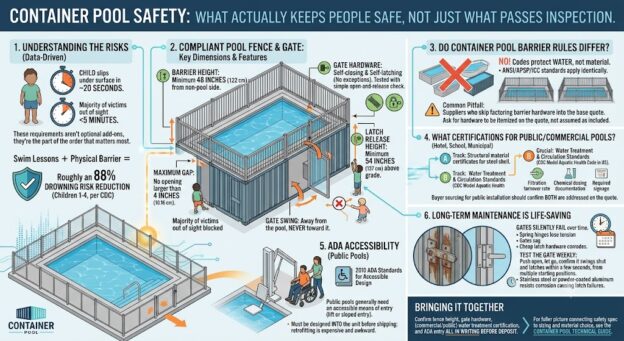
A child can slip under the surface of a pool in about 20 seconds, and the accounts collected by drowning prevention researchers describe the majority of victims as having been out of sight for less than five minutes. That’s not a statistic meant to scare anyone away from owning a pool — it’s the reason the safety requirements below aren’t optional add-ons to a container pool quote, they’re the part of the order that matters most. We pulled together the actual codes, the real data behind them, and documented cases of what goes wrong when a spec sheet treats safety as an afterthought.

How Fast Can a Backyard Pool Actually Become Dangerous?

Faster than most parents expect, which is exactly why barrier compliance carries so much weight in pool safety research. Formal swim lessons cut that risk substantially — research cited by the CDC’s drowning prevention guidance associates lessons with roughly an 88% reduction in drowning risk among children ages 1-4 — but lessons don’t replace a physical barrier, they work alongside one. A pool sitting in a backyard without a compliant fence is a liability regardless of whether it’s a poured concrete build or a container conversion; the water doesn’t know the difference, and neither does a two-year-old who’s wandered outside unsupervised.

What Does a Compliant Pool Fence and Gate Actually Require?

The specific numbers repeat across most US jurisdictions with only minor local variation: a barrier at least 48 inches tall, measured from the side facing away from the pool; no gap or opening larger than 4 inches anywhere a small child could pass through; and a gate that swings away from the pool, closes and latches on its own without help, with the release mechanism positioned at least 54 inches above the ground. Some states layer on additional requirements — Arizona, for example, requires either a standalone barrier or a motorized safety cover meeting specific ASTM emergency standards, while other municipalities require door alarms on any structure wall that provides direct pool access. None of this changes based on whether the shell is steel, fiberglass, or poured concrete — the barrier requirements are about the water, not the material underneath it.

  • Barrier height: minimum 48 inches from the non-pool side
  • Maximum gap or opening: 4 inches
  • Gate swing: away from the pool, never toward it
  • Gate hardware: self-closing and self-latching, no exceptions, tested with a simple open-and-release check
  • Latch release height: minimum 54 inches above grade

Do Container Pool Barrier Rules Differ From Regular Pool Rules?

No, and this trips up buyers who assume a prefabricated product gets a different compliance track. Fence and gate codes are written around the pool as a body of water, not around how it was manufactured, so the same ANSI/APSP/ICC barrier standards that apply to a poured pool apply identically to a container pool. Where this actually causes real problems isn’t the standard itself — it’s suppliers who ship a container pool without factoring fence and gate hardware into the base quote, leaving the buyer to source and install compliant hardware separately, sometimes after an inspection has already flagged the gap. Our own container swimming pool export line lists barrier and gate hardware as a standard quote line item specifically to avoid that gap. Ask for this to be itemized on the quote specifically, not assumed as included.

What Certifications Should a Commercial or Public Container Pool Carry?

A pool open to hotel guests, students, or the general public carries a heavier compliance load than a private backyard installation. Beyond standard barrier compliance, commercial and public facilities typically need to meet water treatment and circulation standards, most commonly modeled on the CDC’s Model Aquatic Health Code in the US, covering filtration turnover rate, chemical dosing documentation, and signage. This is a separate certification track from the structural material certificates that cover the steel shell itself — covered in more depth in our Container Pool Technical Guide — and a buyer sourcing for a public installation should confirm both are addressed on the quote, since a supplier who only speaks to structural certification hasn’t actually covered the water safety side of the order.

Can a Container Pool Be Made Accessible for Guests With Disabilities?

Yes, and for hotels, schools, and municipal facilities in the US, it’s a legal requirement rather than an optional upgrade. Under the 2010 ADA Standards for Accessible Design, public pools generally need an accessible means of entry — a pool lift or sloped entry at minimum, with a second access point required once the pool exceeds 300 linear feet of pool wall. This has to be designed into the unit before it ships; retrofitting a lift onto a completed shell afterward is considerably more expensive and sometimes structurally awkward. If you’re sourcing for a public-facing installation, this line item belongs in the RFQ from day one, not as a change order discovered during final inspection.

What Do Real Safety Complaints Actually Teach Buyers?

Cross-referencing safety hardware guidance against real pool ownership discussions, one pattern shows up repeatedly: gate hardware quietly fails over time, and it’s rarely dramatic when it happens. Spring hinges lose tension, gates start sagging just enough to stop latching reliably, and cheap latch hardware corrodes — one hardware guide notes specifically that stainless steel or powder-coated aluminum resists the corrosion that causes latching failures over time, which is a real, ongoing maintenance point rather than a one-time install-day checkbox. The standard advice from gate hardware specialists is to physically test the gate weekly: push it open, let go, and confirm it swings shut and latches within a few seconds, from multiple starting positions. A container pool’s gate is no more immune to this failure mode than any other pool’s, and treating it as something that only needs checking at initial inspection is exactly how a compliant barrier quietly becomes a non-compliant one eighteen months later.

Bringing It Together

None of the requirements above are unique to container pools — they’re the same barrier codes, the same commercial water treatment standards, and the same accessibility law that apply to any pool, container-built or otherwise. What actually separates a safe installation from a risky one is whether these get treated as line items on the original quote or as afterthoughts discovered during inspection or, worse, after an incident. Confirm fence height, gate hardware, and — if the project is commercial or public-facing — water treatment certification and accessible entry, all in writing, before the deposit goes down.

container pool material compared

Container Pool Materials Compared: Corten Steel vs Stainless Steel vs Fiberglass

Container Pool Materials Compared

We get some version of the same question on nearly every export inquiry: which material actually holds up. It’s a fair thing to want a straight answer on, and the honest one is that there isn’t a single best material — there’s a best material for a given budget, climate, and how long the buyer plans to own the pool. We pulled together real pricing, documented maintenance data, and owner accounts across the market to lay out that comparison properly rather than just picking a favorite.

Which Material Actually Costs More: Steel, Stainless, or Fiberglass?

Coated Corten steel is the market’s default for a reason — it’s the least expensive base material, and most finished container pools built on it land somewhere in the $35,000-$65,000 installed range according to several industry cost guides, with the base structure alone often starting around $28,000-$35,000 before delivery and site work. Fiberglass-lined units tend to sit at the higher end of that range or above it — one US supplier’s insulated fiberglass package runs noticeably higher than its standard steel-shell equivalent at the same length, reflecting the added labor of a vacuum-infused fiberglass layup over a welded steel shell. Marine-grade stainless typically carries the largest material premium of the three, since the alloy itself costs meaningfully more per kilogram than either coated Corten or a fiberglass composite, even before fabrication labor is factored in. Our own container swimming pool export line quotes each of these material options separately for exactly this reason — the price difference is real and worth seeing broken out rather than folded into a single “premium build” number.

How Do These Materials Perform Against Rust and Corrosion?

This is where the real tradeoffs live. Corten steel forms a protective oxide layer in open air, which is exactly why it’s used in shipping containers in the first place — but that same patina doesn’t behave the same way in a permanently wet environment, meaning a pool shell needs a proper coating system, not bare Corten, to actually stay corrosion-free. Industry guides are consistent on this point: without a maintained coating, a steel shell will rust, which is why most suppliers line the interior with fiberglass, vinyl, or concrete and plaster, then apply a zinc-rich or epoxy waterproofing coat over any exposed steel. Marine-grade stainless, built to the ASTM A240 316/316L specification, adds molybdenum specifically to resist the chloride pitting that drives corrosion in coastal and high-salinity environments — a real advantage where Corten’s coating gets tested hardest. Fiberglass avoids the corrosion question for the shell’s water-contact surface entirely, since there’s no bare metal in contact with the water once the gel coat layer is intact.

Which Material Lasts Longest With the Least Maintenance?

Ownership horizon matters more here than any single spec sheet number. A coated Corten shell, built to ISO 12944 immersion-category standards, is fully durable — details covered in more depth in our Container Pool Technical Guide — but it depends on the owner inspecting hardware points, window seals, and other coating penetrations periodically, since that’s where real-world failures tend to start first, not on the flat wall panels. Fiberglass and stainless both reduce that ongoing inspection burden meaningfully, which is part of why suppliers market them on multi-decade lifespans with minimal upkeep rather than a defined recoating interval. On the liner side specifically — relevant regardless of shell material — PVC liners are the least expensive but the shortest-lived under UV exposure, while EPDM rubber and welded polyethylene liners cost more but generally outlast PVC by a meaningful margin.

  • Corten steel, coated + PVC liner: lowest upfront cost, requires periodic coating inspection, most common residential configuration
  • Corten steel, coated + fiberglass or EPDM lining: mid-range cost, better liner longevity, still depends on coating integrity at seams
  • Marine-grade stainless: highest material cost, best resistance to coastal/salt corrosion, lowest long-term maintenance need
  • Full fiberglass gel coat shell: higher upfront cost, no separate liner cycle, marketed on multi-decade service life

Do Real Owners Notice a Difference Between Materials?

Documented owner accounts on public forums and review platforms back this up more consistently than marketing copy alone. One frequently cited account describes rust appearing at hardware and window bolt points on a coated-steel pool within roughly 18 months — not because Corten is a bad material, but because the coating gap at a specific penetration point wasn’t sealed correctly. Owners handling this kind of repair themselves commonly describe using a two-part epoxy coating system to convert and seal the rust before it spreads. On the other side, we haven’t found comparable documented rust complaints tied to properly installed fiberglass or stainless units — which tracks with the physics of the materials, though it’s also worth noting these options simply make up a smaller share of the installed base overall, so the sample of public complaints is naturally thinner.

Which Material Fits Which Climate and Budget?

For an inland, moderate climate on a residential budget, coated Corten with a quality liner remains the most cost-effective, well-tested option — the material has been carrying ocean cargo loads for decades, and a properly specified coating system handles the pool-use case reliably. For a coastal or high-salinity property, the corrosion resistance of ASTM A606-grade Corten under a heavier coating spec, or a move to marine-grade stainless, becomes worth the added cost since that’s precisely the environment where coating maintenance gets hardest to stay ahead of. For a hospitality or long-hold commercial project where minimizing maintenance visits matters more than upfront price, fiberglass or stainless both reduce the ongoing labor conversation considerably.

Bringing It Together

None of these three materials is objectively the right choice — each one trades upfront cost against long-term maintenance in a different place. Coated Corten steel is the affordable, well-proven default that rewards an owner who checks the coating periodically; stainless earns its premium mainly in coastal and high-salinity markets where corrosion resistance actually gets tested; fiberglass trades a higher purchase price for skipping the liner and recoating conversation almost entirely. The buyers who end up satisfied five years in are consistently the ones who matched the material to their actual climate and maintenance appetite before ordering — not the ones who picked whichever option looked shiniest in the listing photo. For a deeper look at how materials interact with size, spec, and the specific product line these numbers reflect, see the Container Pool material.

20ft Container Pool vs 40ft Container Pool

20ft Container Pool vs 40ft Container Pool

20ft Container Pool vs 40ft Container Pool-which is better?

Every buyer we’ve quoted eventually asks some version of the same question: is the 40ft actually worth it, or is that just upselling. It’s a fair question, and the honest answer needs real numbers, not a sales pitch — so here’s what actual market pricing, real permit rules, and real installation costs across the industry say about the two sizes side by side.

What’s the Actual Size Difference Between a 20ft and 40ft Container Pool?

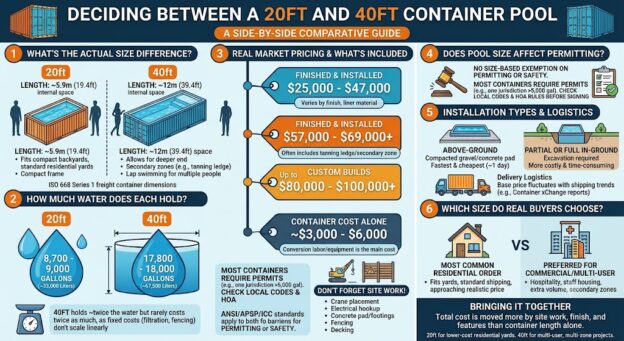
The length difference is obvious — roughly 5.9m of internal space on a 20ft versus roughly 12m on a 40ft, both built from the original container frame, which is why ISO 668 Series 1 freight container dimensions are the reason these are the only two lengths you’ll find across nearly every supplier in this market. The full engineering spec behind both sizes — wall thickness, coating, filtration sizing — is covered separately in our Container Pool Technical Guide. What’s less obvious until you compare real listings is that the 40ft isn’t just “more of the same pool” — it typically supports a deeper end, a separate shallow zone or tanning ledge, and enough width for two or three people to swim laps past each other, none of which a 20ft physically has room for.

How Much Water Does Each Size Actually Hold?

Real figures cited across several industry cost guides put a 20ft container pool at roughly 8,700-9,000 gallons — call it 33,000 liters — filled from a garden hose or a water truck in about 30 minutes for a 20ft unit, versus roughly 17,800-18,000 gallons, or about 67,500 liters, for a 40ft. That’s not quite double-to-double on cost, which is the detail that actually matters to a budget conversation: the 40ft holds roughly twice the water but rarely costs exactly twice as much, because fixed costs — filtration plant, fencing package, factory setup — don’t scale linearly with length.

What Does a 20ft vs 40ft Container Pool Actually Cost?

Pricing varies enough across the market that a single number is misleading, so here’s the real spread we found checking multiple suppliers’ published pricing:

  • 20ft, finished and installed: commonly $25,000-$47,000 depending on liner material, filtration package, and finish level
  • 40ft, finished and installed: commonly $57,000-$69,000+, often including a tanning ledge or secondary zone as standard
  • Fully custom builds with premium decking, heating, and site work on either size: can reach $80,000-$100,000+
  • Bare, unconverted container cost alone (before any pool work): roughly $3,000-$6,000 depending on size and condition — a reminder that the conversion labor and equipment, not the steel box itself, is most of what you’re paying for

The gap between the cheapest “starting at” price and the fully finished number is almost always site work — crane placement (commonly $300-800), electrical hookup (commonly $200-500), concrete pad or footings, decking, and fencing. A quote that only shows the pool’s base price without these line items isn’t wrong, exactly, but it isn’t the number you’ll actually spend either.

Does Pool Size Affect Whether You Need a Permit?

This catches buyers off guard more than almost anything else. Some US jurisdictions set the permit threshold surprisingly low — one Florida county, for example, requires a permit for any pool over 5,000 gallons — which both a 20ft and a 40ft clear by a wide margin. In practice, this means the permit question isn’t really about which size you choose; it’s about whether you’ve checked your local building department and HOA rules before signing a contract, not after a container is already sitting in your driveway. Fence and barrier requirements, commonly referenced against ANSI/APSP/ICC standards in the US, apply the same way to both sizes as well — there’s no size-based exemption on safety compliance.

What Do Real Installation Costs Look Like Beyond the Pool Itself?

Site prep is where a lot of budget conversations go sideways. Above-ground placement on a compacted gravel bed or a concrete pad is the fastest and cheapest route, often completed in roughly a day once the unit arrives — worth knowing if you’re trying to hit a specific weekend or event. Partial or full in-ground installation costs meaningfully more and takes longer because of the excavation involved, and it’s a decision worth making before ordering, not after, since it affects crane access and site logistics on delivery day. Base container market pricing also moves with broader shipping trends — Container xChange’s market reports track this, and it’s part of why quotes can shift from one quarter to the next even when nothing about the design has changed. The filtration and structural specs that determine how a quote holds up over time,

Which Size Do Real Buyers Actually Choose?

Across the suppliers whose pricing and sales data we reviewed, the 20ft comes up repeatedly as the most common residential order — it fits a standard backyard, avoids the oversized-load shipping conversation a 40ft sometimes triggers, and lands at a price point that’s meaningfully more approachable for a first-time buyer. The 40ft shows up more often on hospitality, staff housing, or multi-user residential projects where the extra water volume and secondary zone genuinely change what the pool can do, not just how big it looks in a photo. Our own container swimming pool export line sees a similar pattern from export buyers — 20ft for a first order or a space-constrained site, 40ft once the project has a defined commercial or multi-user purpose.

Bringing It Together

Neither size is the “better” one in the abstract — a 20ft is the lower-cost, lower-risk choice for a residential yard or a pilot order, and a 40ft earns its higher price when the project genuinely needs the extra water volume, a second zone, or multi-user capacity. What the real pricing data across the industry actually shows is that the size decision matters less to total cost than most buyers assume going in — site work, permits, and finish level move the final number more than the four meters of container length ever will. Get those line items in writing before comparing a 20ft quote against a 40ft one, and the size question usually answers itself.

This comprehensive technical reference infographic for shipping container pools provides data-driven specifications to guide buyers toward informed decisions using real numbers instead of vague marketing terms. It outlines the precise dimensions, water capacities, and weights for standard 20ft residential units and 40ft commercial units, highlighting the critical importance of verifying the actual as-built weight to prevent dangerous crane-lifting accidents. Structurally, the guide contrasts standard 1.5-2mm container walls with the required 3-4mm Corten weathering steel plates needed to withstand water pressure, while referencing ISO 12944 coating standards. Additionally, the infographic details essential filtration turnover rates (6-8 hours for residential, 4-6 hours for commercial), climate-specific insulation R-values, liner material variables, and provides a clear breakdown on how to evaluate tiered product warranties covering the pool's structure, surface, and equipment.

Container Pool Specifications-What the Spec Sheet Should Actually Say

Container Pool Specifications introduce

Every container pool quote we’ve ever seen has a photo of a finished pool at the top and a wall of vague adjectives underneath it — “durable,” “premium,” “industrial-strength.” What a buyer actually needs is a set of numbers: length, weight, wall thickness, coating standard, filtration rate, warranty terms. We pulled those numbers together here from real product listings, documented owner experiences, and our own export orders, so this reads as a reference sheet rather than a brochure.

What Dimensions Does a Container Pool Actually Come In?

Length follows the original container frame, so 20ft and 40ft dominate the market, with a smaller number of suppliers offering a 30ft option for buyers who want something between the two. A 2026 product announcement from a North American manufacturer listed exactly this range — 20ft, 30ft, and 40ft lengths, widths up to 12ft, and depths up to 8ft (roughly 2.4m) — which lines up with what we see across the broader market rather than being an outlier. Most residential orders land at 20ft; most hospitality and commercial orders land at 40ft, largely because filtration and structural costs don’t scale linearly with length, so the larger unit tends to deliver more usable water per dollar spent.

Put the two standard sizes side by side and the practical differences are easy to see. A 20ft unit lines out to roughly 5.9m of internal length, typically built to a depth between 1.2m and 1.8m, holding somewhere around 20,000-25,000 liters of water, with an empty steel shell weighing approximately 3,000-4,500kg. A 40ft unit roughly doubles the length to around 12m, can go slightly deeper — commonly 1.2m to 2.1m — holds around 40,000-50,000 liters once filled, and carries an empty shell weight in the 5,000-8,000kg range. Those weight figures are for the bare shell before fit-out, plumbing, and water; the final installed and filled weight is considerably higher, which is exactly why the next section matters.

How Much Does a Container Pool Weigh, and Why Does That Matter?

This sounds like a minor line item until it isn’t. One widely documented buyer account describes a 40ft unit quoted at roughly 12,500 lbs that turned out to weigh closer to 16,000 lbs once it was actually on the crane — the crane operator caught it mid-lift, the pool nearly dropped, and the project had to bring in a larger crane on short notice. That’s not a hypothetical risk; it’s a real, published account of exactly what happens when a supplier estimates weight from an older spec sheet instead of weighing the specific unit that shipped. Before booking a crane or a flatbed, get the as-built weight in writing, ideally from a weighbridge ticket rather than a nameplate estimate. It’s a five-minute ask that avoids a very expensive afternoon.

What Wall Thickness and Coating Spec Should Be on the Quote?

An unconverted shipping container’s corrugated steel wall typically runs about 1.5-2mm — strong enough for stacked cargo loads, not thick enough on its own for sustained water pressure. A proper pool conversion adds structural plate, commonly 3-4mm, at the floor and lower walls specifically, following the same weathering-steel family (Corten, meeting the ASTM A606 specification in the US market) used across the shipping industry for its corrosion resistance. On top of the steel, the coating system matters as much as the metal underneath it — a full system built against the immersion categories in ISO 12944 is the difference between a shell that needs attention in year three and one that doesn’t need attention for a decade or more. Ask for the coating standard by name on the quote, not just the phrase “anti-rust coating,” which by itself tells you nothing about durability.

What Filtration and Insulation Specs Actually Get Used?

Filtration turnover — how often the full water volume passes through the filter — is usually spec’d around a 6-8 hour cycle for residential use, tightening to 4-6 hours for commercial installations with heavier bather traffic, broadly in line with the water treatment principles referenced in commercial pool codes like the CDC’s Model Aquatic Health Code. Insulation, where climate calls for it, is typically specified by R-value: roughly R-10 covers a moderate climate, while cold-winter markets push closer to R-19 or higher to keep heating costs from eating the savings a buyer expected from going with a container pool in the first place. Skipping insulation to shave a few hundred dollars off a quote is one of the more common false economies we see on residential orders headed to colder regions.

  • Filtration: confirm turnover rate in hours, not just “filter included”
  • Insulation: ask for R-value, not just “insulated walls”
  • Liner: ask which material — PVC, EPDM rubber, or a fiberglass gel coat system — since UV resistance and expected service life differ meaningfully between them
  • Water treatment: confirm whether salt-chlorination, standard chlorine dosing, or UV/ozone secondary treatment is included, since these aren’t interchangeable in the quote

What Do Real Spec Sheets Get Wrong (or Leave Out)?

Cross-referencing a stack of actual listings and forum threads from real owners, the gaps repeat themselves. Weight, as covered above, is one. Liner material is another — plenty of listings say “durable liner” without naming what it’s made of, and PVC, EPDM, and fiberglass gel coat age very differently under UV exposure. Coating standard is a third: “rust-resistant” appears constantly, a named standard like ISO 12944 almost never does. And warranty terms are often the least specific line on the whole document — some suppliers advertise a flat “10-year warranty” without separating structural, coating, and equipment coverage, which matters because a pump failure and a shell leak are very different repair conversations. A liner is commonly rated for something like 8-12 years of service life under normal conditions, which is a reasonable number to hold a supplier to directly rather than accepting an unqualified warranty headline.

How Do You Read a Warranty Line on a Container Pool Quote?

Read it in three parts: structure, surface, and equipment. Structural warranty covers the steel shell itself against defects in the weld or the plate. Surface warranty covers the coating or liner against premature failure — this is the one most likely to have exclusions tied to water chemistry maintenance, so ask what voids it. Equipment warranty covers the pump, filter, and any heating or automation, usually shorter than the structural term and often passed through from a third-party manufacturer rather than the pool builder itself. One detail worth confirming explicitly, because it’s caused real disputes: whether the warranty transfers to a new owner if the property is sold, since some suppliers tie coverage to the original purchaser only. That’s the kind of clause nobody reads until they need it, and by then it’s too late to negotiate.

The full engineering reference these specs are built against — including how they interact with sizing and material choice — is covered in Container Pool Technical Guide. And for the specific product line these numbers reflect on our own orders, see our container swimming pool export line.

Bringing It Together

A spec sheet is only useful if it actually specifies something. Length and depth are the easy part; weight, wall thickness by location, a named coating standard, filtration turnover in hours, insulation R-value, and a warranty broken into structure, surface, and equipment are the details that separate a pool that holds up from one that generates a forum thread about rust and a warranty that didn’t transfer. None of these numbers are secret — they’re just easy to leave off a glossy quote, and the buyers who ask for them in writing are consistently the ones who don’t end up standing on a crane operator’s phone call wondering why the pool weighs more than promised.

container pool technical guide introduce

Container Pool Technical Guide

Anyone who spends an afternoon researching container pools ends up in the same place: a dozen browser tabs of Alibaba listings, a handful of glowing brand websites, and, if they dig a little further, a few forum threads and complaint boards where actual owners describe what happened after delivery. We went through that same exercise from the supplier side, cross-referencing published product listings, publicly available owner reviews, real installed projects, and the engineering standards this product category is actually built against. This guide is the result — a working technical reference rather than a sales page.

Product Parameters: What the Spec Sheet Should Actually Tell You

Listings across the market vary more than buyers expect. One recent press release from a North American manufacturer described its container pool line as available in three lengths — 20ft, 30ft, and 40ft — with widths up to 12ft and depths up to 8ft, giving buyers a sense of the outer range this product category spans. The base frame on most of these units still follows ISO 668 Series 1 freight container dimensions even after conversion, which is why port handling and inland trucking treat a finished pool the same way they’d treat an unconverted container. On the wholesale side, Alibaba listings for container pools commonly show a minimum order quantity of one unit, which tells you something useful: this isn’t a bulk commodity product, and a serious factory should be willing to quote and build a single unit without the buyer needing to place a container-load order.

What the spec sheet should specify, and what a lot of listings gloss over, is shell wall thickness in millimeters, filtration turnover rate, and depth profile — not just overall footprint. A pool advertised only by length and a vague “durable steel” description hasn’t actually told you anything about how it will perform in five years. Our own container swimming pool export line publishes shell thickness, ribbing interval, and coating system as standard line items on every quote, specifically because these are the numbers we see buyers most often forget to ask for until something goes wrong. The full parameter breakdown — dimensions, water volume, filtration sizing by pool size — is in container pool product parameters.

Raw Materials: What a Container Pool Shell Is Actually Made Of

The base shell almost always starts as weathering steel — commonly Corten, which in the US corresponds to the ASTM A606 specification for high-strength, low-alloy steel with improved atmospheric corrosion resistance. This is the same steel family used in bridges and shipping containers themselves, chosen because it forms a stable oxide layer that slows further corrosion rather than needing constant repainting. Some suppliers instead use marine-grade stainless steel or line the interior with fiberglass and a UV-protected gel coat rather than relying on the coated steel shell alone — each approach has real tradeoffs in cost, weight, and long-term maintenance that are easy to gloss over in marketing copy but matter a great deal five years into ownership.

The liner is the other half of the materials question, and it’s where a lot of quality variation hides. PVC liners are the most common and the least expensive, but they degrade under sustained UV exposure faster than EPDM rubber or a welded polyethylene liner. A buyer comparing two quotes at similar prices should ask specifically which liner material is used and what warranty period it carries — this single line item explains more price variation between suppliers than almost anything else in the quote. The complete materials comparison, including where each option tends to fail first, is in container pool materials.

Comparing Pools by Parameter: Size, Depth, and Filtration Load

Parameter comparison is where a lot of buyers get stuck, because two pools that look similar in a photo can have meaningfully different specs. Depth commonly ranges from about 1.2m to 2.1m depending on whether the unit is intended as a plunge pool or a lap pool, and filtration turnover — how often the full water volume passes through the filter — should scale with both depth and expected bather load, not just container length. A hospitality project running a pool at near-continuous occupancy needs a faster turnover rate than a residential backyard unit used a few hours a day, and pricing quotes that don’t differentiate on this basis usually haven’t actually engineered for the intended use case. We break down how these parameters interact — and which ones actually move the price — in container pool parameter comparison.

Comparing Pools by Material: Steel, Stainless, and Fiberglass

The steel-versus-fiberglass debate comes up in almost every buyer conversation, and the honest answer is that neither is universally better — they solve for different priorities. Corten steel shells, properly coated to the immersion categories in ISO 12944, are strong, relatively economical, and repairable if the coating is damaged — a rust spot can be sanded, primed, and recoated rather than requiring a full liner replacement. Fiberglass-lined units, by contrast, skip the coated-steel corrosion question entirely by relying on a gel coat interior, which some buyers prefer for a smoother, more pool-like finish, at a typically higher unit cost. Stainless steel shells cost more still but eliminate the weathering-steel maintenance conversation almost entirely, which matters more in a coastal or high-salinity market than an inland one. The full side-by-side, including what we’ve seen fail first in each material category, is in container pool material comparison.

What Real Owner Reviews Actually Tell You About Quality Control

This is the part most technical guides skip, and it’s arguably the most useful. Publicly documented owner complaints about container pools — the kind that show up on consumer review platforms rather than brand websites — cluster around a small number of repeatable problems: units delivered heavier than the quoted weight, catching crane companies off guard on install day; rust developing at hardware and window bolt points within as little as 18 months when the coating system wasn’t specified for the local climate; and warranty terms that don’t transfer if the property changes hands. Barrier and gate hardware complaints show up too, usually because a residential order shipped without confirming compliance against a standard like the ANSI/APSP/ICC barrier requirements for the destination market. None of these are exotic failure modes — they’re exactly the line items covered in the parameters and materials sections above. A buyer who confirms shipped weight in writing, asks for the specific coating standard rather than the word “durable,” and reads the warranty transfer terms before signing avoids the large majority of the complaints we’ve seen documented across the industry. On the other side, positive reviews we’ve come across tend to cite the same things repeatedly — responsive installation support and a crew that shows up when scheduled — which says as much about the buyer’s due diligence during the sales process as it does about the product itself.

Where Container Pools Are Actually Being Installed

Real projects tell a more grounded story than renderings. A country hotel in Malaysia built its guest pool alongside rooms made from stacked red shipping containers; a glamping resort in Argentina added a container pool as part of a broader shipping-container cabin development. On the hospitality construction side more broadly, a 201-room Hampton by Hilton near Bristol Airport had its container-built room modules — manufactured in China and shipped in — installed on-site in about three weeks, a timeline that illustrates why hospitality developers keep returning to prefabricated, container-based construction for both rooms and amenities: the disruptive part of the build happens off-site, not on the property.

Safety Requirements: What Actually Gets Checked at Inspection

Safety compliance splits into two tracks that buyers frequently conflate. The container frame’s dimensional standard governs logistics and handling — it says nothing about whether the finished pool is safe to swim in. Pool safety compliance is a separate matter entirely: residential barrier and gate hardware requirements, and — for hotels, resorts, schools, or any publicly accessible installation — commercial water treatment and circulation requirements typically modeled on the CDC’s Model Aquatic Health Code. A buyer sourcing for a public or semi-public installation should ask a supplier directly which of these two tracks their quote actually covers, since “certified” on its own is a claim that means very little without specifying against which standard. The full safety checklist, broken down by installation type, is in container pool safety requirements.

Putting It Together

A container pool is a manufactured product, and like any manufactured product, the gap between a good one and a disappointing one comes down to specifics that are easy to skip past in a sales conversation: wall thickness in millimeters, a named coating standard, a liner material with a stated warranty, a filtration rate matched to actual use, and safety documentation that names the standard it’s built against rather than just asserting compliance. The real reviews, real projects, and real listings referenced throughout this guide point to the same conclusion from different directions — the pools that hold up are the ones where every one of those details was specified in writing before the deposit was paid, not assumed afterward.