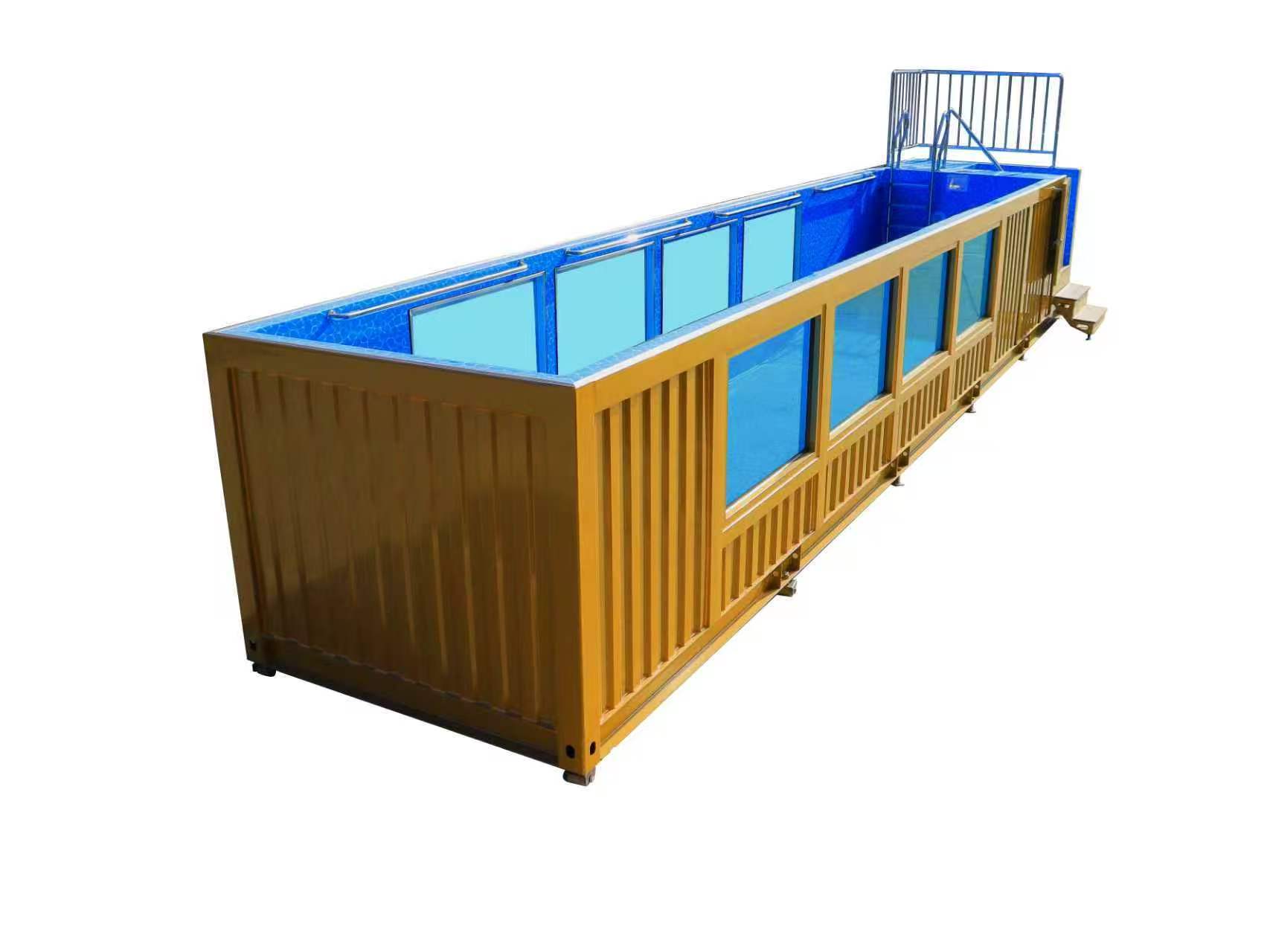
Container Pool Certificate: Which Ones Are Real, and Which Ones Matter
Written by the GKC Pro Export & Compliance Team. Last updated July 2026.
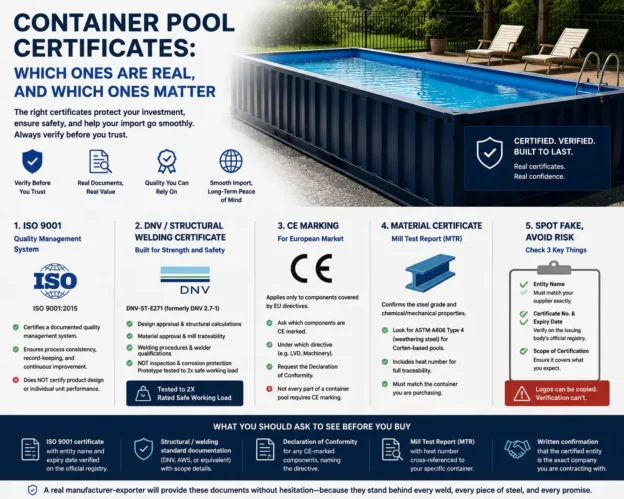
A certificate PDF is one of the easiest things to fake in this industry, and one of the least checked. A logo gets copied from a competitor’s site, a certificate number stays the same year after year even though it expired eighteen months ago, or the entity name on the document belongs to a related company that isn’t actually the one building your order. None of that is paranoia — it’s a documented pattern across container sourcing generally, and it’s exactly why “we’re certified” means almost nothing on its own. This page covers which certificates actually apply to a container pool, what each one certifies (and doesn’t), and how to check whether the document in your inbox is real before you rely on it.
Why Do Buyers Even Need to Ask About Certificates for a Container Pool?
Because a certificate is the only piece of paper standing between “the factory told me it’s fine” and something you can independently verify. A container pool is a welded steel structure holding several thousand gallons of water under constant pressure, sitting in a backyard or on a hotel rooftop for a decade or more — not somewhere you want to be taking a stranger’s word for it. The certificates worth asking about fall into four categories: a quality management system certificate (ISO 9001), a structural or welding certificate specific to the container conversion, regional compliance marking if you’re reselling into a regulated market, and a material certificate for the steel itself. Full specifications for both container pool sizes, including which of these apply to our own units, are on the container pool product page.
What Does an ISO 9001 Certificate Actually Certify — and What Doesn’t It Cover?
ISO 9001:2015 certifies that a documented quality management system exists at a specific legal entity and address, and that the factory follows it — things like process consistency, corrective-action tracking, and record-keeping. It does not certify that any individual unit passed a specific structural test, and it doesn’t certify the product design at all. That distinction catches people out more than it should: a factory can be genuinely, currently ISO 9001 certified and still ship a unit with a bad weld if that particular batch skipped a step in the process. Treat ISO 9001 as evidence the factory runs a real, auditable operation — not as a substitute for checking the structural certification underneath it.
What Is a DNV or Structural Welding Certificate, and Why Does It Matter for a Container Conversion?
DNV is a classification society — the same kind of independent technical authority that certifies ships and offshore platforms — and its container standard, DNV-ST-E271 (originally published in 1989 as DNV 2.7-1), has been used to certify close to 40,000 containers worldwide since it launched. What that certification actually checks is worth knowing in detail: design appraisal against structural calculations and load cases, material approval traceable back to the mill sheet, welding procedures and welder qualifications verified through inspection and, where required, non-destructive testing, corrosion protection meeting a defined coating standard, and a prototype unit physically tested to twice its rated safe working load before the design is approved at all. That last point is worth sitting with for a second — a properly certified container design isn’t tested to the load it’s expected to carry, it’s tested to double that, specifically so there’s margin left when the unexpected happens. A container pool built on that kind of structural foundation is a fundamentally different product from one where “should be fine” is doing the load-bearing.
Does a Container Pool Need CE Marking to Sell Into Europe?
Sometimes, and only for parts of it — this is where a lot of buyers get the wrong impression from a supplier’s marketing page. CE marking applies only to product categories covered by specific EU directives, and it’s the manufacturer declaring — usually through self-assessment, not automatic third-party approval — that a product meets the relevant essential requirements before it goes on the EU market. A steel shell by itself may not fall under a CE-marked category the same way an electrical pump or heater does under directives like the Low Voltage Directive or the Machinery Regulation. The practical takeaway: ask specifically which components of a container pool carry CE marking, under which directive, and request the Declaration of Conformity for those components — not a blanket “CE certified” claim covering the whole unit, which usually means someone’s overstating what the mark actually applies to.
What About the Steel Itself — What Should a Material Certificate Show You?
A mill test report ties the structural steel back to a specific heat number, with documented chemical composition and mechanical properties matching the claimed grade. For a Corten-based container pool, that grade is typically ASTM A606 Type 4 weathering steel. Ask to see this document with the heat number cross-referenced to the actual container you’re buying, not a generic spec sheet the factory sends to everyone — the two are easy to confuse, and only one of them is actually evidence about your unit specifically.
How Do You Tell a Real Certificate From a Borrowed or Expired One?
Check three things every time, in this order: the certified entity name (does it match the legal company you’re actually contracting with, word for word, or does it belong to a sister company whose certificate got forwarded to you instead?), the certificate number and expiry date (most certification bodies run a public registry you can search independently — use it, rather than trusting the PDF on its face), and the scope of certification (a general quality-management certificate doesn’t cover a structural welding claim, and vice versa). This is the same due-diligence habit worth applying to the exporter itself, not just the paperwork they hand you — our container pool exporter guide covers how to verify a supplier’s business registration and export history the same way, independently rather than by trusting what’s on their website.
What Should You Actually Ask to See Before You Trust the Certificates?
The ISO 9001 certificate, with entity name and expiry date checked against the certification body’s own registry
Documentation for the structural or welding standard used on the container conversion — DNV, AWS, or equivalent — not just a mention of it
A Declaration of Conformity for any specific component claiming CE marking, naming the directive it falls under
A mill test report with a heat number cross-referenced to your specific container
Confirmation, in writing, that the certified entity is the exact company you’re signing a contract with
None of these certificates individually guarantee a defect-free container pool. Together, they’re the difference between trusting a claim and being able to check it — and a real manufacturer-exporter will hand them over without hesitation, because they’ve got nothing to hide behind a copied logo.
How to Import a Container Pool: The Real Process, Step by Step
Written by the GKC Pro Export & Compliance Team. Last updated July 2026.
A container pool doesn’t usually get stuck at customs because the product is complicated. It gets stuck because one document was late, one weight wasn’t verified, or one code on the invoice didn’t match what an officer expected to see. None of that is really about the pool — it’s the same paperwork every ocean container has to clear, and once you’ve watched the sequence run once, start to finish, it stops feeling like a mystery and starts looking like a checklist. This page walks through what actually happens between placing a deposit and the container showing up at your gate: who’s responsible for what, which documents matter, and where the real costs hide when something goes wrong.
What Does the Container Pool Import Timeline Actually Look Like, Start to Finish?
Order confirmation and deposit come first, followed by production — a structural steel conversion takes real weeks, not days, for either the 20ft or 40ft size (full specs for both are on the container pool product page). Once the unit is built, it goes through a pre-shipment inspection, a verified weight declaration, and freight booking, then loading and export customs clearance at the origin port. Ocean transit itself can run anywhere from roughly two to six weeks depending on the route. Then comes an arrival notice at the destination port, import customs clearance, duty payment, and finally delivery or pickup. Every stage on that list produces a document, and the buyers who avoid delays are usually the ones who know which document belongs to which stage before it’s due — not the ones scrambling to find out after a forwarder calls asking for it.
Who Is Legally Responsible for Getting the Container Pool Through Customs?
Whoever is named as the importer of record is on the hook — legally and financially — for accurate documentation and duty payment, regardless of what the exporter promised verbally. That responsibility shifts depending on which Incoterm the contract specifies: under EXW or FOB, the buyer is generally arranging freight and clearing customs at destination as importer of record; under DDP, the seller handles more of that burden, though the buyer is still often named as importer of record on the actual customs entry in many countries, even when someone else is footing the bill. This is exactly why the exporter you choose matters beyond product quality — a supplier who can’t produce a clean commercial invoice or an accurate certificate of origin isn’t just a manufacturing risk, they’re a customs delay waiting to happen on your shipment. How to actually vet that before you commit is covered in our container pool exporter guide.
What Documents Do You Actually Need to Clear a Container Pool Through Customs?
Commercial invoice — states sale price and terms; customs uses this to assess duty, so an error here is the single most common cause of a hold
Packing list — itemizes what’s physically inside the container, checked against the invoice
Bill of lading — the shipping line’s title document; you generally can’t take possession without it
Certificate of origin — confirms the goods were manufactured in China, relevant to tariff treatment
Import declaration or entry form — the specific form your destination country requires at the point of clearance
Mill test report — supporting evidence if a materials-based duty question or warranty claim comes up later
What Is VGM, and Why Will Your Container Get Rejected Without It?
Verified Gross Mass has been a mandatory global requirement since July 2016, under a SOLAS amendment enforced by the IMO — the shipper has to declare the verified total weight of the packed container before it’s allowed onto a vessel, full stop, no informal workaround. There are two approved methods: weighing the entire packed container on a certified scale, or adding up the individual item weights plus the container’s own tare weight. For something as heavy and irregularly shaped as a welded steel pool shell, weighing the whole container is almost always the practical choice, and a forwarder will typically handle it for somewhere around $50–$100. Skip it, or file it late, and the terminal simply won’t load the container — it sits, and every day it sits past free time is a day you’re paying for.
What Extra Steps Apply If You’re Importing Into the United States?
U.S.-bound ocean shipments need an Importer Security Filing, commonly called ISF or “10+2,” submitted to Customs and Border Protection at least 24 hours before the container is loaded at the origin port — not after departure, before it. Miss that window, file it inaccurately, or skip it, and CBP can assess liquidated damages of $5,000 per violation, capped at $10,000 per shipment. Shipments valued above the formal entry threshold — a container pool clears this easily — also generally require a customs bond, either a single-transaction bond for a one-off order or a continuous bond if you’re importing regularly. None of this is unusual or a sign anything’s wrong; it’s simply the standard checklist for a first-time U.S. importer, and the ones who get surprised by it are almost always the ones who assumed their freight forwarder had it automatically covered.
How Much Does Getting the HS Code Wrong Actually Cost You?
A prefabricated pool structure built from a shipping container isn’t always classified under the same Harmonized System heading as a plain, unmodified container, depending on your destination country’s tariff schedule — and getting that code wrong is one of the more common triggers for a full physical customs exam, not just a paperwork correction. Once a container gets pulled for exam, you’re generally looking at added exam fees plus however many extra days it sits while the inspection is scheduled and completed — days that count against your free time regardless of whose mistake caused them. It’s worth getting the code confirmed in writing by your own customs broker before the container ships, rather than trusting the description on the exporter’s commercial invoice by default.
What’s the Difference Between Demurrage and Detention — and How Do You Avoid Both?
Demurrage is the fee a shipping line or terminal charges once a container has sat at the port longer than its free time — typically somewhere in the range of three to seven calendar days depending on the port, after which daily charges start accruing and can run into the hundreds of dollars per day. Detention is a related but separate fee for holding onto the carrier’s physical container equipment past its free days once it’s left the port, whether that’s because customs clearance is dragging on or because it hasn’t been returned empty yet. Watching a shipment sit somewhere mid-Pacific for an extra week isn’t just an inconvenience — it’s a bill accumulating in the background that nobody notices until the invoice arrives. The way to avoid both is unglamorous but effective: have your customs paperwork, VGM, HS code confirmation, and inland trucking arranged before the vessel arrives, not after the arrival notice lands in your inbox.
What Should You Confirm With Your Exporter Before the Container Even Leaves the Factory?
The Incoterm agreed in writing, and exactly what it does and doesn’t cover
Who’s arranging the VGM weighing, and who’s paying for it
The HS code they intend to use, confirmed separately by your own broker
The complete document set they’ll provide, listed by name, in writing
A realistic transit time to your specific port, not a generic “4–6 weeks” estimate
Who is named as importer of record on the customs entry, confirmed before shipment, not discovered after
Importing a container pool isn’t harder than importing any other full-container ocean shipment — it just has a sequence, and every delay story that turns into an expensive one usually traces back to a document that was late, a weight that wasn’t verified, or a code nobody double-checked. Get those three things right and the rest of the process runs about as smoothly as ocean freight ever does.
Written by the GKC Pro Export & Compliance Team. Last updated July 2026.
Somewhere between a third and half of the “manufacturer” listings you’ll find searching for a container pool exporter are, by industry estimate, trading companies working through someone else’s factory. That’s not automatically a problem — a good trading company can still deliver a good product — but if you don’t know which one you’re actually dealing with, you can’t judge lead time, MOQ, or who stands behind a structural defect eighteen months from now. This page covers four things worth checking before you commit to an exporter: what real export experience looks like on a container pool order, how the import process actually plays out once the container leaves China, which certifications are worth asking to see, and how to verify any of it yourself — including us — before a deposit changes hands.
What Makes a Container Pool Exporter’s Track Record Worth Trusting?
Export experience isn’t a number on a homepage banner. It shows up in specifics: a business license whose registered scope reads “manufacturing” or “production” rather than just “wholesale” or “import-export” , a willingness to issue a VAT invoice under the exact same company name as that license, and a country list you can cross-check rather than take on faith. A factory with real export history will also support more than one Incoterm — EXW, FOB, CIF, and DDP are all common on container products, and a supplier who can only quote one is telling you something about how thin their logistics bench actually is.
Here’s what that difference looks like in practice. Two exporters quote the same 40ft container pool order at nearly identical prices — one with three years and roughly forty shipments behind it, the other two months old with zero completed orders. On paper, both quotes look the same: same price, same stated lead time. The gap shows up later, when a weld fails a pre-shipment inspection or a customs officer in the destination country questions the HS code on the invoice. The experienced exporter has a documented fix already — a standard repair procedure, a pre-written classification explanation for their broker. The newer one is improvising in real time, on your shipment, on your clock.
Our own container pool line sits inside a broader manufacturing operation with 18+ years of export experience, ISO 9001, JIS “R” grade, and DNV welding certification across our container product lines — the same production and QC system that builds the pool shells, and the same one that already ships expandable container houses and grandstand units to buyers across Africa, Europe, the Middle East, and the Americas under EXW, FOB, CIF, and DDP terms. Full specifications and shipping terms for both container pool sizes are on the container pool product page.
How Does the Import Process Actually Work Once You Place an Order?
Once you place an order, understanding the full shipping and customs process can help avoid costly delays. Our detailed guide on How to Import a Container Pool explains each step from production, inspection, shipping documents, customs clearance, and final delivery.:
Commercial invoice — states the sale price and terms; customs uses this to assess duty, so an error here is the single most common cause of a clearance delay
Packing list — itemizes what’s physically inside the container, cross-checked against the invoice at customs
Certificate of origin — confirms the goods were manufactured in China, which matters for tariff treatment under whatever trade agreement (or lack of one) applies to your destination country
Bill of lading — the shipping line’s receipt and title document; you generally can’t take possession of the container without it
Mill test report — ties the structural steel back to its material grade, useful evidence if a warranty question comes up years later
On the Incoterms 2020 side — the International Chamber of Commerce’s current rulebook — it’s worth actually reading the clause for whichever term you agree to rather than assuming you know what it covers. Take a distributor in Rotterdam agreeing to FOB Ningbo terms: under that rule, the exporter’s responsibility ends once the container is loaded onto the vessel at Ningbo. Everything after that — ocean freight, marine insurance, destination port handling, inland trucking to the distributor’s warehouse — is the buyer’s to arrange and pay for. Buyers who assume FOB works like door-to-door delivery are usually the ones surprised by an unexpected freight-forwarder invoice a few weeks later.
On the customs side, the container pool gets declared under a Harmonized System code, the classification framework maintained by the World Customs Organization and used by more than 200 countries to set duty rates. This is one area where it genuinely pays to double-check rather than assume: a prefabricated pool structure built from a shipping container isn’t always classified the same way as an unmodified container, depending on the destination country’s tariff schedule, and getting it wrong is a common source of the multi-week clearance delays reported in freight forums. Ask your exporter for the exact code used on their most recent shipment to your destination country, and confirm it independently with a local customs broker before the container is loaded — not after it’s already at sea.
Which Certifications Should a Container Pool Exporter Actually Be Able to Show You?
Before making a purchase decision, buyers should understand which certificates are meaningful and which ones are only marketing materials. Our guide on Container Pool Certificatesexplains how to verify certificate scope, company name, expiry date, and certification authority records.
Ask for the certificate PDF, not just the logo on the website, and check three things: the certified entity name (does it match the company you’re actually buying from, or a related entity whose certificate they’re borrowing?), the scope of certification, and the expiry date. ISO 9001 is the baseline worth confirming — it certifies that a quality management system exists and is followed at a specific legal entity and address, not that any individual product has been tested. That distinction matters: a factory can be genuinely ISO 9001 certified and still ship a defective unit if the process wasn’t followed correctly on that particular batch, which is exactly why the certification and the pre-shipment inspection are two separate checks, not one.
Beyond ISO 9001, ask what welding and structural standard governs the container conversion itself, and whether the exporter can produce mill test reports tying the steel back to its material grade. A legitimate certification body will also let you look the certificate up independently — most publish a searchable registry rather than expecting you to trust a PDF a supplier emailed you. None of this takes more than a few minutes to request. It’s the follow-through that separates a real manufacturer-exporter from a listing.
How Do You Tell a Real Manufacturer-Exporter From a Trading Company in Practice?
A live video call is the fastest test that’s hard to fake. Ask to see a specific machine — the CNC cutting table, the welding bay, a container mid-conversion — and watch how the person on camera responds. A real factory walks you there in under a minute; a trading company stalls, changes the subject, or sends a recorded tour instead. Payment method is another tell worth taking seriously: no legitimate manufacturer needs crypto “for faster processing,” and that single request should end a negotiation on the spot — it’s the exact pattern behind a reported case where an importer lost $67,000 after a supposed factory insisted on Bitcoin for a routine order.
You can also skip the trust-me step entirely for the basic registration facts. Every legally registered company in China has a public record on the National Enterprise Credit Information Publicity System, the government registry run by China’s State Administration for Market Regulation — searchable by company name or unified social credit code, and it will show you the registered business scope directly rather than whatever a sales rep tells you. For a container pool specifically, also ask to see photos or a short walkthrough from a completed, shipped order — not a rendering, an actual finished project with a real destination. Our container pool project page walks through completed orders and the buyers behind them, which is a reasonable thing to ask any exporter to produce before you send money.
How Can You Verify Everything on This Page — Including Us?
We’d rather you check than take our word for it. Our registered business scope is searchable on the government registry linked above, and we’ll provide our ISO 9001 certificate number, JIS “R” grade documentation, and DNV welding certification on request so you can confirm them independently before any deposit is paid. We also do live video walkthroughs of the specific equipment used on container pool conversions — the same offer we’d expect a buyer to ask of any exporter, ours included. If a claim on this page doesn’t hold up once you’ve checked it, that’s useful information too, and we’d want to know.
What Should You Ask to See Before You Send a Deposit?
Business license with a manufacturing/production scope, not just wholesale or trading — cross-checked against the government registry, not just the supplier’s own copy
A VAT invoice sample matching the exact company name on that license
A live video walkthrough of the specific equipment used to convert the container
ISO 9001 (or equivalent) certificate — verify the entity name and expiry against the certification body’s own registry, not just the logo
The HS code they’ve used on prior shipments to your destination country, confirmed separately with your own customs broker
Photos or a walkthrough from a completed, shipped container pool project
A cost breakdown by Incoterm, so you know exactly what’s included at FOB versus CIF versus DDP before you compare prices across suppliers
A container pool exporter worth working with won’t hesitate on any of these. The ones worth avoiding are the ones who treat a reasonable question as an inconvenience — that reaction alone tells you more than the answer would have.
A buyer we talked to last year had already signed a lease for a mining camp site before his container homes even left the port. His schedule gave him eleven days between customs clearance and the first shift of workers arriving. Eleven days sounds tight until you realize the actual unfolding of an expandable container house takes less time than unloading the truck. That gap between what “fast setup” sounds like in a product listing and what it actually means on a gravel pad in the middle of nowhere is where import decisions get made — or get regretted.
What Actually Happens During Those 15 Minutes?
Strip away the marketing language and the mechanism is simple. A crane or forklift lifts the closed unit off the flatbed and sets it on the prepared foundation — concrete piers, screw piles, or a compacted gravel pad, depending on soil conditions and how long the unit will stay in place. Once it’s level, the side wings release. The roof panels, hinged at the central core, swing outward and lock into temporary or permanent struts. The floor panels drop down from the same hinge line to form a continuous, load-bearing base. Last, the end walls swing out like oversized doors and latch into both the floor and roof tracks. On a unit that’s been engineered correctly, this sequence — wings out, floor down, walls locked — genuinely runs in the 10 to 15 minute range with a trained two- or three-person crew.
What that 15 minutes does not include is plumbing and electrical hookup. The 20ft expandable container house we manufacture ships with the bathroom and kitchen pre-fitted inside the central core specifically so those lines never have to be disconnected during transport or reconnected on site. Even so, tying the unit into a septic line, a water main, or a generator typically adds anywhere from one to four hours, depending on how far the utility points sit from the pad. Buyers who quote “15-minute install” to their own end customers without separating structural unfolding from utility hookup usually end up fielding an awkward call on delivery day. Better to set that expectation up front.
Why Do Importers Care About Setup Time More Than the Price Tag?
Price matters, obviously. But talk to anyone sourcing housing for a construction camp, a disaster-relief contract, or a seasonal labor site, and the conversation turns to schedule risk before it turns to unit cost. A traditional site-built dormitory can take three to six weeks from ground-breaking to occupancy, and that clock is vulnerable to weather, permitting delays, and skilled-labor shortages in remote regions. An expandable unit compresses that timeline because the labor-intensive part — cutting, welding, insulating, wiring — already happened at the factory under controlled conditions. What’s left on site is assembly, not construction. That distinction is exactly why we built our workers dormitory line around the same folding chassis: mining and infrastructure clients don’t have six weeks to spare between contract award and crew arrival, and every idle day is a day their equipment sits unused too.
There’s also a labor-cost angle that’s easy to underestimate. A four-person crew can complete the structural assembly of one unit in roughly an hour once the foundation is ready, compared to a full construction crew working for days on a stick-built equivalent. For a project deploying 20 or 40 units — not unusual for a mining camp or disaster-response contract — that difference compounds fast, both in wages paid and in how quickly the site becomes revenue-generating or operational.
How Is the Frame Engineered to Fold Without Cracking?
This is the part buyers should push suppliers on, because it’s also where cheaper competitors cut corners. A folding structure has more moving joints than a fixed one, and every hinge point is a potential stress concentration. The two failure modes we see most often on lower-grade units are hinge fatigue after repeated fold cycles and corrosion at the chassis welds where galvanizing wasn’t applied evenly before assembly. The fix isn’t complicated — it’s just not free. A hot-dip galvanized structural steel chassis, rather than a painted or spray-coated one, holds up far longer in humid or coastal climates. Structural steel connections should follow recognized design practice; the American Institute of Steel Construction publishes the standards most engineers reference for load-bearing steel framing, and it’s worth asking your supplier which design code their chassis calculations are based on. Container dimensions themselves, meanwhile, follow the ISO 668 freight container standard, which is why a folded 20ft unit keeps the same external footprint — roughly 6.06m long, 2.44m wide, 2.59m high — as a standard shipping container and stacks and trucks through the same logistics network without special permits.
How Does a Folded Unit Compare to What You’re Actually Shipping?
Here’s the number that surprises first-time buyers most: a 20ft expandable unit occupies 18 square meters folded — identical to a standard 20ft container — but unfolds into roughly double or more that usable floor area once the wings, floor, and roof extend outward. You’re not paying to ship the finished square footage. You’re paying to ship a compact box that becomes something considerably larger once it lands. That efficiency is also why the folding design allows two complete units to load into a single 40ft shipping container for bulk export orders, which cuts freight cost per unit meaningfully on larger contracts compared to shipping oversized modular boxes that each need their own container slot. If you’re comparing this against flat-pack or standard modular options for a specific project, our buyer’s guide for expandable container houses walks through the tradeoffs in more depth, including where a rigid modular unit still makes more sense than a folding one.
What Do Buyers Actually Ask Before They Sign the PI?
A few questions come up on almost every call, and they’re worth answering plainly rather than burying in a spec sheet. Foundation type: screw piles work well for temporary camp deployments because they don’t require concrete curing time, while concrete piers suit units expected to stay put for years. Fold cycles: ask how many open-close cycles the hinge system is rated for if the unit will be relocated repeatedly, such as for seasonal glamping or event use — this matters a lot more for operators running expandable units at a camp or resort site than for a one-time permanent installation. Climate rating: insulation package (rock wool versus EPS) should match the destination climate, not just the factory’s default spec. And certification: for projects in North America or the EU, confirm which building code compliance documents the manufacturer can actually provide, not just claim — this comes up constantly with clients evaluating expandable container house options for the US market against local competitors.
For emergency and relief procurement specifically, the questions shift toward consistency at scale — whether the manufacturer can hold identical quality across a large order placed on short notice, which matters more than any single unit’s finish when you’re deploying housing for disaster response and can’t afford variation between the tenth unit and the hundredth.
What Should You Verify Before the Container Loads?
A short checklist, built from the questions that actually save buyers money: confirm the steel gauge and galvanizing spec in writing, not just verbally; request weld inspection photos or a third-party inspection report before final payment; get the fold-cycle rating in the contract if the unit will be moved more than once; and clarify Incoterms early — FOB pricing looks lower on paper but shifts freight risk and cost onto you, while DDP simplifies the math for a first-time importer even if the unit price reads higher. None of this is unique to expandable housing, but the folding mechanism adds one more component — the hinge and lock system — that a generic container-house checklist won’t cover. It’s worth five extra minutes on the factory call. You can browse the full range of configurations, including 30ft and 40ft options, on our expandable container house product page.
The 15-minute figure isn’t wrong, but it’s also not the whole story, and the buyers who do best with this product are the ones who ask what’s actually included in that number before they commit to a delivery date. Structural unfolding really can happen in minutes once the foundation is ready and the crew knows the sequence. What determines whether the project succeeds is everything around that 15 minutes — the chassis steel, the hinge engineering, the foundation prep, and a supplier who tells you honestly where the fast part ends and the normal construction work begins.
A buyer in Ontario once told a supplier flat out that she didn’t want a “quality guaranteed” line in the contract — she wanted the actual inspection report, with photos, tied to the serial number stamped on her specific unit. The factory sent it without pushback, and that single document became the reason she placed a second order eight months later. Most buyers never think to ask for that level of detail, and most suppliers are happy to let a vague promise stand in for real documentation. This article covers what quality inspection on a container pool should actually involve, stage by stage, and what a buyer should be requesting before a deposit turns into a shipped container.
What Does “Quality Inspection” Actually Cover on a Container Pool?
The phrase gets used loosely enough that it’s worth defining before anything else. Real quality inspection on a container pool isn’t one checkpoint at the end of production — it’s a sequence of checks tied to each manufacturing stage, because a defect caught after the lining is already on is far more expensive to fix than one caught while the steel is still bare. A serious inspection process checks the container’s structural frame before cutting begins, the weld quality after reinforcement, the lining application and cure, the plumbing and electrical systems under load, and finally the completed unit under a full watertight test.
Skip any one of those checkpoints and you’re not getting a faster inspection process — you’re getting an incomplete one that happens to look identical to a thorough one in the final delivery photos.
How Is the Steel Frame and Welding Actually Checked Before the Lining Goes On?
This step happens before the part a buyer can actually see in photos, which is exactly why it gets skipped by suppliers cutting corners. Inspectors check the container frame for corrosion, dimensional accuracy, and squareness before any cutting starts, then re-check weld quality once the opening is cut and the reinforcement bracing goes in. Weld inspection on a legitimate production line references a documented structural welding code — not a welder’s personal judgment — since a weld that looks clean on the surface can still fail under sustained load if penetration or bead consistency wasn’t verified.
Steel grade matters here too. Weathering steel meeting the ASTM A606 specification is the material most serious factories reference for corrosion resistance, and a buyer comparing quotes should ask directly whether that spec is actually being followed or just mentioned as a talking point. A factory that can produce a material test certificate for the specific batch of steel used in your order is operating at a different level than one that can’t.
What Happens During the Interior Lining Inspection, and Why Does Cure Time Matter So Much?
If a container pool develops a leak, this is almost always where the root cause traces back to. Lining inspection checks surface preparation before application, application consistency across the full interior surface, and — most critically — that the lining cured for its full specified duration before the unit moved to the next production stage. A lining that looks flawless in a photo taken three days into a seven-day cure is indistinguishable from a properly cured one until it’s holding water under real conditions for months.
This is the inspection point buyers should push hardest on, because it’s also the one factories are most tempted to skip when a delivery date is tight. Ask specifically how the factory documents cure time completion — a dated inspection log tied to a specific unit’s serial number is a real answer; “we always let it cure properly” without documentation is not.
What Does a Real Watertight Test Actually Look Like?
This is the inspection stage that separates a factory willing to prove its work from one asking a buyer to take its word for it. A proper test fills the completed pool to full capacity and holds it there for a defined period — long enough that a seam failure, weld leak, or improperly sealed fitting has time to reveal itself — before the water gets drained and the unit moves to final prep for shipping. A factory that drains and repacks within hours of filling hasn’t actually tested anything; it’s performed a demonstration.
Ask for photos or video specific to your unit’s test, not generic footage from a previous batch. Buyers sourcing pool equipment for markets with formal certification requirements should also confirm filtration and circulation components meet standards like NSF/ANSI/CAN 50, which governs pool and spa equipment safety in several major import markets — a detail that matters more once the unit is installed and a local inspector starts asking questions the factory never anticipated.
Do Electrical and Plumbing Systems Get Tested Before Shipping, or Just Assembled?
Assembly and testing aren’t the same thing, and it’s worth asking a supplier directly which one they’re actually doing. Electrical systems should be tested under load — pumps running, lighting circuits energized — not just visually inspected for correct wiring. Plumbing connections should be pressure-tested before the unit is packed, since a fitting that holds under casual inspection can still fail once it’s under continuous operating pressure at the destination.
A factory that skips load testing isn’t necessarily cutting corners maliciously — sometimes it’s simply never been asked to prove it does this, because most buyers never ask. Buyers who specify load and pressure testing explicitly in a purchase order, and request documentation of the results, get a materially different level of scrutiny than buyers who assume it’s happening by default.
Should You Trust the Factory’s Own QC, or Pay for Third-Party Inspection?
Factory-run quality control and independent third-party inspection aren’t interchangeable, and understanding the difference matters most on a first order with a new supplier — the kind of question worth resolving before an order even starts by reading how to tell a real container pool manufacturer apart from a reseller in the first place. In-house QC is run by people whose paycheck depends on the factory hitting its shipping schedule, which creates a natural — not necessarily dishonest, just structural — pressure toward passing units that are borderline. Independent inspection firms such as SGS, commonly used across Chinese export manufacturing, have no stake in whether a given shipment ships on time, which is exactly why their reports carry more weight with buyers who’ve been burned before.
For a first order with a new factory, or for any bulk order above a size where a defect would be genuinely costly, paying for a third-party pre-shipment inspection is one of the cheapest insurance policies available in this entire sourcing process — typically a few hundred dollars against a shipment worth many times that. Repeat orders with a factory that’s proven reliable over several cycles are where a buyer can reasonably start relying more on in-house QC alone.
What Do Real Buyers Say About Defects and How Factories Handled Them?
Feedback from buyers who’ve actually dealt with a defect tends to focus less on whether something went wrong — since something occasionally does, across any manufacturing category — and more on how the factory responded once it did. Buyers describing positive experiences consistently mention a supplier who acknowledged an issue quickly, provided documentation of the fix, and kept communication open through resolution. The complaints that show up most often in reviews of weaker suppliers involve a factory going silent once a problem surfaced, or disputing a defect’s existence rather than addressing it.
That pattern is worth remembering when evaluating a factory before an order, not just after: ask directly what the documented process is if an inspection reveals a defect post-delivery, and treat a vague or defensive answer as a real signal about how that relationship will go if something actually goes wrong.
What Documentation Should You Request Before Releasing Final Payment?
A short, practical list worth keeping on hand for every order. Request the structural inspection report tied to your unit’s serial number, not a generic template. Ask for the material test certificate confirming steel grade and batch. Request dated documentation of lining cure time completion. Ask for photos or video of the specific watertight test performed on your unit. Request load-test results for electrical and pressure-test results for plumbing. And if the order size justifies it, budget for independent third-party inspection rather than relying solely on the factory’s self-reported QC.
None of this is unusual to ask for. A factory with a real inspection process already has all of this documentation sitting in a file somewhere — the only question is whether they’re willing to hand it over before final payment or only after you’ve already pushed hard enough to make them.
So What Should “Passed Quality Inspection” Actually Mean to You as a Buyer?
Strip the phrase down to what it should actually guarantee: a structural frame checked before cutting, welds verified against a real code, a lining cured for its full duration and documented, systems tested under actual load rather than just assembled, and a completed unit that held water under a real test before it ever got packed. A factory willing to hand over documentation for every one of those stages, on request, before final payment, is operating at a fundamentally different level than one offering a confident verbal assurance and nothing else.
Buyers ready to compare configurations directly already have specifications and current documentation practices in hand from the sections above — the only step left is asking a shortlisted supplier for the paperwork before final payment, not after.
How Strong Is a Container Pool Manufacturer’s Manufacturing Capability?
An importer in Toronto once spent three weeks going back and forth with a supplier over email, getting confident answers to every question, right up until he asked for a video of the actual welding shop floor. The replies got vague fast — “we can arrange that soon,” then nothing for a week. He moved on to a different factory that sent the video within a day. That single test told him more about manufacturing strength than any certificate on a homepage ever could. This article is about that gap — between what a supplier claims about production capability and what a buyer can actually verify — and how to close it before a deposit leaves your account.
What Does “Manufacturing Strength” Actually Mean When You’re Sourcing From China?
Every supplier’s about page uses the phrase, and almost none of them define it in a way a buyer can act on. Stripped down to what actually matters for a container pool order, manufacturing strength comes down to three questions: does the factory weld and finish the product itself, does it run under documented quality systems that can be independently checked, and can it hold consistent quality across a multi-unit order rather than just a single showcase piece.
Container House Co., Ltd. positions itself directly against the alternative here — the company describes itself explicitly as a manufacturer, not a trading company, running its own fixed production system rather than subcontracting work out and reselling it under a factory-sounding name. That distinction sounds like marketing language until a buyer has been on the receiving end of a trading company’s inconsistent batch quality, and then it stops sounding like marketing and starts sounding like the only question that matters.
Is This Factory Actually Building the Pool, or Just Reselling Someone Else’s Work?
This is the question importers ask too late, usually after a second or third order arrives with quality that doesn’t match the first. A real manufacturer welds the steel frame in-house, applies the interior lining on its own production line, and runs final testing under its own quality team — all traceable back to one facility and one set of workers who’ve done this specific job hundreds of times before. A trading company, by contrast, sources from whichever subcontracted shop has capacity that week, which means the buyer’s second order might come from an entirely different welding crew than the first, with no way to know that happened until quality drifts.
Container House Co., Ltd. has operated its own facility in Qingdao for more than 18 years, and that duration is worth treating as a practical filter rather than a marketing line — a factory that’s been running production for nearly two decades has already worked through the failure modes a two-year operation hasn’t encountered yet: a bad batch of steel, a coating supplier who cut corners, a shipment flagged at a customs port for a paperwork mismatch. None of that shows up on a spec sheet, but all of it shows up in how consistently a factory performs order after order.
How Do Certifications Like ISO 9001, JIS “R,” and DNV Actually Protect a Buyer?
Certifications get listed on almost every supplier’s homepage, and most buyers skim past them without understanding what each one is actually supposed to guarantee. ISO 9001 certifies that a factory runs documented, repeatable quality management processes — not that every unit is perfect, but that the process for catching defects is systematic rather than improvised. JIS “R” grading, maintained by the Japanese Industrial Standards Committee, references the same rigor Japanese industrial standards apply to structural steel classification, a system known for being stricter than many regional equivalents. Welding standards maintained by classification bodies like DNV govern the structural integrity of the welds holding the pool shell together under the load of several tons of water.
Container House Co., Ltd. states its production follows all three of these systems: ISO 9001, JIS “R” Grade, and DNV welding standards. What a buyer should do with that claim is simple — ask for the actual certificate numbers and verify them independently rather than accepting a logo image as proof. A factory with nothing to hide sends documentation without hesitation. One that stalls or deflects the request is answering the question a different way.
What Happens When an Order Needs Customization — Does the Factory Have the Engineering Depth?
Standard configurations are the easy case for almost any factory. Manufacturing strength gets tested the moment a buyer asks for something outside the standard spec — a non-standard depth, a viewing window, an upgraded filtration package built for a specific voltage market. A factory without real engineering depth either refuses the request outright or accepts it and improvises a solution on the shop floor without updated structural drawings, which is exactly how a custom unit ends up with a problem the standard version never had.
A factory built for real customization work responds to that kind of request with clear structural drawings and buildable specifications before production starts, not after — the kind of practical, layout-first engineering support that separates a manufacturer solving a buyer’s actual project needs from one just running the same mold on repeat. Buyers requesting anything beyond a stock configuration should ask specifically to see the updated drawing before deposit, not just a verbal confirmation that “we can do that.”
How Does a Factory’s Production System Hold Up Under a Bulk or Multi-Unit Order?
A single well-built sample pool proves very little about whether a factory can hold that same quality across ten units shipped to three different countries. This is where a documented, fixed manufacturing system matters more than any individual worker’s skill — consistent materials sourcing, controlled welding procedures, and repeatable process steps are what keep unit three identical to unit one, rather than relying on one especially careful welder having a good week.
Buyers placing bulk or multi-unit orders should ask a factory directly how quality stays consistent across a large order — not “do you guarantee quality,” which every supplier will answer yes to, but specifically what process prevents drift between the first unit off the line and the fiftieth. A factory with a real answer will describe documented steps. A factory without one will describe a feeling.
What Do Real Importers Say About Working With a Factory That Has Real Manufacturing Depth?
Feedback from importers who’ve actually run a bulk sourcing relationship tends to focus less on the product itself and more on whether the factory behaved like a manufacturer or a middleman under pressure. Buyers consistently describe the difference in terms of communication during production — clear updates, willingness to send progress documentation, and a factory that answers hard questions about process rather than deflecting them. The complaints that show up in reviews of weaker suppliers rarely center on a single defective unit; they center on a factory going silent mid-production, or a second order arriving noticeably different from the first — the kind of inconsistency that only shows up when there’s no real manufacturing system underneath the marketing copy.
That distinction matters most for distributors and wholesalers building a repeat sourcing relationship rather than placing a one-time order, since the entire business case for factory-direct sourcing collapses if quality can’t be trusted to hold from one shipment to the next.
How Do You Actually Verify a Factory’s Manufacturing Strength From Another Continent?
A short, practical list. Ask for a video walkthrough of the actual welding and lining stations, not a studio-shot product photo. Request the specific certificate numbers behind any ISO, JIS, or DNV claim and verify them independently rather than trusting a logo. Ask how many years the factory has operated its own production line at its current address — a company that’s moved facilities repeatedly or rebranded recently is worth extra scrutiny. Request references from buyers who’ve placed multi-unit or repeat orders specifically, since a single satisfied first-time buyer proves less than a distributor who’s ordered five times over two years. And ask the factory to walk through, specifically, what changes in its process when an order scales from one unit to ten — a factory with a real system will have a real answer.
So What Should “Manufacturing Strength” Actually Prove Before You Order?
Cut through the language on any supplier’s homepage and manufacturing strength comes down to three verifiable things: the factory builds the product itself rather than subcontracting it out under a manufacturer’s name, its certifications trace back to real, checkable documentation rather than a logo, and its process holds consistent quality whether it’s building one pool or ten. A factory with 18 years of production history under its own roof, running ISO 9001 and DNV-referenced welding standards, and willing to prove any of it on video isn’t just a safer bet — it’s a fundamentally different kind of supplier relationship than one built on trust alone.
Buyers ready to compare specifications can review the container pool product line for current sizes and configurations, and importers who want the fuller picture of what separates a real manufacturer from a reseller across this entire product category should read the container pool manufacturer guide, which covers vetting questions beyond production capability alone.
A sourcing agent in Dubai once asked a factory for daily photo updates during production, because his client had been burned before by a supplier who quoted a finished-looking render and delivered a pool with visible weld spatter along the waterline six weeks later. The factory agreed without hesitation and sent updates from cutting day through the final watertight test. That’s the difference this article is really about — not whether a container can technically become a pool, but whether the factory building it treats every stage as something a buyer is allowed to see. This guide walks through what actually happens between a bare steel container and a pool ready for export, stage by stage, so an importer knows exactly what to ask for before wiring a deposit.
What Happens Before the Steel Ever Gets Cut?
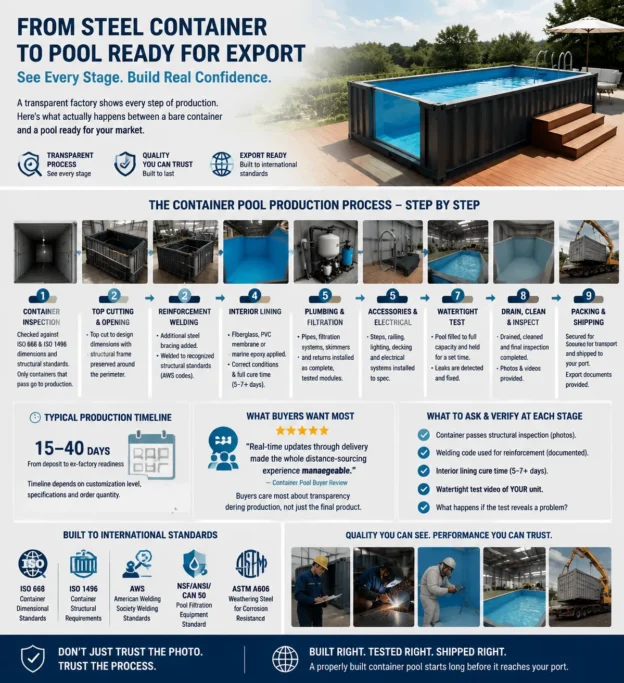
Nothing gets cut until the container itself passes inspection, and this is the step most buyers never think to ask about. A used or new shipping container arriving at the factory gets checked against ISO 668 dimensional standards and ISO 1496 structural requirements — corner castings intact, floor free of rot or excessive rust, frame square within tolerance. A container that fails this check either gets rejected outright or routed to a repair line before it ever reaches the pool production floor.
This matters more than it sounds like it should. A frame that’s already slightly warped before cutting begins will only get worse once a section of the top is removed, since that top structure is part of what keeps the whole box rigid. Buyers sourcing from a factory that skips this inspection step to save a day or two are buying a pool that starts its life with a structural deficit nobody will mention on the spec sheet.
How Does a Shipping Container Actually Become a Pool Shell?
Once a container passes inspection, the top gets cut open to the pool’s design dimensions — typically leaving structural framing intact around the perimeter rather than removing material indiscriminately. This is where reinforcement comes in: additional steel bracing gets welded around the opening and along the base to compensate for the structural strength lost when the top panel comes off. A container’s original engineering assumes a closed box under stacking loads on a cargo ship, not an open vessel holding several tons of standing water, so this reinforcement stage isn’t optional finishing work — it’s the step that determines whether the shell holds its shape for fifteen years or starts flexing within two.
Weld quality at this stage should reference a recognized structural welding code rather than whatever technique a given welder learned informally — the standards maintained by the American Welding Society are the benchmark most serious factories build against. A buyer evaluating a supplier can reasonably ask which welding code the factory’s own QC team references, and a factory that can’t answer specifically is a factory that’s improvising.
What Makes the Interior Lining Stage the Riskiest Step in the Whole Process?
If a container pool is going to fail, this is almost always where the failure started. The interior lining — most commonly fiberglass, reinforced PVC membrane, or marine-grade epoxy coating — is the only barrier between pool water and bare steel, and it has to go on in the right conditions: correct surface preparation, correct ambient temperature and humidity during application, and a full, uncompressed cure time before the pool ever touches water.
This is exactly the stage a rushed production timeline compresses first, because it’s invisible in a finished photo — a lining that cured for three days instead of the seven it needed looks identical on delivery day to one that cured properly. The steel underneath a fiberglass or epoxy lining commonly gets specified to ASTM A606 weathering steel for its corrosion resistance, which buys some margin against a lining flaw, but it doesn’t make lining quality optional. Buyers comparing two quotes with a two-week production gap between them should ask directly whether that gap came out of the lining cure time, because that’s the shortcut that turns into a warranty claim eighteen months after installation, not eighteen days.
How Do Plumbing, Filtration, and Electrical Systems Get Installed Without Compromising the Shell?
Once the lining has fully cured, plumbing, filtration, and electrical systems go in as complete, tested modules rather than being pieced together around the pool after the fact. Steps, safety railing, decking, and lighting typically get fitted at this stage too, along with any penetrations for skimmers, returns, and drains — each of which represents a potential leak point if it isn’t sealed correctly against the lining before final assembly.
Filtration specs vary by destination market and local code requirements, which is worth flagging early in a quote request rather than discovering after the unit ships that the pump voltage doesn’t match the destination country’s standard. A factory experienced in export — rather than one only building for the domestic market — will ask about destination voltage and local safety equipment requirements before finalizing the plumbing and electrical package, not after.
What Does the Final Watertight Test Actually Involve?
This is the stage that separates a factory willing to prove its work from one asking a buyer to trust it blind. A proper final test fills the completed pool entirely and holds it at full capacity for a defined period — long enough to reveal any lining seam failure, weld leak, or fitting that wasn’t sealed correctly — before the water gets drained and the unit is dried, cleaned, and prepped for shipping.
Ask a supplier for photos or video of this specific test on your unit, not stock footage from a previous batch. A factory that stalls on that request, or offers only a generic “we test every unit” line without documentation, is telling a buyer something worth paying attention to. Pool equipment and safety performance in many destination markets also gets referenced against standards like NSF/ANSI/CAN 50, which covers filtration and circulation equipment used in pools and spas — worth checking against for any buyer importing into a market with formal equipment certification requirements.
How Long Does Each Stage Take, and Why Do Quotes Vary So Much?
This is usually the first question a buyer asks and the last one a factory answers honestly. Standard production for a container pool typically runs 15 to 40 days from deposit to ex-factory readiness, and that range exists because customization level changes almost every stage described above — a stock depth and standard filtration package moves through cutting, lining, and assembly quickly, while a custom viewing window, non-standard depth, or upgraded filtration system adds engineering time before production even starts, plus additional cure and testing time once it does.
A factory quoting a flat 15 days regardless of what’s being customized either hasn’t actually scoped the order or is planning to compress a stage that shouldn’t be compressed — and lining cure time is almost always the first one to get cut when a factory is chasing a deadline it shouldn’t have promised.
What Do Real Buyers Say About Watching Their Pool Get Built?
Buyers who’ve gone through a full production cycle consistently mention the same thing: it’s not the finished pool that builds confidence, it’s whether the factory shared the process along the way. One buyer reviewing a container pool company described real-time updates through delivery as the reason the whole distance-sourcing experience felt manageable rather than stressful. That pattern holds across the category — the complaints that show up in reviews rarely center on the pool’s performance once installed; they center on a factory that went quiet for three weeks in the middle of production and left a buyer guessing whether anything was actually happening.
For a sourcing agent or distributor managing a client relationship on top of the supplier relationship, that transparency isn’t a nice-to-have. It’s the difference between being able to give a client an honest update and having to invent one.
What Should You Ask a Factory to Prove at Each Production Stage?
A short list worth keeping on hand when comparing quotes. Ask for photos of the container passing structural inspection before cutting begins, not just the finished shell. Ask which welding code governs the reinforcement work and whether that’s documented per unit or just claimed generally. Ask how long the interior lining cures before the unit moves to the next stage, and treat any answer under five to seven days with real skepticism. Ask for video of the full watertight test specific to your unit. And ask what happens, contractually, if that test reveals a problem — a factory with a clear, already-documented answer to that question is a fundamentally different supplier than one who’s never had to think about it.
None of these questions require special industry knowledge to ask. They just require knowing that the production process has real stages worth verifying individually, rather than trusting a single glossy product photo to represent all of them.
So What Does a Properly Built Container Pool Actually Require?
Strip the process down and it comes down to five things done in the right order and not rushed: a container that passes real structural inspection, reinforcement welded to a recognized code, a lining applied and cured properly before anything touches water, systems installed as tested modules rather than afterthoughts, and a final watertight test a factory is willing to document rather than just claim. Skip or compress any one of those and the pool that arrives will look finished in every photo right up until the lining problem shows up on its own schedule, not the buyer’s.
Buyers ready to compare current configurations can review the container pool product line directly for size options and standard specifications, and anyone still working through whether a container pool fits their sourcing plan at all should start with the complete container pool buying guide for importers and wholesalers, which covers the broader sourcing questions this production breakdown assumes a buyer has already answered. Container dimensional standards referenced throughout the fabrication process are maintained by the International Organization for Standardization, and the weathering steel spec most factories build against traces back to ASTM International’s published standards — both worth knowing by name the next time a supplier’s spec sheet references them without explanation.
A wholesaler in Brisbane once told us he’d been burned twice before he ever placed an order with a factory directly — both times by trading companies that called themselves “manufacturers” on Alibaba, took a 30% deposit, and then subcontracted the actual welding to whichever shop had capacity that month. The pool that arrived the second time had a lining that started bubbling within four months. That story isn’t rare in this category, and it’s exactly why “container pool manufacturer” has become one of the most-searched terms among importers who’ve already been burned once and don’t intend to be burned twice. This guide walks through what separates a real manufacturer from a reseller wearing a manufacturer’s homepage, how the product actually gets built, and what to check before a deposit leaves your account.
What Actually Separates a Real Container Pool Manufacturer From a Reseller?
The honest answer is that most buyers can’t tell from a website alone — the photos look the same, the certifications get listed the same way, and every company claims 15+ years of experience whether or not it’s true. What actually separates a manufacturer from a reseller is whether the welding, the interior waterproofing, and the final inspection happen on one factory floor under one quality system, or whether the order gets split across three subcontractors who never coordinate with each other.
Container House Co., Ltd., for example, has run its own production facility in Qingdao for over 18 years, and that detail matters less as a marketing line and more as a practical filter: an 18-year operation has already worked through the failure modes — bad batches of steel, a subcontracted coating job that peeled, a shipment that got flagged at customs — that a two-year trading company hasn’t encountered yet. Buyers evaluating a manufacturer should ask directly whether the factory owns its own welding line and lining application process, or whether either step gets outsourced. The answer changes everything about consistency from one order to the next.
How Is a Container Pool Actually Built, Step by Step?
This is the part that separates buyers who ask good questions from buyers who get surprised later. A container pool starts as a standard ISO shipping container — most commonly a 20-foot or 40-foot unit — and the manufacturing sequence follows a fixed order that shouldn’t be skipped or compressed no matter how urgent the delivery date is.
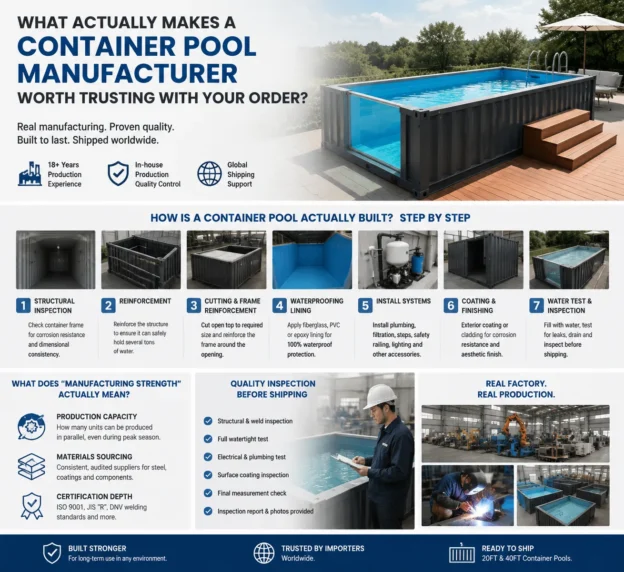
Structural inspection comes first, checking the container’s frame for the corrosion resistance and dimensional consistency that ISO 668 and ISO 1496 specify. Reinforcement follows, since a container’s structural strength for stacking on a cargo ship isn’t automatically the same strength profile needed once it’s holding several tons of water instead of dry freight. The top gets cut open to the pool’s dimensions, the frame gets reinforced around that opening, and only then does the interior waterproofing go on — fiberglass, reinforced PVC, or marine-grade epoxy, depending on the spec. Plumbing, filtration, steps, safety railing, decking, and lighting get installed as complete modules before the exterior coating or cladding goes on. The unit then gets fully filled, tested, drained, and inspected before it’s ever packed for shipping.
Skipping or rushing any one of those stages is exactly how a pool that looks finished in photos develops a lining failure eighteen months later. Buyers who want the complete stage-by-stage breakdown, including cure times and what to ask a factory to confirm at each step, can review the full container pool production process guide.
What Does “Manufacturing Strength” Actually Mean When You’re Comparing Factories?
Every supplier’s homepage says “strong manufacturing capability.” Almost none of them define what that phrase should actually mean to a buyer placing a bulk order. In practice, it comes down to three things that are worth asking about directly rather than assuming.
Production capacity is the first — how many units can the factory run in parallel without pulling workers off other product lines, and does that capacity hold during peak season or collapse the moment three big orders land at once. Materials sourcing is the second — whether the factory buys weathering steel and coating materials from consistent, audited suppliers or shops around for whatever’s cheapest that week, since inconsistent raw material sourcing is the single biggest driver of batch-to-batch quality variation. Certification depth is the third, and it’s where a lot of resellers get caught: a real manufacturer’s production runs under documented systems like ISO 9001, industry-specific grading such as JIS “R,” and recognized welding standards like those maintained by DNV, not just a certificate scanned onto a website that nobody can trace back to an actual audit.
A factory with real manufacturing strength can tell you, specifically, how many container pools it shipped in the last twelve months and to which markets — not a vague “hundreds of satisfied customers” line. For a deeper look at what production capacity and certification depth actually look like on the factory floor, the manufacturing strength and production capacity breakdown covers the specifics.
How Do You Know a Container Pool Passed Real Quality Inspection Before It Shipped?
Quality control claims are cheap to write and expensive to verify from another continent, which is exactly why so many buyers end up trusting a factory’s word without ever seeing the process. A legitimate inspection sequence checks structural integrity first — weld quality, frame squareness, corrosion resistance on the exposed steel — then moves to a full watertight test where the pool gets filled completely and held for a defined period to catch any lining failure before it ever leaves the factory floor. Electrical and plumbing systems get tested under load, not just visually checked. Only after every stage passes does the unit get drained, dried, and packed for export.
The detail that matters most to an importer sourcing sight-unseen: ask for photos or video of the actual watertight test on your specific unit, not stock photography of a different pool from a different batch. A factory with nothing to hide will send it without hesitation, and a factory that stalls on that request is telling you something too. For the complete testing checklist buyers should request before releasing final payment, see the container pool quality inspection process.
What Should a Container Pool Manufacturer’s Spec Sheet Actually Include?
A spec sheet that just lists dimensions and a price isn’t a spec sheet — it’s a price tag with extra steps. What a buyer should actually receive before committing to an order includes the steel grade and gauge (weathering steel to ASTM A606 is the benchmark most serious manufacturers reference), the interior lining material and its warranty period, the filtration and pump specifications, the standard lead time from deposit to ex-factory readiness, and which Incoterms the factory supports.
On lead time specifically: production for a standard configuration typically runs 15 to 40 days, with the wide range driven almost entirely by how much customization is requested — a stock color and standard depth moves fast, while a custom viewing window or non-standard filtration setup pushes toward the long end of that window. A manufacturer that quotes a flat number regardless of customization level either hasn’t thought it through or isn’t planning to hit it.
Who’s Actually Buying From Container Pool Manufacturers, and Why?
The buyer list for this category splits into a few recognizable groups, and each one is solving a slightly different problem. Wholesalers and distributors are sourcing inventory to resell under their own brand into markets where local pool builders quote months-long backlogs. Hospitality operators — boutique hotels, glamping sites, short-term rental portfolios — are after a distinctive design feature that a poured-concrete pool can’t deliver on the same timeline or budget. Residential importers are comparing a factory-direct unit against a $65,000-to-$120,000 local inground pool quote and doing the math on freight versus local markup.
A related example from the same manufacturer’s broader container product line illustrates how these RFQs actually play out: a procurement contact in Malaysia approached with a request for two 20-foot and one 40-foot expandable container units, needing confirmation on customization support before committing. The back-and-forth wasn’t about price alone — it was about whether the factory could handle a multi-unit, multi-size order with consistent quality across all three units and clear documentation for import. That’s the same conversation a container pool buyer should expect to have before placing a bulk order, regardless of which product line it’s for.
What Do Real Buyers Say About Working With a Factory-Direct Manufacturer?
Feedback from buyers who’ve actually gone through a full sourcing cycle tends to focus less on the finished product and more on the process getting there. Buyers reviewing container pool companies consistently flag communication responsiveness and delivery updates as the difference between a smooth experience and a stressful one — one buyer described a factory’s real-time updates through delivery as the reason the whole process felt manageable despite the distance involved. Complaints, where they show up, rarely center on the pool itself once it’s installed; they center on vague timelines, unclear documentation, or a factory that goes quiet between deposit and shipping confirmation.
That pattern is worth remembering when comparing quotes: the cheapest factory on paper is sometimes the one that goes silent for three weeks in the middle of production, and the cost of that silence — in missed installation windows, in a customer asking for updates you don’t have — is real even if it never shows up on an invoice.
How Do You Vet a Manufacturer Before Sending a Deposit?
A short list, built from the mistakes buyers make most often. Ask for the factory’s actual production address and, where possible, request a video walkthrough of the welding and lining stations — not just the showroom. Confirm which certifications the factory holds and ask for documentation you can independently verify, rather than a logo on a webpage. Request references from buyers in your target market specifically, since a factory that’s shipped successfully to the Middle East may have zero experience with the electrical and permitting requirements a North American import needs. Clarify Incoterms in writing — EXW, FOB, CIF, and DDP all shift risk and cost differently, and assuming the wrong one is a common source of disputes after the fact. And ask the question every serious factory should be able to answer without hesitation: what happens if a unit arrives with a defect — who pays, and what’s the documented process.
So, What Makes a Container Pool Manufacturer Worth Trusting With a Bulk Order?
Strip away the sales copy and it comes down to three things: whether the welding and lining happen under one roof instead of three subcontractors, whether the certifications are real and checkable, and whether the factory answers hard questions about lead time and defect handling without deflecting. A manufacturer that’s been building these units for close to two decades, running production under ISO 9001 and recognized welding standards, and willing to show you the actual inspection process on your specific order is a fundamentally different bet than a reseller with a nice-looking catalog and no factory floor of its own.
Buyers ready to compare specifications directly can review the container pool product line for current configurations and MOQ, and importers weighing multiple sourcing options may also find it useful to see how factory-direct export terms compare across suppliers in the container pool exporter comparison guide before finalizing a shortlist.
Authoritative external references cited in this article:
A distributor in Perth placed an order in early May, told his client the pool would be ready for the first heatwave of summer, and then watched that promise slip by three weeks because nobody had separated “shipping time” from “the whole rest of the process” when the quote came in. That gap between what a factory quotes and what actually lands on a truck at the destination port is where most container pool orders go sideways. This article breaks down what shipping time really covers, how long each stage takes, and what an importer or distributor needs to lock down before promising a delivery date to anyone.
What Does “Container Pool Shipping Time” Actually Mean — And What Gets Left Out of the Quote?
Ask ten suppliers for a shipping time and you’ll get ten different numbers, because most of them are only quoting the ocean transit — the part between the container leaving a Chinese port and arriving at the destination port. That’s one leg of a four-leg trip. The full sequence runs: production at the factory, inland trucking to the port of departure, ocean freight, and then customs clearance plus inland delivery on the receiving end. Skip any one of those legs when you’re calculating a delivery date and you’ll be the one explaining the delay to a customer, not the factory.
This matters more for a container pool than for most products, because the unit isn’t a small box that clears customs in an afternoon — it’s declared as either a modified shipping container or specialized pool equipment depending on the destination country, and that classification decision alone can add days if it isn’t settled before the container ships.
How Long Does Production Actually Take Before a Container Pool Even Reaches the Port?
Factory lead time for standard export goods out of China typically runs 15 to 30 days from order confirmation and deposit, and a container pool sits toward the middle of that range rather than the fast end — the base steel structure itself takes little time, but cutting the pool opening, reinforcing the frame, applying the interior waterproof lining, and curing it properly before the unit ever touches water adds real days that can’t be rushed without risking the one component that fails first: the lining.
A rushed lining is the single most common reason a container pool develops leaks within the first year, so a buyer chasing a two-week production promise should ask exactly what step got compressed to hit that number. Customization stretches this window further — a request for a specific coating color, a viewing window, or a non-standard depth means the factory is no longer pulling from a repeatable process, and 30-plus days from confirmation to ready-for-loading isn’t unusual once drawings need a revision or two.
How Long Is Ocean Freight, Route by Route?
Once the container actually leaves port, transit time from China to the US or Europe typically runs four to eight weeks, and that range holds whether the cargo is a container pool, a prefab house shell, or anything else moving by standard ocean freight — the pool itself doesn’t change the sailing schedule. Trans-Pacific routes to Australia generally run shorter, often landing in the three-to-four-week range given the shorter overall distance, though buyers should still confirm the specific port pair rather than assume a blanket number.
Here’s the part that catches new importers off guard: the freight quote and the destination arrival date rarely account for congestion. Normal port conditions add five to ten days beyond the printed transit time simply from vessel queuing and terminal handling. During peak periods — the pre-Chinese-New-Year rush most of all — that congestion window can stretch to fourteen or twenty-one days at transshipment hubs, and a distributor who books freight in December without accounting for that seasonal squeeze is the one fielding angry calls in February.
What Happens at Customs, and How Much Time Should You Budget For It?
Customs clearance splits into two very different outcomes, and which one you get is mostly out of your hands. A document exam — where the paperwork is reviewed without opening the container — typically clears in two to three days. A physical exam, where the container gets opened and inspected, runs seven to fourteen days and can add $1,000 to $3,000 in port storage and handling fees on top of the delay itself.
The single biggest lever an importer has over which outcome they get is HS code accuracy. A container pool misclassified as a standard shipping container, or vice versa, is exactly the kind of paperwork mismatch that triggers a physical exam — not because customs officers are picking on the shipment, but because the declared value and the declared product don’t line up cleanly. Confirming the correct classification with a customs broker before the container books passage costs nothing and saves the two weeks that a hold at port would otherwise cost.
How Does Chinese New Year Wreck a Shipping Timeline If You Don’t Plan Around It?
This is the seasonal trap that catches importers every single year, and it’s entirely avoidable with a calendar. Most Chinese factories close for fourteen to twenty-one days around the holiday, but the real disruption runs longer than the closure itself — container drayage from factory to port becomes difficult in the two to three weeks before the holiday as truck drivers head home, and recovery afterward isn’t instant either. New worker training, equipment recommissioning, and a supplier-side scramble to catch up all stretch the real return to normal production well past the first day factories reopen.
An order placed in early January with a January production promise is, in practice, an order that either ships late or ships rushed — and a rushed container pool is exactly the product where a shortcut in the lining shows up as a leak eighteen months later. Buyers ordering for a spring or early-summer installation should count backward from Chinese New Year and place the order with enough buffer that production doesn’t collide with the shutdown.
How Does Factory-Direct Shipping Time Compare to a Locally Built Container Pool?
Here’s where the comparison actually matters for a buyer deciding where to source. Locally built container pool companies in markets like the US and Canada quote their own lead times, and those numbers aren’t always faster than importing — one North American builder currently quotes six to eight weeks from order to delivery, while a completed-pool builder covered by Axios reported being roughly eight months out on new orders during a high-demand stretch, purely from backlog rather than shipping distance.
That’s the detail worth sitting with: a factory-direct import from China, landing in four to eight weeks of ocean transit plus fifteen to thirty days of production, can realistically compete with — or beat — a domestic builder’s own backlog, especially during a seasonal demand spike when every local shop is booked out. The tradeoff runs the other way too: a domestic builder can usually absorb a warranty issue faster than a factory eight thousand miles away, so the calculus isn’t purely about which number is smaller.
What Do Real Buyers Say About How Long Their Pool Actually Took to Arrive?
Feedback from actual buyers tends to focus on the handoff moment more than the paperwork stages behind it. One buyer reviewing a container pool company on Trustpilot described the installation process as seamless once the unit arrived, with the team keeping them updated in real time through delivery — the kind of comment that reflects good communication during transit as much as a smooth physical install. Buyers researching container pools broadly report a similar pattern: once the unit is actually on-site, setup itself takes days, not weeks, since the pool arrives essentially complete. The frustration buyers report almost never centers on installation day — it centers on the weeks before that, when a vague “shipping time” quote didn’t match what actually happened at the port.
What Can You Do to Shorten the Timeline Without Cutting Corners on Quality?
A few habits separate importers who hit their delivery promises from those who don’t. Confirm production lead time and shipping time as two separate numbers in writing, since conflating them is the single most common estimating mistake in this category. Book ocean freight early during any period within six weeks of Chinese New Year, since vessel space tightens fast and late bookings get pushed to slower, more congested sailings. Verify HS code classification with a broker before the container ships rather than after a hold notice arrives. And resist any factory quote that promises a compressed production timeline on a fully customized unit — ask specifically whether the interior lining cure time was shortened to hit that number, because that’s the shortcut that turns into a warranty claim.
None of this requires exotic logistics knowledge. It requires treating the shipping quote as four separate numbers instead of one, and asking the supplier to itemize each stage before a delivery date gets promised to anyone downstream.
So, How Long Should You Actually Budget for a Container Pool Order?
Add it up honestly and a realistic window runs somewhere between nine and eighteen weeks from deposit to delivery at the destination port — fifteen to thirty days of production, four to eight weeks of ocean freight, and anywhere from a few days to two weeks for customs, before local trucking and installation even start. That’s a wider window than most quotes advertise, and it’s the number a serious buyer should actually plan around, not the ocean-transit figure alone. Distributors who want the full specification sheet and current lead times can review the container pool product line directly, and buyers who are still deciding whether a container pool fits their project at all should start with the complete container pool buying guide for importers and wholesalers, which covers sourcing questions beyond just timing.
Shipping delays in this category almost never come from the ocean voyage itself — they come from treating a four-stage process as if it were one number. Get production, freight, and customs clearance quoted and confirmed separately, and the delivery date you promise a customer has a real chance of holding.
Authoritative external references cited in this article:
Ocean carrier capacity, scheduling, and transit reliability standards — World Shipping Council
A distributor in Melbourne sends the same message every buying season: her local granny flat supplier just raised prices 18% again, and her margin on a $40,000 unit shrank to almost nothing. She’s not alone. Import managers across Australia, the U.S., the Gulf, and East Africa are asking the same question in different words — can I import a granny flat from China directly, skip the local markup, and still land a unit that passes inspection? The short answer is yes, but the process has enough moving parts that most first-time importers get at least one of them wrong. This article walks through what an expandable granny flat actually is, what it costs to import from a Chinese factory, and where importers lose money if they don’t ask the right questions upfront.
What Exactly Is a Granny Flat, and Why Are Importers Sourcing It From China?
A granny flat is a small secondary dwelling — traditionally built for an aging parent, now used just as often as a rental unit, guest house, or worker accommodation. The definition hasn’t changed much. What’s changed is where importers are sourcing the structure itself.
Site-built granny flats in markets like Australia and the U.S. run $150 to $300 per square foot, with most completed projects landing between $60,000 and $360,000. That price is almost entirely local labor and local material markup — a Chinese factory building the same steel-and-panel structure at scale can land a comparable unit for a fraction of that, before freight and duty. That gap is exactly why importers keep this category on their sourcing list even when shipping costs rise: the expandable granny flat folds down to a shippable footprint and still opens into a full livable unit in a few hours on-site.
Granny Flat, Granny Pod, ADU — Does the Import Paperwork Treat Them the Same?
Terminology matters for customs classification, not just marketing. A granny pod is a specialized elder-care unit, usually smaller, sometimes fitted with medical monitoring. A granny flat is broader — rental income, home office, guest space, or elder care, depending on the floor plan an importer orders. An ADU is simply the North American term for the same category.
For import purposes, what matters is the HS code the factory declares, not which of these three labels ends up on the marketing page. An importer bringing in a residential steel structure needs the correct classification confirmed before the container ships — not after it’s sitting in a bonded warehouse waiting on a customs broker to sort out a paperwork mismatch.
What Does It Actually Cost to Import a Granny Flat from China?
Start with the ex-works price, then add every line item that shows up after the factory invoice, because that’s where importers get surprised.
The factory price for a folded steel unit depends on size, insulation grade, and interior finish — not on labor hours, since on-site assembly runs 2 to 4 hours with a 2 to 3 person crew instead of a multi-week framing schedule a local contractor would bill for. On top of that ex-works number, an importer needs to budget for ocean freight, which drops significantly per unit when multiple folded units share a single standard container. Import duty and customs clearance typically add 5 to 15 percent of declared value depending on the destination country, and that percentage swings hard based on whether the HS code was classified correctly the first time. Inland trucking at both the origin port and the destination port is a separate cost, and it’s the one importers most often forget to quote before committing to a shipment. Add site prep — a flat pad or piers, plus a crane or forklift for offloading — and the landed cost is meaningfully higher than the number on the factory quote, but still well under the $150-to-$300-per-square-foot benchmark for a site-built unit in most destination markets.
What Sizes Are Available, and How Do They Affect Container Loading?
Container loading efficiency is the single biggest lever an importer has over per-unit freight cost, so size selection isn’t just a floor-plan decision — it’s a shipping decision.
A 20ft-class unit is the entry point: smallest footprint, lowest ex-works price, and the easiest to combine multiple folded units inside one standard shipping container, which is where an importer’s real margin gets protected. Full specs are on the 20ft expandable container house page. A 30ft-class unit steps up to a two-room layout and still folds down efficiently for freight. The 40ft-class configuration, detailed on the 40ft expandable container house page, is the largest single-fold option and fits a full kitchen and two bedrooms, but takes up proportionally more container space per unit, which changes the freight math for importers ordering in volume. For importers who need a 3-bedroom or duplex-style rental product, a double-storey shipping container home stacks modules instead of expanding a single one, and needs to be quoted separately for freight since it doesn’t fold to the same compact shipping footprint.
A 20ft-class unit expands to roughly 35 to 40 square meters of usable floor area with no internal load-bearing columns, folding down to about the footprint of a standard shipping container for transit. That’s the number importers should be asking every supplier for before comparing quotes — usable floor area after expansion, not just the folded shipping dimensions on the spec sheet.
What Should an Importer Verify About the Steel Frame Before Placing a PO?
This is the part importers skip when they’re moving fast, and it’s the part that causes returns and disputes later. The structural frame on a legitimate factory-built unit is Q235 galvanized steel, not a lighter-gauge substitute dressed up to look the same in a photo. Ask the supplier for the actual gauge specification on the top and bottom side rails, the secondary beams, and the corner hangers — a factory with nothing to hide will send this without hesitation.
Wall insulation choice should match the destination climate: rock wool for fire resistance and hot-climate markets, EPS sandwich panel where cost matters more than thermal mass. Wind resistance on a properly engineered unit should be rated to Level 10, and importers should get that rating in writing rather than accepting “durable” as a description. Expected service life on a well-built unit runs 15 to 20 years with normal maintenance. None of these specs show up in a glossy render, but they’re exactly what a customs inspector, a local building authority, or an unhappy end customer will ask about eighteen months after the container clears port.
Structural steel welding and fabrication standards for this category generally reference the codes maintained by the American Institute of Steel Construction, a nonprofit standards body, and importers bringing modular steel structures into North America should also be familiar with guidance published by the Modular Building Institute, the industry’s nonprofit trade association. For units headed into markets with residential building code requirements, cross-checking against the International Code Council’s published standards before finalizing a purchase order can save an importer from a rejected shipment at the local permitting stage.
Who Is Actually Importing These Units, and What Are They Solving For?
Every importer in this category is solving a slightly different version of the same problem. African importers are sourcing worker-camp and mining-site accommodation, where speed of deployment matters more than finish quality. Middle East contractors are importing temporary housing for oil and construction projects, where insulation spec against extreme heat is the deciding factor in supplier selection. European distributors are importing backyard granny flats and short-term rental units, where local council size limits shape which configuration clears customs and permitting without a fight. North American importers are bringing units in for classic ADU use and remote-site housing where local construction crews are expensive or unavailable. Southeast Asian operators are importing units for resort bungalows and retail kiosks, where the unit needs to look finished on arrival, not industrial.
For importers specifically sourcing emergency or disaster-response housing, deployment speed is the entire business case — units arrive pre-wired and pre-plumbed, foundation-flexible enough to sit on a temporary pad without a full civil works package. There’s a deeper breakdown of that sourcing scenario in the guide on expandable container houses for emergency placement.
What Do Importers Say After Their First Container Actually Clears Port?
Feedback from importers who’ve run a full sourcing-to-deployment cycle tends to be specific, not glowing. An importer running worker housing in Africa reported installation costs came in roughly 40 percent lower than sourcing local labor and materials for the same headcount. A European rental-property distributor said the unit was tenant-ready fast enough that it paid for itself within the first rental season. A Middle East contractor flagged that the frame held up through a full summer of extreme heat and wind loading without the panel warping that a cheaper competitor’s units showed after one season. A U.S. importer put it simply: it was the only option that fit a budget after two local contractor bids had already blown past it. None of that should be read as a guarantee — supplier quality varies — but the pattern across regions is consistent enough to be useful signal when evaluating a new factory.
What Paperwork and Payment Terms Should an Importer Lock Down Before Shipping?
Payment structures in this category typically run through T/T or Alibaba Pay, and importers should confirm the split — deposit versus balance on shipment, versus balance on inspection — before production starts, not after. Incoterms matter more here than in most product categories, since the difference between EXW, FOB, CIF, CFR, DAP, and DDP determines which party carries risk and cost at each stage of the shipment, and it’s worth negotiating this explicitly rather than accepting whatever term appears on the factory’s standard quote. Confirm the HS code classification in writing before the container books, since a misclassification is the single most common reason a shipment gets held at customs. Ask for MOQ and lead time specific to the configuration ordered — standard units typically ship in 30 days, but any customization extends that window, and importers who don’t confirm this upfront are the ones calling their broker in week three asking where the container is.
Is Importing Beat Sourcing Locally, Dollar for Dollar?
Run the comparison on the numbers that matter to an importer’s margin, not the ones that sound good in a sales deck. Rental income on a granny-flat-style unit typically runs $500 to $2,000 per month depending on market — the same range a locally built unit generates, which means the entire return-on-investment advantage comes from acquisition cost, not rental performance. Steel-frame, sandwich-panel construction generally needs less ongoing maintenance than a wood-framed structure exposed to the same weather, which matters to an importer who’s also fielding warranty calls after the sale. A folded unit can be closed back up and relocated to another lot; a poured-foundation local build cannot, which is a real selling point for distributors reselling into markets where tenants or land leases change. Factory-direct pricing plus freight and customs still typically undercuts a $150-to-$300-per-square-foot local build by a wide margin, even after every import cost is added in — but importers should run that math against their specific destination country’s duty rate before assuming the gap holds everywhere equally.
How Should an Importer Customize a Unit for Their Local Market?
Customization is where a factory earns repeat import orders instead of a one-time sale. Size and layout can shift to match local rental unit expectations — module count, room configuration, and bedroom-to-bathroom ratio all move based on what a given market expects a granny flat to include. Exterior finish and color can be branded for resale under a distributor’s own name. Interior wall material, flooring, and ceiling finish should match what local building codes and buyer expectations require, and this is worth specifying in the purchase order rather than accepting factory defaults. Electrical configuration needs to match the destination country’s voltage standard — 110V, 220V, or 380V — and this is a detail that gets missed more often than it should on a first import order. Plumbing layout, including off-grid sewage treatment options, matters for importers selling into markets without reliable municipal hookups. Solar integration and upgraded insulation are increasingly requested add-ons as energy costs rise in destination markets.
For importers building out a full catalog rather than a single SKU, a mobile expandable prefab house or a fold-out container house variant fills different price points within the same product line, which helps a distributor cover more of the market with one supplier relationship instead of managing quality control across several factories.
So, Should You Import a Granny Flat from China?
Category
Key Details
Notes / Impact
Local vs China Cost
Local site-built: $150–$300/sq ft ($60k–$360k total). China factory-direct: fraction of local cost (ex-works) + ocean freight + duty (5–15%) + inland trucking + site prep
Landed cost still well below local benchmark; assembly only 2–4 hours with 2–3 person crew
Container loading efficiency is the biggest lever on per-unit freight cost
Must-Verify Specs
Frame: Q235 galvanized steel (actual gauge on rails/beams/hangers) Insulation: Rock wool (hot/fire) or EPS Wind: Level 10 (in writing) Life: 15–20 years Standards: AISC + MBI (NA); ICC cross-check
Skipping these causes returns, disputes, or rejected permits
Who Imports & Why
Africa: worker/mining camps (speed) Middle East: oil/construction housing (heat insulation) Europe: backyard/rental units (council size limits) North America: ADUs/remote housing (high local costs) SE Asia: resorts/kiosks (finished look) Emergency: rapid deployment
All solve the same core problem: lower cost + faster deployment than local builds
Paperwork & Payment
Payment: T/T or Alibaba Pay (confirm deposit/balance split) Incoterms: negotiate EXW/FOB/CIF/CFR/DAP/DDP explicitly HS code: confirm in writing before booking Lead time: 30 days standard (custom longer) MOQ: confirm per configuration
Specify everything in the PO; factory defaults often mismatch local codes
Final Decision Factors
Compare: local contractor quote vs fully landed China cost vs duty rate + lead time of destination country
Strong margin case for most markets if HS code, steel specs, and Incoterms are locked correctly
Strip away the sales language and an importer’s decision comes down to three numbers: the local contractor or supplier quote, the fully landed cost of a factory-direct unit, and the duty rate and lead time for the destination country. For most importers comparing a $150-to-$300-per-square-foot local build against a folded steel unit that clears customs and assembles in a few hours on-site, the margin case is strong. The risk sits in the details — HS code accuracy, verified structural specs, and Incoterm negotiation — which is exactly why the checklist above matters as much as the price on the factory’s first quote.
Importers ready to move from research to a formal quote can review the full spec sheet on the contact Container House Co., Ltd directly for a landed-cost breakdown built around a specific destination country and order volume. Distributors comparing sourcing options can also review completed import case studies or the full expandable container house buyer’s guide before committing to a first purchase order.
 English