Author Archives: jzxadmin

high quality container pool vs low quality container pool

High Quality Container Pools vs. Low Quality container Pools

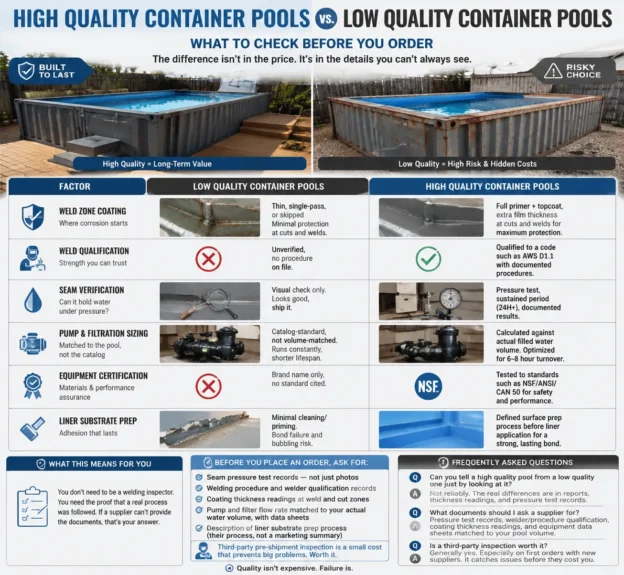
High Quality Container Pools vs. Low Quality Container Pools: What to Check Before You Order

A closer look at where the two actually diverge — and a practical checklist for finding out which one you’re being quoted.

Two container pool quotes can land in your inbox on the same day, for roughly the same price, with nearly identical spec sheets. One of them will still be watertight in three years. The other might need a liner replacement before its first anniversary. The gap between high quality container pools and low quality container pools isn’t cosmetic — it’s a handful of specific decisions made on the factory floor, most of which never make it onto a spec sheet at all. Below is where those decisions actually happen, and what to ask a supplier if you want to know which side of the line their build falls on.

Steel and Weld Prep — Where Corrosion Actually Starts

A standard shipping container is engineered to stack and rack — it’s not engineered to hold a static column of water pressing outward on every wall. Once a factory cuts openings, welds in reinforcement plates, or adds cross-bracing for pool loads, the original coating around every one of those cuts is gone. That bare steel is where corrosion starts, usually within the first rainy season if it isn’t re-primed and re-coated before final paint. This isn’t a minor footnote — the Container Handbook published by GDV walks through exactly how cutting, welding, and reinforcement change a container’s corrosion resistance and structural load rating, and it’s required reading for anyone specifying a container-based build.

Low quality builds skip the re-coating step or rush it — one thin pass instead of a proper primer-and-topcoat system. It looks fine at delivery because the paint is new everywhere, not because the process was done right. High quality container pools treat every cut and weld zone as a separate coating job, often with a higher dry-film thickness at those points than on the untouched panel steel, because that’s where the original protection was removed.

Weld quality itself is the other half of this. A weld that’s visually smooth can still be undersized, porous, or lacking proper penetration — defects you can’t catch by eye. Structural welds on a load-bearing pool shell should be performed under a qualified procedure, and the benchmark most fabricators reference is AWS D1.1, the Structural Welding Code for Steel, which sets out how welders and welding procedures get qualified and how finished welds are inspected and accepted. If a supplier can’t tell you who qualified their welders or how, that’s usually because no one did.

Seam Testing — The Step That Gets Skipped Under Deadline Pressure

Every container pool has seams that need to hold water under constant pressure, not just resist a splash. The honest way to confirm a seam is sound is to pressurize it — fill the unit, or pressure-test the welded seams directly, and watch for pressure drop or visible seepage over a set period, typically 24 hours minimum. That takes time and factory floor space, which is exactly why it’s the first thing to disappear when a factory is trying to hit a shipping deadline on a low-margin order.

What you get instead, on a low quality build, is a visual inspection: does the weld bead look continuous? Good enough, ship it. The problem is that a seam can look perfect and still fail under sustained hydrostatic pressure, because the defect is inside the weld, not on the surface. That’s the exact failure mode behind most of the “leak six months in” complaints — it was never actually pressure-tested, just eyeballed.

Pump and Filtration Sizing — Matched to the Pool, Not the Catalog

Here’s a detail that trips up a lot of buyers: pump specs are often quoted off a manufacturer’s standard catalog pairing, not calculated against the actual filled water volume of your specific unit. A 20ft container pool holding roughly 15,000–18,000 liters needs enough turnover capacity to cycle that volume within a reasonable window — commercial applications typically target a full turnover in 6-8 hours, residential builds can run longer. A pump sized for a smaller “standard” volume runs constantly under load trying to keep up, shortens its own service life, and still loses the fight against water clarity in hot weather or heavy bather load.

Component certification matters here too, and it’s easy to check. NSF/ANSI/CAN 50 sets material health, corrosion resistance, and performance testing requirements for pool and spa equipment, and it’s the reference point most commercial pool operators already use when specifying pumps and filters. Ask your supplier for the actual flow rate against your unit’s real volume, and whether the equipment is certified to that standard — not just the brand name on the box.

Liner Bonding — A Surface Prep Problem Wearing a Materials Label

When a liner starts bubbling or lifting at the edges, most buyers assume the liner material itself failed. Nine times out of ten, it’s the substrate underneath. Liner adhesion depends on the surface being clean, dry, and properly primed before the liner ever goes on — skip that step, or rush it to keep the production line moving, and the bond starts failing wherever moisture finds a way underneath. Once that starts, it doesn’t self-heal; it spreads.

There’s no shortcut to checking this before an order ships, which is exactly why it belongs on your inspection checklist rather than something you take on faith.

Factor Low quality container pools High quality container pools
Weld zone coating Thin, single-pass, or skipped Full primer + topcoat, extra film thickness at cuts/welds
Weld qualification Unverified, no procedure on file Qualified to a code such as AWS D1.1
Seam verification Visual check only Pressure test, sustained period, documented
Pump sizing Catalog-standard, not volume-matched Calculated against actual filled water volume
Equipment certification Brand name only, no standard cited Tested to standards such as NSF/ANSI/CAN 50
Liner substrate prep Minimal cleaning/priming Defined prep procedure before liner application

What This Means for Your Next Order

You don’t need to become a welding inspector to buy correctly here. You need to ask for the paperwork that a real manufacturing process naturally produces, and treat a supplier’s inability to produce it as your answer.

Before you place an order, ask your supplier for:

  • Seam pressure test records — not just a photo of the finished weld
  • Welding procedure and welder qualification records, ideally referencing a recognized code
  • Coating thickness readings at weld and cut zones specifically, not just the general panel
  • Pump and filter flow rate matched to your unit’s actual water volume, with equipment data sheets
  • A description of their liner substrate prep process, in their own words, not a marketing summary

If you’re placing a first order with a new factory, or the order value justifies it, a third-party pre-shipment inspection covering these same points is inexpensive relative to what a failed unit costs you in freight, reinstallation, and a dissatisfied end customer.

You can see how these process controls are reflected in our own build spec on the container swimming pool product page.

Frequently Asked Questions

Can you tell a high quality container pool from a low quality one just by looking at it?

Not reliably. A freshly painted low quality unit looks nearly identical to a properly built one at handover. The real differences are in weld inspection reports, coating thickness readings, and pressure test records — documents most buyers never think to ask for.

What documents should I ask a container pool supplier for before placing an order?

Seam pressure test records, welder/welding procedure qualification, coating thickness measurements, and equipment data sheets showing pump flow rate against your unit’s actual water volume. A supplier building to a real process will have these ready.

Is it worth paying for a third-party inspection before shipment?

Generally yes, especially on a first order with a new supplier. It’s a small cost relative to the order value and catches the problems that only surface after months of use.
Container Pool Reviews and Buyer Feedback

Before and After: How Container Pools Perform in Different Use Environments

Before and After: How Container Pools Perform in Different Use Environments

A performance breakdown for B2B importers and wholesalers evaluating container pools for coastal, desert, and commercial hospitality deployments.

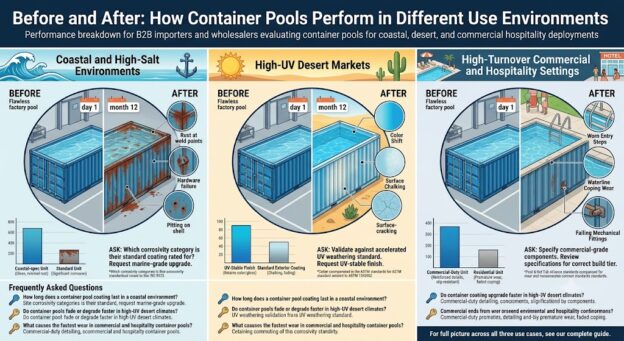
A container pool that looks flawless in a factory photo can behave very differently once it’s installed on a salt-exposed coastline, baking under desert sun, or cycling through hundreds of hospitality guests a month. For buyers sourcing at volume, the real question isn’t what the product looks like on day one — it’s what it looks like after twelve months in the environment it’s actually going into. This page breaks down before-and-after performance across the three use cases we see most often from our B2B customers.

Coastal and High-Salt Environments

Salt-laden air accelerates corrosion on any steel-based structure, and a container pool’s shell, welds, and fixtures are all exposed to it continuously. The severity isn’t uniform — a site’s distance from open water, prevailing wind direction, and humidity all shift how aggressive the atmosphere actually is. Corrosion engineers classify this using formal corrosivity categories, and the international reference for that classification is ISO 9223, which defines corrosivity categories for atmospheric environments based on first-year corrosion rate data. A pool built with a coating and substrate combination rated for a lower corrosivity category than the install site will show pitting, rust bleed at welds, and hardware failure well ahead of schedule.

What “before and after” looks like here: at handover, a coastal-spec unit and a standard unit are visually indistinguishable. By month twelve, the gap is obvious — the coastal-spec shell still shows a clean painted surface at the waterline and seams, while the underspecified unit shows early rust bloom at weld points and fastener heads.

Buyer takeaway: ask your supplier which corrosivity category their standard coating system is rated for, and whether a marine-grade upgrade is available for coastal orders. This single question filters out a large share of underspecified factory offers.

High-UV Desert Markets

Intense, sustained UV exposure combined with large day-to-night thermal swings is the dominant stressor in desert climates. Coating chemists have studied this extensively, and the accelerated test protocol most manufacturers reference when projecting long-term coating performance is ASTM’s accelerated UV weathering standard, used across the outdoor equipment industry to simulate long-term sun and moisture exposure in a controlled test cycle. A finish that hasn’t been validated against this kind of protocol tends to chalk, fade unevenly, or develop surface micro-cracking well before its expected service life is up.

The before-and-after signature of desert wear is different from coastal wear: instead of corrosion, you see color shift and surface texture change, concentrated on the sun-facing panels rather than distributed evenly around the unit. A well-specified UV-stable finish holds its original color and gloss level noticeably longer than a standard exterior coating under the same exposure.

High-Turnover Commercial and Hospitality Settings

Glamping sites, eco-resorts, and boutique hotels put container pools through a different kind of stress: not environmental exposure, but repeated human contact. Wear concentrates around entry steps, waterline tile or coping, and mechanical fittings rather than the structural shell. Commercial pool operators generally work within recognized safety and construction standards for this reason, and buyers sourcing for hospitality projects often reference the standards maintained by the Pool & Hot Tub Alliance, the ANSI-accredited body that develops national consensus standards for public and commercial pools when specifying commercial-grade components.

In this setting, the clearest before-and-after indicator isn’t the shell finish at all — it’s the condition of high-touch details after a season of guest turnover. Units built with commercial-duty coping, slip-resistant surfacing, and reinforced entry points show markedly less visible wear than units built to residential specification but deployed commercially.

If you’re comparing factory quotes for a hospitality or commercial project, it’s worth reviewing our container swimming pool product specifications to see which build tier matches the use environment you’re deploying into, since residential and commercial specs are not interchangeable.

Frequently Asked Questions

How long does a container pool coating last in a coastal environment?

Lifespan depends on the site’s corrosivity category and the coating system used before shipment. Ask your supplier what standard their coating is rated against and request inspection photos after the first 12 months.

Do container pools fade or degrade faster in high-UV desert climates?

Finishes without UV weathering validation often show chalking, color shift, or micro-cracking within the first year. Supplier UV test data is the most reliable predictor of long-term performance.

What causes the fastest wear in commercial and hospitality container pools?

Wear concentrates at entry points, waterline detailing, and mechanical fittings due to guest turnover, not the structural shell itself. Commercial-duty detailing matters more here than for residential installs.

For the full picture across all three use cases, including additional site photos and a longer-format comparison, see our complete guide:

Container Pool Reviews and Buyer Feedback

5 Things Buyers Say About Our Container Pool After 12 Months introduce

5 Things Buyers Say About Our Container Pool After 12 Months

Real Customer Reviews: What Buyers Actually Say About Our Container Pools

Anyone can publish a five-star testimonial next to a professional product photo. What’s harder to fake is a buyer describing, months later, how a pool actually held up — the coating, the pump noise, the water clarity after a heavy rain season, the phone call to support when something needed adjusting. This article pulls together that kind of feedback, organized by buyer type and region, as a companion to our broader round up.

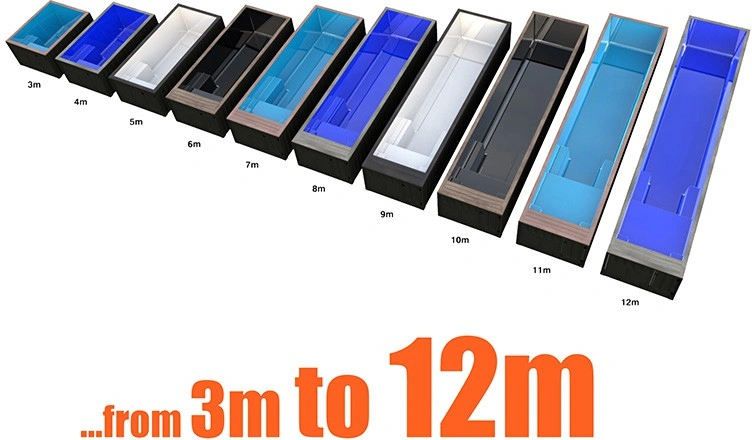
container pool Length display

Why Genuine Reviews Matter More in B2B Purchasing

Import and wholesale buyers rarely make purchasing decisions based on marketing copy alone. Procurement teams typically weigh verified buyer experience alongside factory audits and product certifications. This mirrors the broader shift toward experience-based trust signals described in Google’s own guidance on ranking systems, which emphasizes that content demonstrating real-world experience is treated as a stronger trust signal than descriptive claims alone — a principle that applies just as directly to how B2B buyers evaluate supplier claims before placing an order.

Residential Buyers: Ease of Maintenance Dominates Feedback

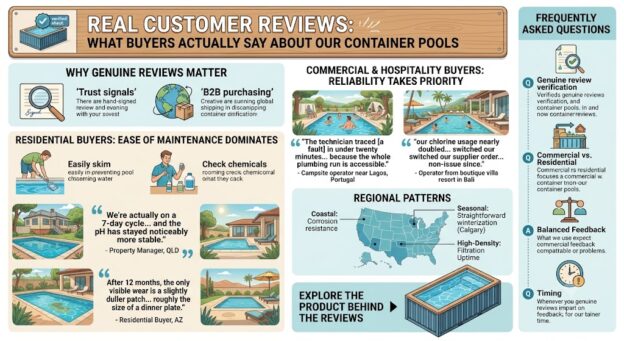
Residential buyers most consistently mention how manageable day-to-day upkeep is compared to what they expected. A recurring theme is that the compact plumbing layout and factory-sealed structure make weekly maintenance faster than anticipated, with several buyers specifically noting that water clarity stayed consistent between service visits even during peak summer use.

“We bought a 4m x 8m unit for a short-term rental property outside Brisbane in June last year. Before ordering, I’d budgeted for chemical top-ups every 3-4 days based on what our old fiberglass pool needed. A year in, we’re actually on a 7-day cycle even through the December-February peak season, and the pH has stayed noticeably more stable between guest turnovers than I expected from a modular unit.”

— Property manager, short-term rental portfolio, Queensland, Australia

Coating appearance is the second most common topic. Buyers in sun-exposed climates report that surface color holds up well through the first year, though a smaller number mention needing minor touch-up in areas with prolonged direct UV exposure — feedback consistent with expected performance ranges for exterior coatings under sustained UV load, as documented in materials testing guidance from bodies such as ASTM International’s coatings and related materials standards.

“Ours sits on a west-facing patio in Scottsdale, so it takes direct sun from about 1pm until sunset most of the year — that’s the exact exposure I was worried about when comparing coating options before we ordered. After 12 months, the only visible wear is a slightly duller patch on the corner that catches reflected glare off our patio glass, roughly the size of a dinner plate. Everything else looks close to day one.”

— Residential buyer, Scottsdale, Arizona, United States

Commercial and Hospitality Buyers: Turnaround and Reliability Take Priority

Hospitality operators and campsite owners consistently frame their feedback around guest turnover rather than aesthetics. The most cited positive theme is filtration reliability under daily heavy use, with several operators noting fewer unplanned service interruptions than they experienced with previous in-ground installations. A secondary theme is how quickly a technician could diagnose an issue, which commercial buyers attribute to the modular plumbing access built into the container structure.

“We operate three units at our campsite near Lagos, each rotating through roughly 40-60 guests a day during July and August. Across all three, we logged one filtration fault in the full year — a clogged intake after a windy week blew debris into the surrounding area. The technician traced it to the intake screen in under twenty minutes because the whole plumbing run is accessible from a single service panel, rather than needing to dig anything up like our old in-ground setup required.”

— Campsite operator, Lagos, Algarve, Portugal

Where hospitality buyers report friction, it’s most often tied to peak-season chemical consumption during high-occupancy periods, which is consistent with general operational guidance published by industry associations such as the Pool & Hot Tub Alliance on commercial pool water treatment demand scaling with bather load.

“Our occupancy rate jumps from around 50% in the shoulder months to close to 95% from June through August, and our chlorine usage nearly doubled during that stretch compared to what we budgeted based on off-season consumption. Once we caught the pattern after the first peak season, we switched our supplier order from monthly to bi-weekly during June-August and it’s been a non-issue since.”

— Hospitality operator, boutique villa resort, Bali, Indonesia

Regional Patterns in Buyer Feedback

Feedback collected across different climates shows consistent regional patterns rather than random variation:

  • Coastal and tropical regions: Buyers emphasize corrosion resistance and coating durability under high humidity and salt exposure.
  • Continental and seasonal climates: Buyers focus feedback on how straightforward seasonal draining and refilling procedures were.
  • Arid, high-UV regions: Buyers report strong coating performance with occasional notes on evaporation rates requiring more frequent top-ups.
  • High-density commercial settings: Buyers prioritize filtration uptime and fast technician response over cosmetic factors.

“Winters here regularly drop below -20°C, so the draining and winterization process was the single biggest question mark for us before we placed the order — it was actually the deciding factor between two suppliers we were comparing. In practice, draining, disconnecting the pump lines, and covering the unit took under an hour following the guide that shipped with the unit, and refilling in May was just as straightforward. No cracking or seal issues after the first freeze-thaw cycle.”

— Residential buyer, Calgary, Alberta, Canada

What Balanced Feedback Looks Like

Genuine reviews aren’t uniformly glowing, and that’s part of what makes them useful. Buyers who report a minor issue alongside overall satisfaction — a coating touch-up, a seasonal draining step, a filtration adjustment during a heat wave — are describing the realistic maintenance profile of the product rather than an idealized one. Procurement teams evaluating a new supplier relationship tend to weigh this kind of mixed, specific feedback more heavily than uniformly positive claims with no operational detail behind them.

Explore the Product Behind the Reviews

If this feedback aligns with what you’re sourcing for your own market, our container swimming pool outlines available configurations, standard dimensions, and customization options for factory-direct orders.

Frequently Asked Questions

How do you verify that container pool customer reviews are genuine?

Verified reviews are tied to confirmed orders and follow-up contact after installation, rather than being collected anonymously, and buyers are identified by region and use case (residential, hospitality, rental property) rather than by unverifiable third-party review sites alone.

What do commercial buyers say about container pools compared to residential buyers?

Commercial buyers, such as hospitality operators and campsite owners, tend to focus feedback on turnaround time between guest cycles and filtration reliability under heavy use, while residential buyers focus more on ease of maintenance and appearance over time.

Do buyers report problems as well as positive feedback?

Yes. Genuine buyer feedback includes minor issues such as coating touch-up needs in high-UV climates or seasonal draining requirements in cold regions, and this kind of balanced feedback is generally considered more credible than uniformly positive reviews.

How long after installation do most reviews get collected?

Meaningful reviews are typically collected at the 6-month and 12-month marks, since early delivery-day impressions don’t reflect how the pool performs after a full cycle of water chemistry management, weather exposure, and regular use.

summary

As an emerging product, it is important to fully understand the container pool; this article will provide you with a better understanding of containers.

Container Pool Reviews and Buyer Feedback

Container Pool Reviews

Container Pool Reviews and Buyer Feedback

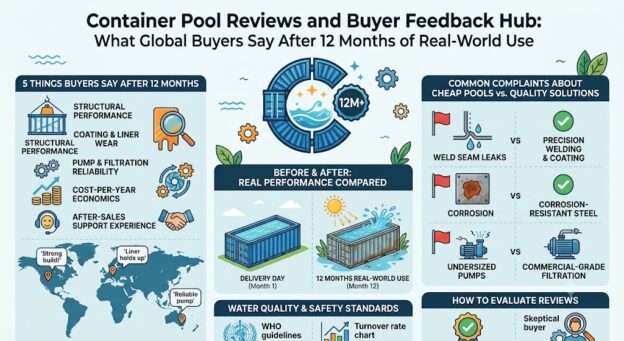
Container Pool Reviews and Buyer Feedback Hub: What Global Buyers Say After 12 Months of Real-World Use

Before committing to a bulk order, most experienced importers want to know one thing: does the container pool actually perform the way the sales brochure promises once it’s installed, filled, and used through a full season — or a full year? Marketing copy is easy to produce. Independent, verifiable container pool reviews and buyer feedback is not.

This hub page brings together everything a serious buyer needs before making a purchase decision: what customers across different climates and markets report after extended use, how container pools compare before and after installation in real operating conditions, and why cheaper units so often fail to hold up — along with what separates a durable build from a disposable one.

Container pool reviews list

⭐⭐⭐⭐⭐ Perfect solution for our backyard!

“We always wanted a pool, but the soil in our yard is way too hard and full of rocks to dig up. This container pool was the perfect alternative because it can be placed directly on the ground. The crane installation took just a few minutes and required no concrete foundation!

The best part is that it cost us 50% less than a traditional embedded pool. Everything is fully integrated—the steps, deck, and the powerful filtration system are all built right in (the filter is hidden perfectly under the stairs, saving us so much space). The interior surface is incredibly smooth, which makes it super easy to clean and completely prevents algae from growing.

It is highly durable, built to last for at least 25 years without any corrosion or leaks, and we can even set up separate hot and cold water sections to use it all year round. If you want a cost-effective, hassle-free pool, this is definitely it!”

⭐⭐⭐⭐⭐ Highly Recommend – Incredible Value and Features!

“We are absolutely thrilled with our modified shipping container pool! It cost just a fraction of the price of a traditional pool, and the ongoing maintenance costs are incredibly low.

The features packed into this 4,800-gallon pool are amazing:

  • Built-in Systems: It came fully equipped with its own heating and sanitation system.

  • Spa Features: It features a color-changing LED light and 8 built-in jacuzzi jets.

  • Smart Design: There is a heavy-duty, heat-resistant plastic partition inside that perfectly separates the swimming pool area from the jacuzzi section.

Our absolute favorite part is the 1.2×2.4 meter viewing window cut into the side wall—it gives the pool such a unique look! Because all the materials were prefabricated at the factory, installing it above ground in our yard was simple, flexible, and didn’t leave behind a mountain of construction waste. It is the perfect eco-friendly way to enjoy a pool and hot tub right at home!”

⭐⭐⭐⭐ Honest review of our 8x20ft Container Pool

“We recently purchased a standard 8×20 ft shipping container pool for our backyard, and I wanted to share a realistic breakdown of what to expect:

  • Price & Value: We paid within the typical $35,000 to $65,000 price range (the average is around $49,000, though some basic models start from $16,500 to $39,900).

  • Heavy-Duty Build: These are heavily modified by the manufacturer. They actually weld a second layer of steel plates inside the original corrugated walls to guarantee it won’t leak water. This adds a massive amount of weight to the structure. We deliberately avoided the fiberglass interior option because those are prone to ‘spiderweb cracks’ which are incredibly difficult and expensive to repair.

  • Installation Requirements: Because of its sheer size and weight, you absolutely must hire a crane to drop it into place. You also need to make sure you have a large, open outdoor space that can accommodate a 20 to 40-foot length.

  • The Swimming Experience: It’s great for lounging, but if you want to use it for serious exercise, keep in mind that even the longest container pool is less than half the length of a short-course racing pool. You can only swim a very short distance before you have to turn around.

Overall, it is a solid, heavily engineered product, just make sure you have the outdoor space and a crane lined up for delivery!”

⭐⭐⭐⭐⭐ Absolute Game Changer for Our Space!

We recently installed the 40ft model (11.8m x 2.2m x 1.7m), and it has completely transformed our space. Compared to a traditional concrete pool, the construction cost was significantly lower, and the build timeline was incredibly short since the main structure arrived pre-formed and ready for quick setup.

What completely sold us on this design was the split dual-zone functionality:

  • The Swimming Area: It features a brilliant counter-current jet system (逆流器) that allows you to swim and surf against a strong current for an awesome workout.

  • The Heated Massage Zone: A built-in jacuzzi area with warm, circulating water that is absolutely perfect for winding down and soothing muscle tension.

The manufacturer fully equipped it with everything we needed, including a salt chlorine generator, skimmer, pool lights, and a proper pool cover. It is incredibly flexible, highly customizable in terms of size and color, and can even be easily disassembled and transported if we ever need to relocate it. If you want a creative, eco-friendly, and highly practical pool, this is definitely the way to go!

Why Verified container pool Reviews Matter More Than Marketing Claims

In the pool and recreational water equipment industry, product claims around structural integrity, water retention, and material durability are only meaningful when they can be independently verified. Regulatory bodies overseeing consumer protection have increasingly scrutinized how online reviews are solicited, filtered, or fabricated, which is why buyers are right to be skeptical of testimonials that appear only on a single seller’s own website. The U.S. Federal Trade Commission has issued formal guidance making clear that endorsements and testimonials must reflect the honest opinions of the reviewer and cannot misrepresent typical results. That standard is the benchmark we hold ourselves to when compiling feedback for this page. Where possible, we source buyer comments directly from post-delivery follow-up calls, after-sales service tickets, and repeat-order conversations — not curated marketing quotes. Where a testimonial is a placeholder pending direct buyer permission, we mark it clearly rather than presenting it as verified.

What Buyers Report After 12 Months of Real-World Use

A pool that looks perfect on delivery day tells you very little. The real test is what a buyer says after twelve months of sun exposure, water chemistry cycling, seasonal draining, and — in commercial settings — heavy daily guest turnover. We’ve compiled the recurring themes from buyers across five continents into a dedicated review roundup, using the same five-continents format we’ve used for other product evaluations on this site.

Read the full breakdown here: 5 Things Buyers Say About Our Container Pool After 12 Months. It covers structural performance, coating and liner wear, pump and filtration reliability, cost-per-year economics compared to traditional in-ground builds, and the after-sales support experience — organized by region so you can compare feedback from a climate similar to your own.

Before and After: How Container Pools Perform in Different Use Environments

Static product photos can’t show you how a container pool holds up in a coastal climate with high salt exposure, a high-UV desert market, or a high-turnover commercial hospitality setting. That’s precisely why side-by-side before-and-after documentation matters more for this product category than for most.

Material scientists have long noted that UV exposure and thermal cycling are the two most significant long-term stressors on any polymer-coated or composite structure exposed outdoors, which is why the American Society for Testing and Materials maintains weathering standards used across the outdoor equipment industry — including accelerated UV weathering test methods that manufacturers use to project long-term coating performance before a product ever reaches a customer. A container pool built to those tolerances should show minimal fading or surface degradation after a year of outdoor use; one that wasn’t will show it quickly. We’ve documented this in practice on our dedicated comparison page: Before and After: Real Container Pool Performance Across Different Use Cases, covering residential backyard installs, glamping and eco-resort deployments, and high-frequency commercial use.

Common Complaints About Cheap Container Pools — and How Quality Manufacturing Solves Them

Not every container pool on the market is built to the same standard, and buyer complaints tend to cluster around a predictable set of failure points: seam leaks, corrosion at weld points, pump undersizing, and liner delamination within the first year. These aren’t random defects — they’re the direct result of cost-cutting in steel gauge, coating process, or weld quality.

Industry guidance on shipping-container conversions consistently emphasizes that the structural steel used in a container-based build must retain its corrosion resistance and load rating even after cutting, welding, and reinforcement — a process documented in detail in the widely referenced Container Handbook published by GDV, which outlines how structural modifications affect a container’s long-term integrity. Buyers evaluating a low-cost quote should ask specifically what steel grade and coating process is used, and whether reinforcement was engineered for the added hydrostatic load of a filled pool — not just repurposed from a standard shipping container spec.

We break down each common failure point and the manufacturing standard that prevents it on our dedicated cluster page: Common Problems With Cheap Container Pools — and How Quality Construction Solves Them.

Water Quality and Safety Standards Buyers Should Ask About

Beyond structural durability, recurring buyer questions center on water treatment and filtration adequacy — particularly for commercial or shared-use installations. International guidance on recreational water environments, including the World Health Organization’s guidelines for safe recreational water environments covering pools and similar settings, outlines the filtration turnover rates and disinfection benchmarks that any pool — container-based or traditional — should be able to meet. A container pool supplier should be able to confirm the filtration system’s turnover rate against these benchmarks before you order, not after installation.

How to Evaluate Container Pool Reviews Before You Order

Given how much variance exists in build quality across suppliers, buyers are well served by applying the same skepticism to container pool reviews that consumer protection bodies recommend for any big-ticket purchase. Trade and standards organizations focused on pool and spa safety, such as the Pool & Hot Tub Alliance, publish consumer resources outlining the safety and construction questions buyers should raise with any pool manufacturer — questions that apply just as directly to container-based builds as to traditional in-ground pools. Before relying on any review, it’s worth asking: was this buyer verified, was the review solicited or unsolicited, and does the feedback address structural performance over time rather than just initial appearance.

Container Pool Specifications

All of the feedback on this page refers to our standard container pool build. Full technical specifications — including container dimensions, steel gauge, coating process, filtration system, and MOQ — are available on our container pool specifications page. If you’re comparing our build against a competitor’s quote, that page is the fastest way to check whether you’re comparing equivalent products.

Frequently Asked Questions

How long does a container pool typically last before major maintenance is needed?

With proper steel grade, coating, and installation, most buyers report no major structural maintenance needed within the first 3–5 years. Cosmetic maintenance such as coating touch-ups or liner inspection is recommended annually.

Are container pool reviews from different climates comparable?

Climate significantly affects wear patterns — UV exposure, freeze-thaw cycling, and humidity all stress different components. That’s why our review roundup is organized by region rather than presented as a single aggregate score.

What’s the most common reason buyers report dissatisfaction with a container pool?

The most frequently cited issues trace back to undersized filtration systems and inadequate weld/coating quality on lower-cost builds — both of which are addressable by confirming specifications before ordering rather than after delivery.

Can I request references from existing buyers before ordering?

Yes. We can connect prospective buyers with existing customers in a comparable climate or use case upon request, subject to the buyer’s availability and privacy preferences.


Container Pool Configurations for Different Regions

Container Pool Configurations for Different Regions

Container Pool Configurations for Different Regions

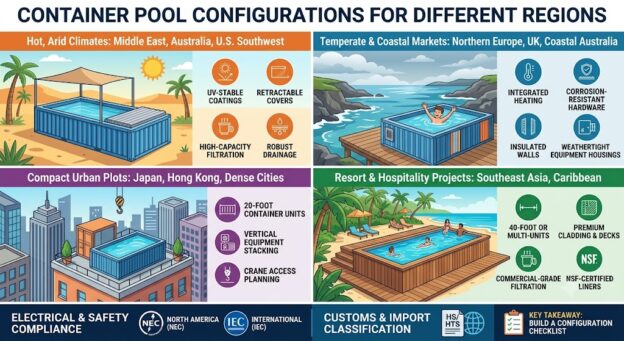
A container pool built for a resort in Southeast Asia and one built for a rooftop-adjacent lot in Northern Europe are rarely specified the same way. Climate, site density, and local compliance requirements all shape how a container pool should be configured for a given market. This guide walks through the main regional variables B2B buyers should account for when sourcing or specifying container pools for international markets.

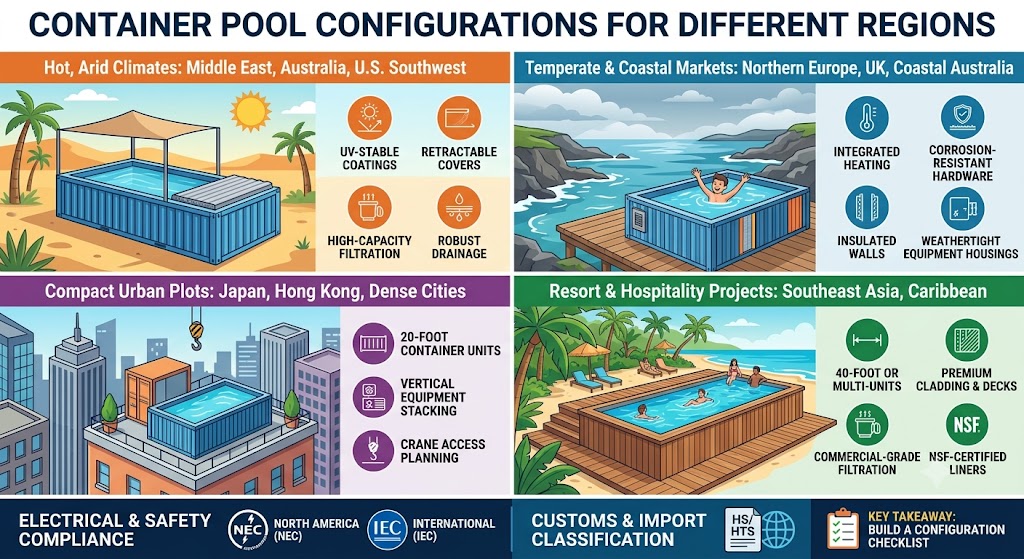
Hot, Arid Climates (Middle East, Australia, U.S. Southwest)

In high-heat, high-UV, low-humidity markets, the priorities shift toward heat and evaporation management rather than heating:

  • UV-stable exterior coatings and cladding to prevent premature fading or chalking of the exterior finish under intense, sustained sun exposure.
  • Shade structures or retractable pool covers to reduce evaporation loss and limit water temperature swings during peak daytime heat.
  • Higher-capacity filtration and circulation to manage dust load and higher bather usage typical of warm-climate installations that stay in use most of the year.
  • Robust drainage and overflow design around the container base, since arid-climate installations still need to handle occasional heavy rain events without pooling water against the steel shell.

Temperate and Coastal Markets (Northern Europe, Coastal Australia, the UK)

Buyers in these regions typically request configurations aimed at extending the usable swimming season and resisting salt-air corrosion:

  • Integrated heating systems, since ambient water temperature is rarely warm enough for comfortable swimming without supplemental heat for most of the year.
  • Insulated wall panels behind the interior lining to reduce heat loss and lower ongoing heating costs.
  • Corrosion-resistant hardware — stainless steel fittings, marine-grade fasteners, and coated ladders or rails — for installations near the coast, where salt air accelerates corrosion on unprotected metal components far faster than inland environments.
  • Weathertight equipment housings to protect pumps, filters, and heaters from sustained rain and humidity.

Compact Urban Plots (Japan, Hong Kong, Dense European Cities)

Space, not climate, is the dominant constraint in dense urban markets:

  • 20-foot container units dominate this segment, since the shorter footprint fits side yards, rooftop-adjacent spaces, and other tight lots that could never accommodate a poured in-ground pool.
  • Vertical equipment stacking is common, with pumps and filtration housed in a compact adjacent unit rather than a separate ground-level equipment pad.
  • Crane access planning becomes a critical site-survey step, since urban installations often require rooftop or narrow-access placement that a standard truck-mounted crane cannot easily reach.

Resort and Hospitality Projects (Southeast Asia, the Caribbean, Australia)

Commercial and hospitality buyers typically specify larger, higher-finish configurations:

  • 40-foot units or multi-container configurations, sometimes joined end-to-end or arranged in an L-shape, to create a full lap-pool length or a larger shared pool area.
  • Premium cladding and integrated decking to match hospitality branding and guest-facing aesthetics rather than the exposed weathering-steel look favored in some residential markets.
  • Commercial-grade filtration and water treatment, since hospitality installations face higher bather loads and are far more likely to fall under public or semi-public pool health codes than a private residential installation.
  • NSF-certified interior coatings are worth confirming for any project with public or guest access, given the stricter water-quality expectations applied to commercial facilities.

Electrical and Safety Compliance Vary by Destination

Electrical requirements for pool equipment differ meaningfully between markets and should be confirmed before finalizing a configuration:

  • In North America, pool electrical installations fall under NEC Article 680, which sets requirements for ground-fault protection, bonding, and clearance distances around pumps, lighting, and receptacles.
  • In the EU, UK, and most other international markets, pool electrical work is governed by IEC 60364-7-702, which defines protective zones around the pool (based on horizontal distance from the water’s edge) and mandates residual current devices on AC circuits serving the pool area.

Because these standards differ in zone definitions and protective-device requirements, a container pool’s pump, lighting, and heater wiring generally needs to be configured — or at minimum re-certified — for the destination market’s electrical code rather than assumed to be a universal fit.

Customs and Import Classification Also Vary

Since a container pool starts life as a modified shipping container, its customs treatment is not always self-evident. Standard shipping containers are typically classified under HS/HTS heading 8609 for customs purposes, but a converted, equipment-fitted pool unit may be classified differently by some customs authorities depending on the destination country’s rules and how much it has been modified from a standard freight container. Buyers should confirm the correct HS code and any applicable duty treatment with their customs broker or the destination country’s tariff schedule before finalizing an order, since misclassification can lead to delays, incorrect duty assessments, or penalties.

Practical Takeaway for Buyers

Rather than treating “container pool” as a single fixed product, B2B buyers sourcing across multiple regions should build a configuration checklist per market: climate-driven equipment choices (heating vs. shading and evaporation control), site-driven sizing (20-foot vs. 40-foot or multi-unit), finish level appropriate to residential vs. hospitality use, and destination-specific electrical and customs compliance. Confirming these variables with the manufacturer before production avoids costly rework or non-compliant installations after the unit has already shipped.

For the full overview of how container pools are engineered and manufactured, see the pillar guide: What Is a Container Pool? The Complete Guide for Importers and Wholesalers. To review current specifications and MOQ, visit our container pool product page.


External authoritative references cited in this article:

  1. IEC 60364-7-702 swimming pool electrical installation zones and requirements — GlobalSpec: IEC 60364-7-702
  2. NEC Article 680 pool electrical requirements (North America) — PoolDial: Pool Electrical Requirements: NEC Article 680 Explained
  3. HS/HTS code classification system for internationally traded goods — International Trade Administration: Harmonized System (HS) Codes
container pool material show

Container Pool Materials: Why container pool Works for Outdoors

Container Pool Materials: Why They Work Outdoors

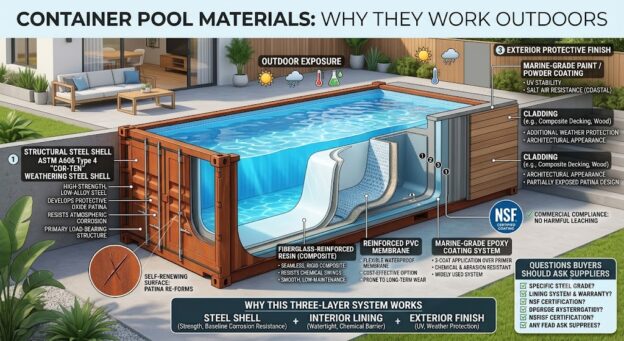
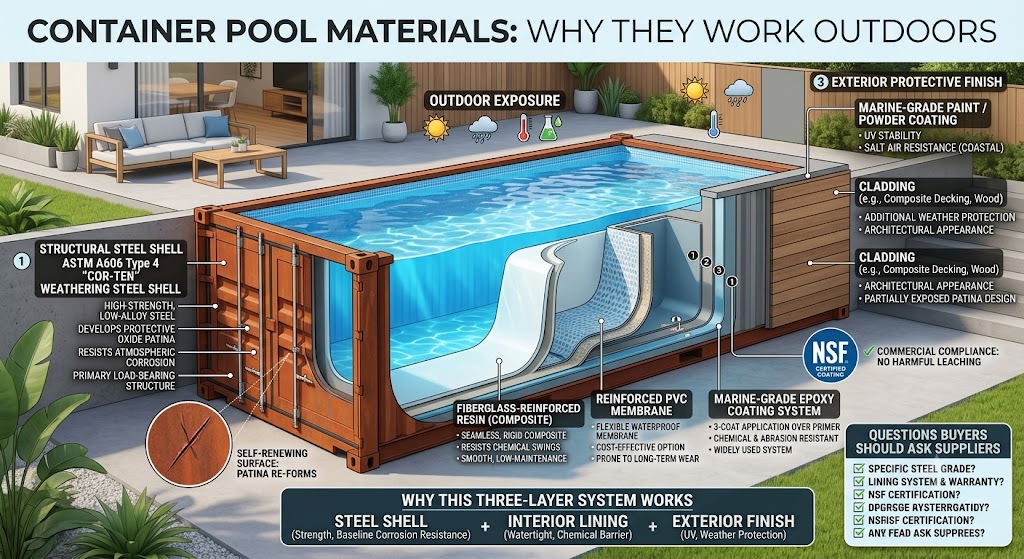
A container pool has to do two jobs at once: hold water reliably for years, and survive constant outdoor exposure to sun, rain, temperature swings, and pool chemicals. Neither job is handled by a single material. This guide breaks down the three material layers that work together to make a steel shipping container function as a long-term outdoor swimming pool, and what buyers should ask suppliers about each one.

Layer 1: The Structural Steel Shell

The base structure of a container pool is the steel shipping container itself, most commonly specified to ASTM A606 Type 4, a high-strength, low-alloy weathering steel widely known by the trade name Cor-Ten. Unlike ordinary carbon steel, A606 steel contains added copper, chromium, and nickel that allow the surface to develop a dense, adherent oxide layer — a patina — when exposed to alternating wet and dry conditions. That patina is self-renewing: if the surface is scratched, a fresh protective layer re-forms within days to weeks rather than leaving bare metal exposed. This is why weathering steel is the standard choice not just for shipping containers but for bridges, exposed architectural steel, and outdoor sculpture.

This structural layer is what gives a container pool its load-bearing strength and its resistance to atmospheric corrosion on exterior, above-water surfaces. It is not, however, the layer that keeps pool water contained — that job belongs to the interior lining.

Layer 2: The Interior Waterproofing System

The interior lining is the single most important material decision in a container pool, because it is the only barrier between standing pool water — plus the chlorine or salt used to sanitize it — and the steel shell underneath. Three lining approaches are common:

  • Fiberglass-reinforced resin. Liquid resin is applied in layers over a fiberglass reinforcement, curing into a seamless, rigid composite shell. This approach is well established in the marine industry for boat hulls and is valued for resisting deformation from water chemistry swings and offering a smooth, low-maintenance surface.
  • Reinforced PVC or vinyl membrane. A flexible waterproof liner installed over the prepared steel surface. It is a cost-effective option but, being flexible rather than rigid, can be more prone to long-term wear than a laminated composite system.
  • Marine-grade epoxy coating systems. A two-component epoxy is applied directly to the primed steel in multiple coats, typically requiring three coats at controlled thickness for fully submerged applications, with the correct primer and cure time between layers. Properly specified epoxy systems are chemical- and abrasion-resistant and are widely used in both residential and commercial pool applications.

For any of these systems, water quality and public-health compliance matter, particularly for commercial or hospitality-scale projects. NSF-certified pool coatings are formulated and tested to ensure they do not leach harmful substances into pool water and meet recognized chemical-resistance and durability benchmarks — a certification worth confirming when a container pool is destined for a public-facing or commercial installation.

Layer 3: The Exterior Protective Finish

Above the waterline and on the container’s outward-facing surfaces, a separate finish protects against UV exposure, weathering, and cosmetic fading:

  • Marine-grade paint or powder coating, chosen for UV stability and resistance to salt air in coastal markets.
  • Cladding, such as wood, composite decking, or stone veneer, applied over the container exterior for both additional weather protection and a finished architectural appearance.

Because Cor-Ten steel is often left partially exposed by design for its weathered aesthetic, buyers should clarify with suppliers which surfaces are meant to show natural patina and which are fully clad or painted, since maintenance expectations differ significantly between the two approaches.

Why This Three-Layer System Works

No single material in a container pool is doing all the work. The steel shell provides structural strength and a baseline resistance to atmospheric corrosion; the interior lining provides the actual watertight, chemical-resistant barrier; and the exterior finish protects against UV and weather-driven cosmetic degradation. A failure in any one layer — a coating that peels, cladding that traps moisture against the steel, or a shell that wasn’t properly prepped before coating — can shorten the pool’s usable life regardless of how strong the other layers are.

Questions Buyers Should Ask Suppliers

  • What specific steel grade is used for the container shell (e.g., ASTM A606 Type 4), and is mill test documentation available?
  • Which interior lining system is used — fiberglass resin, PVC membrane, or epoxy — and what warranty period does the supplier offer on that lining?
  • Is the interior coating NSF-certified, particularly for commercial or public-facing installations?
  • What surface preparation process (sandblasting, priming, cure time) precedes lining application?
  • What exterior finish or cladding options are available for different climate zones?

Bottom Line

The reason a steel box engineered for ocean freight can also function as a durable outdoor pool comes down to combining a corrosion-resistant structural steel with a properly specified, chemical-resistant interior lining and a weather-appropriate exterior finish. Buyers who understand this layered material system are better positioned to evaluate supplier quality and set accurate durability expectations with their own customers.

For the full overview of how container pools are engineered and manufactured, see the pillar guide: What Is a Container Pool? The Complete Guide for Importers and Wholesalers. To review current specifications and MOQ, visit our container pool product page.


External authoritative references cited in this article:

  1. ASTM A606 Type 4 weathering steel specification and corrosion behavior — Corten.com: ASTM A606 Type 4 Weathering Steel
  2. NSF-certified pool coating standards and public health compliance — ecoFINISH: NSF-Certified Coatings for Public Pools
  3. Epoxy and waterproofing membrane technical requirements for pool interiors — ISOMAT: Waterproofing of Swimming Pools and Painting with Epoxy Coating
Container Pool vs Traditional Pool Pros and Cons feature

Container Pool vs. Traditional Pool: Pros and Cons

Container Pool vs. Traditional Pool: Pros and Cons

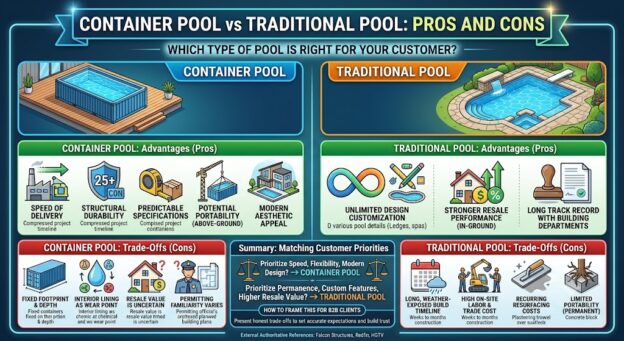
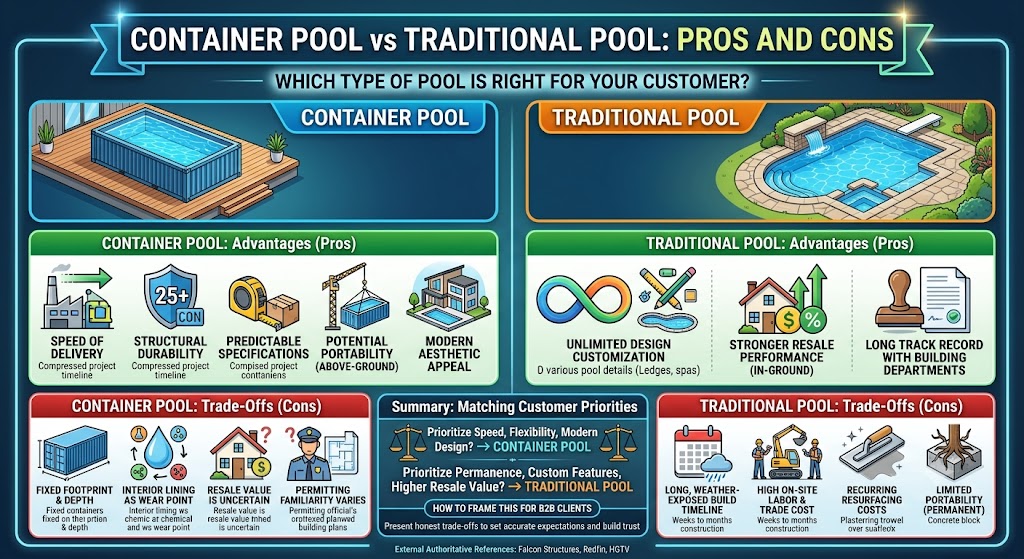
Once a buyer has decided a container pool fits the site and timeline, the next question is usually about trade-offs: Container Pool vs Traditional Pool: Pros and Cons? what does the customer actually gain and give up compared with a conventional in-ground pool? This guide lays out the honest pros and cons on both sides so importers and wholesalers can set accurate expectations with their customers.

Container Pool: Advantages

Speed of delivery. Because the shell, waterproofing, and equipment are fabricated and tested at the factory, on-site work is largely limited to placement and hookup. This compresses a project that would normally run months into a matter of weeks.

Inherent structural durability. Shipping containers are built to survive years of ocean transport, repeated stacking, and rough handling. Industry sources on container durability commonly cite a structural lifespan in the range of 25 years or more for a well-maintained unit, with some units remaining structurally sound after 30 to 35 years — a strong starting point for a pool shell before any pool-specific reinforcement is even added.

Predictable specifications. Because the base unit follows standardized container dimensions, wholesale buyers get consistent quoting, packing, and freight planning across production runs, rather than negotiating a bespoke structural design for every order.

Potential portability. Above-ground container pool installations can, in many cases, be disconnected and relocated — something a poured concrete or gunite shell simply cannot do.

Modern aesthetic appeal. For customers seeking a distinctive, industrial-style design statement rather than a conventional pool look, the container form factor is itself a selling point.

Container Pool: Trade-Offs to Disclose

Fixed footprint and depth. The pool’s length, width, and usable interior height are set by the container’s dimensions. Custom shapes, tanning ledges, or unusual depths require additional fabrication work beyond the base unit.

Interior lining is the real wear point. The waterproof lining — not the steel — is what’s in constant contact with pool water and chemicals. Buyers should confirm lining material, application quality, and warranty terms, since a coating failure exposes the underlying steel to corrosion regardless of how durable the container itself is.

Resale value is uncertain in some markets. Real estate data consistently shows that above-ground pool installations are treated as personal property by most appraisers in the U.S. and typically add little to no resale value, unlike permanently installed in-ground pools. Buyers selling into markets where resale value matters to the end customer should set expectations accordingly, particularly for above-ground container pool configurations.

Permitting familiarity varies. Container pools generally face the same building, electrical, and safety permit requirements as conventional pools, but some local building departments are less familiar with the product category and may request extra engineering documentation before approval.

Traditional Pool: Advantages

Unlimited design customization. Gunite and shotcrete construction can be shaped into virtually any size, depth, or feature set — infinity edges, integrated spas, custom lighting, tanning ledges — because the shell is formed on site rather than constrained by a factory unit.

Stronger resale performance when in-ground. In-ground pools, particularly concrete and fiberglass, consistently add more resale value than above-ground alternatives and are the only pool types that reliably appraise into a home’s value in most U.S. markets. National estimates commonly put the value uplift from a well-built in-ground pool at roughly 5% to 8% of home value, with far higher premiums in warm-climate markets.

Long track record with local building departments. Because in-ground concrete and gunite construction has been the dominant residential pool method for decades, permitting and inspection processes are generally well understood by local authorities, reducing approval friction.

Traditional Pool: Trade-Offs to Disclose

Long, weather-exposed build timeline. A standard in-ground project typically runs 8 to 14 weeks under good conditions, with permitting delays, custom features, or poor weather commonly extending real-world projects to three to six months.

High on-site labor and trade cost. Excavation, rebar and gunite crews, tile setters, and deck contractors are all coordinated on site over an extended schedule, which drives both cost and the risk of scheduling delays compared with factory-built alternatives.

Recurring resurfacing costs. Concrete and gunite pool interiors typically need replastering or resurfacing every 10 to 20 years depending on the finish, an ongoing cost that customers should budget for beyond the initial build.

Limited portability. A poured or sprayed concrete shell is a permanent site feature; relocation is not a realistic option.

How to Frame This for Customers

The most useful comparison isn’t “which pool is better” but “which trade-offs match this customer’s priorities.” A customer prioritizing installation speed, site flexibility, and a distinctive design will generally see the container pool’s trade-offs as acceptable. A customer building a permanent, fully custom feature with resale value as a priority will often be better served by a traditional in-ground build. Presenting both sides accurately — rather than overselling either option — is what builds long-term trust with B2B customers making a significant purchase decision.

For the full overview of how container pools are engineered and manufactured, see the pillar guide: What Is a Container Pool? The Complete Guide for Importers and Wholesalers.

Container Pool vs Traditional Pool: Which One Do You Need?


External authoritative references cited in this article:

  1. Shipping container structural lifespan and maintenance factors — Falcon Structures: How Long Do Shipping Containers Last?
  2. Pool type and resale value data, including above-ground vs. in-ground appraisal treatment — Redfin: Does a Pool Increase Home Value?
  3. In-ground pool cost, maintenance, and resurfacing considerations — HGTV: Does a Swimming Pool Add Value to a Home?
Container Pool vs Traditional Pool feature

Container Pool vs Traditional Pool: Which One Do You Need?

Container Pool vs Traditional Pool: Which One Do You Need?

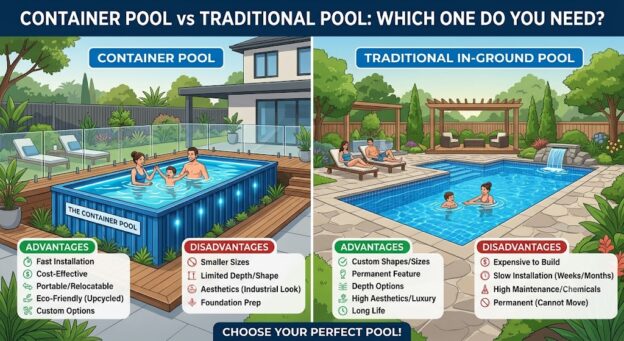
Choosing between a container pool and a traditional in-ground pool is less about which product is “better” and more about matching the build method to the site, timeline, and budget of the specific project. This guide breaks down the decision points that matter most to buyers and their end customers.

Start With the Site, Not the Product

Before comparing features, the physical site usually narrows the choice on its own:

  • Access-constrained lots. Traditional in-ground pools require heavy excavation equipment and, for gunite or concrete builds, a rebar structure poured or sprayed on site. If a lot has narrow side access, overhead power lines, or no room for excavation machinery, a factory-built container pool that arrives complete and is simply craned into place is often the only practical option.
  • Open, flexible lots. Where excavation access isn’t a constraint, both options are viable, and the decision shifts to timeline, budget, and design preference.

Timeline: The Biggest Practical Difference

This is usually the single largest factor separating the two options.

A conventional gunite or concrete in-ground pool follows a sequential build process: design and permitting, excavation, steel rebar framework, gunite or shotcrete application, a mandatory curing period, then tile, coping, and decking. Industry sources put a standard project at roughly 8 to 14 weeks in a straightforward case, with permitting delays, custom features, or difficult terrain commonly pushing well-documented projects out to three to six months.

A container pool skips most of this sequence because the shell, waterproofing, and equipment are built and tested at the factory before the unit ever reaches the site. On-site work is generally limited to site preparation, crane placement, and utility connection — a matter of days rather than months once the unit lands.

For buyers marketing to customers on a tight schedule (a seasonal rental property, a hospitality opening date, a resale-ready development), this timeline gap is often the deciding factor.

Cost Structure: Where the Money Goes

The two build methods spend money differently, which matters when positioning a container pool against a customer’s cost expectations:

  • Traditional concrete/gunite pools carry high labor and on-site trade costs (excavation crews, rebar and gunite application, tile setters, deck contractors) spread across a multi-month schedule. National cost data for custom gunite pools commonly runs from roughly $50,000 up into six figures once decking, equipment, and finishes are included, with resurfacing every 10 to 15 years as an ongoing cost the customer should budget for.
  • Container pools shift most of the cost into factory fabrication rather than on-site labor, which can compress both cost and schedule risk since the build happens in a controlled environment rather than being exposed to weather delays, subcontractor scheduling gaps, and site-specific surprises common to in-ground builds.

Buyers should present these as different cost profiles rather than a simple “cheaper vs. more expensive” comparison, since the right answer depends on how much design customization the end customer actually needs.

Design Flexibility vs. Speed and Predictability

This is the core trade-off to communicate to customers:

  • Traditional pools win on customization. Gunite and shotcrete construction can form virtually any shape, depth, or built-in feature — infinity edges, tanning ledges, integrated spas, custom lighting — because the shell is formed on site rather than constrained by a factory unit.
  • Container pools win on predictability and speed. Because the shell is based on standardized ISO container dimensions, the footprint, structural specifications, and production process are consistent from one order to the next, which makes quoting, freight planning, and delivery timelines far more predictable for both the supplier and the end customer.

Longevity and Maintenance

Both build methods can last decades when properly built and maintained, but the maintenance profile differs:

  • Concrete and gunite pools typically need interior resurfacing (plaster, pebble, or tile) roughly every 10 to 20 years depending on the finish, in addition to routine water chemistry management.
  • Container pools depend heavily on the quality and maintenance of the interior waterproof lining, since that lining is what protects the steel shell from long-term water exposure; the steel structure itself is inherently durable given its origin as freight-transport equipment.

Neither option is maintenance-free, and buyers should set realistic expectations with customers on both sides of the comparison.

Quick Decision Framework

Factor Favors Container Pool Favors Traditional Pool
Site access Limited/constrained Open, unrestricted
Timeline Weeks Months
Design customization Standardized footprint Fully custom shape/depth
Relocation potential Possible (above-ground) Not practical
Budget structure Factory cost, less on-site labor Higher on-site labor/trade cost
Aesthetic Modern/industrial Traditional/customizable

Bottom Line for B2B Buyers

Container pools and traditional in-ground pools serve different segments of the same market rather than competing head-to-head on every project. Buyers who position container pools specifically around speed, site flexibility, and predictable specifications — rather than trying to sell them as a universal replacement for custom in-ground construction — tend to see the clearest fit with customer expectations.

For a full breakdown of how container pools are engineered and manufactured, see the pillar guide: What Is a Container Pool? The Complete Guide for Importers and Wholesalers.

Container Pool vs. Traditional Pool: Pros and Cons

External authoritative references cited in this article:

  1. In-ground pool construction timelines (fiberglass, vinyl, gunite/concrete) — Angi: How Long Does It Take to Build a Pool?
  2. Gunite pool construction phases, timeline, and cost breakdown — Pool Cost Estimator: Gunite Pool Cost Estimate 2026
  3. ISO shipping container standard dimensions (structural basis for container pool footprint) — TandemLoc ISO Container Info
what is container pool? container pool introduce

What Is a Container Pool? The Complete Guide for Importers and Wholesalers

What Is a Container Pool? The Complete Guide for Importers and Wholesalers

For buyers sourcing swimming pool products for resale, hospitality projects, or residential developments, the “container pool” category has moved from a novelty to a serious line item in many catalogs. This guide explains what a container pool actually is, how it is built, when it makes sense compared with a traditional in-ground pool, and what to check before placing a wholesale or import order.

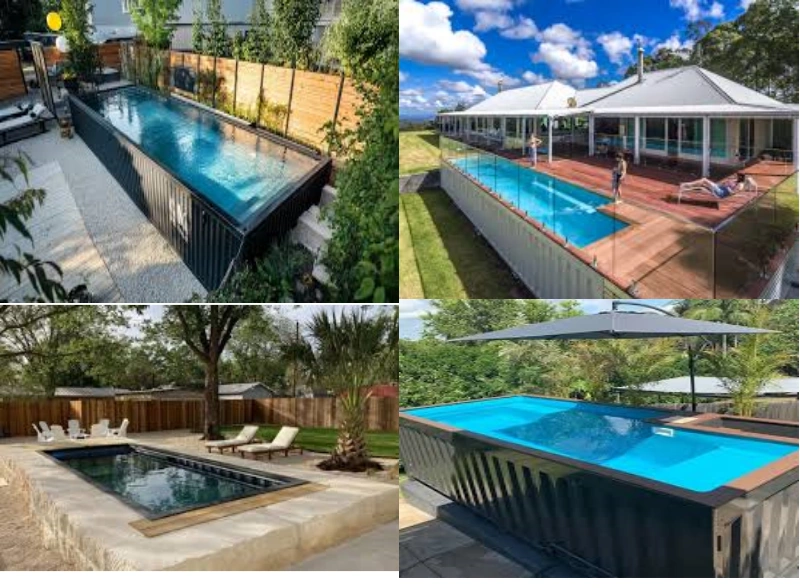
A four-panel photo showcase displaying diverse shipping container swimming pool installations, including an above-ground pool with a glass window, a deck-integrated elevated lap pool, a semi-inground patio pool, and a modern backyard plunge pool.

What Is a Container Pool and How Does It Work?

A container pool is a swimming pool built from a repurposed or purpose-built steel shipping container. Rather than pouring concrete or installing a fiberglass shell on site, the manufacturer converts the rigid steel box itself into the pool structure: cutting an opening in the top, reinforcing the frame, waterproofing the interior, and fitting a filtration and circulation system before the unit ever leaves the factory.

Most units are based on standard ISO shipping container sizes, most commonly the 20-foot and 40-foot lengths, with a fixed width of 8 feet and a height of either 8 feet 6 inches (standard) or 9 feet 6 inches (high-cube). A 20-foot container yields roughly 160 square feet of swimming surface, comparable to a large hot tub or compact lap pool, while a 40-foot unit doubles that length for a full-size lap pool. Because the containers already conform to ISO 668, ISO 1496, and ISO 3874 dimensional and structural standards, buyers can rely on predictable, repeatable specifications across suppliers — the same standardization that keeps intermodal shipping containers interchangeable also keeps container pools dimensionally consistent from one production run to the next.

The manufacturing process typically follows this sequence:

  • Structural inspection and reinforcement — the container frame is checked for corrosion or deformation, and cross-bracing is added where the roof or side panels are cut away.
  • Interior treatment — the raw steel interior is sandblasted, primed, and coated with a waterproof, chemical-resistant lining (fiberglass, PVC membrane, or marine-grade coating).
  • Plumbing and equipment installation — skimmers, return jets, a pump, a filter, and often a heater are plumbed directly into the shell, usually housed in an adjacent equipment bay built into the same container.
  • Finishing — steps, safety rails, decking, lighting, and an exterior coating or cladding are added depending on the buyer’s specification.

Because the pool arrives essentially complete, on-site work is limited to site preparation, crane placement, and utility hookup — a meaningfully shorter installation cycle than a conventional built-in pool.

Container Pool vs. Traditional Pool: Which One Do You Need?

Container Pool vs Traditional Pool Pros and Cons feature

The right choice depends on the end customer’s site conditions, budget, and timeline rather than on which product is objectively “better.”

A container pool tends to suit projects where:

  • The installation site has limited access for heavy concrete or excavation equipment.
  • The customer wants the pool operational in weeks rather than months.
  • Relocation or resale value matters — an above-ground container pool can, in many cases, be disconnected and moved.
  • The project favors a modern, industrial aesthetic rather than a traditional in-ground look.

A traditional poured-concrete or fiberglass pool tends to suit projects where:

  • The customer wants a fully custom shape, size, or depth rather than a fixed rectangular footprint.
  • The pool is a permanent, non-negotiable feature of a large residential or resort build.
  • Local regulations or HOA requirements favor conventional in-ground construction.

For wholesale and B2B buyers, this distinction matters for positioning: container pools are best marketed to customers prioritizing speed, portability, and a distinctive design statement, not as a blanket replacement for every pool project.

(Detailed comparison: Container Pool vs. Traditional Pool: Which One Do You Need? — Cluster Guide)

3. Container Pool vs. Traditional Pool: Pros and Cons

Container Pool vs Traditional Pool Pros and Cons feature

Advantages of a container pool

  • Faster deployment. Factory fabrication and finishing happen off-site, so on-site time is largely limited to placement and hookup.
  • Portability. Above-ground installations can potentially be relocated by disconnecting utilities and transporting the unit, unlike a poured-in-place pool.
  • Predictable, repeatable manufacturing. Because the base structure follows ISO container dimensions, quoting, packing, and freight planning are more standardized than with custom-built pools.
  • Durable base structure. Steel shipping containers are engineered to survive years of ocean transport, heavy stacking, and repeated handling, which gives the pool shell inherent structural strength before any pool-specific reinforcement is added.

Trade-offs to disclose to buyers

  • Fixed footprint. The pool’s length and width are set by the container’s dimensions; custom shapes require additional fabrication.
  • Interior height limits. A standard container’s usable interior height is under 8 feet, which affects depth options unless the unit is partially recessed into the ground.
  • Coating maintenance. The waterproof lining is the primary barrier between pool water and the steel shell, so lining quality and periodic inspection are more important than with a fiberglass or concrete shell.
  • Permitting. Most jurisdictions apply the same safety and building permit requirements to container pools as to conventional pools, and some local building departments are still unfamiliar with the product, which can slow approval.

(Full pros-and-cons breakdown: Container Pool vs. Traditional Pool: Pros and Cons — Cluster Guide)

4. Container Pool Configurations for Different Regions

Container Pool Configurations for Different Regions

Buyers sourcing for different markets should expect regional variation in how container pools are specified and installed:

  • Hot, arid climates (Middle East, Australia, parts of the U.S. Southwest) — buyers typically prioritize UV-stable exterior coatings, shade structures or retractable covers, and higher-capacity filtration to manage evaporation and dust load.
  • Temperate and coastal markets (Northern Europe, coastal Australia, the UK) — heating systems and insulated wall panels are more common requests, along with corrosion-resistant hardware for salt-air environments.
  • Compact urban plots (Japan, Hong Kong, dense European cities) — the 20-foot container size dominates because it fits tight side-yard or rooftop-adjacent installations that could not accommodate a poured pool.
  • Resort and hospitality projects (Southeast Asia, the Caribbean, Australia) — 40-foot units or multi-container configurations are more common, often finished with cladding, integrated decking, and premium lighting packages to match hospitality branding.

Freight and import compliance also vary by destination: buyers should confirm local electrical standards for pumps and heaters, water-treatment chemical import rules, and whether the destination country classifies the unit as a modified shipping container or as pool equipment for customs purposes, since this affects duty codes and required documentation.

(Region-by-region configuration detail: Container Pool Configurations by Region — Cluster Guide)

5. Container Pool Materials: Why They Work Outdoors

container pool material show

The core material in a container pool is Cor-Ten-type weathering steel, most commonly specified to ASTM A606. Unlike standard carbon steel, A606 weathering steel contains added copper, chromium, and nickel that allow the surface to form a stable, adherent oxide layer — a patina — when exposed to weather. That patina slows further corrosion rather than flaking away, which is why weathering steel is also standard in bridges, exposed structural steel, and outdoor architecture. Combined with a properly applied interior waterproof coating and correct drainage around the exterior, this is what allows a steel box designed for ocean freight to also function as a long-term outdoor pool shell.

Three material layers typically work together:

  1. Structural steel shell — the weathering-steel container body, providing the load-bearing structure and resistance to atmospheric corrosion on exterior surfaces.
  2. Interior waterproofing membrane — fiberglass, reinforced PVC, or a marine-grade epoxy coating applied over the steel to isolate pool water from the metal and prevent internal corrosion.
  3. Exterior protective finish — marine-grade paint, powder coating, or cladding (wood, composite decking, or stone veneer) applied for additional weather protection and aesthetics.

Buyers should ask suppliers for the specific coating system and warranty terms on the interior lining, since this — not the steel itself — is usually the component most exposed to long-term wear from pool chemicals and water contact.

(Full materials and coatings guide: Container Pool Materials: Why They Work Outdoors — Cluster Guide)

6.Container Pool Trend: How the Market Is Developing Globally

container pool market trend

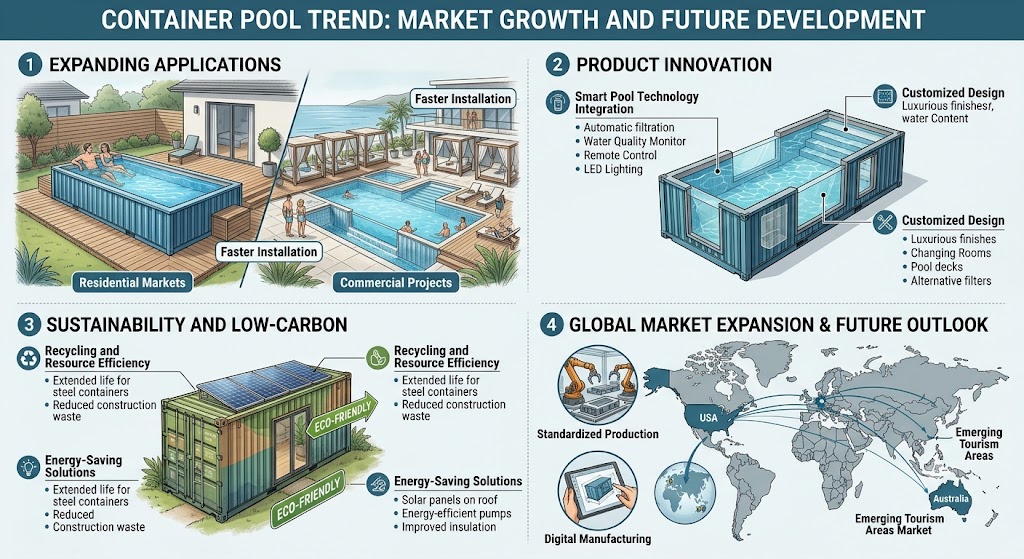
The container pool trend shows how modular swimming solutions are moving from a niche product into a growing category for residential, hospitality, and commercial applications.

In the past, container pools were mainly considered a creative alternative for homeowners looking for unique backyard designs. Today, demand is expanding because buyers are searching for faster installation, lower construction costs, and more flexible outdoor recreation solutions.

Several market changes are accelerating this growth. Residential customers are investing more in backyard leisure spaces, while hotels, resorts, campsites, and vacation rental operators are using container pools to create additional guest experiences without long construction periods.

At the same time, container pools are evolving beyond simple steel structures. Manufacturers are adding smart filtration systems, automatic water treatment, heating solutions, customized finishes, and modular designs to meet different regional and project requirements.

Sustainability is also becoming an important factor. As part of the wider modular construction movement, container pools support factory-controlled production, efficient material usage, and reduced on-site construction waste.

For international importers and distributors, the growing container pool trend represents a new business opportunity. Markets in North America, Europe, Australia, Southeast Asia, and the Middle East are showing increasing interest in products that combine mobility, speed of installation, and modern outdoor living design.

Safety and Compliance Considerations for Import Buyers

Regardless of construction method, container pools sold into markets such as the United States, Australia, the UK, and the EU are generally expected to meet the same residential pool safety expectations as conventional pools. In the U.S., for example, aboveground and onground residential pools fall under ANSI/APSP/ICC-4, and pool and spa drain covers must meet anti-entrapment requirements under the Virginia Graeme Baker Pool and Spa Safety Act, enforced by the Consumer Product Safety Commission. Importers and wholesalers should confirm with manufacturers which barrier, drain-cover, and equipment standards a given container pool model is designed to meet for the destination market, since requirements differ by country and, within the U.S., by state and local jurisdiction.

Sourcing a Container Pool: What to Ask Suppliers

For B2B buyers evaluating factories or trading companies, useful qualifying questions include:

  • What container grade and steel specification (e.g., ASTM A606 Type 4) is used for the shell?
  • What interior lining system is applied, and what is the warranty period?
  • Which pool safety and equipment standards does the finished unit meet for the destination market?
  • What is the standard lead time from order confirmation to factory completion?
  • Can the unit be split or partially disassembled for containerized ocean freight, or does it ship as a single oversized unit?
  • What documentation (mill certificates, test reports, compliance declarations) is provided with each shipment?

Container House Co., Ltd. works with international importers and wholesalers on steel container-based products for export, and can walk buyers through specification, compliance documentation, and shipping logistics for container pool orders. Visit our container pool product page for current specifications and MOQ.

Frequently Asked Questions

Is a container pool as durable as a traditional pool? The steel shell itself is engineered to survive years of heavy handling and ocean transport, but the pool’s long-term durability depends heavily on the quality of the interior waterproof lining and exterior coating maintenance, not on the steel alone.To see how these materials hold up in various climates according to actual buyers, read our comprehensive Container Pool Reviews.

Can a container pool be relocated after installation? Above-ground installations can generally be relocated by disconnecting utilities and transporting the unit, though feasibility depends on the installation method and local logistics. In-ground or partially buried installations are far harder to move.

Do container pools need the same permits as traditional pools? In most jurisdictions, yes. Container pools are generally subject to the same building, electrical, and safety permit requirements as conventional pools, though some local building departments may request additional engineering documentation since the product type is less familiar to them.

What size container pool is most common for wholesale orders? The 20-foot container is the most widely ordered size for residential-scale projects, while 40-foot units are more common for lap-pool configurations and hospitality projects.

What steel grade should I ask suppliers about? Ask specifically whether the container is fabricated from ASTM A606-compliant weathering steel (often marketed as Cor-Ten), since this determines the shell’s baseline corrosion resistance before any interior coating is applied.

External authoritative references cited in this article:

  1. ISO container standards (ISO 668, 1161, 1496, 3874) — TandemLoc ISO Container Info
  2. ASTM A606 weathering steel specification — ASTM International
  3. ANSI/APSP/ICC pool construction standards — ICC Digital Codes: APSP Standards
  4. Virginia Graeme Baker Pool and Spa Safety Act / drain cover compliance — U.S. Consumer Product Safety Commission
  5. Standard shipping container dimensions and repurposing — Boxhub Shipping Container Dimensions Guide
An all-blue container grandstand, built for both style and performance. With rows of comfortable seating and a robust steel structure, it delivers an exceptional viewing experience for fans at outdoor sports events, festivals, and temporary venues.

Export Documents & Incoterms Explained: Importing a 40ft Container Grandstand

Export Documents & Incoterms Explained: Importing a 40ft Container Grandstand

Buyers importing a 40ft container grandstand with 63 seats for the first time often underestimate how much the paperwork and shipping terms affect total landed cost and customs clearance speed. Structural equipment like grandstands tends to draw more scrutiny at customs than generic cargo, since it may fall under building material, temporary structure, or public safety equipment classifications depending on the destination country. This article explains what documents to expect from a supplier and how the common shipping terms compare.

Export Documents a Supplier Should Provide

Product Certificates

For a grandstand, relevant certificates typically cover the steel material grade, load-bearing test results, and — depending on the destination market — compliance with local structural or fire safety codes for temporary public seating structures. Buyers importing into regulated markets such as the EU or Australia should confirm which certificates their local authority actually requires before assuming a supplier’s general certification is sufficient.

PI / CI / PL (Proforma Invoice, Commercial Invoice, Packing List)

The Proforma Invoice is issued before payment to confirm order terms; the Commercial Invoice and Packing List are issued after shipment and are required by customs at the destination to verify declared value, quantity, and cargo contents against the physical shipment. Discrepancies between the Packing List and the actual container contents are a common cause of customs delays, so buyers should cross-check line items rather than treat this as a formality.

Certificate of Origin (CO)

The Certificate of Origin confirms the country of manufacture and can affect the import duty rate applied, particularly where a free trade agreement or preferential tariff applies between the exporting and importing countries. Requirements and formats vary by destination, and origin documentation is generally issued or authenticated through a recognized chamber of commerce or trade body rather than the manufacturer alone.

Shipping Schedule Updates

Regular updates on vessel booking, estimated departure, and estimated arrival help buyers coordinate site preparation and installation crews, which matters more for a grandstand than for generic goods since on-site assembly is usually scheduled around a fixed event or venue opening date.

Shipping Terms (Incoterms) Compared

Incoterms define the point at which cost, risk, and responsibility transfer from seller to buyer. The current reference standard is Incoterms® 2020, published by the International Chamber of Commerce. The terms most relevant to container grandstand orders are:

  • EXW (Ex Works): Buyer takes responsibility from the factory gate onward, including export customs clearance in China. Lowest quoted price, highest buyer responsibility.
  • FOB (Free On Board): Seller handles export clearance and loading onto the vessel at the origin port; buyer arranges and pays for the main ocean freight and destination-side logistics. This is the most commonly used term for B2B container orders.
  • CFR (Cost and Freight): Seller pays for freight to the destination port, but risk transfers to the buyer once goods are loaded onto the vessel, similar to FOB in risk terms but bundling freight cost into the seller’s quote.
  • CIF (Cost, Insurance and Freight): Same as CFR, with the seller also arranging marine insurance for the shipment.
  • DAP (Delivered At Place): Seller delivers to a named destination, with the buyer responsible for import clearance and duties from that point.
  • DDP (Delivered Duty Paid): Seller handles the entire process including destination customs clearance and duty payment, offering the buyer the least involvement but usually at a higher quoted price.

Buyers should also be aware that import duty classification for grandstands can vary by destination customs authority depending on whether the product is classified as structural steel, seating equipment, or a temporary structure kit — it’s worth confirming the applicable HS code with a local customs broker before finalizing the Incoterm, since this affects the real cost difference between FOB and DDP quotes.

Reducing Freight Costs Through Timing

Ocean freight rates are not fixed — they move with seasonal demand, container equipment availability, and port congestion. Rate volatility on major trade lanes is tracked by indices such as the Freightos Baltic Index, which shows how container freight rates can swing significantly across the year on the same route. Where a buyer’s installation timeline allows flexibility, booking during a lower-demand shipping window, or consolidating with other outbound cargo, can meaningfully reduce the freight portion of landed cost.

What to Confirm Before Placing an Order

  • Which certificates apply to your destination country’s regulations for temporary public seating structures?
  • Does the CO qualify your shipment for any preferential tariff under a trade agreement?
  • Which Incoterm matches your team’s capacity to handle destination customs and last-mile delivery?
  • Is there flexibility in your installation date to ship during a lower freight-rate window?

This documentation and shipping-terms process is one part of a broader sourcing process. For the complete buyer walkthrough covering pricing, MOQ, certification, and factory inspection, see our Buyer’s Guide: How to Buy a Container Grandstand.

To review technical specifications for a mid-size venue, see our 40ft Container Grandstand – 63 Seats product page, which lists standard export documentation included with this model.

FAQ

What documents does a buyer need to clear customs for a container grandstand import?

At minimum: Commercial Invoice, Packing List, Bill of Lading, and Certificate of Origin. Product certificates such as material or safety test reports are also commonly requested for structural equipment like grandstands.

Which Incoterm is safest for a first-time buyer?

FOB and CIF are the most common choices because they clearly define where the supplier’s responsibility ends while still giving the buyer control over destination-side logistics. DDP shifts more risk and paperwork to the seller but usually costs more.

Can freight cost be reduced by timing the shipment?

Yes. Ocean freight rates fluctuate with seasonal demand and port congestion, so booking during lower-demand periods or consolidating cargo can reduce freight cost, provided the buyer’s installation deadline allows the flexibility.