Author Archives: jzxadmin

40ft Container Grandstand (63 Seats): Shipping, Freight & Delivery Guide

40ft Container Grandstand (63 Seats): Shipping, Freight & Delivery Guide

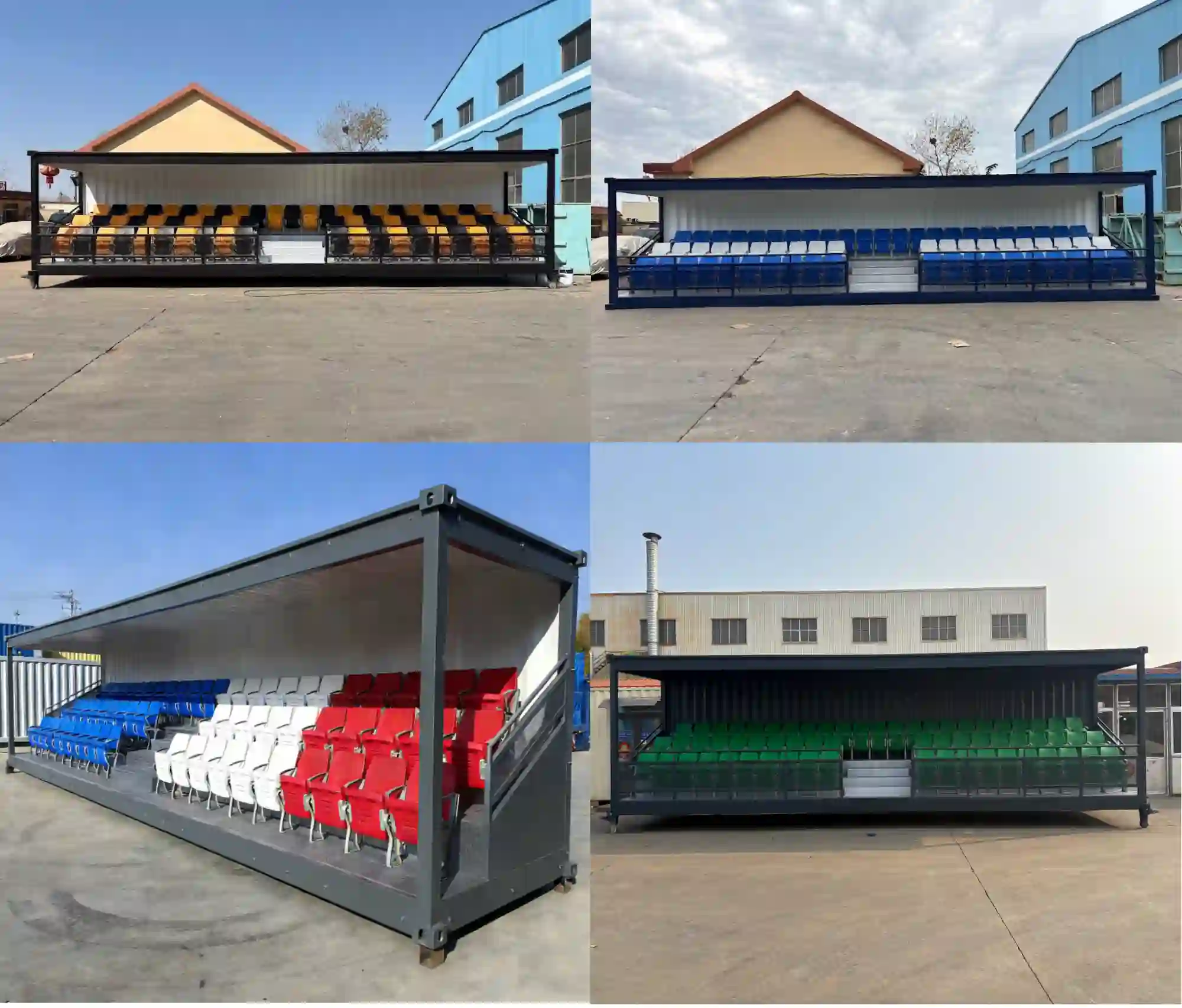
Once you’ve finalized specifications for a 40ft container grandstand with 63 seats, the next practical question is almost always logistical: how does the unit actually get from the factory floor to your venue? Shipping a self-contained, foldable grandstand housed inside a standard 40ft container is more straightforward than shipping loose structural steel, but buyers still benefit from understanding how production notification, freight agent selection, and port logistics fit together. This article walks through that process objectively, based on standard export practice for containerized sporting and event infrastructure.

Step 1: Production Completion Notification

For any B2B order of this scale, the manufacturer should notify the buyer as soon as production is completed and the unit has passed final quality inspection. This notification typically includes photos or video of the finished grandstand, confirmation that it has been loaded and secured inside the 40ft container, and the estimated readiness date for pickup. Buyers should request this checkpoint explicitly in their purchase agreement, since it is the trigger point for booking transportation — whether that means dispatching your own trucking arrangement to the factory gate or instructing a freight forwarder to schedule a vessel slot.

Step 2: Choosing How the Container Is Transported

There are generally two paths for moving the container grandstand from factory to destination port, and buyers are free to choose either:

  • Appoint your own freight agent. If you already have an established relationship with a forwarder in your home market, the manufacturer can communicate directly with that agent to arrange pickup, export documentation, and vessel booking. This is often preferred by buyers who want tighter control over freight cost negotiation or who are consolidating this shipment with other imports.
  • Use the manufacturer’s transportation team. Alternatively, the manufacturer’s own logistics team can manage the full export process — trucking the container to port, completing customs clearance, and booking ocean freight. This route tends to reduce coordination overhead for buyers who are ordering internationally for the first time.

Neither approach is inherently better; the right choice depends on your internal logistics resources, whether you’re combining this shipment with other cargo, and how much visibility you want into freight cost breakdowns. According to the International Chamber of Commerce’s Incoterms guidance, the choice of shipping terms (such as FOB or CIF) directly determines which party is responsible for freight booking and risk transfer at each stage, so it’s worth confirming the agreed Incoterm before deciding who manages transportation.

Step 3: Why Qingdao Port Matters for This Product Line

For container grandstand exports, Qingdao Port is typically the nearest major deep-water port to the manufacturing base, which has practical implications for buyers:

  • Shorter inland trucking distance from factory to port reduces the risk of in-transit damage to the folded seating structure.
  • Qingdao maintains frequent liner services to major markets, which helps keep transit schedules predictable rather than dependent on transshipment.
  • Established container-handling infrastructure at major Chinese ports supports standard 40ft high-cube containers without special equipment requests.

Qingdao ranks among the world’s busiest container ports by throughput, a scale reflected in global rankings such as the World Shipping Council’s Top 50 Container Ports list, which tracks annual TEU volume across major global gateways. That volume generally translates into more sailing frequency and carrier options for outbound B2B freight compared with smaller regional ports.

Step 4: Realistic Timeline Expectations

For a single 40ft container grandstand with 63 seats, buyers should plan around the following general sequence, understanding that exact timing varies by carrier schedule and destination:

  1. Production and QA completion — confirmed via notification from the factory.
  2. Inland trucking from factory to Qingdao Port — typically a short-haul movement of one to a few days depending on exact origin.
  3. Port processing and customs export clearance.
  4. Ocean transit time — this varies significantly by destination region and should be confirmed with your carrier or forwarder based on current sailing schedules.
  5. Destination port handling and final-mile delivery to your venue or installation site.

Ocean freight transit times fluctuate with port congestion, seasonal demand, and carrier capacity. The UNCTAD Review of Maritime Transport tracks these industry-wide trends annually, and it’s a useful reference for buyers trying to set realistic expectations for lead time rather than relying solely on quoted “standard” transit days, which can shift with broader shipping market conditions.

What This Means for Your Purchase Planning

If you’re evaluating a 40ft container grandstand purchase, build your installation timeline backward from your event date, adding buffer time for customs clearance and final-mile delivery rather than assuming door-to-door delivery matches the shortest quoted ocean transit figure. For the full purchasing process — from initial inquiry through production, payment terms, and delivery — see the complete Buyer’s Guide: How to Buy a Container Grandstand, which covers each stage of the procurement process in sequence.

Frequently Asked Questions

Who notifies the buyer when the container grandstand is ready?

The manufacturer notifies the buyer as soon as production is completed, so the buyer can begin coordinating pickup or booking a vessel without delay.

Can I use my own freight forwarder for a container grandstand order?

Yes. Buyers can appoint their own freight agent and have the manufacturer communicate directly with that agent, or they can rely on the manufacturer’s own transportation team to arrange shipment.

Which port is used for exporting 40ft container grandstands?

Qingdao Port is typically the nearest major export port, offering established container shipping routes and reliable vessel scheduling for global buyers.

Container Grandstand Production Timeline: What to Expect From Order to Delivery

Container Grandstand Production Timeline: What to Expect From Order to Delivery

Timeline is one of the first planning questions any buyer asks — especially when a grandstand needs to be ready ahead of a sports season, a school opening, or an event date. This guide explains our standard production timeline, what can extend it, and how we keep buyers informed at every stage.

1. Standard Production Time: Approximately 30 Days

For a standard configuration, our typical production time is around 30 days from order confirmation and deposit payment to factory completion. This covers structural fabrication, seating module assembly, welding and finishing, quality inspection, and pre-shipment preparation. Our minimum order quantity is just 1 unit, so this 30-day estimate applies whether you’re ordering a single grandstand or the first batch of a larger rollout.

As a reference point, our standard 40FT container grandstand with 63 seats is priced at EXW $14,000 USD at MOQ 1, and generally falls within this standard production window when no major customization is involved.

2. What Can Extend the Timeline

2.1 Customization Complexity

Standard configurations move fastest through production because tooling, cutting patterns, and assembly sequences are already optimized. When a buyer requests non-standard seat counts, custom roofing structures, branded color schemes, or added features like VIP boxes or accessibility ramps, additional engineering review and fabrication steps are required. Structural modifications are cross-checked against relevant design codes — for example, wind and seismic load provisions under ISO 19902 structural design standards — before fabrication begins, which can add to the schedule depending on complexity.

2.2 Order Volume

Larger orders naturally require more production line time. A single unit and a 10-unit order don’t scale linearly in production days, since batch runs benefit from shared setup — but buyers ordering in volume should expect the schedule to extend beyond the 30-day baseline, and we provide a specific timeline estimate once quantity and configuration are confirmed.

3. Production Timeline vs. Total Delivery Timeline

It’s important to distinguish production time from total delivery time. Production is only one phase — after fabrication is complete, the unit still needs to clear pre-shipment inspection, be loaded and transported to port, and complete ocean freight to the destination country. Ocean freight duration depends heavily on origin and destination ports; buyers can reference general transit benchmarks through resources like Freightos’ ocean freight transit time data when planning installation dates. Import clearance also depends on destination country customs procedures and any required compliance documentation — for buyers in Australia specifically, this includes checks aligned with Australian biosecurity import requirements for goods shipped in wood-packaged or container-based cargo.

Phase Typical Duration Notes
Production (standard config) ~30 days Extends with customization or high volume
Pre-shipment inspection 1–3 days Can be done in parallel with final packing
Port-to-port ocean freight Varies by route Confirm with your freight forwarder based on destination
Customs clearance (destination) Varies by country Depends on local import regulations and documentation readiness

4. How We Keep You Updated

We provide production updates early and proactively — buyers don’t need to chase status reports. Typical touchpoints include confirmation of production start, mid-production progress with photos, pre-shipment inspection results, and shipping documentation once the unit is loaded. If any factor is likely to extend the timeline (customization complexity, material lead time, or order volume adjustments), we flag this as early as possible so you can plan installation and logistics accordingly.

5. Planning Your Order Around a Deadline

If you’re working against a fixed date — a season opener, an event, or a school term start — we recommend confirming your order at least 60–75 days ahead of the date you need the grandstand installed and operational, to comfortably account for production, freight, and customs clearance. For buyers new to this process, our Container Grandstand Buyer’s Guide covers the full procurement timeline step by step, including supplier comparison points and answers to frequently asked questions about ordering, payment, and delivery.

Get a Timeline Estimate for Your Order

Share your target installation date, seat count, and destination port, and we’ll confirm container bleacher a realistic production and delivery schedule.

Container Grandstand MOQ: How Order Quantity Affects Your Unit Price and ROI

Container Grandstand MOQ: How Order Quantity Affects Your Unit Price and ROI

If you’re sourcing container grandstands for a single stadium, a school sports ground, or a multi-venue rollout, one of the first questions you’ll ask is: what’s the minimum order quantity, and how does volume affect price? This guide breaks down our MOQ policy, the real economics behind bulk ordering, and how to calculate the order size that gives you the best return.

1. Our Minimum Order Quantity: Just 1 Unit

Unlike many manufacturers that require bulk commitments before they’ll even quote a price, we accept orders starting from a single 40FT container grandstand unit. This low-MOQ policy exists because our container grandstands are prefabricated, modular structures — each unit is fully self-contained (seating, structural frame, and container shell), so there’s no minimum batch size required to run production efficiently.

This makes container grandstands accessible to a wider range of buyers, including:

  • Schools and universities purchasing a single grandstand for one field
  • Local councils testing a pilot installation before a multi-venue rollout
  • Event organizers who need portable seating for a one-off tournament
  • Sports federations expanding capacity incrementally, venue by venue

2. Reference Pricing: 40FT Container Grandstand (63 Seats)

As a baseline reference, our standard 40FT container grandstand — configured with 63 seats — is priced at EXW $14,000 USD per unit at MOQ 1. EXW (“Ex Works”) is a standard ICC Incoterms® trade term meaning the buyer takes responsibility for freight, insurance, and export clearance from our factory gate — a distinction worth understanding before comparing quotes across suppliers. This figure gives buyers a starting point for budgeting, though final pricing depends on seating configuration, roofing, guardrails, branding, and certification requirements. For a full breakdown of what drives the quote up or down, see our pricing factors cluster article.

3. Why Larger Orders Reduce Your Unit Cost

While MOQ 1 keeps the door open for small buyers, ordering in larger quantities meaningfully changes your unit economics. Three mechanisms drive this:

3.1 Production Efficiency at Scale

Structural steel cutting, welding jigs, and seating module assembly all have setup costs that get distributed across the batch. When we run 5, 10, or 20+ units in a single production cycle, the per-unit share of tooling, setup, and QC time drops — and that saving is reflected directly in your unit price.

3.2 Shipping Cost Per Unit Drops Significantly

Ocean freight is priced primarily by container/vessel space, not by product count. A single 40FT container grandstand ships as one 40FT unit — but when you consolidate multiple units into the same shipment or vessel booking, you gain leverage on freight rates and reduce per-unit logistics overhead. Container dimensions and structural classification for 40FT units follow the ISO 668 series of standards for freight container classification, which is useful reference when coordinating with a freight forwarder. For buyers importing to Australia, the EU, the Middle East, or Southeast Asia, freight can represent a meaningful share of landed cost, so this compounding effect matters at scale.

3.3 Profit Margins Increase With Volume

Because fixed costs (engineering review, documentation, export compliance checks) are largely quantity-independent, spreading them over more units directly improves your margin per seat sold or per venue equipped — particularly relevant if you’re a distributor, contractor, or rental operator reselling capacity rather than an end-user installing for a single venue.

4. MOQ vs. Bulk Order: Which Should You Choose?

Buyer Profile Recommended Order Size Why
Single school/venue, first purchase 1 unit (MOQ) Test fit, installation process, and after-sales service before scaling
Multi-venue council or federation rollout 5–10 units Meaningful unit cost and freight savings begin to compound
Distributor / rental fleet operator 10+ units Maximizes margin per unit for resale or rental deployment
Large-scale stadium or multi-site project 20+ units Best achievable EXW pricing and consolidated shipping economics

5. Calculating Your ROI at Different Order Volumes

When evaluating order size, buyers should weigh three factors together rather than focusing on unit price alone: EXW unit cost, freight cost per unit, and expected utilization (seats deployed vs. seats sitting in storage). Whenever possible, increasing quantity improves your ROI — but only up to the point where deployment capacity keeps pace with delivery. We recommend phased ordering (e.g., 5 units now, 5 units in the next fiscal cycle) for buyers who want volume pricing without overcommitting capital upfront.

6. Requesting a Volume Quote

Because pricing scales with configuration and quantity together, we provide tailored quotes rather than a fixed volume price list. To get an accurate number for your project — whether that’s 1 unit or 50 — share your target seat count, delivery region, and timeline, and our team will return a formal quotation with EXW and shipping-inclusive options. For larger or multi-unit orders, we recommend arranging independent pre-shipment inspection through a third party such as Bureau Veritas inspection services before final payment release.

If this is your first time importing a container grandstand, our Container Grandstand Buyer’s Guide walks through the full procurement process step by step — including supplier comparison criteria and answers to the most common buyer questions.

Get Your Container Grandstand Quote

Tell us your required quantity and destination port, and we’ll providecontainer grandstand EXW and CIF pricing within 24 hours.


Why Communication Quality Matters as Much as Product Quality in Container Grandstand Export

Why Communication Quality Matters as Much as Product Quality in Container Grandstand Export

When sourcing a container grandstand for an international project, buyers often focus entirely on steel specs and pricing — and overlook a factor that causes just as many costly mistakes: communication quality during the export process. A miscommunicated seat count, an unconfirmed technical detail, or a rushed answer to an engineering question can lead to shipment delays, wrong configurations, or compliance issues once the structure arrives on site.

This article looks at why professional, accuracy-first communication is a core part of our container grandstand service — not a soft add-on — and what buyers should expect when working with a serious export partner.

The Real Cost of Poor Communication in Foreign Trade

Foreign trade transactions involve more moving parts than a domestic sale: customs documentation, container loading specs, structural certifications, and cross-language technical exchanges. When any of these are handled by a team without real export experience, small misunderstandings compound. A seat count gets misquoted. A layout requirement gets lost in translation. A delivery timeline is confirmed without checking production capacity.

For a structural product like a container grandstand — where seating capacity, structural load, and layout configuration must match the buyer’s exact use case — this is not a minor risk. It’s the difference between a stand that fits the venue and one that requires costly on-site rework.

What Our Export Team Brings to Every Inquiry

5+ Years of Foreign Trade Experience

Our export team has spent years handling international B2B transactions specifically, not just general customer service. That experience means fewer assumptions, more proactive clarification, and a working understanding of what buyers in different regions typically need — from documentation to shipping terms.

Clear English Communication, Supported by Translation Tools

All inquiries are handled in clear, professional English by default. For buyers who prefer or require another language, our team uses translation tools to ensure nothing gets lost — but every technical detail is still verified by a native English-speaking team member before it’s confirmed back to the client, reducing the risk of translation-based errors on critical specs.

Engineer-Verified Technical Answers

This is the detail most suppliers skip: before confirming structural, dimensional, or material specifications — including anything relevant to a 40FT container grandstand configured for 63 seats — our team checks with engineers rather than guessing or reciting a generic answer. This is why replies sometimes take a little longer than a same-minute chat response. We treat that delay as a feature, not a flaw: a confirmed answer is worth more than a fast one when the buyer is making a purchasing decision based on it.

This approach mirrors general procurement best practice — buyers evaluating technical suppliers are generally advised to weight response accuracy and technical verification over speed, since errors caught after order confirmation are far more expensive to fix than a short delay in the inquiry stage.

Focused, Not Diversified

We work exclusively on container grandstand solutions. That focus means our team isn’t splitting technical knowledge across dozens of unrelated container product lines, and buyers won’t encounter unrelated upselling during what should be a straightforward technical conversation about seating capacity, layout, or delivery scope.

Communication as Part of Total Landed Value

Buyers evaluating suppliers for temporary or modular public structures are increasingly advised to assess vendor communication and documentation practices as part of overall procurement risk — not as a separate, soft consideration. Structural product categories in particular benefit from documented, engineer-verified specification exchanges, since these records often matter for later compliance or insurance review. International trade guidance also generally recommends buyers confirm technical specifications in writing before production begins, precisely to avoid the kind of misalignment that undermines otherwise well-built products.

For reference, buyers can review general supplier evaluation frameworks from:

What This Means for a 40FT / 63-Seat Order

For a configuration like our 40FT container grandstand with 63 seats, communication accuracy touches nearly every stage: confirming seat spacing and row layout, verifying container welding specs with engineers, and making sure delivery scope is documented before production starts. Buyers working with our export team can expect every one of these details to be confirmed in writing, checked technically, and communicated clearly — even if that means a reply takes a bit longer than expected.


This article is part of our container grandstand resource hub, covering the full buyer decision process from pricing to service experience. For a complete breakdown of how pricing, materials, and delivery scope work together across our container grandstand range, see our Container Grandstand purchasing guide

container grandstand for sports stadium seatin

Container Grandstand Price: What Determines the Real Cost of a 40FT Modular Stand

Container Grandstand Price: What Determines the Real Cost of a 40FT Modular Stand

When international buyers request for a container grandstand price, they often expect a single flat number. In reality, container grandstand pricing is shaped by several variables — and understanding them is the difference between choosing a trustworthy supplier and falling into the trap of an unrealistically cheap offer that costs far more in repairs, downtime, and safety risk over its service life.

This article breaks down the core pricing factors for container-based grandstands, using our 40FT / 63-seat model as a reference point, and explains why transparent, factor-based pricing is a signal of supplier reliability — not a red flag.

Why “Cheapest container grandstand Price” Is the Wrong First Question

Before diving into cost breakdowns, it’s worth repeating a warning that matters more than any spec sheet: extremely low-priced container grandstands are almost always a signal of low-grade steel, thin-gauge welding, or substandard coatings. The visible symptoms show up later — rust bleeding through paint within a season, water leakage around seams, and in worst cases, structural failure under crowd load. A grandstand is temporary infrastructure holding real people; the cost of failure is not just financial.

That’s the foundation of our container grandstand pricing framework — every quote reflects material grade, structural engineering, and finish quality, not just a container shell with seats bolted on.

The Four Factors That Shape Container Grandstand Pricing

1. Interior Finishing Level

The finishing level inside a container grandstand affects both durability and end-user comfort. Options typically range from basic painted interiors to fully finished units with insulated panels, non-slip flooring, and integrated wiring for lighting or signage. Higher finishing levels raise unit cost but significantly extend service life in outdoor, high-UV, or coastal environments where corrosion risk is elevated.

2. Seat Structure and Durability

Seating is not a cosmetic add-on — it’s a load-bearing, high-wear component. Sturdy, durable seating systems use thicker-gauge steel frames, corrosion-resistant fasteners, and UV-stable seat materials designed for repeated public use across multiple event cycles. Cheaper seat assemblies cut costs here first, since seat quality is less visible in a photo than the container shell itself.

3. Complete Delivery Scope for Temporary Grandstands

For temporary or touring events, pricing must reflect the full delivery scope, not just the unit itself. This includes:

  • Transport-ready folding or telescopic mechanisms
  • Setup and breakdown compatibility for repeated relocation
  • Any accessory components (guardrails, stairs, roofing) required for a compliant temporary structure

Buyers comparing quotes should confirm whether “complete delivery” is actually included, or whether it’s an unlisted add-on that appears after the deposit is paid.

4. Custom Layout Requirements

Standard tiered layouts cost less than customized row spacing, ADA-compliant access points, VIP sections, or non-standard capacity configurations. Custom engineering work — and any corresponding structural recalculation — is reflected in the final price.

Reference Pricing: 40FT Container Grandstand, 63 Seats

As a practical benchmark, our 40FT container grandstand configured for 63 seats is priced at USD $14,000 EXW.

This EXW (Ex Works) pricing reflects:

  • Latest-build containers, welded specifically for grandstand structural use (not repurposed or aged shipping stock)
  • Durable seat framing built for repeated public load-bearing use
  • Standard finishing suitable for outdoor sports, school, and community event use

EXW pricing means the buyer arranges freight from our factory; we’re glad to provide destination-inclusive quotes on request once loading port and destination are confirmed.

Why We Use Only Latest-Build Containers

Grandstand welding requires structural integrity that aged or corroded containers cannot reliably guarantee. Using latest-condition containers as the welding base reduces the risk of hidden fatigue points in the steel — a factor that becomes critical once a structure is load-bearing for public seating. This is a foundational part of how we protect long-term durability and value in every quote, and it’s a major reason our pricing sits above the lowest-cost offers in the market.

For buyers wanting to understand international structural safety expectations for temporary grandstands, the IStructE guidance on temporary demountable structures is a useful independent reference point when evaluating supplier claims.

Choosing a Supplier: What to Ask For

When comparing container grandstand price, ask suppliers to specify:

  1. Container age/condition used for welding
  2. Seat frame gauge and material spec
  3. Whether “complete delivery” includes transport-ready mechanisms and accessories
  4. Whether custom layout work is priced separately

A supplier willing to break down pricing against these four factors — rather than offering a single opaque number — is signaling the kind of transparency that protects your investment over the structure’s full service life.


This article is part of our container grandstand resource hub. For a full breakdown of how interior finishing, seat durability, delivery scope, and custom layouts interact to determine pricing across our full range of container grandstand models, see our Container Grandstand guide

Container Grandstand Factory Inspection: What Buyers Should Check Before Placing an Order

Why Factory Inspection Matters for Container Grandstand Buyers

For B2B buyers sourcing large modular structures like container grandstands, the purchase decision rarely rests on price alone. A grandstand is a load-bearing, public-safety structure — used at stadiums, festivals, race tracks, and temporary event venues — so structural integrity, material quality, and manufacturing consistency directly affect the buyer’s liability and end-user safety.

Unlike smaller consumer goods, defects in a grandstand’s steel frame or welds are difficult to detect after installation and costly to remedy on site. This is why experienced international buyers increasingly treat a factory audit as a standard step in the procurement process, rather than an optional courtesy. At GKC, we welcome clients to visit our factory precisely because it removes uncertainty from a high-stakes purchase.

The Problem: Sourcing Structural Products from a Distance

Most overseas buyers cannot physically evaluate a supplier’s capabilities before signing a contract. Common risks include:

  • Unverified welding quality — a weak weld is invisible in photos or a finished product but critical to structural load capacity.
  • Substituted raw materials — steel grade, wall thickness, or coating specifications can be downgraded to cut cost without the buyer’s knowledge.
  • Inflated production capacity claims — some trading companies present factory photos that are not their own, misrepresenting scale or equipment.
  • Inconsistent quality control — without visibility into the production line, buyers cannot confirm whether inspection checkpoints actually exist.

These risks are amplified for container grandstands specifically, because the product combines structural steel engineering with modular container fabrication — two disciplines that require different quality controls.

The Solution: What an On-Site Factory Inspection Reveals

A factory visit allows buyers to verify, first-hand, the claims made in a supplier’s catalog or sales conversations. A well-organized inspection typically covers four areas:

1. Real Production Lines

Buyers can observe whether the factory operates active, sufficiently equipped production lines — confirming manufacturing capacity matches quoted lead times and order volumes, rather than relying on outsourced or subcontracted fabrication without disclosure.

2. Raw Materials and Welding Quality

This is the most safety-critical inspection point. Buyers should be able to:

  • Check mill certificates for steel grade and thickness against the technical specification sheet
  • Observe welding technique, bead consistency, and whether welders hold relevant certifications
  • Request non-destructive testing (NDT) results or ask for weld sampling where applicable

3. New Models and Product Innovation

Viewing prototypes or recently developed models — such as accessible seating modules, quick-assembly connectors, or weather-resistant finishes — helps buyers assess whether a supplier invests in R&D or simply replicates existing designs.

4. End-to-End Manufacturing Process

Walking the full process, from steel cutting and container shell fabrication through assembly, painting, and final QC, gives buyers a transparent view of where quality checkpoints occur and how defects are caught before shipment.

What This Means for Procurement Decisions

Buyers who complete a factory inspection are typically able to negotiate contracts with greater confidence, specify tighter quality clauses, and reduce the risk of disputes over material substitution or workmanship after delivery. This is consistent with international sourcing best practices: standards such as ISO 9001 quality management systems and pre-shipment inspection protocols used by many industrial buyers exist precisely because on-paper certifications alone do not guarantee consistent execution on the factory floor. Structural welding for steel components is also commonly benchmarked against codes such as AWS D1.1 Structural Welding Code or, for buyers in Europe and the UK, Eurocode 3 for steel structure design.

For buyers unable to travel, a reasonable alternative is a third-party inspection service — such as SGS, Bureau Veritas, or TÜV — conducted on their behalf, or a live video walkthrough of the production line and welding stations. Buyers weighing this option alongside other supplier evaluation criteria may find it useful to review our supplier comparison guide, which outlines how factory audits fit into a broader vendor evaluation checklist.

Practical Tips for Planning a Factory Visit

  • Request the visit during active production, not only during a showroom tour, to see real working conditions.
  • Bring your technical specification sheet so materials and dimensions can be checked directly against production.
  • Ask to see mill certificates and quality inspection records, not just the finished product.
  • Photograph or video the welding and material stages for your own internal procurement records.
  • Combine the visit with a factory audit checklist covering equipment, workforce, safety compliance, and warehousing.

Conclusion

A factory inspection is not a formality — it is a practical risk-management tool for buyers investing in structural, safety-relevant products like container grandstands. Suppliers who welcome open access to their production lines, raw material documentation, and welding processes are generally signaling confidence in their own quality control systems. For international buyers evaluatingcontainer grandstand suppliers, requesting — or arranging a proxy inspection of — the factory should be treated as a standard part of due diligence, not an exception.

How to do Container Grandstand Maintenance?

Container Grandstand Maintenance: How to Prevent Rust on Outdoor Installations

The Problem: Even Quality Steel Rusts Without Maintenance

A container grandstand built with galvanized Q235 steel and anti-corrosion coating is designed for 15–25+ years of service — but that lifespan assumes ongoing maintenance, not a “set it and forget it” installation. Outdoor exposure to rain, humidity, UV, and temperature swings gradually breaks down even high-quality protective coatings. According to corrosion research published by NACE/AMPP, the global cost of corrosion across infrastructure runs into trillions of dollars annually — and the majority of that damage is preventable through routine maintenance, not better materials alone.

For buyers, this means: the material spec gets you a durable structure, but the maintenance plan is what actually delivers the 15-25 year lifespan in practice.

Why Outdoor Container Grandstands Are Especially Vulnerable

Unlike indoor stadium seating, container grandstands are freestanding, fully exposed structures. Three conditions accelerate wear:

  1. Standing water and poor drainage — water pooling at joints, seams, or the base frame is the single biggest driver of localized rust, even on galvanized steel.
  2. Coating wear at high-friction points — staircases, handrails, and seat connection points see the most foot traffic and contact, wearing through protective coating faster than open frame sections.
  3. Coastal salt exposure — even with anti-corrosion treatment, salt air re-deposits on exposed steel between maintenance cycles, requiring more frequent inspection in coastal regions.

The Solution: A Practical Maintenance Schedule

Every 3 months

  • Inspect for surface rust at welds, bolts, and joint connections — these fail before open steel surfaces because coating is thinnest there.
  • Clear drainage points and seams of debris to prevent water pooling.
  • Check handrails and staircases for coating wear from foot traffic.

Every 6 months

  • Re-tighten structural bolts and fasteners, which loosen slightly from thermal expansion/contraction cycles.
  • Touch up any coating chips or scratches with matching anti-corrosion paint before they spread.
  • For coastal installations, rinse salt residue from the frame with fresh water.

Annually

  • Full structural inspection, including load-bearing joints and staircase connections.
  • Re-apply protective coating to any high-wear zones identified during quarterly checks.
  • Document inspection results — useful for warranty claims and for government/tender compliance records.

What Happens If Maintenance Is Skipped

Timeframe Without Maintenance Typical Result
6-12 months Minor surface rust at joints, still cosmetic
1-3 years Rust penetrates coating at high-wear points (stairs, rails)
3-5 years Structural weakening at affected joints; safety risk under full load
5+ years Potential need for partial frame replacement, costing more than maintenance ever would have

How We Help Reduce Maintenance Burden From the Start

Maintenance is easier when the structure is engineered to need less of it:

  • Hot-dip galvanizing (tested to ISO 1461) provides a thicker, more durable protective layer than painted steel alone — extending the interval between required touch-ups.
  • Drainage-optimized frame design reduces standing water at joints, the leading cause of localized corrosion.
  • Reinforced high-traffic points (stairs, handrails, seat connections) use upgraded coating thickness specifically because they wear faster than open frame sections.

This doesn’t eliminate maintenance — no outdoor steel structure is maintenance-free — but it significantly extends the interval between required service and reduces the cost of upkeep over the structure’s lifespan.

The Bottom Line

A container grandstand’s 15-25 year lifespan isn’t automatic — it’s the result of correct material selection at the manufacturing stage, combined with a consistent maintenance schedule after installation. Buyers who treat maintenance as optional typically see real structural issues within 3-5 years; buyers who follow a quarterly inspection routine routinely get the full rated service life.

Would you like to receive information on the specific materials and product details of the container-based grandstand?

Container Grandstand Materials: How to Avoid Corrosion, Structural Failure, and Compliance Rejection

Container Grandstand Materials: How to Avoid Corrosion, Structural Failure, and Compliance Rejection

Container Grandstand Materials: How to Avoid Corrosion, Structural Failure, and Compliance Rejection

Most buyers only realize the problem too late
Three issues quietly destroy the investment in container viewing platforms – and these hidden dangers are completely not shown in the basic quotation:
Because the steel was not designed according to the climatic conditions of the actual installation environment, the frame will be corroded and damaged within 2 to 3 years.
The structure deforms when carrying a full load of people because the frame was built according to general specifications rather than the actual load-bearing capacity of the site.
The project gets stuck at customs or fails the tender review due to materials not meeting the certification requirements of the destination market.
When these situations occur, the viewing platform has already been installed – and the cost of repairing it is much higher than selecting the correct type before construction. Here are the methods to prevent each problem.

Question 1: Corrosion in coastal or high-humidity areas

Reason: Salty and humid air and high humidity significantly accelerate the oxidation rate of steel, far exceeding that in inland environments. According to the corrosion engineering data from NACE/AMPP, marine and coastal atmospheric environments are the most severe corrosive conditions for unprotected carbon steel – untreated frames can exhibit measurable deterioration after continuous exposure for several years.
Solution: Before the manufacturing process begins, rather than after installation, it is necessary to specify the use of anti-corrosion steel frames with rust-proof coatings. Usually, a combination of hot-dip galvanizing and protective topcoats is adopted instead of simply painting the steel, as the latter can only delay corrosion but cannot prevent it. Then, regular anti-corrosion maintenance should be carried out for the container platforms.
How to verify: Test to confirm whether the paint layer meets international standards.

Question 2: Causes of structural failure when the venue is fully occupied:

The price of the stands is usually based on the area they cover, rather than the actual seating load capacity. Even if the structural drawings appear exactly the same, their performance can vary significantly when the number of spectators exceeds the capacity – especially during events when they are affected by wind loads or uneven crowd movement.
Solution: For any high-capacity installation project, the framework needs to adopt specially designed reinforced load-bearing structures to accommodate the actual seating density and crowd weight that the venue is expected to bear, rather than simply enlarging the standard modules for use. This includes strengthening the lateral supports, upgrading the structural steel sections, and conducting tests for both static loads (seat capacity) and dynamic loads (crowd movement, wind force).
How to verify: Require the supplier to conduct quality inspection and inquire whether this structure has been calculated in accordance with the recognized load standards.

Question 3: Why does non-compliance occur when submitting bids in the EU or through government tenders?

Many buyers believe that “steel is steel” – but the EU market and most government procurement processes require a formal CE certification to prove that the products meet harmonized safety standards. Without this certification, your project may be rejected at customs, blocked during the tender evaluation process, or marked during the import inspection, and the goods may have already been shipped.
Solution: Choose manufacturers that produce in accordance with CE compliance standards from the very beginning and prepare the relevant documents before shipment, rather than making “post-event remediation” commitments afterwards.
How to verify: Obtain the CE certificate directly and compare it with the official CE marking guidelines of the European Commission to ensure that it covers the correct product category.

Not sure which material specification is suitable for the climate conditions, load-bearing requirements or market demands of your project? Please tell us your geographical location and the estimated number of visitors. We will provide you with purchase options and CE certification documents before you place your order.

[Get free material specification consultation →]

uk container grandstand project introduce

UK Container Grandstand project Solution

How Customised Container Grandstands Are Transforming UK Event Revenue

UK Container Grandstand project have quietly become the answer:robust, scalable, and now — thanks to advanced manufacturing and deep customisation — genuinely premium.

The UK events industry — from premier horse racing and rugby to music festivals and corporate hospitality — has always demanded more than bare seating. Organisers and sponsors alike expect structures that perform commercially as well as physically.Over the past three years, a growing number of UK importers and event operators have discovered that the right container grandstand is not just infrastructure. It is a revenue platform.

What makes a container grandstand different?

Unlike traditional temporary structures that require weeks of on-site labour, container grandstands are built off-site, shipped in standard ISO containers, and assembled in days. Each grandstand unit is structurally self-contained, stackable, and rated to meet or exceed UK Health and Safety Executive (HSE) guidance on temporary structures at events.

But the real competitive edge — particularly for UK clients — lies in what can be done before the steel is ever bolted together. Today’s leading manufacturers offer end-to-end customisation that transforms a functional seating structure into a fully branded, commercially differentiated hospitality product.

40%average uplift in sponsor package value
100%DDA-compliant access configurations available
15+custom RAL colours for seats and fascias

Four customisations driving UK client revenue

UK importers consistently highlight four features that have had the most measurable impact on event income and client retention. Here is how each one works in practice.

Sponsor logo integration

Full-colour, UV-resistant branding applied to fascias, risers, and seat backs — visible from the pitch and from broadcast cameras.

VIP seat engraving

Individual seat names CNC-engraved or laser-etched into premium seat backs — creating permanent, personal hospitality assets clients can sell year on year.

Custom colour seats

Club colours, sponsor palettes, or bespoke RAL matches across every seat — consistent, durable, and visually powerful at any scale.

Wheelchair & disabled access

Integrated level-access aisles, designated wheelchair bays, and compliant ramping — meeting the Equality Act 2010 and DDA obligations from day one.

Sponsor logo customisation: turning structure into a media asset

The front fascia of a grandstand is prime media real estate. In a typical UK sports broadcast, a well-positioned branded fascia can achieve equivalent exposure to a pitch-side LED board — but at a fraction of the cost and with far longer durable life. Our container grandstands accept full-bleed vinyl graphics, painted steel branding panels, or digitally printed polycarbonate inserts, with artwork produced to specification from your sponsor’s brand guidelines.

UK event operators report that the ability to offer branded grandstand real estate has unlocked new sponsorship conversations — particularly with title sponsors seeking tangible, long-term visibility beyond digital inventory. According to Event Industry News, experiential and visible venue branding has become one of the top three factors sponsors consider when evaluating UK events partnerships.

VIP seat engraving: the hospitality product that sells itself

There is a meaningful difference between a seat a guest is allocated and a seat that bears their name. CNC-engraved or laser-etched personalised seat plaques — fitted flush to premium seat backs — have become one of the most effective upsell mechanisms available to UK hospitality teams.

“A named seat is no longer just a physical thing — it is a relationship. Clients renew their packages because their name is on the stand.”

— UK Racing Venue Hospitality Director (composite client feedback)

The commercial model is straightforward: a venue or event operator sells named seats as multi-year hospitality packages, with the engraving acting as both a premium differentiator and a retention mechanism. The seats themselves are durable enough to carry the engraving for ten or more seasons, making the initial customisation cost negligible against the lifetime package value.

Custom colour seats: brand coherence at scale

Stadium-grade injection-moulded polypropylene seats are available across a broad RAL colour spectrum. For UK clubs and event operators, this means grandstands that arrive in team colours, sponsor palettes, or venue-specific schemes — without any on-site painting or finishing work. Seats are UV-stabilised and frost-resistant, which matters considerably in the UK climate.

The visual impact of a colour-matched stand is significant: it signals investment, permanence, and attention to detail — all of which feed directly into the perceived value of sponsor placements and hospitality packages within the structure.

Disability access: compliance as competitive advantage

The Equality Act 2010 and the Sport England Accessible Sports Facilities guidance set clear expectations for event seating. Our container grandstands are configured with level-access aisles running perpendicular to the seating banks, integrated wheelchair bays with companion seating, and ramped approaches that meet Part M of the Building Regulations.

Beyond legal compliance, accessible configuration meaningfully expands the addressable audience for any event. UK local authorities and sports governing bodies increasingly require evidenced accessibility provision as a condition of venue licensing — making DDA-compliant grandstand design not just ethical but commercially necessary.


What this means for UK importers and event operators

The aggregate effect of these customisation options is a structural shift in what UK clients can charge for event seating. A standard general-admission temporary stand sells on capacity. A customised container grandstand — with sponsor branding, named VIP seats, club-colour seating, and inclusive access — sells on experience, exclusivity, and commercial partnership.

Several of our UK import clients have reported sponsorship package uplifts of 30–50% following grandstand customisation, with named-seat hospitality programmes generating annualised revenue that comfortably exceeds the original structure cost within two seasons.

Getting started: what UK clients need to know

Lead times for customised container grandstands are typically 10–14 weeks from design sign-off to delivery at UK port, with assembly taking 3–5 days on site depending on configuration and ground conditions. Structural certification is provided to Eurocode structural standards, and each unit ships with full documentation for UK building control and HSE notification purposes.

Customs classification and import duty on temporary seating structures imported into the UK currently falls under Commodity Code 9406 (prefabricated buildings), and buyers are advised to confirm current tariff rates with a licensed customs broker. For reference, the UK Global Tariff tool provides up-to-date commodity classification and duty rates.

Whether you are planning a one-season festival structure or a permanent-feel event venue that travels with your portfolio, the commercial case for customised container grandstands in the UK market has never been stronger.

Regarding container grandstands, we have projects from other countries available for your reference; we hope this article helps you understand and purchase grandstands.

Australia Container Grandstand Project: Rental, Lease & Rent-to-Own

Australia Container Grandstand Project solution for budget

A fixed budget should not equate to limitations. This article covers an overview of the Australia container grandstand project.

Across Australia, local councils, regional sports federations, and event management companies face the same recurring challenge: the need for quality spectator infrastructure without the capital expenditure that permanent construction demands.

A concrete grandstand at a regional sportsground can cost between AUD $800,000 and $3.5 million before factoring in planning approvals, extended construction timelines, and ongoing maintenance. For most organisations, that number is simply off the table — and yet the demand for safe, compliant, and comfortable spectator seating is real and growing.

What pain points did our grandstand containers project?

✕

Pain Point

“Our budget is fixed and we can’t afford a permanent structure.” — The #1 objection from Australian councils, sports bodies, and event companies considering grandstand upgrades.

✓

The Solution

Lease or rent-to-own container grandstand models deliver compliant, modular seating at a fraction of the capital cost — with no maintenance liability carried by the client after the event or contract period.

Australia Container Grandstand Project Study: The Football Association of the Victoria Region

our container grandstand exporting project

Real Case · · · Australia, Victoria

From a budget deadlock to the construction of 2,400 seats within 6 weeks

A regional football organization in Victoria, Australia, has been applying for funds from the government for the permanent expansion of the stands for four consecutive years. The project is estimated to cost 1.2 million Australian dollars, far exceeding the government’s available budget. With the recommendation of the state-level association, the organization signed a purchase contract with a container stand supplier.

This modular stand, which can accommodate 2,400 people, is composed of 38 container modules and is installed on the original concrete foundation. It was put into operation 60 days after the contract was signed. The monthly rental cost has been included in the existing infrastructure budget of the association.

Finally, an Australian modular stand project was successfully completed at a cost of 900,000 Australian dollars, reducing the expenditure by 300,000 Australian dollars compared to before and reducing the construction time by 50% compared to traditional stand construction. When the event is over, the container stands can also be rented out to other sports organizations.

“We have entered into a cooperation with this Chinese container stand. They have a professional sales team and technical team. During the procurement stage, I don’t need to invest much effort. I will purchase the container stand again.”

— Infrastructure purchaser, Regional Sports

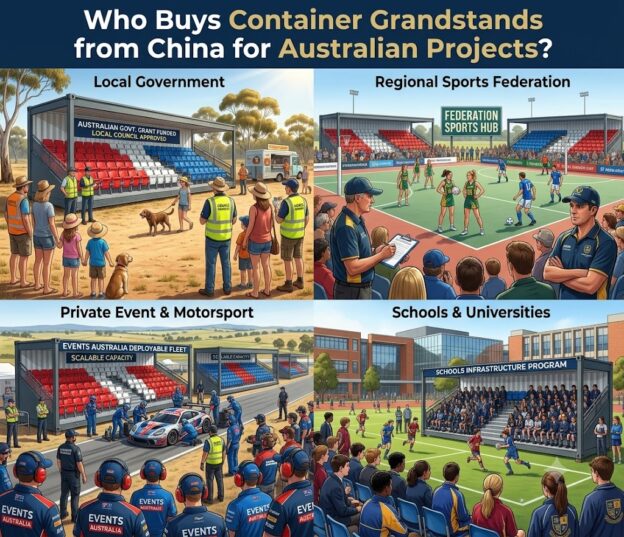
Who Buys Container Grandstands from China for Australian Projects?

The buyer profile for China-manufactured container grandstands exported to Australia is broader than many assume. The common thread is not sector — it is the combination of a defined seating need, a fixed or limited capital budget, and a requirement for speed.

Local Government & Municipal Councils

Regional and rural councils operating under fixed annual capital budgets represent the largest buyer segment. Sports infrastructure grants from Sport Australia, state government programmes, and local budget allocations frequently cover the cost of a China-sourced container grandstand where they would fall short of a permanent build. The shorter procurement and construction timeline also aligns with the financial year cycles that govern council spending approvals.

Regional Sports Federations

Football, rugby, cricket, netball, and athletics federations operating at state or regional level often control their own venues without access to government capital funding. Container grandstands purchased outright from China allow federations to own their spectator infrastructure asset — and critically, to on-hire that asset to other events during non-peak periods, creating a revenue stream that partially offsets the purchase cost.

Private Event & Motorsport Companies

Commercial event operators running motorsport rounds, outdoor festivals, equestrian events, and multi-day concerts require scalable, relocatable grandstand capacity that a permanent structure cannot provide. A fleet of container grandstand modules purchased from a Chinese factory gives event companies a deployable, reusable asset that works across multiple events and multiple sites per year.

Schools & Universities

Educational institutions with active sporting programmes and community-use facilities are a growing buyer segment. Australian Government education infrastructure funding rounds increasingly include sports facility upgrades, and container grandstands fit within typical project budget envelopes where permanent construction would not.

In summary about Australia Container Grandstand Project

Australia container grandstand demand is being driven by a clear structural gap between rising spectator requirements and limited public or private capital budgets. Traditional concrete construction often exceeds financial capacity and delivery timelines, while still carrying long-term maintenance burdens that many councils and event operators want to avoid.
Container grandstand systems provide a practical alternative — combining modular design, rapid deployment, and flexible financial models such as lease or rent-to-own. From regional sports federations to councils and private event operators, the value lies in the same outcome: faster delivery, controlled cost, and the ability to reuse or redeploy assets across multiple venues and seasons.
Rather than treating budget constraints as a limitation, modular infrastructure turns them into a planning advantage. This is the direction modern sports venue development is moving toward — scalable, compliant, and financially flexible seating solutions built for real operational conditions in Australia.
To explore more real deployments and technical configurations, visit our global container grandstand project portfolio and see how Container House Co., Ltd delivers scalable spectator solutions across different countries and event scenarios.