Author Archives: jzxadmin

container grandstand project

American Container Grandstand Project

American Grandstand Project: How Container Grandstands Solve the “Seats in Weeks, Not Months” Problem

From NCAA stadium overflow games to NFL pop-up fan zones, outdoor music festivals, and motorsport events, the American live-event market is facing the same recurring headache: organizers need thousands of extra seats, and they need them fast — often in a matter of weeks, not the months a traditional fixed stand would require.

This is exactly the gap that the container grandstand was engineered to close, and it’s why it has become the go-to answer for any American Grandstand Project running on a tight clock.

container grandstand feature

The Real-World Pressure Behind Every American Grandstand Project

Picture a familiar scenario: a sports organization confirms a qualifying match, a championship round, or a one-off exhibition game only three weeks before kickoff — and the host venue simply doesn’t have enough permanent seating on one side of the field. This is not a hypothetical. It is the everyday reality our team has been called in to solve for clients around the world, and it maps directly onto what American stadium operators, county fairgrounds, and event promoters face every season.

When a venue is short on capacity and the deadline is measured in days, three traditional options usually fail:

  • Permanent stand construction — too slow, too expensive, and often blocked by local zoning or off-season construction windows.
  • Scaffold-style temporary seating — quick to rent, but limited in capacity, weather resistance, and reusability.
  • Doing nothing — turning away ticket revenue and disappointing fans.

A fourth option, modular container grandstands, removes the bottleneck entirely.

What Makes the Container Grandstand Different

The core innovation behind our container grandstand system is that almost all of the heavy lifting happens before the units ever leave the factory. The structural framework and the seating-tier layout are pre-welded and installed inside the container at the factory, rather than being fabricated on-site. That single decision is what compresses a normally months-long build schedule into days.

In practice, this means:

  • Multiple grandstand units can be pre-assembled concurrently in the factory, rather than sequentially on a job site.
  • A site crew using a single mobile crane can erect a grandstand seating roughly 630 spectators in around two working days.
  • Units ship as standard container footprints, simplifying customs, trucking, and rail logistics — a major advantage for any American Grandstand Project that needs to move steel across state lines or through port logistics on a deadline.
  • Because the framework is factory-certified before departure, on-site quality control issues — a common cause of delay in field-welded stands — are largely eliminated.

For a deeper breakdown of how this rapid-deployment workflow runs from factory floor to game day, see our full case study on the container grandstand project.

Why This Matters for the American Market Specifically

American venues operate under some of the strictest life-safety frameworks for temporary spectator structures in the world. The National Fire Protection Association’s NFPA 102 standard governs construction, egress, fire protection, and structural requirements for grandstands and temporary seating used in stadiums, fairgrounds, and assembly venues across the U.S. Any rapid-deployment seating solution brought into an American Grandstand Project needs to be engineered with these life-safety provisions in mind from the design stage — not retrofitted afterward.

This is precisely why factory pre-fabrication matters so much in this market: structural calculations, load testing, and engineering sign-off can be completed and documented before the unit ever reaches the venue, rather than scrambled together under deadline pressure on-site.

Built for the Use Cases American Organizers Actually Face

A modular container grandstand fits naturally into several scenarios common to American sports and event organizers:

  • Temporary capacity boosts for marquee games, rivalry weekends, or postseason runs that exceed a stadium’s normal seating.
  • Touring events and festivals that need professional-grade seating at a different location every few weeks.
  • New or renovating venues that need spectator seating online before permanent stands are finished.
  • Multi-purpose fairgrounds and motorsport tracks that only need full grandstand capacity for a handful of event days per year.

The Bottom Line

Whatever is driving the timeline — a late venue confirmation, a sudden capacity shortfall, or a touring schedule that never sits still — the underlying engineering challenge is the same: build serious, code-compliant spectator seating in a fraction of the usual time. That’s the problem the container grandstand was purpose-built to solve, and it’s the foundation of every successful American Grandstand Project we support.

To see the full rapid-deployment process in action, including factory pre-assembly, crane-based on-site erection, and project timelines, visit our Container Grandstand Project page.

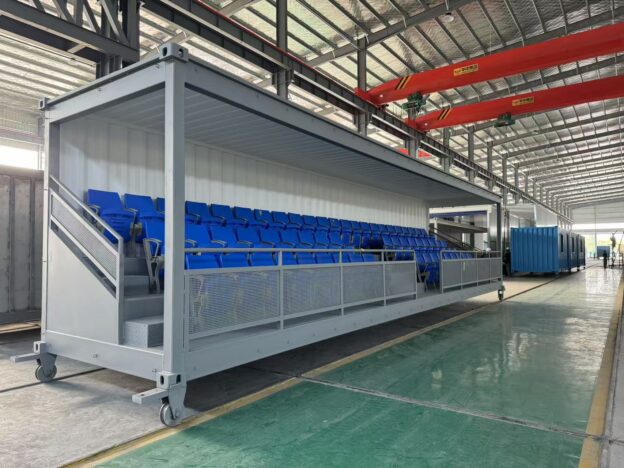
A modular container grandstand structure installed inside a factory, featuring a steel frame with multiple rows of blue stadium seats, safety railings, and an elevated platform. The unit is designed for rapid deployment and temporary event seating, showcasing a durable, prefabricated construction suitable for sports events, concerts, and large gatherings.

Container Grandstand Project: The Global Grandstand Solutions

1. What Is a Container Grandstand Project?

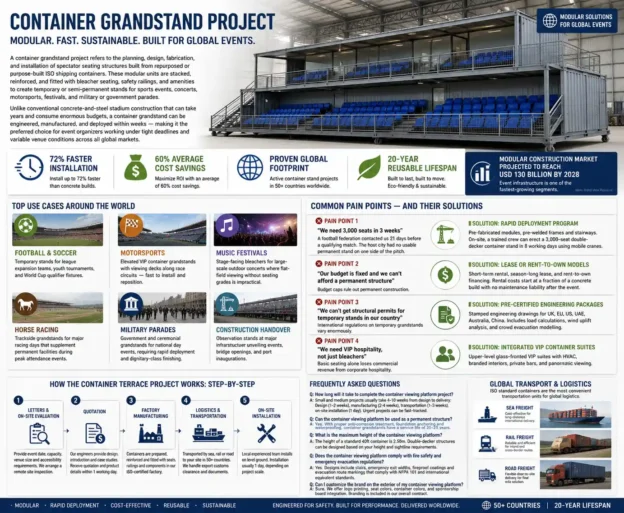
A container grandstand project refers to the planning, design, fabrication, and installation of spectator seating structures built from repurposed or purpose-built ISO shipping containers. These modular units are stacked, reinforced, and fitted with bleacher seating, safety railings, and amenities to create temporary or semi-permanent stands for sports events, concerts, motorsports, festivals, and military or government parades.

Unlike conventional concrete-and-steel stadium construction that can take years and consume enormous budgets, a container grandstand can be engineered, manufactured, and deployed within weeks — making it the preferred choice for event organizers working under tight deadlines and variable venue conditions across all global markets.

  • 72% Faster Installation: Stop waiting months for traditional methods. Our container units install up to 72% faster than concrete builds, allowing you to get your venue up and running in record time.

  • 💰 60% Average Cost Savings: Maximize your ROI. By choosing modular solutions for temporary venues, you can experience an average of 60% cost savings without compromising on quality or structural integrity.

  • 🌍 Proven Global Footprint: Trust in a solution with active container stand projects across 50+ countries worldwide. We deliver reliable engineering on a global scale.

  • 🌱 20-Year Reusable Lifespan: Built to last, built to move. With a typical reusable lifespan of 20 years, our container units offer an eco-friendly, highly adaptable, and sustainable long-term investment.

our container grandstand exporting project

2. Why Choose Shipping Container Grandstands?

The global market for container grandstand projects has exploded since 2018, fueled by the rise of temporary sporting events, growing sustainability mandates, and the demand for rapid deployment in emerging markets. According to Grand View Research’s Modular Construction Market Report, the modular construction industry is projected to reach USD 130 billion by 2028, with event infrastructure among its fastest-growing segments.

Core Advantages at a Glance

  • Speed: A 63-seat stand can be assembled in as little as 5–10 hours on-site.
  • Reusability: Container units can be relocated, reconfigured, or repurposed across multiple events.
  • Scalability: Modular design means you can expand capacity by simply adding more container bays.
  • Sustainability: Repurposed containers reduce steel demand; units can incorporate solar panels and rainwater harvesting.
  • Logistics-ready: ISO-standard containers are shippable by sea, rail, and road to any destination in the world.

3. Top Use Cases Around the World

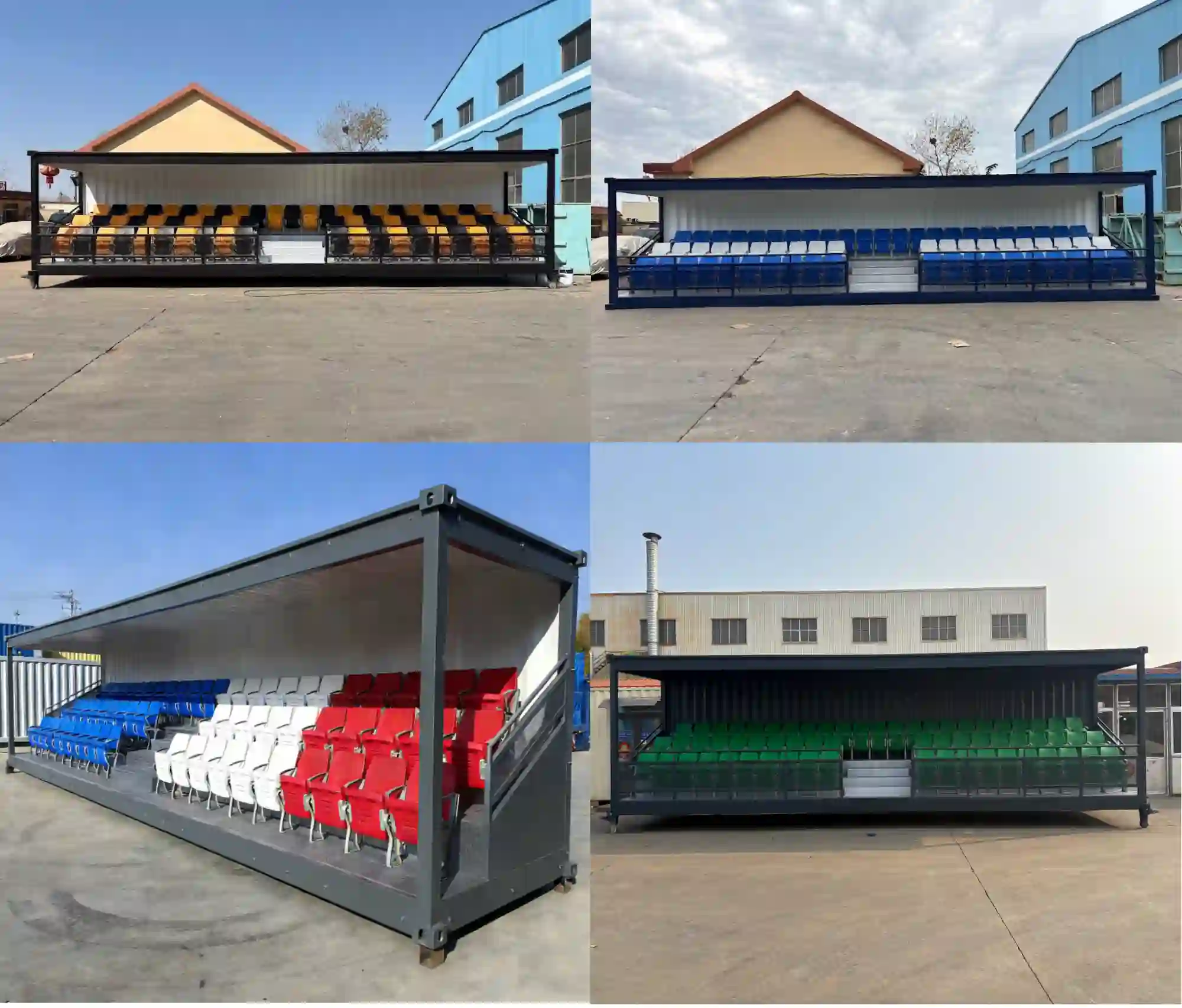
Container grandstand application In different fields
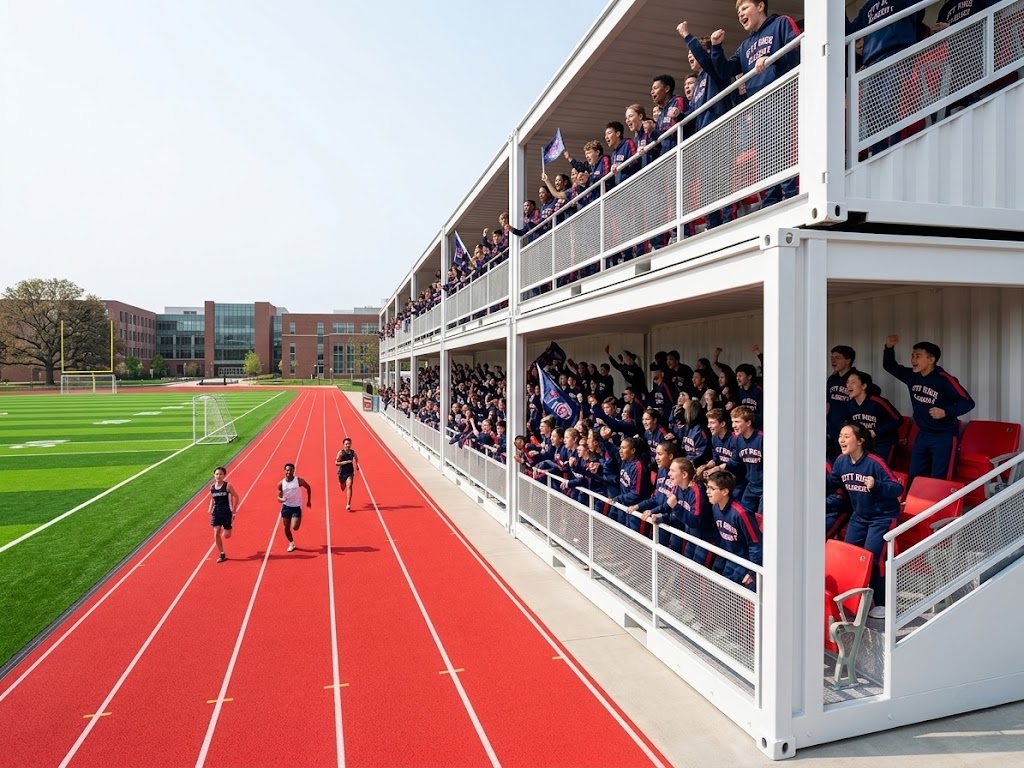
container grandstand used in temporary sports stadium seating
Container grandstand application in school sports facility modular seating system
Modular seating solution for festival using container grandstand system

⚽

Football & Soccer

Temporary stands for league expansion teams, youth tournaments, and World Cup qualifier fixtures in markets without permanent venues.

🏁

Motorsports

Elevated VIP container grandstands with viewing decks along race circuits — fast to install, easy to reposition between events.

🎵

Music Festivals

Stage-facing bleachers for large-scale outdoor concerts where flat-field viewing without seating grades is impractical.

🏇

Horse Racing

Trackside grandstands for major racing days that supplement permanent facilities during peak attendance events.

🎖️

Military Parades

Government and ceremonial grandstands for national day events, requiring rapid deployment and dignitary-class finishing.

🏗️

Construction Handover

Observation stands at major infrastructure unveiling events, bridge openings, and port inaugurations.

Common Pain Points — and Their Solutions

When clients globally search for a container grandstand project supplier, they are typically wrestling with one or more of the following operational problems. Here we address each challenge directly with proven solutions.

❌ Pain Point 1 — “We need 3,000 seats in 3 weeks”A football federation contacted us 21 days before a qualifying match. The host city had no usable permanent stand on one side of the pitch.
✅ Solution: Rapid Deployment Plan
Our factory can concurrently pre-assemble modular container grandstands. The structural framework and grandstand layout have all been pre-welded and installed before the containers leave the factory. A professional team on-site uses a mobile crane to build a container grandstand capable of accommodating 630 people within two working days. View our rapid deployment case →
❌ Pain Point 2 — “Our budget is fixed and we can’t afford a permanent structure”Municipal councils, sports federations, and private event companies frequently face immovable budget caps that rule out permanent construction.
✅ Solution: Lease or Rent-to-Own Container Grandstand ModelsWe offer short-term rental (per-event), season-long lease, and rent-to-own financing structures for container grandstand projects. Rental costs start at a fraction of a concrete build, with no maintenance liability after the event. Explore our rental pricing options →
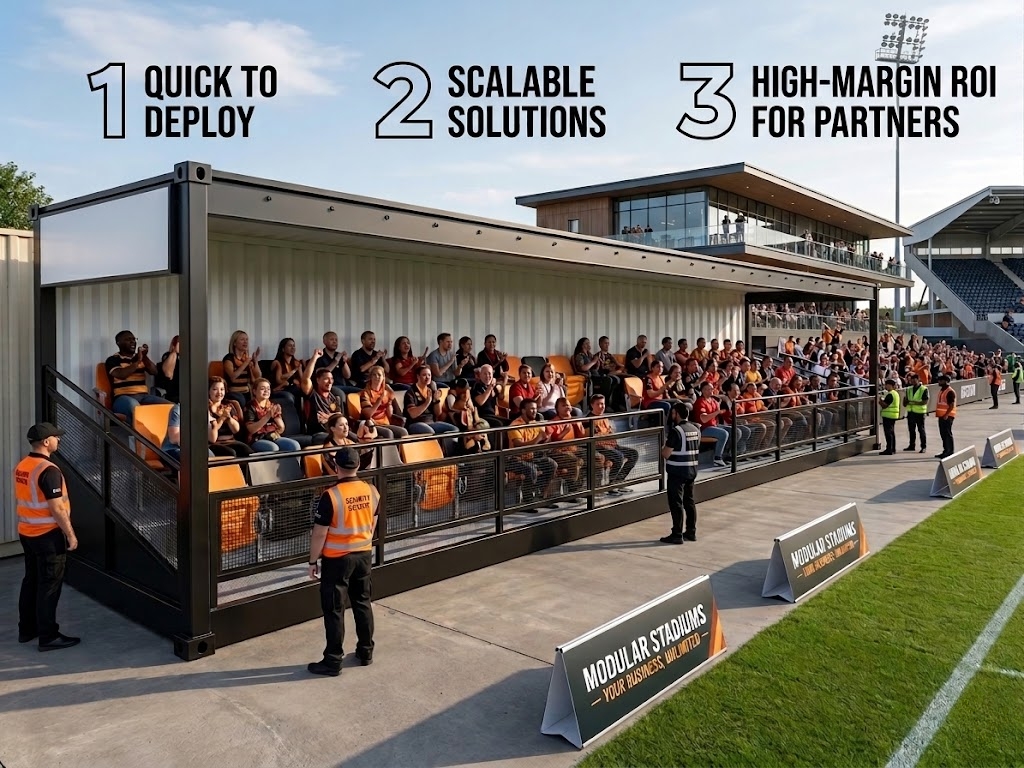
Uk container grandstand project solution:

How the Container Terrace Project Works: Step-by-Step

Letters and On-site Evaluation
Please provide your event date, estimated number of participants, venue size, and any accessibility requirements. Our team will arrange a remote site inspection using the requested information. Quotation
Our structural engineers will provide you with an introduction and case studies for the container viewing platform project. You will receive the quotation and product details within one working day.
Factory manufacturing
The containers are prepared, reinforced and installed in our ISO-certified manufacturing plant. Seats, railings and identification components are all installed before the containers are shipped.
Logistics and transportation
The containers are transported to your site by sea, rail or road. Our global logistics partners operate in over 50 countries. We handle all the export customs clearance and customs document processing for international container viewing platform projects. Learn about ISO container transportation types.
On-site installation
The customer selects a suitable and experienced construction team locally to install the containers on the flat land by the roadside. The installation period is usually 1 day, and the specific time depends on the scale.

Frequently Asked Questions about container grandstand project

How long will it take to complete the container viewing platform project?

From the initial design to the delivery for use, small and medium-sized container viewing platform projects usually take 4 to 10 weeks. This includes design (1-2 weeks), manufacturing (2-4 weeks), transportation (1-3 weeks depending on the origin and destination), and on-site installation (1 day). For urgent projects, we can shorten the construction period. Please contact our rapid deployment team

Can the container viewing platform be used as a permanent structure?

Yes. Although most customers use container viewing platforms for temporary or semi-permanent applications, the design of ISO steel frames has a service life of up to 20 to 25 years. Through appropriate anti-corrosion treatment, foundation anchoring and waterproof measures, container viewing platform projects can be used as long-term site facilities.

What is the maximum height of the container viewing platform?
The height of a standard 40ft container is 2.59m. pls check our container grandstand details.

Does the container viewing platform comply with fire safety and emergency evacuation regulations?

Yes – all designs include stairs, emergency exit widths, fireproof coatings and evacuation route markings that comply with NFPA 101 (life safety regulations) and international equivalent standards. For projects with more than 500 seats, we provide emergency evacuation simulation reports. Please refer to the requirements of NFPA 101 for life safety regulations.

Can I customize the brand on the exterior of my container viewing platform?

Sure. Container exterior decoration is an ideal platform for commercial brand promotion. We offer logo printing, seat digital and color customization, container viewing platform color customization, and sponsorship board integration services. The brand promotion plan is included in our overall contract for container viewing platform projects.

How is the container viewing platform transported internationally?

ISO standard containers are the most convenient transportation units for global logistics. The containers used for your viewing platform are transported by standard 20ft or 40ft freight.


Two construction safety inspectors in hard hats and high-visibility vests examine a modular shipping container grandstand at a racetrack stadium during an on-site safety certification process

Container Grandstand Certification: The Complete Global Guide

What Is Container Grandstand Certification?

Container grandstand certification is an official verification process that confirms a modular, shipping-container-based spectator stand meets all applicable structural, fire, electrical, and crowd-safety requirements before it can be legally occupied by the public. Certification is issued by an accredited third-party inspection body, a national authority, or both — depending on the jurisdiction where the structure is deployed.

Unlike permanent stadium construction, container grandstands are temporary or semi-permanent structures that can be assembled and disassembled across multiple sites. This portability creates a complex regulatory environment: a unit certified in Germany may require additional local sign-off before it operates in the UAE. Understanding this landscape is the foundation of any global deployment strategy.

💡 Quick Definition
Container grandstands — also called modular grandstands, temporary grandstands, or stackable container stands — use ISO-standard shipping containers as the structural base unit, fitted with tiered seating, handrails, staircases, and optional roofing systems.


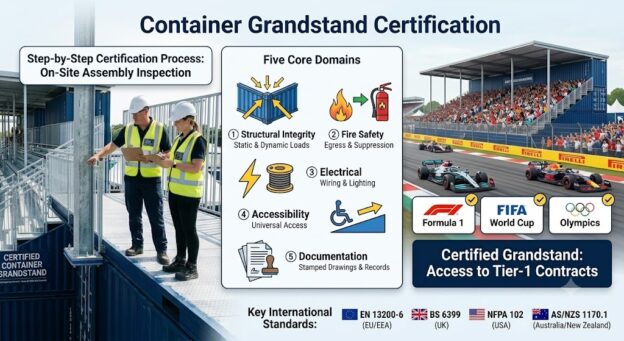
The certification covers five core domains: (1) structural integrity under static and dynamic crowd loads, (2) fire safety and egress routes, (3) electrical systems and lighting, (4) accessibility compliance, and (5) assembly & installation documentation. All five must be satisfied before a certificate of occupancy is granted.

Why Container Grandstand Certification Matters for Global Events

The tragic Roskilde Festival crush in 2000 and the Duisburg Love Parade disaster in 2010 permanently changed how regulators around the world approach crowd safety at temporary venues. Today, operating an uncertified grandstand — even for a single-day event — can result in immediate closure, criminal liability for the event organizer, and seven-figure fines in many jurisdictions.

Beyond legal risk, container grandstand certification serves as a commercial differentiator. Tier-1 event promoters, Formula 1 circuits, FIFA-licensed venues, and Olympic organizing committees now mandate certification documents as part of their supplier onboarding RFP. Without it, a rental company simply cannot bid on the most lucrative contracts.

⚠️ Risk Alert
In the UK, operating an uncertified temporary grandstand at a licensed event venue can constitute a criminal offence under the Safety of Sports Grounds Act 1990. Similar statutes exist in Germany (§ 33i GewO), Australia (Building Act 2011), and Canada (provincial occupancy standards).

Key International Standards & Regulations

The regulatory landscape for container grandstand certification is fragmented across jurisdictions. However, several international standards form the technical backbone that most national bodies reference or directly adopt.

Standard / Code Scope Key Markets Status
EN 13200-6 Spectator facilities — temporary demountable structures EU / EEA Mandatory
BS 6399-1 / Eurocode 1 Loading codes for structures (incl. crowd loads) UK, Ireland, EU Mandatory
ISO 668 / ISO 1161 Series 1 freight containers — specifications Global Reference
NFPA 102 Standard for grandstands, folding and telescopic seating, tents USA, Middle East, Southeast Asia Mandatory
AS/NZS 1170.1 Structural design actions — permanent, imposed, other Australia, New Zealand Mandatory
FIFA / World Athletics TDS Technical delivery standards for event venues FIFA / WA event hosts Conditional
CSA S269.2 Access scaffolding / temporary structures Canada Mandatory

For a deeper technical breakdown, the ISO Technical Committee 104 (Freight Containers) publishes the foundational container specifications that structural engineers must reference when calculating load paths through container grandstand modules.

The UK’s Health and Safety Executive (HSE) provides one of the most comprehensive publicly available guidance documents — the Purple Guide to Health, Safety and Welfare at Music and Other Events — which dedicates an entire chapter to temporary demountable structures including container grandstands.

Step-by-Step Container Grandstand Certification Process

While every jurisdiction has nuances, the global certification process for a container grandstand follows a consistent arc across seven stages.

01
Structural Design Review


A qualified structural engineer produces stamped drawings showing load calculations, connection details, and foundation requirements.

02

Container Inspection & ISO Compliance

Each container module is inspected for structural integrity, corrosion, and compliance with ISO 668/1161 dimensions and corner casting specs.

03

Fire Safety Assessment

A fire engineer maps egress routes, calculates evacuation times, and specifies suppression systems, detection, and signage.

04

Electrical & MEP Sign-Off

All electrical installations must meet local wiring regulations. A certified electrician issues an installation certificate.

05

On-Site Assembly Inspection

A third-party inspector attends the completed assembly, checking that the build matches approved drawings exactly.

06

Load Testing (if required)

Some authorities require a witnessed load test — typically 5 kN/m² for spectator areas — before issuing the final certificate.

07

Certificate of Occupancy Issued

The authority having jurisdiction (AHJ) issues the final certificate. This document must be kept on-site throughout the event.

✅ Pro Tip
Start the certification process a minimum of12 weeks before your event datein Europe and North America, and16 weeksin markets like Saudi Arabia, China, or Brazil where additional government ministerial approvals may be needed.

Required Documents & Inspections

A complete container grandstand certification package typically includes the following documentation. Missing any single item is the most common reason for certification delays.

Structural Package

Signed and stamped structural drawings, a geotechnical report if ground anchoring is used, a dynamic crowd-load analysis (per Eurocode 1 or local equivalent), and connection details for container stacking and interlocking. The standards table above lists the applicable code for each market.

Fire Safety Package

An evacuation strategy report, a fire risk assessment, material datasheets confirming flame-retardancy ratings (typically Class B-s1,d0 in Europe or Class A or B per ASTM E84 in North America), and a site-specific emergency response plan submitted to the local fire authority.

Electrical & Mechanical Package

Single-line electrical diagrams, an earthing and bonding strategy, lighting lux-level calculations for emergency routes (minimum 3 lux at floor level per EN 1838), and HVAC documentation for enclosed VIP units.

Operational Documentation

A crowd management plan, a maintenance and inspection log showing the service history of each container unit, certificates of conformity for all proprietary components (seats, railings, staircases), and a contractor competency matrix listing all responsible engineers and their credentials.

📁 Document TipOrganize your certification file using the seven-stage process structure outlined above. Auditors and inspectors will move through documents in this sequence — a well-organized pack dramatically reduces inspection time.

Regional Certification Requirements by Market

🇪🇺 Europe (EU / EEA)

The primary framework is EN 13200-6 (Spectator Facilities — Temporary Demountable Structures). In addition, all member states require a Declaration of Performance (DoP) under the EU Construction Products Regulation (CPR No 305/2011). Notified Bodies (NoBos) — organizations authorized by EU member states — must carry out third-party assessments for certain structural products used in the grandstand. See our certification process guide for timelines.

🇬🇧 United Kingdom

Post-Brexit, the UK applies its own regime. Container grandstands require approval under the Building Regulations 2010 (specifically Part A — Structure, Part B — Fire Safety, Part M — Accessibility) and must comply with the Event Safety Guide (Purple Guide). The local authority building control (LABC) or an approved inspector issues the completion certificate. The HSE temporary structures guidance is the key reference document.

🇺🇸 United States

Certification is managed at the state and local level. The primary technical standard is NFPA 102 (Grandstands, Folding and Telescopic Seating, Tents, and Membrane Structures) and the International Building Code (IBC). A licensed Professional Engineer (PE) must stamp drawings in the state of use. The Authority Having Jurisdiction (AHJ) — typically the local fire marshal and building department — issues the temporary structure permit.

🇦🇪 Middle East (UAE, Saudi Arabia, Qatar)

FIFA World Cup Qatar 2022 established a high-water mark for container grandstand standards in the region. The primary references are NFPA 102, local civil defense authority codes, and — for major sporting events — applicable federation technical delivery standards. Saudi Vision 2030 event projects typically require approval from the General Entertainment Authority (GEA). Allow additional time for ministerial approvals.

🇦🇺 Australia & New Zealand

Container grandstands fall under the National Construction Code (NCC), Volume One, Class 9b (assembly buildings). Structural design follows AS/NZS 1170. State-based private certifiers (Building Surveyors) or local councils issue the occupancy permit. WorkSafe NZ publishes specific guidance for temporary grandstands at public events.

🌏 Asia (China, Japan, Southeast Asia)

China requires approval from the local Municipal Housing and Urban-Rural Development Bureau. Japan applies the Building Standards Law (建築基準法) — container structures require a confirmed exemption or special approval. In Singapore, the Building and Construction Authority (BCA) oversees all temporary structural permits. Allow 16–20 weeks for first-time deployments in these markets. Review the certification timeline section for planning purposes.

Certification Timeline & Costs

One of the most common questions event organizers ask is: “How long does container grandstand certification take, and what will it cost?” The honest answer is: it depends on the market, the size of the structure, and whether your design package is complete and correct on first submission.

Market Typical Timeline Approx. Third-Party Cost Key Variable
UK 6–10 weeks £4,000 – £15,000 LABC vs. Approved Inspector route
EU (Germany / France) 8–14 weeks €5,000 – €20,000 NoBo category / capacity
USA 4–8 weeks $3,500 – $18,000 State & county AHJ
UAE / Qatar 10–16 weeks AED 20,000 – 80,000 Civil defense & municipality
Australia 6–10 weeks AUD 6,000 – 25,000 State / Territory building surveyor
China 16–24 weeks RMB 50,000 – 200,000 Bureau approvals + local fire authority

These costs cover third-party inspection and certification fees only — not the internal engineering costs of producing the design package. For complex multi-tier container grandstands (3,000+ seats), total engineering and certification costs typically range from 1–3% of the structure’s rental value for the event.

⚠️ Timeline TipRe-certifying an existing certified design for a new site in the same jurisdiction is significantly faster (often 2–4 weeks) than a first-time submission. Investing in a well-documented, type-tested design from the outset pays dividends across every subsequent deployment.

How to Pass Container Grandstand Certification First Time

After analyzing hundreds of container grandstand certification submissions across global markets, the following factors consistently separate first-time passes from costly re-submissions.

1. Engage Your Structural Engineer at the Design Stage

The most expensive mistake is treating structural engineering as a box-ticking exercise at the end of the design process. Engage your SE from day one — before containers are purchased — so load paths, connection details, and foundation strategies are baked in, not bolted on. Reference the seven-stage certification process to understand where the SE’s role begins.

2. Use Pre-Certified Container Modules Where Available

Several manufacturers now offer container grandstand systems with type approval certificates from TÜV, Bureau Veritas, or Lloyd’s Register. Using a type-approved system reduces third-party inspection scope significantly — the certifier reviews the site-specific installation rather than the base design from scratch. The Bureau Veritas global network is particularly strong for this approach in Europe, the Middle East, and Asia-Pacific.

3. Pre-Submit for AHJ Comment

In most markets, a pre-submission meeting with the Authority Having Jurisdiction is available — and strongly recommended. A 60-minute meeting before you submit drawings can prevent a 6-week resubmission cycle. Ask explicitly what their specific local requirements are beyond the national standard.

4. Document Every Component with a Paper Trail

Certifiers need to trust that what they inspect on day one of assembly is what will be there on event day. A robust maintenance and inspection log, combined with documented serial numbers for every structural component, closes this gap. The documents section above outlines the full documentation package required.

5. Plan for Ongoing Compliance, Not Just Initial Certification

In markets like the UK and Australia, a container grandstand used at multiple events in the same season may require periodic re-inspections — particularly if the structure is re-erected on different ground conditions. Build a compliance calendar into your event operations plan, and retain the services of a competent person (as defined by the applicable legislation) throughout the event period.

✅ Checklist SummaryStructural engineer engaged early · ISO-compliant containers confirmed · Fire strategy commissioned · AHJ pre-submission meeting booked · Full documentation package assembled · Type-tested components prioritized · Ongoing compliance calendar created
Africa grandstand supplier feature

Top Africa Grandstand Brand list for your purchasing

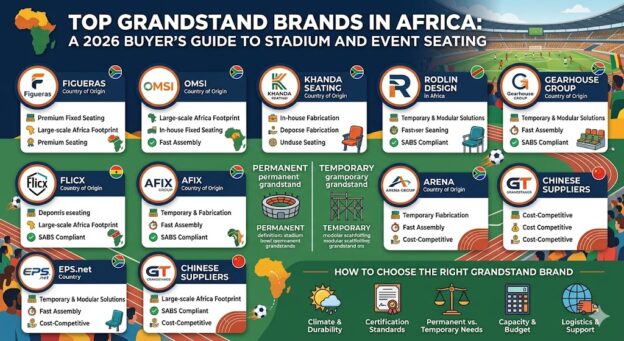
Top Africa Grandstand Brand list: A 2026 Buyer’s Guide to Stadium and Event Seating

The Africa Grandstand Brand List represents Africa’s stadium industry is in the middle of its biggest building boom in decades. Morocco is racing to finish venues for the 2025–2026 Africa Cup of Nations and the 2030 FIFA World Cup, Kenya, Uganda, and Tanzania are constructing new arenas for the 2027 AFCON, and dozens of smaller markets are upgrading school, club, and community sports grounds. Behind every one of these projects sits a less glamorous but equally critical decision: which grandstand brand will supply the seating.

This guide breaks down the grandstand brands actually active in Africa right now — international seating manufacturers, South African fabricators, European temporary-structure specialists, and the fragmented but fast-growing pool of modular exporters — so that facility managers, event organizers, contractors, and procurement teams can shortlist suppliers with confidence.

Quick takeaways

  • Premium fixed seating for flagship stadiums in Africa is dominated by a handful of European manufacturers with proven continental track records.
  • South Africa has its own mature base of local grandstand and stadium-seating manufacturers serving the wider continent.
  • Temporary and modular grandstands — used for festivals, school sports days, and pop-up venues — are increasingly sourced from European hire specialists and Asian export factories.
  • Stadium construction in Africa is closely tied to major tournaments (AFCON, CHAN, the 2030 World Cup) and to large-scale Chinese-financed infrastructure programs.

Why Grandstand Demand Is Surging Across Africa

The Confederation of African Football (CAF) has tightened its venue requirements significantly ahead of the 2027 AFCON, which Kenya, Uganda, and Tanzania will co-host. Host venues are now expected to provide presidential and VVIP seating areas, dedicated press sections with one to two hundred seats, hospitality skyboxes, and media centers, in addition to the core spectator bowl. Kenya’s 60,000-seat Talanta Sports City in Nairobi and the 48,000-seat Moi International Sports Centre, Tanzania’s Benjamin Mkapa and Samia Suluhu Hassan stadiums, and Uganda’s Mandela National and Akii Bua stadiums are all being expanded or rebuilt to meet these standards.

A similar pattern played out for the 2023 AFCON in Ivory Coast, where the 60,000-seat Alassane Ouattara Stadium was built, and is playing out again in Morocco, where venues such as the Grand Stade de Tanger, Grand Stade Mohamed V, and the Complexe Sportif Prince Moulay Abdellah are being upgraded toward a combined capacity well beyond 250,000 seats across the tournament’s host cities. Many of these projects are financed and built through partnerships with Chinese state construction firms, a pattern often described as “stadium diplomacy,” which has shaped how seating and grandstand contracts get awarded across the continent for nearly two decades.

Beyond elite football, the same demand curve applies to athletics tracks, multipurpose arenas, university sports grounds, and the steady stream of concerts, festivals, and corporate events that need temporary tiered seating. This combination of mega-tournament infrastructure and everyday event demand is what has pulled in such a varied mix of grandstand brands — from century-old European seating houses to nimble local fabricators.

Permanent vs. Temporary Grandstands: Know What You’re Buying

Alternative Grandstand: Why Buyers Are Moving Away from Traditional Systems

Before comparing brands, it helps to separate the market into two broad categories, since most manufacturers specialize in one or the other.

Permanent grandstands are bolted or cast into a stadium’s structure, typically using tip-up plastic or polypropylene seats mounted on steel or concrete risers. They are built for decades of service, must meet strict fire, load, and accessibility standards, and are the category most major stadium seating manufacturers compete in.

Temporary or demountable grandstands are modular systems — usually aluminum, steel, or a scaffolding base — that can be assembled, taken apart, and reused across multiple events or seasons. They are the standard choice for festivals, marathons, rodeos, school sports days, and venues that need extra capacity for a single tournament without committing to permanent construction.

The Leading Grandstand Brands Serving Africa

1. Figueras International Seating (Spain)

Figueras is one of the most established stadium seating manufacturers with a documented African footprint. The company recently outfitted Rabat’s Stade Olympique Annexe Prince Moulay Abdellah with three of its seating models ahead of the 2025–2026 AFCON, working alongside a local logistics partner to manage installation. Figueras also lists reference projects in Nigeria, including the Kaduna Township Stadium and Lagos Business School, and maintains a broader catalogue of theatre, auditorium, and arena seating used worldwide. For large-scale, multi-decade stadium fit-outs, Figueras is consistently shortlisted by African architects and project managers.

2. OMSI (Italy)

OMSI has become one of the most active seating brands in North Africa over the past two years, installing seats in more than ten stadiums across Morocco, Algeria, and Cameroon. Its largest African contract to date was the Grand Stade de Tanger, where it supplied roughly 70,500 seats, and it also fitted out Rabat’s Stade Al Medina and contributed around 26,700 seats to Algeria’s Stadio 5 Juillet 1962. OMSI’s North African projects are tied directly to Morocco’s preparation for both the 2025–2026 AFCON and the 2030 World Cup, making it a brand worth watching as more North African tournament venues come online.

3. Khanda Seating (South Africa)

Khanda Seating is a South African manufacturer that handles the full chain — manufacturing, transport, and installation — in-house rather than outsourcing any stage of the process. With around three decades of operating history, the company has supplied stadium and sport seating across South Africa and into other parts of the continent, and it is known for being flexible enough to customize products for individual client specifications rather than offering only standard catalogue items.

4. Rodlin Design (South Africa)

Founded in 1993 with offices in Johannesburg and Cape Town, Rodlin Design produces fixed seating that meets South African Bureau of Standards (SABS) compliance, a useful reference point for any buyer benchmarking quality standards in the region. Its portfolio spans stadiums, convention centers, churches, and universities across Southern Africa, and its product range includes UV-resistant, flame-retardant, and vandal-resistant stadium seating for both general spectator areas and VIP sections.

5. Gearhouse Group / Havaseat (South Africa, distributing PERI Arena from Germany)

Gearhouse Group, a South African live-events technical supplier founded in 1991, distributes the German-engineered PERI Arena grandstand system under its Havaseat brand. The system is designed for fast assembly and disassembly, uses non-slip wooden decking to reduce noise, and is built to European and American safety standards — making it a popular choice for prestige temporary seating at fashion shows, concerts, and sporting events across South Africa.

6. Flicx South Africa

Flicx manufactures steel grandstands finished in enamel paint, designed to be moved easily between locations and offered for either rental or purchase. Optional add-ons include dome, galvanized sheet, or shade-cloth roofing and handrails, and the company’s grandstands are most commonly seen at athletics facilities alongside its other track-and-field equipment.

7. AFIX Group (Belgium/Netherlands)

AFIX Group’s AFIXFAST product line builds grandstands and stages on a modular scaffolding base, designed to work on uneven or constrained sites. The system uses adjustable baseplates so it can level itself across sloped or irregular terrain, and it is engineered to meet international audience-load safety regulations — relevant for any African event site that lacks a purpose-built, perfectly flat venue.

8. Arena Group / Arena UKE (United Kingdom)

Arena Group offers two distinct tiered grandstand systems: ClearView, a demountable modular seating system, and the A-Frame system, which has been used commercially for more than 30 years. Both are built to comply with the Green Guide to Safety at Sports Grounds, the UK’s benchmark safety standard for spectator facilities, and the company markets its systems for everything from golf tournaments to festivals and conferences — a flexible profile that suits the wide variety of event types found across African markets.

9. EPS.net (Germany)

EPS.net manufactures temporary standing and seated grandstands built from steel, aluminum, and planed wood, including a folding five-tier system designed for compact urban sites such as marathon finish lines or city-center concerts. Its grandstands come with safety certification for every configuration and can be adapted with wheelchair ramps, individual seat numbering, and flag adapters — practical features for organizers running multi-day events with changing capacity needs.

10. GT Grandstands (United States)

GT Grandstands is an international bleacher and grandstand manufacturer best known for custom permanent installations using I-beam construction, which adapts well to hillsides and uneven terrain — a useful trait for African sites without flat, pre-leveled ground. The company also builds press boxes, team benches, and ADA-compliant accessible seating, and works directly with clients through site measurement and design consultation phases.

11. Chinese Modular Grandstand Exporters and State Construction Firms

Two distinct types of Chinese suppliers show up repeatedly in Africa’s grandstand market. The first is a layer of large state-owned construction firms — such as Beijing Construction Engineering Group and China Road and Bridge Corporation — which have built or renovated entire stadiums across the continent, including Tanzania’s Benjamin Mkapa Stadium, Ivory Coast’s Alassane Ouattara Stadium, and Kenya’s Talanta Sports City, typically as part of broader bilateral infrastructure financing. The second is a much larger and more fragmented group of small and mid-sized factories, mostly based in Guangdong, Shandong, and Jiangxi provinces, that export cost-competitive aluminum, steel, and HDPE modular grandstands and bleachers through global B2B trade platforms. This segment is growing quickly — industry estimates put the global temporary stadium seating market above $1.2 billion annually with growth near 6.8% a year — but quality and after-sales support vary widely between suppliers, so buyers sourcing this way should request certifications and references before committing to a large order.

Container Grandstand is a revolutionary, modular seating solution designed to meet the growing demand for sports infrastructure across Africa. Engineering a perfect blend of structural integrity and modern architectural aesthetics, our container grandstands repurpose high-grade shipping containers into durable, secure, and elevated stadium seating. Whether for community football pitches, school sports fields, or temporary event arenas, this eco-friendly solution offers unmatched versatility and an exceptional viewing experience.

How to Choose the Right Grandstand Brand for Your African Project

With this many categories of supplier, the right choice depends less on brand reputation alone and more on matching the product to your specific project conditions.

Climate and material durability should be the first filter. Coastal, high-humidity, and high-UV regions common across much of Africa put real stress on plastics and unprotected steel, so ask any manufacturer for material specifications and warranty terms rather than relying on a generic catalogue description.

Certification matters more than it might seem. Look for compliance with recognized standards such as SABS (South Africa), CE marking (common among European manufacturers), or the UK’s Green Guide to Safety at Sports Grounds — these give a transferable benchmark for safety and load-bearing performance even when local regulations are still developing.

Permanent versus temporary needs should be decided early, since most manufacturers specialize heavily in one category. A tournament-grade national stadium calls for a fixed-seating specialist like Figueras or OMSI, while a touring event, festival, or seasonal sports league is far better served by a temporary or modular system from a brand like AFIX Group, EPS.net, or a regional hire company.

Capacity and budget naturally narrow the field further — large stadium contracts justify the lead times and costs of premium European manufacturers, while smaller venues, schools, and community sports grounds are often better matched to local South African fabricators or export-grade modular suppliers.

Logistics and lead time deserve more attention than they usually get. Imported seating systems can involve long sea-freight transit times and customs processes, so factor shipping schedules into any tournament-driven deadline well before signing a contract.

Finally, local installation and after-sales support can make or break a project regardless of how good the seating itself is. Brands with an established African presence or local distribution partner — as seen with Gearhouse Group’s relationship with PERI Arena, or Figueras’ work with local logistics partners in Morocco — tend to deliver smoother installations than suppliers shipping a product with no regional support network.

Frequently Asked Questions

What exactly counts as a “grandstand”? A grandstand is any raised, tiered seating structure built to give spectators a clear view of a sports field, stage, or event area. The term covers everything from a simple steel bleacher at a school sports day to a fully engineered, multi-tier permanent stadium stand.

Are grandstands in Africa mostly imported or locally manufactured? Both. Large national stadiums tied to international tournaments tend to use imported European seating systems from brands like Figueras or OMSI, while smaller venues, schools, and regional sports clubs are frequently served by local manufacturers such as Khanda Seating, Rodlin Design, or Flicx South Africa, alongside imported modular systems from Asian and European exporters.

How much does a grandstand cost in Africa? Costs vary enormously by scale and material — a small modular bleacher seating a few hundred people can cost a fraction of what a permanent tip-up seating contract for a 40,000-seat stadium requires. Buyers should request itemized quotes covering materials, shipping, installation, and any required certification testing rather than comparing headline prices alone.

What safety standards should grandstands in Africa meet? At minimum, buyers should look for compliance with a recognized international or regional standard — SABS in South Africa, CE marking from European manufacturers, or sport-specific guidance such as the UK’s Green Guide to Safety at Sports Grounds — since many African countries are still formalizing their own dedicated stadium safety codes.

Which African countries are building the most new stadiums right now? Morocco currently leads, driven by the 2025–2026 AFCON and 2030 World Cup preparations, followed closely by Kenya, Uganda, and Tanzania, which are jointly building and upgrading venues for the 2027 AFCON. Nigeria, Ivory Coast, and several other West and East African nations also have active stadium construction or renovation projects underway.

Besides local African brands, what other grandstand brands are worth noting?

There are different well-known grandstand suppliers all over the world.  

When selecting a local grandstand supplier in Africa, you can also consider different suppliers in other markets.

Final Thoughts

The Africa Grandstand Brand list operating across Africa today range from century-old European seating houses fitting out 60,000-seat tournament venues to nimble South African fabricators serving regional clubs and schools. Choosing among them comes down to matching your venue’s scale, climate, budget, and timeline to a manufacturer with a proven track record in similar conditions — and increasingly, that means looking specifically for brands with documented African project experience rather than relying on global reputation alone.

Europe Grandstand Supplier List show

Europe Grandstand Supplier List in 2026

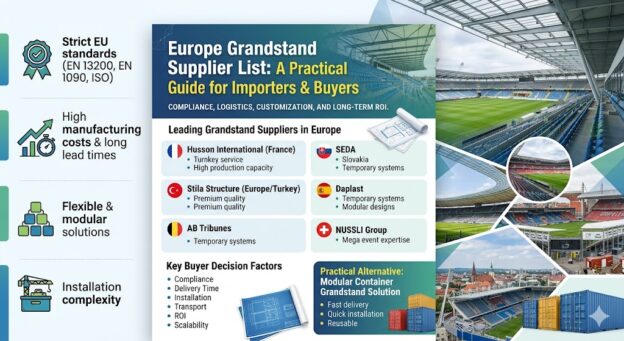
Europe Grandstand Supplier List: A Practical Guide for Importers & Buyers

Europe Grandstand Supplier List is important.For importers, contractors, and project developers, sourcing grandstands in Europe is not just about price—it’s about compliance, logistics, customization, and long-term ROI.

Typical pain points include:

Strict EU standards (EN 13200, EN 1090, ISO certifications) → risk of non-compliance
High manufacturing costs → European suppliers often quote premium prices
Long lead times → custom engineering + local production bottlenecks
Limited flexibility → traditional steel structures vs. modular demand
Installation complexity → requires local teams or expensive supervision

European suppliers are known for quality—but not always for flexibility or cost-efficiency.

Below is an objective and practical breakdown of key suppliers widely recognized in the European market.

Leading Grandstand Suppliers in Europe

Husson International (France)

Overview:
A long-established French manufacturer specializing in fixed and telescopic grandstands.

Strengths:

  • Over 50 years of experience and 1,500+ installations worldwide
  • Full turnkey service: design → manufacturing → installation
  • Strong compliance with EN standards and safety certifications

Weaknesses:

  • High cost for custom projects
  • Longer lead times due to in-house European manufacturing
  • Less suitable for fast-deployment projects

Best for: Government projects, stadiums, long-term infrastructure

Stila Structure (Europe/Turkey)

Overview:
A large-scale grandstand manufacturer with flexible product lines.

Strengths:

  • High production capacity (up to 500,000 units annually)
  • Wide range: mobile, telescopic, permanent tribunes
  • Strong experience in international stadium projects

Weaknesses:

  • Quality consistency can vary depending on project scale
  • Engineering customization may require detailed coordination

Best for: Large-scale projects with budget constraints

SEDA (Slovakia)

Overview:
A premium European manufacturer focusing on high-end seating and structural systems.

Strengths:

  • Strong certifications (EN 1090, ISO welding standards)
  • High-quality materials (metal, upholstery, plastics)
  • Fully customized engineering solutions

Weaknesses:

  • Higher price positioning
  • Longer design cycles for bespoke projects

Best for: Premium arenas, indoor venues, VIP seating projects

AB Tribunes (Belgium)

Overview:
Specializes in temporary and modular grandstand systems.

Strengths:

  • Strong experience in global events (F1, Tour de France)
  • Portable and flexible designs
  • Fast installation capability

Weaknesses:

  • Not ideal for permanent structures
  • Limited architectural customization

Best for: Events, temporary stadiums, short-term capacity expansion


Daplast (Spain)

Overview:
A well-known European supplier of modular grandstands and seating systems.

Strengths:

  • Modular systems with fast installation
  • Certified durability (EN standards, ISO certification)
  • Strong adaptability for space constraints

Weaknesses:

  • Focus more on seating + modular units than full structural EPC
  • Limited flexibility in ultra-custom designs

Best for: Medium-scale stadium upgrades and modular seating


NUSSLI Group (Switzerland)

Overview:
Global leader in event infrastructure and temporary grandstands.

Strengths:

  • Extensive global experience (World Cup, large-scale events)
  • High engineering capability
  • Strong reputation in temporary structures

Weaknesses:

  • Premium pricing
  • Not ideal for small or budget projects

Best for: Mega events, international sports competitions

Key Buyer Decision Factors (What Importers Really Care About)

Before selecting a supplier, experienced buyers focus on:

Compliance: EN 13200 / EN 1090 / FIFA standards
Delivery time: Can it be shipped in 15–30 days?
Installation complexity: Modular vs. welded structures
Transport efficiency: Flat-pack vs. bulky shipments
ROI: Cost per seat over lifecycle
Scalability: Can you expand later?

👉 This is where many European suppliers fall short:
high quality—but limited flexibility and higher total cost of ownership.

Practical Alternative: Modular Container Grandstand Solution

For importers seeking faster ROI + easier logistics, modular systems are gaining traction.

One example is the container-based grandstand solution from:
👉 Container Grandstand Manufacturer

Key Advantages:

  • Fast delivery (35 days production)
  • Modular & foldable structure → lower shipping cost
  • Quick installation (no heavy civil works)
  • Reusable & relocatable → higher long-term value
  • Customizable layouts (VIP, media, retail integration)

Especially suitable for:

  • Temporary stadiums
  • Emerging markets
  • Sports events & commercial venues
  • Contractors needing fast deployment

Internal Resource for Further Supplier Comparison

For a broader overview of global brands and suppliers, you can also refer to:Global Bleacher Brands 

This helps buyers benchmark European suppliers vs. global alternatives.


Industry Authority References

To ensure compliance and best practices, buyers should also consult:

  • European seating and safety standards (EN 13200 framework referenced by manufacturers)
  • Certified seating and stadium solutions used across UEFA/FIFA-level projects

Final Thoughts: How to Choose the Right Supplier

SupplierCountry/RegionType of GrandstandsKey StrengthsKey WeaknessesBest For
Husson InternationalFranceFixed & Telescopic50+ years experience, 1,500+ installations, full turnkey (design-manufacture-install), strong EN complianceHigh cost, longer lead times, less suitable for fast projectsGovernment projects, stadiums, long-term infrastructure
Stila StructureEurope/TurkeyMobile, Telescopic, PermanentHigh production capacity (500k units/year), wide product range, international stadium experienceQuality consistency may vary, requires detailed coordination for customizationLarge-scale projects with budget constraints
SEDASlovakiaHigh-end seating & structural systemsStrong certifications (EN 1090, ISO), high-quality materials, fully customized solutionsHigher price, longer design cyclesPremium arenas, indoor venues, VIP seating
AB TribunesBelgiumTemporary & ModularExperience in major events (F1, Tour de France), portable & flexible, fast installationNot ideal for permanent structures, limited architectural customizationEvents, temporary stadiums, short-term capacity
DaplastSpainModular grandstands & seatingFast installation modular systems, certified durability, good for space constraintsMore focused on seating than full EPC, limited ultra-custom designsMedium-scale stadium upgrades, modular seating
NUSSLI GroupSwitzerlandTemporary & Event InfrastructureGlobal experience (World Cup etc.), high engineering capability, strong reputationPremium pricing, not suitable for small/budget projectsMega events, international sports competitions

There is no “best” supplier—only the best fit for your project.

  • Choose European manufacturers if:
    • You need strict compliance + premium quality
    • Budget is less sensitive
    • Project is permanent infrastructure
  • Choose modular/container solutions if:
    • You need speed + flexibility
    • You want lower upfront investment
    • Your project involves temporary or scalable seating

Bottom Line for Buyers

Smart importers today are not just comparing suppliers—they are comparing business models:

👉 Traditional Steel Grandstands vs. Modular Container Grandstands

The winning choice depends on how fast you need ROI and how flexible your project must be.

Sourcing grandstands in Europe requires balancing superior quality and strict compliance requirements against long lead times and high total cost of ownership. This directory of European grandstand suppliers serves as a strategic benchmark for importers, contractors, and project developers, enabling them to compare traditional European manufacturers with emerging modular alternatives.

russian grandstand list introduce

Top Russia Grandstand Supplier List

How to Sourcing the Russia Grandstand Supplier?

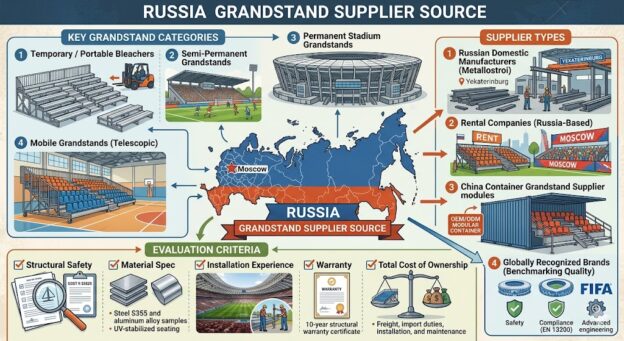
Whether you are organizing a major sporting championship, an open-air concert, a motorsports event, or a municipal stadium upgrade, finding a reliable grandstand supplier in Russia demands careful due diligence. The Russian market blends domestic manufacturers with international players, creating a competitive landscape where quality, delivery reliability, safety certifications, and total cost of ownership vary widely.

This article provides an objective, comparative overview of the Russia grandstand supplier list — covering local fabricators, Central Asian importers, and globally recognized grandstand brands. Procurement managers, event organizers, and sports facility directors will find actionable criteria to evaluate each option fairly.

What Is a Grandstand? Key Product Categories

Before comparing suppliers, it helps to understand the core product lines:

  • Temporary / Portable Bleachers — Modular aluminum or steel seating systems assembled for one event and demounted after.
  • Semi-Permanent Grandstands — Structures installed for a season or multi-year period but designed for relocation.
  • Permanent Stadium Grandstands — Fixed reinforced steel or concrete-hybrid structures with integrated roofing, VIP boxes, and media facilities.
  • Mobile Grandstands (Telescopic) — Rolling, collapsible bleacher units common in indoor arenas and multi-purpose halls.
  • VIP Tribune / Press Grandstands — Elevated, enclosed structures with premium amenities.

Understanding which category fits your project is the first filter when reviewing any Russia grandstand supplier list.


Russia Grandstand Supplier List: Domestic Manufacturers

1. Russian Steel Fabrication Companies (Metallostroi Segment)

Russia has a sizable base of steel fabrication plants, many of which produce grandstand structures as part of a broader metal construction portfolio. Key characteristics:

  • Typical locations: Chelyabinsk, Yekaterinburg, Nizhny Novgorod, and the Moscow Oblast
  • Strengths: Lower logistics costs for domestic projects; familiarity with Russian GOST building standards; ability to adapt designs to regional climate conditions (harsh winters, permafrost in Siberian regions)
  • Weaknesses: Variable quality control; limited experience with international safety standards (EN 13200 series, UEFA/FIFA guidelines); longer lead times for complex engineered products; lower degree of product standardization
  • Typical capacity: 200–5,000 seats per project
  • Price range: Moderate, dependent heavily on current domestic steel prices (linked to MMK, Severstal, NLMK commodity rates)

Notable limitations: Few Russian-only fabricators publish independently verified safety load test results. Buyers should request third-party structural engineering sign-offs and GOST R 55528 compliance documentation.


2. Event Equipment Rental Companies (Russia-Based)

Several Moscow- and St. Petersburg-based event companies maintain rental fleets of portable grandstands. These are not manufacturers but redistribute products sourced from European or Asian suppliers.

  • Strengths: Fast mobilization for short-term events; turnkey service including installation and dismantling; no capital expenditure required
  • Weaknesses: Rental fleet condition can be inconsistent; limited customization; branding and color options restricted; structural certification often tied to the original manufacturer, not the rental company itself
  • Best use case: One-time events, city festivals, exhibition matches

3. Post-Soviet Central Asian Suppliers Operating in Russia

Suppliers from Kazakhstan, Belarus, and Ukraine (historically) have competed in the Russian grandstand market, particularly for stadium renovation tenders. Since 2022, supply chain routes and partnerships have shifted considerably, and buyers should verify current legal import/export status before engaging suppliers from these regions.

4.China container grandstand supplier

Qingdao Container House Co., Ltd. is a leading Chinese manufacturer specializing in high-quality modular and shipping container structures. With over 18 years of industry experience, we offer premier OEM/ODM solutions for Modular Grandstand Containers equipped with roofs and steps. Designed for durability, rapid installation, and global export, our container grandstands provide temporary and permanent event seating solutions that meet rigorous international standards.

Spotlight: Bleacher Brands / Grandstand Brand in Worldwide

Among the globally recognized names on any serious grandstand supplier list, Grandstand Brand in Worldwide stands out as a benchmark for quality, compliance, and service reach. Here is an objective assessment:

Strengths

  • International safety compliance: Products engineered to meet multiple concurrent standards — EN 13200 (European), AS/NZS (Oceania), SABS (South Africa), as well as FIFA and World Athletics facility guidelines, making them suitable for projects with mixed regulatory requirements or international event hosting ambitions.
  • Breadth of product range: From compact 100-seat portable bleachers to multi-tier permanent grandstands exceeding 50,000 seats, serves the full spectrum of venue types.
  • Engineering depth: In-house structural engineering teams capable of adapting designs to local wind loads, seismic zones, and climate extremes — a critical factor for Russian projects where Siberian frost and high snow loads must be factored into structural calculations.
  • Global project references: Verified installations across Asia, Africa, the Middle East, Europe, and the Americas provide procurement teams with confidence in execution capability.
  • Turnkey delivery options: Design-supply-install packages reduce coordination risk for buyers who prefer a single point of accountability.

Limitations (Honest Assessment)

  • Import logistics: For Russia-based projects, international shipment lead times and current trade route conditions add procurement complexity. Buyers should confirm logistics routing and import duty implications early in the tender process.
  • Local partner dependency: As with most global brands, the quality of service in any specific market often depends on the strength of the local representative or distributor network.

Chinese OEM Grandstand Suppliers: What Buyers Should Know

China has become a dominant source of grandstand components, with Guangdong, Zhejiang, and Hebei provinces hosting the largest concentration of manufacturers. These suppliers frequently appear on Russia grandstand supplier lists via import brokers and trading companies.

Objective pros:

  • Competitive pricing, especially for aluminum bleachers and plastic seating components
  • High production volume capacity
  • Increasing number of companies seeking EN and other international certifications

Objective cons:

  • Quality control inconsistency between factories and even between production batches
  • Structural certification documents may not be independently verified
  • After-sales support and spare parts availability outside China can be poor
  • Language and communication barriers can complicate punch list resolution

Recommendation: If sourcing from Chinese suppliers, conduct factory audits, request third-party structural load test certificates, and consider engaging an independent inspection agency (SGS, Bureau Veritas, TÜV) to verify compliance before shipment.

European Grandstand Suppliers: Niche but Notable

European manufacturers — particularly from the UK, Netherlands, Germany, and Spain — maintain strong reputations for engineering quality and compliance with FIFA, UEFA, and World Athletics standards. However, for Russia-based projects, buyers should assess:

  • Current trade and export restrictions
  • Insurance and bond coverage availability for Russia-based delivery
  • Euro/ruble exchange rate volatility impact on contract pricing

European brands serve as useful benchmark references when specifying technical standards, even if direct procurement is complicated by current geopolitical context.


Key Evaluation Criteria for Any Russia Grandstand Supplier List

When comparing suppliers — domestic or international — procurement teams should assess the following:

1. Structural Safety Certification

Request load test reports and structural calculations signed by a licensed professional engineer. Verify that the certification body is independent (not self-certified). For international events, confirm alignment with GOST R 55528 and relevant FIFA/UEFA facility standards.

2. Material Specification

  • Aluminum alloy grade: 6061-T6 or 6082-T6 for structural members; avoid unspecified or recycled alloys
  • Steel grade: S355 or equivalent for main structural elements; verify corrosion protection specifications (hot-dip galvanizing, powder coating)
  • Seating: UV-stabilized polypropylene with minimum fire-resistance classification

3. Production Capacity and Lead Time

Verify current factory capacity against your project timeline. Request milestone delivery schedules with penalty clauses for delay.

4. Installation Experience

Ask for a reference list of comparable projects. Verify at least three completed installations with a minimum seating capacity similar to your requirement.

5. Warranty and After-Sales Support

  • Structural warranty: minimum 10 years
  • Seating warranty: minimum 5 years
  • Confirm availability of spare parts and local service technicians

6. Total Cost of Ownership

Do not evaluate on supply price alone. Factor in:

  • Freight and import duties
  • Installation cost
  • Annual maintenance requirements
  • Expected lifespan before replacement or major refurbishment

Tender Tips: How to Structure Your Russia Grandstand Supplier RFQ

When issuing a Request for Quotation (RFQ) to suppliers on your Russia grandstand supplier list, include the following in your specification package:

  1. Site survey data — GPS coordinates, soil bearing capacity, access routes
  2. Capacity and layout requirements — number of seats, row depths, aisle widths, disabled access provisions
  3. Safety standard references — specify GOST R 55528 plus any international event-body requirements
  4. Environmental conditions — maximum snow load (kN/m²), wind speed zone, seismic zone classification
  5. Aesthetic requirements — color, branding, seat type, railing style
  6. Timeline — project start date, installation deadline, event date
  7. Commercial terms — payment milestones, performance bond requirements, warranty expectations

Sharing this level of detail enables suppliers to provide comparable, apples-to-apples quotations.


Frequently Asked Questions

Q: What is the average cost of a grandstand in Russia?

Costs vary enormously by type, capacity, and specification. Indicative ranges:

  • Portable aluminum bleachers (100–500 seats): USD 80–200 per seat (supply only)
  • Semi-permanent grandstands (500–5,000 seats): USD 150–400 per seat
  • Permanent grandstands (5,000+ seats): USD 300–800+ per seat

These ranges reflect international supply costs. Domestic Russian fabrication may be priced lower but with variable quality and certification levels.

Q: Can international grandstand brands deliver to Russia?

Delivery feasibility depends on the supplier’s logistics partners and current trade conditions. Buyers should request DDP (Delivered Duty Paid) quotes and confirm that the supplier carries appropriate export insurance and documentation for Russian customs clearance.

Q: What safety standard applies to grandstands in Russia?

Primary Russian standards include GOST R 55528 (sports facilities) and SP 31-115-2006. For international event hosting (FIFA, FIBA, IAAF), the relevant international body’s technical requirements take precedence and should be specified alongside national standards.


Conclusion: Choosing the Right Supplier from the Russia Grandstand Supplier List

The Russia grandstand supplier landscape is genuinely diverse — from cost-competitive domestic steel fabricators to internationally certified, full-service grandstand specialists. No single supplier is universally “best”; the right choice depends on project scale, budget, timeline, safety requirements, and the intended use of the facility.

For projects where structural integrity, regulatory compliance, and long-term performance are non-negotiable, globally recognized specialists sprovide a compelling value proposition that goes beyond unit price comparison. For smaller, time-sensitive rental needs, Russian event equipment companies offer practical flexibility.

Whatever your sourcing strategy, apply consistent evaluation criteria across all shortlisted suppliers, demand verified certification documentation, and always factor total cost of ownership — not just purchase price — into your decision.


This article is intended as an objective industry reference. All supplier assessments are based on publicly available information and general market observations. Readers should conduct independent due diligence before entering into any procurement agreement.


Related Topics:

Latin America Grandstand Brand List

Latin America Grandstand Brand List

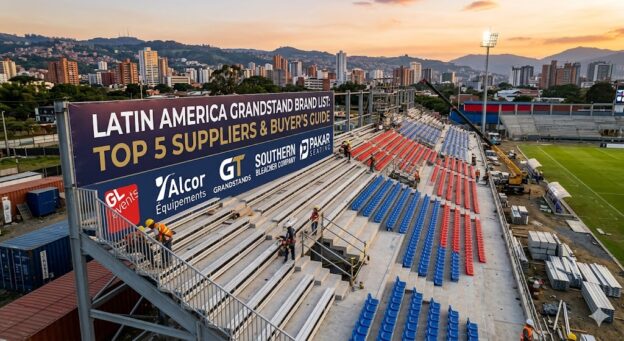
Latin America Grandstand Brand List: Top 5 Suppliers & Buyer’s Guide

Latin America is one of the world’s most dynamic markets for spectator infrastructure. The region hosts an extraordinary density of football (soccer) stadiums, motorsports circuits, multi-sport complexes, and fairgrounds. Demand drivers include:

Ongoing stadium modernization across Brazil, Mexico, Argentina, Colombia, and Chile
Major international events — FIFA World Cup 2026 (with Mexico as co-host), Copa América, Pan American Games, Formula 1 (São Paulo)
Growing municipal investment in community sports and recreational facilities
University athletics expansion driven by enrollment growth across the region

Despite this demand, the Latin America grandstand brand list remains relatively short compared to North America or Europe. Most large-scale grandstand fabrication in the region is either imported from Europe, North America, or Asia, or handled by large international event infrastructure companies with local operations. Regional manufacturers are concentrated in Brazil and Mexico. Understanding this landscape is the first step toward effective procurement.

Who Needs This Latin America Grandstand Brand List?

Whether you are an athletic director at a Brazilian university, a venue developer in Mexico City, an event organizer in Bogotá, or a public works officer in Buenos Aires, sourcing grandstand and bleacher systems in Latin America comes with a specific set of challenges that differ markedly from the North American or European procurement experience.

This Latin America grandstand brand list was compiled to address those challenges directly. The suppliers profiled below have a documented presence in the Latin American market — whether through local operations, regional offices, major project references in the region, or distributor networks serving LATAM buyers. Each profile is presented objectively so procurement managers can assess fit before reaching out for quotes.

Top 5 Suppliers in the Latin America Grandstand Brand List


1. GL events Brasil — São Paulo, Brazil

Website: gleventsbrasil.com.br
Parent Company: GL events (France, listed on Euronext Paris)
Latin America Presence: Brazil operations since early 2000s; regional development in Chile and Peru; São Paulo Expo 30-year management contract; Rio 2016 Olympic Games partner

Company Overview

GL events is a global event infrastructure and venue management group with one of the deepest operational footprints in Latin America of any grandstand and temporary structure supplier. GL events inaugurated São Paulo Expo, the largest conference center in Latin America, and has been a strong presence at major Latin American sporting and political events, including the Rio 2016 Olympic Games, COP 20 in Lima, and the FIFA World Cup operations.

GL events acquired LPR (Brazil), a local event infrastructure company, as part of its strategy to expand services in Latin America. The group has also developed operations in Chile and Peru, and has a track record in modular and durable stadium development globally.

For grandstand buyers in Brazil and broader South America, GL events Brasil is the most established international supplier with proven in-country project management capability.

Products & Services

GL events offers temporary demountable grandstands, modular durable stadiums, permanent stadium seating, event overlay, and full venue infrastructure services. Their stadium division provides everything from initial audit and scope, through design, planning, construction, fit-out, and ongoing maintenance. Products include spectator stands, corporate suites, executive boxes, and accessible seating systems.

Best For: Large-scale temporary grandstands for major international events; venue operators in Brazil, Chile, and Peru; buyers needing a single supplier for grandstand plus full event infrastructure
Notable Latin America References: Rio 2016 Olympic Games; São Paulo Expo; COP 20 Lima; World Youth Day Rio de Janeiro
Coverage: Brazil (primary); Chile; Peru; broader Latin America on project basis


2. Alcor Équipements — France (Active Latin America Exporter)

Website: alcor-equipements.com
Origin: France
Latin America Reach: International export to Americas including Latin America; modular bolt-free system designed for emerging market logistics

Company Overview

Alcor Équipements is a French manufacturer of grandstands, bleachers, and mobile stands that exports internationally across Africa, Asia, Europe, and the Americas. The company’s signature product is a highly modular grandstand system assembled without screws or bolts, making it particularly suitable for markets where skilled installation labor is scarce or where rapid deployment is required — conditions common across the Latin American events landscape.

Alcor clearly distinguishes between bleachers (basic, smaller, versatile structures with elevated bench rows accessed by stairs) and grandstands (more substantial, covered structures with seating, backrests, and integrated facilities). Both product types are available for sale and rental.

The company’s export-optimized system stores compactly, ships efficiently in standard containers, and can be installed by local crews with minimal specialized training — a meaningful advantage for buyers in secondary Latin American cities where international installation teams are costly to mobilize.

Products

Alcor offers portable temporary grandstands, mobile stands, and permanent grandstand structures in various configurations. Rental and purchase options are available. The system is certified to international safety standards and has references across multiple continents.

Best For: Event organizers and rental companies in Mexico, Colombia, Argentina, and other LATAM markets sourcing temporary or portable grandstands; buyers who need cost-effective container-shipped systems
Unique Value: Bolt-free assembly, optimized for export logistics, suitable for local crew installation
Coverage: International export; Latin America served on project basis


3. GT Grandstands — International (Active Latin America Market)

Website: gtgrandstands.com
Origin: United States
Latin America Reach: International grandstand manufacturer serving clients beyond North America

Company Overview

GT Grandstands is an international bleacher manufacturer offering a wide range of seating solutions — grandstands, bleachers, press boxes, benches, and picnic tables — with a commitment to quality and innovation across its international client base. The company has served markets nationwide in the U.S. and internationally for over 15 years.

For Latin American buyers, GT Grandstands represents a well-documented, mid-market North American manufacturer whose aluminum bleacher systems are cost-competitive, well-documented, and manufactured to U.S. structural standards that translate readily to international projects.

Aluminum bleachers from GT Grandstands are durable with a 20–30 year lifespan with proper maintenance, and costs vary based on size and customization. The company’s Universal Bleacher series offers galvanized frames, guardrails, picket or chain-link options, mud sills, rubber bumpers, and Tip-N-Roll capabilities.

Products

GT Grandstands manufactures aluminum angle-frame bleachers, elevated bleachers with ADA compliance options, and I-beam permanent grandstands. Press boxes, team benches, and picnic tables round out the product range. Standard seat width is 18 inches per person, with 3-row bleachers suitable for small venues and I-beam grandstands for large multi-thousand-seat facilities.

Best For: Latin American buyers seeking a mid-market, well-priced aluminum grandstand system from an established North American manufacturer; schools, municipalities, and fairgrounds in Mexico, Central America, and northern South America
Unique Value: Broad aluminum bleacher range from portable to permanent; international shipping experience
Coverage: International; Latin America on export basis


4. Southern Bleacher Company — Graham, Texas, USA (Serving Latin America)

Website: southernbleacher.com
Origin: United States (founded 1946)
Latin America Reach: Documented installations across Canada; international market service; distributed through regional contractors

Company Overview

Since 1946, Southern Bleacher has set the standard for high school bleachers, college stadiums, fairgrounds, speedways, and more. Fans across the U.S. and Canada cheer from Southern Bleacher grandstands, and the company’s products are distributed through regional contractors and partners for international projects.

Southern Bleacher is involved in the production and distribution of bleacher parts, coatings, decking systems, press boxes, rail systems, stadium seating, support structures, team benches, wheelchair accessibility solutions, and ticket booths. As one of the most widely cited North American grandstand brands, Southern Bleacher’s system specifications and product documentation are familiar to engineers and architects across the Americas.

For Latin American buyers, Southern Bleacher is best accessed through authorized regional contractors — several of which operate across Mexico, Central America, and South America — who manage importation, customs clearance, local engineering stamp, and installation.

Products

Permanent aluminum grandstands, portable bleacher systems, press boxes, accessible ramps and platforms, team benches, concession and ticket booth structures. Products are available in customized school and team colors via powder-coat finishes.

Best For: Large Latin American venues seeking a proven, well-documented North American grandstand brand with decades of references; buyers with established contractor relationships who can manage import and installation logistics
Unique Value: Nearly 80 years of product refinement; broadest product range among traditional North American grandstand brands; documented international track record
Coverage: Primary market is USA and Canada; Latin America via export and contractor network


5. Pakar Seating — International (Active Latin America Projects)

Website: pakar-seating.com
Specialty: Temporary, permanent, portable, and mobile grandstands; steel scaffolding-based systems; international project delivery

Company Overview

Pakar Seating is internationally recognized for its permanent grandstand, temporary grandstand, and stadium grandstand systems worldwide. The company manufactures temporary grandstands, mobile grandstands, portable grandstands, stadium grandstands, stadium seats, mobile stadiums, grandstand and stadium roofing, and temporary staircases, platforms, tribunes, and bleachers.

Pakar’s signature product is a hot-dip galvanized high-strength steel grandstand system that is engineered to be both temporary and permanent. Its modular pre-assembled frame system with an interlocking design — ties, braces, beams, and deck units — locks together for fast assembly without heavy lifting equipment.

The system can be installed on concrete, grass, and sand (desert conditions), and on slopes depending on soil conditions — versatility that is particularly valuable in Latin American venues where site conditions vary widely and prepared concrete pads are not always available.

Products

The Pakar grandstand system can be configured as seated or standing, roofed or open-air, with capacity from a few hundred to tens of thousands of spectators. VIP suites, hospitality areas, and media towers can be integrated. The system ships efficiently in standard containers and is designed for assembly by local crews, with Pakar technical teams available for supervision.

Best For: Temporary and demountable grandstand projects across Latin America — motorsports events, rodeos, outdoor concerts, temporary stadium capacity expansions, government and military ceremonial events
Unique Value: Hot-dip galvanized steel system suitable for diverse site conditions; can be used as rental fleet asset; designed for Latin American logistics constraints
Coverage: International; documented projects across multiple continents including the Americas


Comparison Table: Latin America Grandstand Brand List at a Glance

Supplier Origin Type Products Best Application LATAM Presence
GL events Brasil France/Brazil Local operations Temporary + permanent grandstands, full event infra Major events, Brazil, Chile, Peru Direct — Brazil office, regional ops
Alcor Équipements France Export Modular portable grandstands Events, rentals, secondary cities Export — bolt-free system for LATAM logistics
GT Grandstands USA Export Aluminum bleachers, I-beam grandstands Schools, municipalities, fairgrounds Export — international shipping
Southern Bleacher USA (est. 1946) Export/contractor Full aluminum grandstand range Large permanent venues Export — via regional contractors
Pakar Seating International Export Steel temporary/permanent grandstands Events, motorsports, flexible sites Export — designed for emerging market logistics

How to Choose from This Latin America Grandstand Brand List

Matching the right supplier to your Latin American project requires evaluating four variables: project type, site conditions, procurement pathway, and local compliance requirements.

For major event temporary grandstands in Brazil:

GL events Brasil is the obvious first call — the only supplier in this list with a permanent in-country operation, established local teams, and major event references in Brazil and neighboring markets.

For portable/temporary grandstands across LATAM (Mexico, Colombia, Argentina):

Alcor Équipements and Pakar Seating are optimized for export logistics and local installation, making them strong candidates for markets where an international supplier without a local office must still deliver a reliable installation.

For permanent aluminum grandstands for schools, municipalities, and fairgrounds:

GT Grandstands and Southern Bleacher offer the deepest permanent aluminum grandstand product lines in the North American tradition. Both are best procured through regional contractors who manage import logistics.

For venues with non-standard or challenging site conditions:

Pakar Seating’s steel system installs on concrete, grass, and sand, making it the most site-flexible option in this Latin America grandstand brand list — suitable for remote fairgrounds, outdoor motorsports facilities, and temporary military or government event installations.


Also Consider: Container House Co., Ltd. — Modular Infrastructure for Grandstand Venues

Website: https://gkcpro.com/products/grandstand-container/
Company: Container House Co., Ltd.
Specialty: Modular prefabricated container structures for event and venue infrastructure

Any serious review of a Latin America grandstand brand list for procurement purposes must address a question that goes beyond the grandstand itself: what is the rest of the venue going to look like?

In Latin America, grandstand procurement rarely happens in isolation. Venue operators typically need to source — or build — press boxes, broadcast rooms, VIP hospitality areas, concession stands, ticketing booths, medical stations, equipment storage, and security points alongside the seating structure.

This is where Container House Co., Ltd. offers a compelling, logistics-friendly solution that is especially well suited to the Latin American market.

Why Modular Container Structures Fit the LATAM Context

Latin American venue development projects frequently face three constraints that make traditional construction impractical: compressed timelines, limited skilled on-site labor, and remote locations with poor access to construction materials.

Container House Co., Ltd.’s modular prefabricated structures are manufactured off-site, delivered ready-to-install, and require minimal on-site construction work — directly addressing all three constraints. The structures ship in standard containers (the same logistics chain used to import grandstand components), can be assembled by general labor crews with basic tools, and are relocatable if the venue’s needs change.

Specific Applications Alongside a Grandstand

  • Press Box & Broadcast Booths: A modular container unit deployed atop or adjacent to a grandstand functions as a full-specification press box — with power, HVAC, cable management, and fit-out customized to the venue’s broadcast requirements.
  • VIP Suites & Hospitality Boxes: Container-based VIP structures can be stacked and clad to create a premium hospitality tier above general seating, increasing venue revenue per event.
  • Concession & F&B Facilities: Fully equipped concession stands deployed alongside the grandstand structure, serving food, beverages, and merchandise to spectators.
  • Ticketing & Security Booths: Entry control and ticketing infrastructure that integrates with the grandstand access plan.
  • Event Storage & Equipment Rooms: Weatherproof, secure storage for sports equipment, event supplies, and electrical distribution panels.

Procurement Synergy

Sourcing modular container structures from Container House Co., Ltd. alongside grandstand components from one of the suppliers above can simplify procurement by consolidating complementary products into a single shipping and delivery window. Both grandstand steel structures and modular container buildings ship efficiently in standard ISO containers — the logistics chain is the same, and both products can often be coordinated in the same delivery consignment.

Procurement Tip for Latin America: Budget for venue support infrastructure alongside your grandstand system. In many LATAM projects, the press box, concession facilities, and medical station represent 15–30% of total spectator infrastructure cost. Sourcing these as modular prefabricated units from Container House Co., Ltd. can reduce total project cost by 20–40% compared to traditional on-site construction — and dramatically compress the installation timeline.

Explore Container House Co., Ltd. Modular Solutions → gkcpro.com


Compliance & Standards: What Latin American Buyers Must Know

Grandstand procurement in Latin America requires attention to a patchwork of national building codes, safety standards, and accessibility regulations that vary significantly by country.

Brazil: Grandstand structures must comply with ABNT NBR standards (Brazilian Association of Technical Standards), particularly NBR 6118 (structural concrete), NBR 8681 (structural actions), and NBR 6118/NBR 6120 for load calculations. FIFA and CONMEBOL have additional requirements for stadium seating at certified venues.

Mexico: The Mexican Official Standards (NOMs) and local municipal codes govern structural design. Venues used for public events require engineering sign-off from a certified professional engineer (DRO — Director Responsable de Obra). For FIFA World Cup 2026 venues, FIFA’s venue standards apply.

Colombia, Argentina, Chile, Peru: Each country has its own national technical standards body and building code system. For major events, CONMEBOL stadium certification requirements override local codes for football venues.

Practical recommendation: For any grandstand project in Latin America, require your supplier to either provide stamped engineering drawings from a licensed local PE, or engage a local engineering firm to review and stamp imported drawings for the relevant jurisdiction.


canada grandstand supplier list

Canada Grandstand Brand: Top 5 Canadian Suppliers & Complete Buyer’s Guide

Canada’s grandstand industry is smaller and more concentrated than its U.S. counterpart, but it includes credible, well-tenured manufacturers serving markets from community high schools and municipal parks to professional sports complexes and university athletic facilities. The five suppliers below represent the most consistently cited Canada Grandstand Brand list across industry databases, trade directories, and procurement platforms.

Why Research a Canada Grandstand Brand Before Buying?

Choosing a grandstand or bleacher system is a long-term infrastructure investment — structures are expected to serve venues for 20 to 40+ years. For Canadian buyers in particular, sourcing from a Canada grandstand brand rather than importing from the United States or overseas can offer meaningful advantages:

  • Faster delivery and installation scheduling within Canadian provinces
  • Compliance with National Building Code of Canada (NBC) and provincial codes without additional engineering adaptation
  • Barrier-free accessibility design aligned with Canadian accessibility standards
  • Local warranty service, parts supply, and inspection support
  • Bilingual documentation (English/French) for Québec and federal projects

This guide profiles five established Canadian grandstand brands. Each profile covers the company’s location, product specialization, best-fit venue type, and key buying considerations — giving procurement managers, athletic directors, and facility developers the research foundation they need before requesting quotes.

If your facility requirements span multiple countries, you may also consult our ultimate directory of Global Grandstand supplier to evaluate international sourcing options.

Top 5 Canada Grandstand Brands: Supplier Profiles


1. Sport Systems Canada — Ontario, Canada

Website: sportsystemscanada.com
Founded: 1978 (as Canada Hoop Ltd., expanded product line to bleachers and grandstands)
Headquarters: Ontario, Canada
Phone: Available on website

Company Overview

Sport Systems Canada has been designing and installing large grandstand structures for over 40 years and describes itself as the number-one choice for racetracks, stadiums, and entertainment venues throughout North America. Originally focused on basketball equipment, the company expanded its product line to address the evolving needs of the institutional sporting goods market, with bleachers as a key category including indoor and outdoor bleacher seating, telescopic, aluminum tip-n-roll, and galvanized systems.

Products

Sport Systems Canada supplies beam-design grandstands where the clear span steel beam understructure provides space beneath for a variety of uses — from restrooms and concession stands to storage, dressing facilities, and walkways. The design is available with a variety of decking, seating, and railing options. The team can develop press boxes, custom stairs, and accessible ramps to meet egress and site requirements.

Sport Systems Canada grandstands offer more useable space beneath the structure for vendor kiosk placement, emergency vehicle parking, equipment storage, and electrical distribution panel placement.

Key product features include:

  • Semi-closed deck (economical option) and closed tongue-and-groove deck (most popular, prevents items from falling below)
  • Powder-coated finished understructure for team color customization
  • Concrete slab foundation design
  • Accessible (barrier-free) seating configurations

Best For: Municipal parks, high school athletic fields, post-secondary institutions, racetracks, stadiums
Specialty Strength: Large permanent beam-design grandstands; over-40-year track record in Canada
Buyer Note: Sport Systems Canada’s senior technical team specializes in compliance with the latest standards, resulting in innovative designs that optimize space and enhance user experience while ensuring all designs are manufactured to meet stringent building and safety codes.


2. Sheridan Seating Inc. — Orillia, Ontario, Canada

Website: sheridanseating.com
Founded: 1978
Headquarters: Orillia, Ontario, Canada

Company Overview

Sheridan Seating is a Canadian manufacturer that has been designing, manufacturing, and innovating new seating solutions for venues across North America since 1978, manufacturing out of its home plant in Orillia, Ontario, Canada.

Sheridan Seating is a Canadian manufacturer of custom telescopic bleacher and retractable stage solutions for venues across North America, from intimate corporate spaces and local arenas to large theatres.

Products

Sheridan Seating’s flagship product line is the CHEER™ Telescopic Bleacher System, described as the largest telescopic seating platform in North America. The CHEER platform seating system is fully customizable and built with durable polyethylene benches and chairs, Panelam decking, and offers robust seating capacity with generous leg room for students and guests.

Sheridan Seating’s rugged bleacher understructure is made from 100% North American steel. Engineered with ¾” decking and 10-gauge tubing and supported by four columns instead of only two, the systems are designed for toughness and durability. All telescopic seating systems are powered by an industry-leading 4-horsepower motor for electric operation.

Notable installations include Casino Rama (Ontario), Saville Community Sports Centre at the University of Alberta, and Simon Fraser University (British Columbia).

Best For: Gymnasiums, multi-purpose arenas, university and college facilities, performing arts venues, any space requiring retractable/telescopic seating
Specialty Strength: Canada’s most recognized telescopic bleacher manufacturer; deep customization capability; electric retraction systems
Buyer Note: Ideal for buyers who need to reclaim floor space between events, or whose facilities host multiple different uses (sports, convocation, concerts, community events).


3. Centaur Products — Canada

Website: centaurproducts.com
Specialty: Grandstand bleacher installation, stadium and arena chair supply, spectator seating contractor services

Company Overview

Centaur Products has built hundreds of grandstand bleachers across Canada. The company partners with Southern Bleacher, described as North America’s leader in aluminum and steel grandstand bleacher design and fabrication, and has installed hundreds of thousands of chairs for sports facilities across Canada.

Centaur operates as a full-service spectator seating contractor, combining product supply with turnkey installation expertise. The Centaur team has assisted with the design and installation of bleacher seating for facilities ranging from high schools, universities, colleges, recreation complexes, hockey rinks, speedways, fairgrounds, and professional sports facilities.

Products & Services

Centaur’s product line covers the full capacity spectrum: the leg truss system is best suited for seating capacity of 500 to 2,500 spectators and combines the cost-effectiveness of angle frame engineering with some under-bleacher space for storage. Permanent grandstands or horizontal beam grandstands can accommodate as many fans as required, built on a strong foundation offering under-bleacher space for storage or even locker rooms as well as fully customizable designs.

Centaur also supplies arena and stadium chairs in a comprehensive selection of plastics, fabrics, and powder-coat colors.

Best For: Buyers seeking a Canadian contractor who sources North American-fabricated grandstands and provides full installation project management; hockey rinks, arenas, fairgrounds, high school stadiums
Specialty Strength: Hundreds of installations across Canada; acts as both product supplier and installation contractor
Buyer Note: Centaur is particularly well-suited for buyers who want a single Canadian point of contact managing the entire project from specification through installation.


4. Cascadia Sport Systems Inc. — Port Moody, British Columbia, Canada

Website: cascadiasport.com
Headquarters: 3012C Murray Street, Port Moody, B.C., Canada, V3H 1X2
Phone: 604-461-5208 | Toll Free: 1-888-377-8000
Email: info@cascadiasport.com

Company Overview

Cascadia Sport Systems Inc. is a British Columbia-based supplier of world-class sports facility products and services, with a focus on seating for arenas, performing arts centers, gymnasiums, auditoriums, convention centers, lecture halls, and multi-purpose theatres.

Cascadia is a leader in seating supply for arenas, performing arts centers, gymnasiums, auditoriums, convention centers, lecture halls, and multi-purpose theatres, with products provided in over a dozen different countries. With in-house CAD design, manufacturing, and testing, the company provides complete professional installations around the world and is known for excellent follow-up service and exceeding industry standards for warranty coverage.

Products

Cascadia’s seating range covers stadium and arena indoor fixed seating, retractable indoor seating, and options from smaller lecture halls and recreational facilities all the way to stadium and grandstand seating. The company operates full-time installation crews capable of delivering complete professional installations.

Best For: Western Canada buyers (British Columbia, Alberta); arenas, performing arts venues, multi-use facilities; buyers requiring international-grade warranty coverage
Specialty Strength: In-house CAD design and manufacturing; proven international project delivery; strong post-installation warranty and service
Buyer Note: Cascadia is a strong choice for buyers in Western Canada who need a local point of contact with international project experience and a service-oriented track record.


5. Etobicoke Ironworks Limited (EIW) — Weston, Ontario, Canada

Website: eiw.ca
Founded: 1955
Headquarters: 141 Rivalda Road, Weston, Ontario M9M 2M6, Canada
Phone: 416-742-7111

Company Overview

Etobicoke Ironworks Limited (EIW) is a privately owned company which was founded in 1955, with its head office and main production facility currently located in Weston, Ontario. EIW has served the Canadian construction and sports infrastructure market for nearly seven decades, making it one of the longest-established grandstand-related fabricators in the country.

Listed across multiple Canadian and North American grandstand and bleacher supplier directories, EIW provides metal fabrication services relevant to grandstand and spectator seating infrastructure, including structural components, scaffolding, shoring and forming systems, and specialty steel fabrication.

Best For: Buyers in the Greater Toronto Area and Ontario requiring structural steel fabrication and specialty metalwork for grandstand and stadium projects; construction firms needing a fabrication partner for grandstand structural components
Specialty Strength: Nearly 70 years of Canadian ironwork experience; proximity to Ontario’s major sports and educational venue markets
Buyer Note: EIW is best engaged as a fabrication and structural component supplier in coordination with a design-build grandstand contractor, or for retrofit and repair of existing steel grandstand structures.


Comparison Table: Top 5 Canada Grandstand Brands

Brand Location Founded Specialty Best For Capacity Range
Sport Systems Canada Ontario 1978 Beam-design permanent grandstands Schools, parks, racetracks Medium–Large
Sheridan Seating Orillia, ON 1978 Telescopic bleachers, retractable stages Gyms, arenas, multi-use venues Small–Large
Centaur Products Canada — Grandstand installation contractor Schools, arenas, fairgrounds Small–Large
Cascadia Sport Systems Port Moody, BC — Fixed + retractable seating, full-service Western Canada, arenas, theatres Small–Large
Etobicoke Ironworks Weston, ON 1955 Structural steel fabrication GTA, structural components Variable

How to Choose the Right Canada Grandstand Brand for Your Project

With five distinct Canadian suppliers each excelling in different areas, matching your project requirements to the right brand is the critical first decision. Use this framework:

For permanent outdoor grandstands at schools, parks, or fairgrounds:

Sport Systems Canada is the most established Canadian choice, with over 40 years of beam-design grandstand experience nationwide. Centaur Products is a strong alternative if you want a single installation contractor managing the full project.

For indoor/gymnasium retractable bleachers:

Sheridan Seating is Canada’s most recognized telescopic bleacher manufacturer, with installations at major Canadian universities and the largest retractable seating platform in North America. For Western Canada venues, Cascadia Sport Systems offers comparable indoor seating expertise with strong warranty coverage.

For Western Canada buyers:

Cascadia Sport Systems (Port Moody, BC) is the logical primary contact, covering British Columbia and beyond with in-house CAD, manufacturing, and installation capability.

For Ontario structural fabrication and retrofit:

Etobicoke Ironworks is the longest-standing Ontario-based fabricator and is best engaged for structural component supply or existing grandstand repair/retrofit.


6. Also Worth Considering: Container House Co., Ltd. — Modular & Prefabricated Event Infrastructure

Website: https://gkcpro.com/products/grandstand-container/
Company: Container House Co., Ltd.
Specialty: Modular container structures, prefabricated buildings, container grandstand

container grandstand used in temporary sports stadium seating

As procurement buyers research grandstand suppliers, a growing number are discovering that modular prefabricated structures offer a compelling complement — or in some use cases, an alternative — to traditional grandstand seating infrastructure.

Container House Co., Ltd. is an experienced manufacturer of modular container-based structures with broad applications in event and venue infrastructure. For grandstand procurement buyers, the company’s solutions address several adjacent but critical needs:

Press Boxes & Broadcast Booths
Traditional grandstand press boxes are expensive to fabricate on-site and difficult to relocate. Container House Co., Ltd.’s modular structures can be configured as fully functional press boxes, VIP suites, broadcast booths, or referee/judge viewing platforms — deployable at any venue and repositionable as needs change.

Concession Stands & Vendor Kiosks
Every grandstand venue requires food, beverage, and retail service infrastructure. Modular container units from Container House Co., Ltd. can be deployed as turnkey concession facilities alongside or beneath permanent grandstand structures.

Temporary Event Facilities
For events requiring temporary grandstands, modular container structures provide complementary hospitality infrastructure: ticketing booths, medical rooms, security stations, equipment storage, and generator enclosures.

Cost and Speed Advantages
Modular prefabricated structures are manufactured off-site, delivered fully or semi-assembled, and require minimal on-site construction. For venue operators managing tight installation windows or seasonal event schedules, this is a significant logistical advantage.

Integration with Permanent Grandstands
Container House Co., Ltd. structures integrate with permanent aluminum and steel grandstand systems, allowing venues to create a comprehensive spectator experience — seating, services, and support facilities — from a coordinated procurement process.

Procurement Tip: When budgeting a grandstand project, consider allocating line items for press box, concession, and service infrastructure alongside the grandstand itself. Sourcing modular solutions from Container House Co., Ltd. alongside a Canadian grandstand brand can simplify procurement and reduce total project cost.

Explore Container House Co., Ltd. Solutions → gkcpro.com


Buyer’s Decision Checklist: Evaluating a Canada Grandstand Brand

Before contacting any supplier for a quote, confirm your answers to the following:

Project Definition

  • Permanent or temporary/portable grandstand?
  • Outdoor or indoor (telescopic/retractable)?
  • Required seating capacity (number of spectators)?
  • Available site dimensions and footprint constraints?
  • Foundation type (concrete slab, piers, or no foundation)?

Commercial Terms

  • What is the fabrication and delivery lead time?
  • Does the supplier provide turnkey installation, or is a separate contractor required?
  • What is the structural warranty period?
  • Is there a service and parts program for long-term maintenance?

Conclusion: Finding Your Canada Grandstand Brand

Canada’s grandstand supplier market offers procurement buyers a range of credible, experienced options — from the permanent beam-design expertise of Sport Systems Canada and the telescopic bleacher specialization of Sheridan Seating, to the full-service installation contracting of Centaur Products, the Western Canada reach of Cascadia Sport Systems, and the structural fabrication heritage of Etobicoke Ironworks.

According to our canada grandstand brand, The right choice depends on your venue type, required capacity, geographic location, timeline, and compliance requirements. Use the comparison table, buyer checklist, in this guide to shortlist two or three suppliers, then approach the market with a consistent RFQ that allows direct, apples-to-apples comparison.

For venue operators also sourcing press boxes, concession facilities, or modular event infrastructure, Container House Co., Ltd. offers prefabricated modular solutions that integrate seamlessly with grandstand projects and can be procured in parallel to streamline delivery and site coordination.

USA grandstand supplier list

United States Grandstand Brand: Complete Supplier List

Top United States Grandstand Brand list

The U.S. metal stadium seating market includes manufacturers such as Southern Bleacher, Inc., GT Grandstands, Sturdisteel, E&D Specialty Stands, Inc., Dant Clayton, and American Aluminum Seating, Inc. Most players in the industry cater to custom requirements of specific end-use applications, and many have their own installers who assemble the seating on-site, allowing them to serve end-users directly.

The market spans everything from small portable bleacher units for community parks to permanent 100,000-seat stadium grandstands for professional sports venues. Understanding which suppliers specialize in which tier is the first step to efficient sourcing.

Who Is Thisr United States Grandstand Brand list For?

If you are a purchasing manager, athletic director, developer, event organizer, or public works officer searching for a reliable United States Grandstand Brand list, this guide was written for you.

Sourcing grandstand seating in the U.S. market means navigating dozens of manufacturers, product categories, and compliance requirements — all while managing budget, timeline, and safety accountability. This page compiles the most credible American grandstand brands in one objective reference, structured to help you compare options and move toward a procurement decision efficiently.If your project footprint extends beyond domestic borders, you can also explore our comprehensive guide to Global Grandstand Brands to compare international manufacturing standards.


Top United States Grandstand Brands: Supplier Profiles

1. Sturdisteel — Waco, Texas

Website: sturdisteel.com
Founded: 1934
Specialty: Structural steel and aluminum grandstands, bleachers, press boxes

Sturdisteel is an industry-leading fabricator of engineered seating solutions. As an AISC-certified fabricator, the company has engineered, fabricated, and professionally installed structural steel grandstands and bleachers all across North America since 1934. Headquartered in Waco, Texas, its facilities include more than 100,000 square feet of manufacturing space, with sales offices coast-to-coast.

Sturdisteel offers high-quality aluminum stadium seating solutions designed for quick and economical installation in permanent grandstands or bleachers, with a commitment to innovation and reliability that architects and construction specifiers can depend on.

Best For: Large permanent grandstands, structural steel projects, school and university stadiums, specifier-driven procurement
Certifications: AISC Certified Fabricator
Coverage: Nationwide (USA and Canada)


2. Southern Bleacher Company — Graham, Texas

Website: southernbleacher.com
Founded: 1946
Specialty: Aluminum bleachers, stadium grandstands, press boxes, ADA systems

Since 1946, Southern Bleacher has set the standard for high school bleachers, college stadiums, fairgrounds, speedways and more. Fans in every U.S. state and Canada cheer from Southern Bleacher grandstands. Family-owned for seven decades, the company brings deep institutional experience to every project.

Southern Bleacher, Inc. is involved in the production and distribution of products including bleacher parts, coatings, decking systems, picnic tables, press boxes, rail systems, stadium seating, support structures, team benches, wheelchair accessibility solutions, and ticket booths.

Best For: High school and fairground venues, multi-component stadium packages, buyers seeking a full-service long-tenured American brand
Coverage: All 50 U.S. states and Canada


3. Dant Clayton Corporation — Louisville, Kentucky

Website: dantclayton.com
Specialty: Custom stadium seating, aluminum bleachers, grandstands, arenas, indoor and outdoor venues

Dant Clayton offers comprehensive stadium seating solutions, including custom stadium seating, bleacher systems, and full stadium construction support, handling every aspect from initial planning to final construction — covering stadiums, arenas, grandstands, and specialty venues.

Dant Clayton describes itself as more than a bleacher manufacturer. The company takes a consultative approach, bringing an investigative mindset to developing solutions others in the industry cannot see, and prides itself on creating opportunities, enhancing customer visions, and elevating the fan experience through design, pre-construction, and installation services.

In 2021, Dant Clayton announced a new Game Ready Grandstand Line of pre-engineered I-beam modules with standard quality components as their custom grandstands, strengthening the company’s position in the U.S. market.

Best For: College and professional venues, buyers needing turnkey design-build, complex custom grandstand projects
Revenue Range: $25M–$50M (estimated)
Coverage: Nationwide


4. GT Grandstands

Website: gtgrandstands.com
Specialty: Permanent grandstands, portable aluminum bleachers, press boxes, benches, picnic tables

GT Grandstands is an international bleacher manufacturer offering a wide range of seating solutions including grandstands, bleachers, press boxes, benches, and picnic tables. The company is committed to providing quality and innovation, with a focus on creating lasting impressions for spectators.

GT Grandstands has served nationwide for over 15 years, specializing in crafting innovative, durable seating solutions. Aluminum bleachers from GT Grandstands can last up to 20–30 years with proper maintenance, and costs vary based on size and customization.

The company’s Universal Bleacher series offers galvanized frames, guardrails, picket or chain-link options, mud sills, rubber bumpers, and Tip-N-Roll capabilities — making it a flexible choice for buyers with diverse site requirements.

Best For: Mid-size schools and parks, buyers seeking competitive pricing on aluminum bleachers, projects needing fast delivery
Revenue Range: $5M–$10M (estimated)
Coverage: Nationwide + International


5. E&D Specialty Stands, Inc. — North Collins, New York

Website: edstands.com
Founded: 1978
Specialty: Custom bleachers, grandstands, press boxes, VIP seating

E&D Specialty Stands, Inc. has manufactured bleachers and grandstands for over 40 years. From team benches to 100,000-seat grandstands with VIP suites, the company’s seating reflects attention to detail and craftsmanship. As a family-owned and operated company, great pride is placed in using the best materials, providing innovative designs, and maintaining on-time delivery.

Custom grandstands from E&D are available with steel substructure, decking system, concrete foundation, press box support structure, horizontal beams, traverse bays, stringers, front walkway, aisles, joint sleeve assembly, guard railing, and entry stairs.

Best For: Large-scale custom grandstands with VIP requirements, buyers needing full engineering packages
Founded: 1978
Revenue Range: $10M–$25M (estimated)
Coverage: Nationwide


6. Hussey Seating Company — North Berwick, Maine

Website: husseyseating.com
Founded: 1835
Specialty: Telescopic bleachers, portable bleachers, stadium and arena seating, auditorium seating

Family-owned and operated in North Berwick, Maine since 1835, Hussey Seating Company has one of the longest histories in the spectator seating industry. Hussey manufactures telescopic bleachers and platforms, fixed auditorium seating, stadium and arena seating, and fabricates virtually all components in-house.

Hussey’s milestone products include the MAXAM™ telescopic gymnasium seating system introduced in 1999, the MAXAM1 portable tip-and-roll bleacher launched in 2014, and arena installations such as the United Center in Chicago, which houses over 23,000 Hussey seats.

Hussey Seating’s two-century legacy thrives on problem-solving. The company collaborates with customers, architects, and designers to engineer solutions — from custom seating to complex multi-venue projects.

Best For: Indoor gymnasium and arena seating, retractable/telescopic bleacher systems, educational institutions, performing arts venues
Coverage: Nationwide + International
Notable Installations: United Center (Chicago), Wintrust Arena (Chicago), Coors Field, and venues worldwide


7. Bleachers International — Denver, Colorado

Website: getseating.com
Founded: 1993
Specialty: Aluminum bleachers, grandstands, ADA ramps, press boxes, retrofit seating

Bleachers International is a designer, manufacturer, and installer of aluminum bleacher and grandstand seating systems, established in 1993 and located in Denver, Colorado. The company was founded on principles of honesty and integrity. Years of experience enable it to provide virtually any type of bleacher or grandstand, seating from 30 to virtually any number of seats.

One notable operational advantage: the company’s team of bleachers fabricators is also its team of bleachers installers, so when installing on a job site, the team knows exactly what was fabricated in the shop, which makes the process go smoother and faster.

Products include angle frame outdoor bleachers, steel I-beam grandstands, retrofit seating upgrades, prefabricated press boxes, ADA-compliant ramps, and team benches.

Best For: Mid-size permanent and retrofit projects, buyers in the Mountain West region, ADA compliance upgrades
Coverage: Nationwide


8. American Grandstands, Inc. (AGI)

Website: americangrandstands.com
Specialty: Bleachers (sale and rental), portable grandstands, mobile bleachers, repair and inspection

AGI is a full-service bleacher company offering sales, rentals, and service repairs on all brands of seating. American Grandstands takes pride in its design capabilities using computer-assisted design and professional engineering certified in 40-plus U.S. states. Its product range includes tilt-and-roll portable units and the “Century Series” 3-, 4-, and 5-row bleachers.

Best For: Rental markets, multi-use event operators, buyers needing repair and inspection services in addition to new supply
Unique Value: Multi-brand repair service — can service competitors’ equipment


9. American Grandstand Seating (AGS)

Website: americangrandstandseating.com
Specialty: Custom grandstands, mobile bleachers, temporary elevators and ramps, bleacher inspection

American Grandstand Seating offers a comprehensive made-to-order grandstand service focused on customer needs. Its grandstands are designed, customized, and installed with galvanized steel understructure and all-aluminum decking and seating. The company also provides bleacher inspection services to determine repairs or modifications necessary to ensure applicable building code requirements are met or exceeded.

Best For: Custom-order buyers, venues needing structural safety inspections, rental and temporary event solutions


10. Kay Park Recreation Corp.

Website: kaypark.com
Specialty: Portable aluminum bleachers, park and recreation equipment

Kay Park Recreation Corp. offers portable 3-row aluminum bleachers (27-ft length, seating 54) and 4-row bleachers seating 20–72 people, among other site furnishing products.

Best For: Small venues, parks and recreation departments, low-capacity portable bleacher procurement
Typical Capacity: 20–100 seats per unit


11. IPI by Bison — Lincoln, Nebraska

Website: bisonworld.com
Specialty: Portable and permanent indoor/outdoor bleachers, gymnasium equipment

IPI by Bison manufactures portable and permanent, indoor and outdoor, 2-, 3-, or 4-tier bleachers in a variety of designs from its Lincoln, Nebraska facility, along with player benches with and without backs in lengths from 4 to 21 feet. Powder-coated aluminum planks are available to add color customization.

Best For: Gymnasium and multi-purpose indoor bleachers, small-to-medium educational institutions


12. Southeastern Seating, Inc.

Specialty: Continuous aluminum angle frame bleachers, I-beam systems, custom structural steel press boxes

Southeastern Seating manufactures continuous aluminum angle frame bleachers, I-beam systems, and custom structural steel press boxes.

Best For: Schools and community venues in the Southeast United States looking for competitive regional sourcing

13.Container House Co., Ltd.

website:Container grandstand manufacturer-Container House Co., Ltd.

container grandstand feature

Specialty: Modular shipping container grandstands, eco-friendly containerized stadium seating, and integrated premium structural steel press boxes.

Container House Co., Ltd. manufactures innovative, modular shipping container grandstands, customizable containerized stadium seating systems, and fully integrated premium structural steel press boxes.

Best For: Schools, sports clubs, and event venues globally looking for rapid-deployment, sustainable, and highly durable architectural seating solutions.

shortcoming:Manufactured in China, the stands must be purchased by companies with import and customs clearance qualifications, yet the price is lower than that of local U.S. suppliers.

How to Choose the Right United States Grandstand Brand for Your Project

With more than a dozen credible r United States Grandstand Brand list competing for your business, the procurement decision comes down to matching four variables: project scale, product type, geographic service area, and compliance requirements.

Step 1 — Define Your Project Category

Permanent large-scale grandstand (3,000+ seats):

Prioritize Sturdisteel, Dant Clayton, E&D Specialty Stands, or Southern Bleacher. These brands have the engineering depth, fabrication capacity, and installation infrastructure for major permanent projects.

Small-to-medium permanent bleachers (under 2,000 seats):

Container House Co., Ltd. GT Grandstands, Southern Bleacher, Bleachers International, and American Grandstands are strong candidates offering competitive pricing and faster lead times.

Indoor / gymnasium / retractable bleachers:

Hussey Seating and IPI by Bison dominate this segment, with Hussey holding the deepest product line.

Rental / temporary / event bleachers:

American Grandstands, Inc. (AGI) and American Grandstand Seating specialize in rental fleets and rapid-deployment units.

Retrofit or compliance upgrade of existing bleachers:

Bleachers International, American Grandstand Seating, and American Grandstands, Inc. all offer inspection, retrofit, and ADA upgrade services for existing seating infrastructure.

Step 2 — Request Competitive Quotes

The U.S. grandstand market is competitive, and procurement best practice dictates soliciting a minimum of three written quotes for any project above $50,000. Provide each bidding brand with identical specification inputs: seating capacity, site dimensions, access requirements, ADA scope, desired timeline, and permit jurisdiction.

Step 3 — Check References in Your Market Segment

Ask each supplier for three references from comparable completed projects — same venue type, similar capacity, similar compliance scope. A brand that excels at high school football stadiums may not be the optimal choice for a professional motorsports grandstand.

Summary: Finding Your United States Grandstand Brand

RankBrandLocationFoundedWebsiteSpecialtyBest ForCoverage
1SturdisteelWaco, Texas1934sturdisteel.comStructural steel & aluminum grandstands, bleachers, press boxesLarge permanent grandstands, school/university stadiums, structural steel projectsNationwide (USA + Canada)
2Southern Bleacher CompanyGraham, Texas1946southernbleacher.comAluminum bleachers, stadium grandstands, press boxes, ADA systemsHigh school & fairground venues, full-service stadium packagesAll 50 States + Canada
3Dant Clayton CorporationLouisville, Kentucky-dantclayton.comCustom stadium seating, aluminum bleachers, turnkey design-buildCollege & professional venues, complex custom grandstandsNationwide
4GT Grandstands--gtgrandstands.comPermanent grandstands, portable aluminum bleachers, press boxesMid-size schools & parks, competitive pricing, fast deliveryNationwide + International
5E&D Specialty Stands, Inc.North Collins, New York1978edstands.comCustom bleachers, grandstands, VIP seating, press boxesLarge-scale custom grandstands with VIP requirementsNationwide
6Hussey Seating CompanyNorth Berwick, Maine1835husseyseating.comTelescopic & portable bleachers, stadium/arena seatingIndoor gymnasium, arena, retractable bleachers, educational venuesNationwide + International
7Bleachers InternationalDenver, Colorado1993getseating.comAluminum bleachers, grandstands, ADA ramps, retrofitsMid-size permanent/retrofit projects, ADA upgradesNationwide
8American Grandstands, Inc. (AGI)--americangrandstands.comBleachers (sale & rental), portable grandstands, repairsRental markets, event operators, repair & inspection servicesNationwide
9American Grandstand Seating (AGS)--americangrandstandseating.comCustom grandstands, mobile bleachers, inspectionsCustom orders, structural safety inspections, temporary solutionsNationwide
10Kay Park Recreation Corp.--kaypark.comPortable aluminum bleachers, park equipmentSmall venues, parks & recreation departmentsNationwide
11IPI by BisonLincoln, Nebraska-bisonworld.comPortable & permanent indoor/outdoor bleachersGymnasium & multi-purpose indoor bleachersNationwide
12Southeastern Seating, Inc.---Aluminum angle frame bleachers, I-beam systemsSchools & community venues in the SoutheastSoutheast USA
13Container House Co., Ltd.China-(Container house manufacturer)Modular shipping container grandstandsRapid-deployment, sustainable, budget-conscious projectsGlobal (Import)

By United States Grandstand Brand list, The United States grandstand market is well-served by a range of manufacturers, from centuried family businesses to engineering-forward custom specialists. Whether your project is a 200-seat high school bleacher replacement or a 10,000-seat permanent stadium grandstand, at least one American brand in this list has the product line, engineering capability, and national service reach to deliver.

The most important step any procurement buyer can take is to match supplier specialization to project scope before requesting quotes. A brand optimized for temporary event rentals is a different conversation than a structural steel fabricator certified for permanent installations. Use the profiles, comparison table, and buyer checklist in this guide to shortlist two to four suppliers, then use competitive bidding to identify the best combination of quality, compliance, and value for your specific project.

Australia-Grandstand-Supplier-List introduce

The newest Australia Grandstand Supplier List

Australia Grandstand Supplier List for purchasing

When buyers search for an Australia bleacher grandstand supplier list, the goal is not simply to find manufacturers—it is to identify partners who can meet Australia’s strict safety regulations, deliver durable structures for diverse climates, and optimize long-term return on investment.

Australia presents a unique procurement environment for grandstand systems:

  • Strict compliance requirements (AS/NZS standards, building codes)
  • High labor costs driving demand for prefabricated systems
  • Harsh UV exposure and coastal corrosion risks
  • Strong demand from schools, sports clubs, racing events, and temporary venues
  • Increasing need for modular and transportable grandstands

This guide evaluates leading grandstand suppliers serving the Australian market, focusing on structural capability, compliance readiness, modularity, and procurement efficiency.


Australia Bleacher Market Overview

Australia’s grandstand and bleacher market is mature but evolving. Traditional steel and concrete structures still dominate permanent venues, but modular and prefabricated systems are gaining traction due to:

  • Faster installation timelines
  • Reduced on-site labor costs
  • Flexibility for temporary or multi-use venues
  • Lower lifecycle cost through reusability

Key demand sectors include:

  • School and university sports facilities
  • Horse racing and motorsports venues
  • Local football and rugby clubs
  • Event infrastructure (concerts, festivals)
  • Government-funded community sports projects

Australia Bleacher Supplier List for Buyers

1. Container House Co., Ltd. — Modular Container Grandstand Manufacturer (China Export Leader)

our container grandstand exporting project

Website: https://gkcpro.com/products/grandstand-container/

Company Overview

Container House Co., Ltd. is a global manufacturer specializing in modular building systems, with a strong focus on container grandstand solutions designed for export markets including Australia.

Core Product: Container Grandstand System

Unlike traditional Australian suppliers, this company introduces a hybrid solution:

👉 Container + Grandstand Integrated Structure

This system combines:

  • Shipping container base structure
  • Modular seating tiers
  • Optional roofing and branding systems

Key Technical Advantages

  • Q235 galvanized steel frame (2.0–2.5mm)
  • Anti-corrosion powder coating
  • Wind-resistant structural design
  • Waterproof and UV-resistant panels
  • Fully modular expansion capability

Why It Fits the Australian Market

  • Reduces high local construction labor costs
  • Fast deployment (ideal for events and temporary venues)
  • Easy transportation across remote regions
  • Reusable for multiple projects

Customization Capabilities

  • Seating capacity design
  • Roofing for sun protection (critical in Australia)
  • Branding and sponsor integration
  • Wind load reinforcement

Key Advantages for Importers

  • Factory-direct pricing → higher margins
  • Bulk order capability
  • Fast ROI through reuse
  • Ideal for distributors and contractors

Considerations

  • Requires import planning and compliance alignment
  • No local warehouse
  • Lead time: 25–40 days

Author’s Evaluation

Best for:

  • Importers and wholesalers
  • Event infrastructure companies
  • Temporary stadium and racing event setups

2. Pacific Seating — Professional Grandstand Seating Specialist

Website: https://www.pacificseating.com.au/outdoor-indoor-grandstand-seat/

Company Overview

Pacific Seating is a well-established Australian supplier specializing in stadium seating and grandstand solutions for both indoor and outdoor systems. The company’s leadership brings over 30 years of hands‑on experience in the design, sales, and installation of spectator seating across Australia and New Zealand. Its product portfolio includes fixed grandstands, retractable/telescopic seating, and theatre‑style seating.

Core Strengths

Strong compliance with Australian and international standards — Products meet AS 1428 accessibility requirements, BS 5852 flammability (ignition source 5), and BS EN 12727:2000 for strength and durability. Outdoor metal components are hot‑dip galvanized to BS 729, and indoor finishes have a minimum epoxy thickness of 60 microns.

Wide range of seating types — Options include plastic, aluminium, and fully upholstered cold‑cure moulded foam seats. Seat heights of 910 mm and 920 mm with depths of 510–550 mm. Available in 12 standard colours.

Proven experience — Over 30 years of successful installations in schools, stadiums, public venues, auditoriums, theatres, and conference centres.

Key Advantages

Local expertise and fast delivery — As a fully Australian‑owned and operated company, Pacific Seating offers shorter lead times and streamlined project management from design through to installation.

Custom seating layouts — Modular design allows configurations from 54 up to nearly 300 seats per module, with larger custom layouts available for major venues.

Compliance‑ready products — All products are engineered, tested, and certified to meet Australian building codes and OH&S requirements. Fixed bleacher solutions come with a standard 5‑year warranty covering both materials and workmanship.

Long‑term durability — Features include cold‑cure moulded foam cushions sealed in an airtight cocoon to prevent noise and corrosion, polyurethane arm caps that outperform fabric alternatives, fully recyclable components, and sloping support standards designed for lifetime structural performance.

Author’s Evaluation

Best for:

Permanent installations — ideal for fixed grandstands and stadium seating where long‑term durability, compliance, and low maintenance are essential.

Government and institutional projects — a strong track record across schools, councils, and stadium authorities, backed by full Australian standards certification and demonstrated reliability over 30+ years of operation.


3. Steel Post & Rail — Structural Grandstand Engineering Specialist

Website: https://www.steelpostrail.com.au/grandstands/

Company Overview

Steel Post & Rail is a specialist in steel‑based infrastructure, delivering grandstand solutions engineered for maximum durability and safety. With over 20 years of experience in heavy‑fabrication and structural steel, the company focuses on permanent outdoor seating systems that withstand extreme weather, heavy usage, and time. Its grandstands are commonly deployed across regional Australia, serving agricultural shows, motorsport circuits, and community sporting fields.

Core Strengths

  • Heavy‑duty steel construction — All grandstands are fabricated from Australian‑grade structural steel (typically 250 MPa or higher yield strength). Key components such as posts, rails, and stringers use wall thicknesses of 3 mm to 6 mm, depending on load requirements.

  • Designed for long‑term outdoor use — Finished with hot‑dip galvanising (minimum coating thickness of 85 microns to AS/NZS 4680) plus optional powder coating. The system is rated for a service life of 25+ years in coastal, rural, or high‑rainfall environments with minimal maintenance.

  • Engineering‑focused approach — Each grandstand is individually load‑rated and signed off by a qualified structural engineer. Standard designs accommodate live loads of 4 kPa to 7 kPa, compliant with AS 1170.1. Seismic and wind ratings are calculated per AS 1170.4 and AS 1170.2 for each specific site.

Key Advantages

  • High structural stability — The post‑and‑rail system uses rigid moment‑resisting connections rather than simple bracing, providing superior lateral stability. Row‑to‑row vertical deflection under full load is limited to less than L/300, well within code limits. Handrails and guardrails meet AS 1657 (fall protection) with test loads of 0.6 kN/m minimum.

  • Suitable for rural and sports environments — The open‑riser design prevents mud and debris buildup, making it ideal for horse racing tracks, rodeo arenas, motocross circuits, and football fields. No timber or plastic components are used, eliminating rot, UV degradation, or animal damage. Anti‑vandal bolt caps and recessed fixings are standard.

  • Custom fabrication capability — Bespoke sizes can be produced with row lengths from 5 m to 50 m+ in 2 m increments. Seat widths are typically 500 mm per person, but custom widths (450 mm–600 mm) are available. Tier rises can be specified from 250 mm to 400 mm, with row depths from 750 mm to 1,000 mm. Typical lead time for a fully engineered, fabricated, and galvanised grandstand is 8–12 weeks.

Author’s Evaluation

Best for:

  • Permanent sports venues — Ideal for football, rugby, cricket, and athletics clubs requiring a near‑zero maintenance steel structure that lasts 25+ years and complies with all Australian standards.

  • Racing tracks and agricultural events — Proven performer at horse racing courses, greyhound tracks, speedways, rodeo grounds, and agricultural showgrounds where heavy crowds, mud, livestock, and machinery are present. The robust steel construction resists impact damage and requires only periodic inspection, not annual replacement.


4. Grandstands Australia — Turnkey Grandstand Solutions Provider

Website: https://grandstandsaustralia.com.au/

Company Overview

Grandstands Australia provides end‑to‑end grandstand solutions, from design and engineering to manufacturing and installation. The company is a division of BAB Aluminium, a family‑owned Australian manufacturer with over 40 years of experience. All products are designed and built in Sydney.

Core Products

  • Fixed grandstands — Permanent seating for stadiums, schools and public venues. Available from 4 to 8 tiers and lengths of 6 m to 30 m. Backed by a 20‑year warranty.

  • Modular seating systems — Scalable configurations from approximately 54 seats up to 500 spectators per grandstand, expandable in 6 m increments.

  • Covered spectator stands — Designed to integrate with shade sails or full roof structures for UV and weather protection.

Key Advantages

  • Full‑service delivery — One provider handles design, manufacturing, certification, delivery and installation. In one major project, two 30 m grandstands were delivered and fully installed within 5 days.

  • Compliance with Australian regulations — All grandstands include a Structural Certificate verifying compliance with AS 1170.1, AS 1170.2 (wind loads, cyclone‑rated where required), and AS 1428 accessibility standards. Features include anti‑slip step treads, enclosed safety rails and bullnose edging.

  • Experience across large‑scale projects — Clients include Taronga Zoo, Australian Institute of Sport, Marconi Stadium and Queanbeyan Sports Centre. Notable installations: two 30 m grandstands (720 seats) for a W‑League soccer stadium, plus four 6 m grandstands (200 seats) for an adjacent hockey field – total 920 seats.

Author’s Evaluation

Best for:

  • Large stadium projects — Proven capacity to deliver 500+ seat grandstands for professional sports venues.

  • Government tenders — Full AS/NZS compliance, Australian‑made products, 20‑year warranty and successful project history with local councils and state agencies.


5. Felton Industries — Leading Aluminium Grandstand Manufacturer

Website: https://felton.net.au/product-category/grandstands/

Company Overview

Felton Industries is one of Australia’s leading manufacturers of aluminium seating and grandstands, with over 30 years of experience. The company serves thousands of schools, sports clubs, and community facilities across the country. All products are 100% Australian‑made and designed for durability in all weather conditions.

Core Products

  • Aluminium grandstands — Permanent tiered seating systems available from 2 to 6 tiers, with row lengths up to 20 metres. Each grandstand supports live loads of 4 kPa to 7 kPa, fully compliant with Australian Standards.

  • Portable bleachers — Lightweight, wheel‑mounted units that can be set up or packed away in under 30 minutes. Capacities range from 20 to 200 spectators.

  • Tiered seating systems — Modular designs that can be expanded or reconfigured. Typical row depth is 800 mm with seat height of 450 mm per tier.

Key Advantages

  • Lightweight and corrosion‑resistant — Constructed from marine‑grade aluminium (typically 6061 alloy), which weighs approximately one‑third of steel. Aluminium naturally resists rust and requires no painting or galvanising.

  • Ideal for coastal environments — Tested to withstand salt spray, high humidity, and UV exposure for 20+ years without degradation. Perfect for seaside schools, beachside sports clubs, and outdoor pools.

  • Easy installation and relocation — Modular bolt‑together design allows two people to assemble a 50‑seat grandstand in less than a day. Portable models feature heavy‑duty castors and folding frames for quick storage or transport between venues.

Author’s Evaluation

Best for:

  • Schools and community sports — Lightweight, safe, and budget‑friendly. Many installations are fully funded by school P&F associations and local councils.

  • Budget‑conscious projects — Lower transport and installation costs compared to steel. No ongoing maintenance expenses for painting or rust repair.

  • Medium‑scale seating needs — Ideal for 50 to 500 spectators. Typical projects include school ovals, netball courts, swimming pools, and junior sports fields.


Australia Supplier Comparison Summary

Supplier Strength Best For Key Limitation
Container House Co., Ltd. Modular container system Temporary / export / high ROI Import required
Pacific Seating Seating systems Stadium seating Limited structural systems
Steel Post & Rail Steel engineering Permanent structures Less modular
Grandstands Australia Turnkey solutions Large projects Higher cost
Felton Aluminium systems Schools & community Smaller scale

Procurement Strategy for Australian Buyers

To succeed in the competitive Australian grandstand market, buyers should adopt a dual‑sourcing strategy that balances cost efficiency with regulatory compliance. This approach typically reduces total project costs by 15–30% while maintaining full adherence to Australian Standards.


Tier 1: Modular & Cost‑Efficient Systems

Use Container House Co., Ltd. for:

  • Temporary venues — Modular grandstands that can be deployed in 7–14 days and dismantled in under 48 hours. Ideal for events lasting less than 12 months.

  • Event infrastructure — Scalable seating from 100 to 5,000+ spectators. Typical cost savings of 25–40% compared to locally fabricated steel equivalents.

  • Remote or fast‑deployment projects — Flat‑packed designs reduce shipping volume by up to 60%, lowering freight costs to remote sites (e.g., FIFO mining camps, rural race meetings). Lead time from order to site: 4–6 weeks.

Key metrics:

  • Cost per seat: **$80–150 AUD** (vs. $200–400 AUD for local permanent systems)

  • Reusable up to 10+ times across different events

  • Compliant with ISO 9001 and structural wind loading (tested to 40 m/s)


Tier 2: Local Compliance & Permanent Installations

Use local suppliers such as Grandstands Australia, Pacific Seating, Steel Post & Rail, and Felton Industries for:

  • Government projects — Mandatory compliance with AS 1170.1 (loads), AS 1428 (accessibility), AS 1657 (guardrails), and AS/NZS 4680 (galvanising). Local suppliers provide certified structural documentation and 20‑year structural warranties.

  • Permanent stadiums — Designed for 25–50 year service life with minimal maintenance. Typical capacity ranges from 200 to 10,000 seats. Steel and aluminium systems can withstand cyclonic wind regions (C–D) per AS 1170.2.

  • Schools and public facilities — Products meet Department of Education and local council specifications. Many local suppliers offer design‑and‑construct packages with 8–12 week fabrication lead times and on‑site installation within 5–10 days.

Key metrics:

  • Cost per seat (permanent aluminium/steel): $250–600 AUD installed

  • Local warranty average: 5–20 years (material and workmanship)

  • 100% Australian‑made options available (critical for state/federal government tenders)

  • Post‑installation inspection and maintenance contracts typically $2–5 per seat annually


Key Buying Considerations

Before selecting a supplier, ensure:

  • Compliance with Australian standards (AS/NZS)
  • Wind load and structural certification
  • Anti-corrosion treatment (especially coastal areas)
  • UV-resistant materials
  • Installation and logistics planning

Conclusion

The Australia bleacher grandstand supplier market offers a mix of high-quality local engineering providers and cost-efficient global manufacturers.

  • Local companies dominate in compliance-heavy, permanent projects
  • International suppliers like Container House Co., Ltd. lead in modular innovation and cost efficiency

For modern buyers, the smartest approach is not choosing one—but combining both:

👉 Use modular systems for flexibility and ROI
👉 Use local suppliers for compliance and long-term infrastructure

By aligning supplier selection with project type, budget, and timeline, buyers can significantly reduce risk while maximizing investment value.