Author Archives: jzxadmin

Southeast Asia Bleacher Supplier List

Top Southeast Asia Bleacher Supplier List for A Procurement Guide

Top Southeast Asia Bleacher Supplier List: A Procurement Guide for Stadium & Event Infrastructure Buyers

When buyers search for a Southeast Asia bleacher supplier list, the real objective is not just identifying manufacturers—it is minimizing project risk, ensuring compliance with tropical environmental conditions, and optimizing total lifecycle cost (TCO).

Southeast Asia presents unique challenges for bleacher and grandstand systems:

  • High humidity and frequent heavy rainfall
  • Typhoon and monsoon exposure with strong winds and flooding risks
  • Intense UV radiation and heat
  • Salt air corrosion in coastal zones
  • Growing demand for multi-purpose infrastructure supporting SEA Games, national leagues, concerts, festivals, and urban sports venues

This guide identifies leading bleacher suppliers serving the Southeast Asia region and evaluates them based on structural performance, weather adaptability, modularity, and procurement efficiency.

Southeast Asia Bleacher Market Size and Growth

The Southeast Asia bleacher and stadium seating market is expanding steadily, fueled by rapid urbanization, rising interest in sports, and investments in event infrastructure. Demand is strong across Indonesia, Thailand, Vietnam, Malaysia, the Philippines, and Singapore. Key drivers include hosting of the Southeast Asian Games, expansion of professional football leagues, growth in concerts and festivals, and government initiatives for sports tourism and community facilities.

Modular and temporary grandstands are increasingly preferred over traditional permanent concrete seating due to lower upfront costs, faster deployment, reusability, and better suitability for flood-prone or variable sites. The market is shifting toward hybrid models that combine fixed seating for flagship venues with flexible modular systems for recurring events.

Southeast Asia Bleacher Supplier List for purchaser

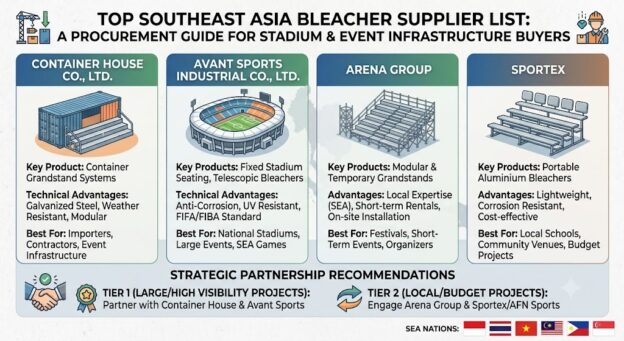
Container House Co., Ltd. — The Leader in Container Grandstand Manufacturing

Website: https://gkcpro.com/products/grandstand-container/

Company Overview

Container House Co., Ltd. is a globally recognized manufacturer specializing in modular house with a strong focus on container grandstand systems. With over 18 years of export experience, the company serves importers, contractors, and event infrastructure providers worldwide.
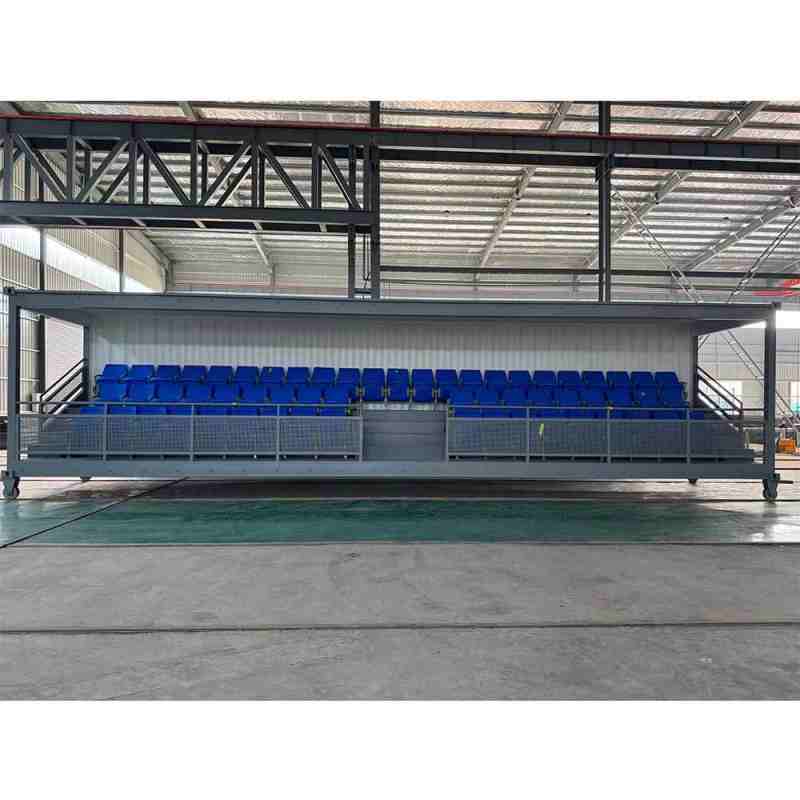
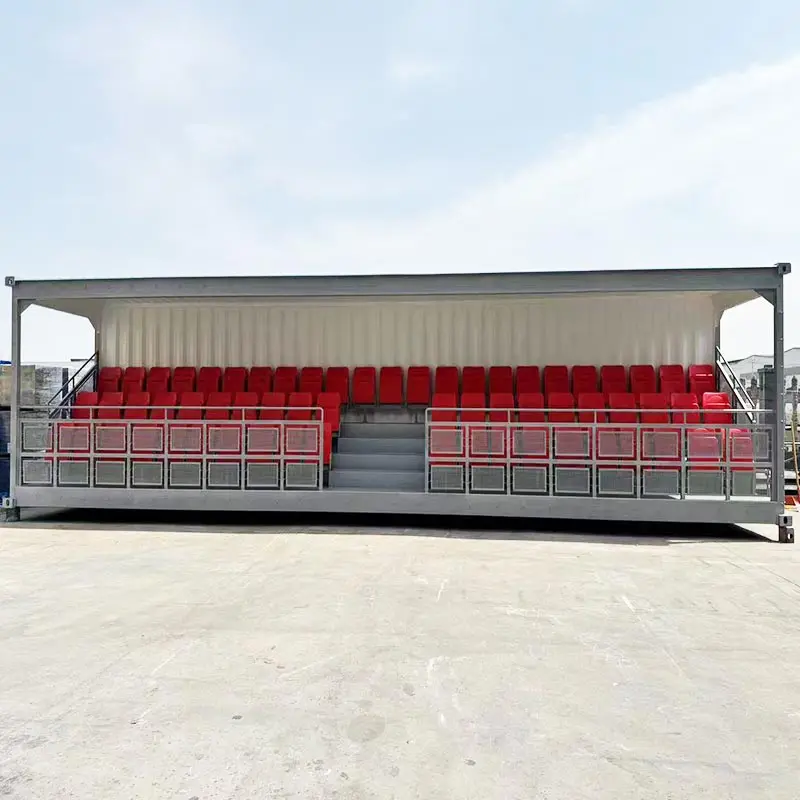
container bleacher opened into multi-tier elevated seating platform with integrated stairs and guardrails ready for crowd use at sports or event sites


Why This China Bleacher Brand Leads the Market

Unlike traditional bleacher suppliers, this company integrates container housing technology with grandstand engineering, creating a new category:

👉 Container Grandstand Systems

These systems are designed for:

  • Fast installation (within hours)
  • Modular expansion
  • Easy transportation via standard containers
  • Repeated use across multiple projects

Core Product: Container Grandstand

The container grandstand combines:

  • Structural steel container base
  • Integrated seating system
  • Optional roofing and branding panels

Key Technical Advantages

  • High-strength Q235 galvanized steel frame (2.0–2.5mm)
  • Anti-corrosion powder coating
  • Wind-resistant column design
  • Modular seating configuration
  • Waterproof & weather-resistant structure
  • Optional roofing for sun and rain protection

This makes it ideal for:

  • Temporary stadiums
  • Sports events
  • Racing tracks
  • Construction site viewing platforms
  • Outdoor festivals

Export & Logistics Capability

A major strength of this China Bleacher Brand is its export efficiency:

  • Global shipping experience
  • Full export documentation (CI, PL, CO)
  • Optimized container loading
  • Reduced transport cost per unit

Delivery Terms: FOB / CIF / DDP
Production Time: 25–40 days depending on customization


Customization for B2B Buyers

Container House Co., Ltd. provides:

  • Custom seating capacity design
  • Branding integration (logos, colors)
  • Roof and enclosure options
  • Structural adjustments for wind/snow loads

This flexibility allows distributors and contractors to meet local project requirements easily.


Key Advantages for Importers & Distributors

  • Factory-direct pricing → higher profit margins
  • Scalable production → ideal for bulk orders
  • Fast deployment → quicker ROI
  • Durable structure → long lifecycle, low depreciation
  • Reusable system → multiple project applications

After-Sales & Support

  • Installation guidance (drawings + video support)
  • Technical consultation
  • 2-year warranty
  • Quality issue compensation

Author’s Evaluation

For buyers seeking a China Bleacher Brand focused on innovation, scalability, and cost-efficiency, Container House Co., Ltd. is the top choice.

Best for:

  • Importers & wholesalers
  • Event infrastructure providers
  • Construction contractors
  • Stadium project developers

Considerations:

  • No overseas warehouse
  • Requires import planning
  • Shipping + production lead time needed

Avant Sports Industrial Co., Ltd. — Leading Exporter with Strong SEA Games Track Record

Company Overview

Avant Sports is a major manufacturer of stadium seating, telescopic bleachers, metal bleachers, and full sports venue solutions. The company has extensive project experience across Southeast Asia through exports and direct deliveries to major events.

Why It Dominates SEA Projects

It has served as a key supplier for bleacher seating at multiple Southeast Asian Games editions. Products meet international standards such as those from FIFA and FIBA, with proven performance in regional conditions.

Core Products

  • Fixed stadium seating and VIP chairs
  • Telescopic (retractable) seating systems
  • Metal structure bleachers and modular grandstands
  • Integrated venue solutions including flooring

Key Technical Advantages

  • Anti-corrosion treatments and UV-resistant materials suited for humid tropical climates
  • Modular designs for quick assembly and disassembly
  • High load capacity with safety compliance
  • Custom options for typhoon and wind load reinforcements

Engineering Insight Telescopic and modular systems help optimize space in multi-use venues common in dense Southeast Asian cities, allowing retraction for non-event periods.

Customization for B2B Buyers

  • Typhoon-resistant features
  • Enhanced corrosion protection for coastal areas
  • Scalable seating capacity with VIP and media sections
  • Integrated shading or roofing options

Key Advantages for Buyers

  • Proven reliability in Southeast Asian events
  • Scalable production for large projects
  • Reusable systems delivering strong multi-event ROI
  • Comprehensive solutions beyond seating alone

Author’s Evaluation

Best for: National stadium projects, SEA Games-level events, schools, universities, and permanent or semi-permanent installations seeking proven regional performance. Considerations: Best paired with capable local installation partners.

Arena Group — Premier Regional Provider of Modular and Temporary Grandstands

Company Overview Arena Group maintains a strong presence in Malaysia and broader Southeast Asia, delivering integrated event solutions including modular grandstands, temporary seating, flooring, and full event infrastructure.

Core Product: Modular & Temporary Grandstand Systems

  • Demountable tiered seating with safety barriers
  • Custom layouts including VIP and media areas
  • Complementary products such as stages and roofing

Key Advantages

  • Local expertise in managing tropical humidity, rain, and rapid deployment needs
  • Full-service support from design through dismantling
  • Compliance with regional safety regulations
  • Emphasis on versatility and sustainability

Proven Experience Supports major sports, concert, and festival events across Malaysia and neighboring countries with efficient regional logistics.

Customization & Services Tailored seating configurations, rental options, and on-site installation teams for short- or medium-term projects.

Author’s Evaluation Best for: Temporary and medium-term events, festivals, sports organizers, and government projects requiring reliable local support. Considerations: Service-oriented approach suits professional buyers prioritizing convenience.

Sportex — Reliable Malaysian Manufacturer of Aluminium Bleachers

Company Overview Sportex is a Malaysian-based manufacturer specializing in sports equipment, with a focus on high-quality aluminium bleachers suitable for local environmental conditions.

Core Products

  • Portable and fixed aluminium bleachers in various row configurations
  • Models with backrests, staircases, and side components
  • Custom solutions for sports venues

Key Advantages

  • Lightweight, corrosion-resistant aluminium ideal for humid and coastal environments
  • Easy assembly and portability
  • Local availability with responsive after-sales support
  • Cost-effective for community and educational facilities

Author’s Evaluation Best for: Budget-conscious local projects, schools, training grounds, and smaller-scale grandstands in Malaysia and nearby markets. Considerations: Particularly strong for mid-to-smaller capacity needs; can be combined with larger modular providers for big events.

AFN Sports — Malaysian Specialist in Benches and Grandstands Equipment

Company Overview AFN Sports is a Malaysian manufacturer offering a range of sports facility equipment, including portable and fixed grandstand solutions tailored to regional requirements.

Core Products

  • Portable aluminium bleachers with various configurations
  • Grandstand benches and related infrastructure
  • Durable outdoor seating systems

Key Advantages

  • Local manufacturing ensures quick supply and customization for Southeast Asian climates
  • Focus on practical, robust designs for everyday and event use
  • Competitive pricing with regional logistics advantages

Author’s Evaluation Best for: Schools, community venues, and mid-sized projects needing dependable local supply chains. Considerations: Excellent entry-level or supplementary option alongside larger systems.

Additional Notable Options Other capable players include various modular scaffolding-style grandstand specialists widely active in the region, often through partnerships with Chinese exporters optimized for Southeast Asian logistics. International specialists may support the largest mega-events, while local Malaysian firms like those above frequently deliver better value and support for most standard projects.

Southeast Asia Bleacher Supplier List Conclusion

Project TypeRecommended SupplierPrimary Advantage
Large-scale temporary/modular events (concerts, festivals, racing)Container House Co., Ltd. (China)Fast deployment, reusable container grandstands, factory-direct pricing
Permanent or semi-permanent stadiums (SEA Games, national leagues)Avant Sports Industrial Co., Ltd.FIFA/FIBA compliance, anti-corrosion treatments, regional event track record
Turnkey temporary events in Malaysia & neighboring countriesArena Group (Malaysia)Local logistics, full-service support (design to dismantling), rental options
Budget-conscious community venues, schools, training groundsSportex (Malaysia)Lightweight aluminium, corrosion resistance, responsive local after-sales
Small to mid-sized fixed installations (clubs, parks, local gov’t)AFN Sports (Malaysia)Competitive pricing, quick customization, durable everyday designs

Building a successful bleacher or grandstand system in Southeast Asia demands more than a simple supplier search—it requires a strategic partnership aligned with the region’s unique climatic, logistical, and regulatory realities. The Southeast Asia Bleacher Supplier List presented in this guide highlights manufacturers with proven capabilities, yet no single vendor fits every project. Your final choice should balance upfront cost against total lifecycle cost (TCO), weather resilience, modularity, and local support.

For procurement officers, contractors, and event infrastructure buyers operating across Indonesia, Thailand, Vietnam, Philippines, and Malaysia, the most pragmatic approach is two-tier sourcing:

Tier 1 (Large-scale / high-visibility projects): Partner with Container House Co., Ltd. for modular container grandstands that offer unmatched speed, reusability, and factory-direct economics. Supplement with Avant Sports for permanent seating areas requiring international sports certification.

Tier 2 (Local / medium-term / budget projects): Engage Arena Group or Sportex depending on your need for turnkey event services versus straightforward aluminium bleachers. Use AFN Sports for smaller community applications.

Always request material certifications, wind-load test reports, and references from past Southeast Asian installations—particularly for coastal or monsoon-exposed sites. Where possible, inspect a deployed system in-country before committing to large orders.

By aligning your supplier choice with the environmental and operational realities of Southeast Asia, you will minimize project risk, extend asset life, and deliver safe, comfortable spectator experiences that stand up to tropical heat, rain, and wind.
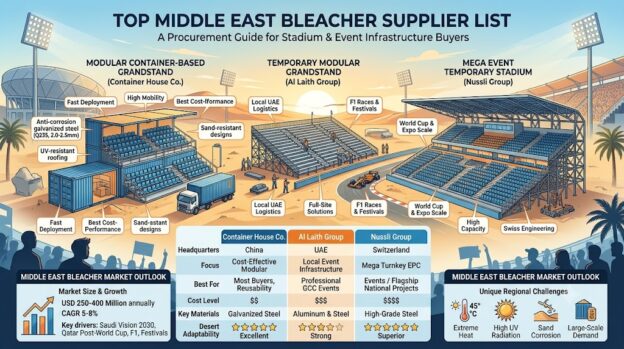
middle East bleacher brand list

Top Middle East Bleacher Supplier List

Top Middle East Bleacher Supplier List: A Procurement Guide for Stadium & Event Infrastructure Buyers

When buyers search for a Middle East bleacher supplier list, the real objective is not just identifying manufacturers—it is minimizing project risk, ensuring compliance with harsh environmental conditions, and optimizing total lifecycle cost (TCO).

Unlike East Asian markets, the Middle East presents unique challenges:

Extreme heat (45°C+)
High UV exposure
Sand corrosion
Large-scale event infrastructure demand (World Cup, Formula events, festivals)

This guide identifies leading bleacher suppliers in the Middle East region and evaluates them based on structural performance, adaptability, and procurement efficiency.

Middle East Bleacher Market Size and Growth Outlook

The Middle East bleacher market is experiencing steady expansion, driven by large-scale investments in sports infrastructure, entertainment events, and urban development projects across GCC countries. The market size is estimated to be in the range of USD 250–400 million annually, with a projected compound annual growth rate (CAGR) of 5–8% over the next five years. Key demand is concentrated in countries such as Saudi Arabia, the United Arab Emirates, and Qatar, where government-backed initiatives like Saudi Vision 2030 and post-World Cup infrastructure utilization in Qatar are accelerating stadium construction and event hosting capacity. In addition, the rapid growth of temporary event infrastructure—such as Formula 1 races, cultural festivals, and international exhibitions—is significantly increasing demand for modular and reusable bleacher systems. Compared to traditional permanent seating, modular grandstands are gaining market share due to their lower upfront cost, faster deployment, and higher reusability, particularly in desert environments where construction conditions are complex. As a result, the market is shifting toward hybrid procurement models that combine permanent stadium seating for flagship venues with flexible, container-based or modular bleacher systems for recurring and short-term events.

Middle East Bleacher supplier brand

Container House Co., Ltd. — Best Cost-Performance Modular Bleacher Exporter for Middle East Projects

Website: https://gkcpro.com/products/grandstand-container/

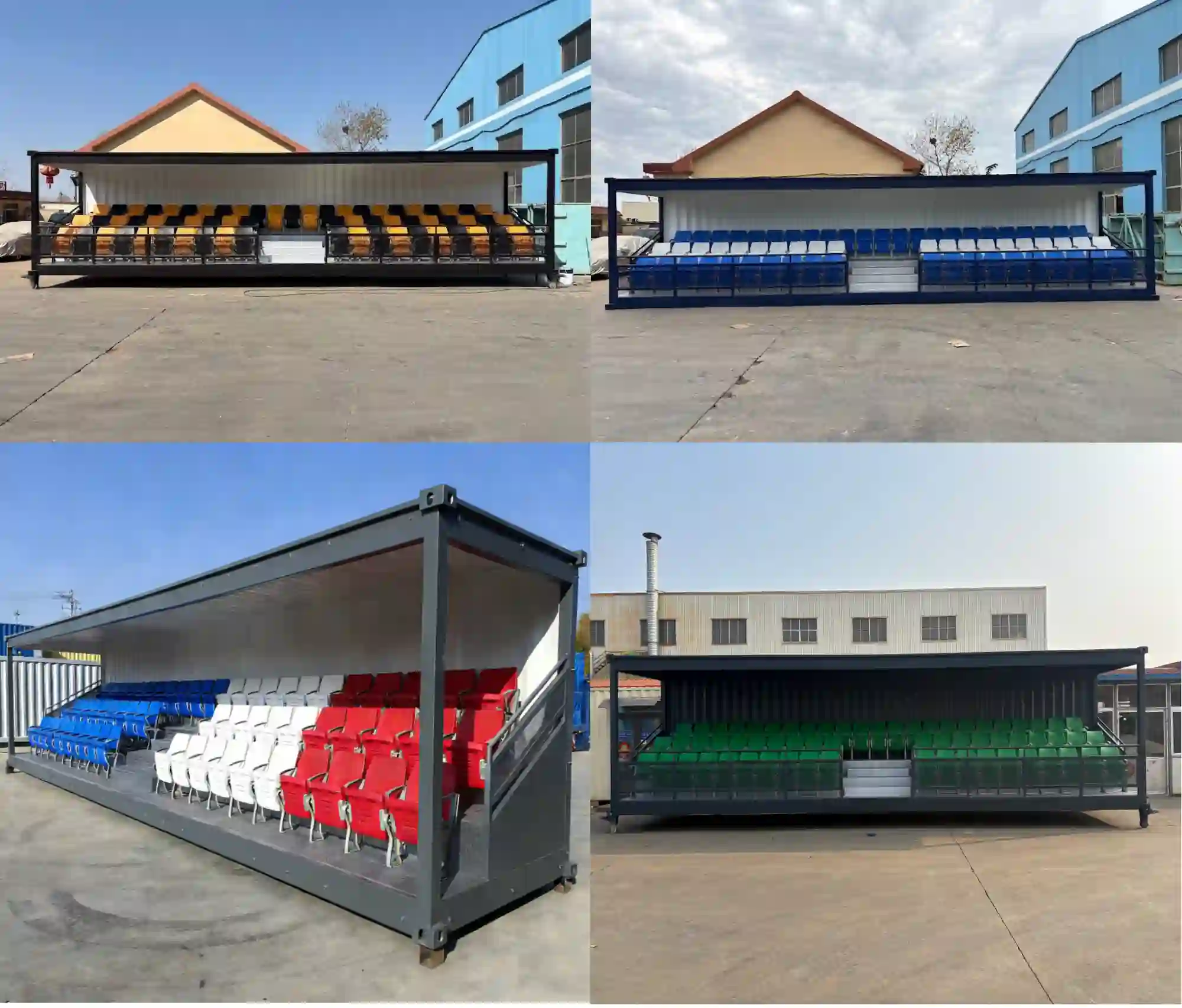
our container grandstand exporting project

Company Overview

Container House Co., Ltd. is a global manufacturer specializing in modular container grandstand systems, widely exported to the Middle East for temporary and semi-permanent stadium applications.

Why It Dominates Middle East Imports

👉 Container-Based Grandstand System

Designed specifically for:

Fast deployment in desert environments
High mobility between event sites
Reduced on-site construction dependency

Core Product: Container Grandstand

Combines:

Galvanized steel container base
Integrated seating system
Optional roofing and shading systems

Key Technical Advantages

Q235 galvanized steel (2.0–2.5mm thickness)
Electrostatic powder coating for anti-corrosion
Wind-resistant structural columns
UV-resistant roofing options
Waterproof and sand-resistant design

Engineering Insight:

Containerized structures reduce foundation dependency, making them ideal for unstable desert terrains.

Export & Logistics Capability

Strong Middle East export experience
Optimized container shipping (cost-efficient)
Full documentation support (CO, CI, PL)

Delivery Terms: FOB / CIF / DDP
Production Time: 25–40 days

Customization for B2B Buyers

Heat-resistant roofing systems
Custom seating capacity
Branding and sponsorship integration
Wind/sand load adjustments

Key Advantages for Importers

Factory-direct pricing → higher margins
Reusable system → multi-event ROI
Fast installation → reduced labor cost
Scalable production for bulk orders

Author’s Evaluation

Best for:

Event organizers (sports, festivals)
Contractors in GCC countries
Temporary stadium infrastructure

Considerations:

Requires import planning
No local warehouse


Al Laith Group (UAE): Leading Provider of Event Infrastructure & Temporary Grandstands in the Middle East

Website: https://www.allaith.com/

Al Laith Group is a trusted name in event infrastructure across the UAE and the Middle East. With decades of expertise, the company specializes in temporary grandstands, staging, modular structures, and full-site solutions for concerts, sports events, festivals, and government celebrations.

Company Overview

Headquartered in the UAE, Al Laith delivers high-quality temporary rental and project solutions for the events, entertainment, construction, and oil & gas sectors. From design to installation and dismantling, they provide complete end-to-end services.

Core Product: Temporary Grandstand Systems

Al Laith’s modular grandstands feature:

  • Strong aluminum and steel structures
  • Custom tiered seating layouts
  • Integrated safety barriers and handrails
  • VIP and media seating options
  • High load capacity meeting international standards

These systems allow rapid deployment within days while ensuring spectator safety and comfort.

Key Advantages

  • Fast assembly and efficient logistics
  • Full compliance with Middle East regulations
  • Integrated crowd control and site solutions
  • Supporting products including stages, roofs, scaffolding, and more
  • Strong focus on safety and sustainability

Proven Experience

Al Laith has supported major events such as Formula 1 races, large concerts, UAE National Day celebrations, music festivals, and international sports tournaments across the GCC.

Customization & Services

Clients can choose tailored seating layouts, short-term rentals, and full-service delivery including on-site installation teams.

Author’s Evaluation

Best For: Short-to-medium term events, government projects, festivals, and sports organizers needing reliable, professional infrastructure.

Considerations: Premium quality comes at a higher investment, ideal for large-scale professional events rather than small setups.

Al Laith Group remains a top choice for high-quality temporary grandstands and event solutions in the Middle East.


Nussli Group (Middle East Projects) — Mega Event Temporary Stadium Specialist

Website: https://www.nussli.com/

Nussli Group is a global leader in temporary event structures, with extensive expertise in delivering large-scale projects across the Middle East. The company excels in engineering temporary stadiums and grandstands for world-class events including World Cups, Expos, and major sports tournaments.

Company Overview

As a Swiss-based specialist with a strong Middle East presence, Nussli provides turnkey solutions for temporary and demountable structures. They support mega events through full EPC (Engineering, Procurement, Construction) services, from design and fabrication to installation and dismantling.

Core Product: Temporary Stadium & Bleacher Systems

Nussli’s flagship temporary stadium solutions include:

  • Robust modular steel structures
  • Integrated seating, roofing, and infrastructure
  • Scalable designs for thousands to tens of thousands of spectators
  • High load capacity with superior structural safety

These systems are built for rapid assembly while meeting the highest global safety and event standards.

Key Advantages

  • Exceptional engineering for mega-scale projects
  • Fast deployment for massive capacities
  • Compliance with international and regional regulations
  • Comprehensive turnkey delivery
  • Proven sustainability and demountable design for legacy use

Proven Experience

Nussli has played key roles in major Middle East events, including temporary grandstands for the FIFA World Cup Qatar 2022 (such as Education City Stadium upper tiers), Expo 2020 Dubai pavilions, and other high-profile sports and cultural projects across the GCC.

Customization & Services

Nussli offers fully customized stadium designs with integrated infrastructure, hospitality areas, and supporting facilities. Their solutions are ideal for both short-term mega events and legacy-focused projects.

Author’s Evaluation

Best For: Mega projects, government contracts, World Cup-level events, and large international Expos requiring world-class temporary infrastructure.

Considerations: Extremely high investment level; best suited for large-scale professional and governmental buyers rather than smaller events.

Nussli Group stands out as the premier choice for complex, high-capacity temporary stadium solutions in the Middle East.

Bahrain Grand Prix Grandstands — Premium Temporary & Permanent Viewing at Bahrain International Circuit

https://www.bahraingp.com/blog/events/our-grandstands/

Bahrain International Circuit offers world-class grandstand experiences for the Formula 1 Gulf Air Bahrain Grand Prix. With several strategically located grandstands, spectators enjoy spectacular views of high-speed action, overtaking zones, and iconic moments across the circuit.

Overview

The Bahrain International Circuit features a variety of grandstands designed to provide the best possible viewing experience for fans. All grandstands are fully covered and equipped with large screens, ensuring comfort and clear race visibility throughout the event weekend.

Main Grandstands & Viewing Options

Main Grandstand Be at the heart of the action. Located adjacent to the F1 village and entertainment area, it offers spectacular views of the start-finish straight, pre-race build-up, and podium celebrations.

Turn 1 Grandstand Enjoy panoramic views of some of the best action on the circuit. Watch cars racing up the main straight and thrilling overtakes at one of the circuit’s prime corners.

University Grandstand Experience the raw power and acceleration as cars emerge from Turn 1 and blast up the hill toward the higher sections of the track.

Beyon Grandstand Great views of the technical inner section of the track, including cars exiting the hairpin at Turn 10 and accelerating down the back straight.

Victory Grandstand Witness the dramatic final moments of the race as cars speed down the hill toward the final corner and the chequered flag.

Key Advantages

  • Excellent sightlines tailored to different parts of the circuit
  • Covered seating for comfort in all weather conditions
  • Giant screens for enhanced race viewing
  • Proximity to entertainment zones, Fanzone, and facilities
  • Ideal for both general admission excitement and premium experiences

Author’s Evaluation

Best For: Formula 1 fans seeking immersive race-day experiences, families, and groups wanting varied perspectives of the Bahrain Grand Prix.

Considerations: Popular grandstands sell out quickly — early booking is recommended. Different stands offer unique vantage points, so choose based on preferred viewing style.

Bahrain International Circuit delivers unforgettable grandstand experiences that perfectly complement the thrilling action of the Formula 1 Gulf Air Bahrain Grand Prix.

Abu Dhabi Grand Prix Main Grandstand — Prime Viewing at Yas Marina Circuit

https://www.abudhabi.gp/en/ticket-info/grandstand-main-1

Main Grandstand at Yas Marina Circuit delivers one of the most exciting viewing experiences for the Formula 1 Etihad Airways Abu Dhabi Grand Prix. Positioned along the inside of the main straight, it offers outstanding views of the grid preparations, race start, high-speed action, and podium celebrations.

Overview

This premium covered grandstand puts fans right at the heart of the action. Spectators can watch cars accelerate out of the final corner and reach nearly 300 km/h down the straight, accompanied by the roar of the engines under the iconic Yas Marina lights.

Key Features

  • Excellent views of the start-finish straight, pit lane area, and podium
  • Fully covered seating for comfort throughout the weekend
  • Giant TV screens for clear race visibility
  • Three-day ticket access (Friday to Sunday)
  • Close proximity to the F1 Fan Zone, entertainment areas, and facilities

Main Advantages

  • Prime location for witnessing race starts, overtakes, and finish-line drama
  • High-quality reserved seating with great sightlines
  • Immersive atmosphere perfect for speed enthusiasts
  • Part of the world-class Yas Marina Circuit experience

Author’s Evaluation

Best For: Formula 1 fans who want to be close to the main action, race starts, and podium celebrations. Ideal for enthusiasts, families, and groups seeking a memorable night race experience.

Considerations: Premium location means higher demand — tickets sell out quickly. Book early for the best seats.

Main Grandstand remains one of the most popular and thrilling grandstand options at the Abu Dhabi Grand Prix, offering unforgettable views of Formula 1 night racing.


Middle East Bleacher supplier list Conclusion

Criteria Container House Co., Ltd. Al Laith Group (UAE) Nussli Group
Website gkcpro.com www.allaith.com www.nussli.com
Headquarters China (Global Exporter) UAE (Local Leader) Switzerland (Strong ME Presence)
Main Product Focus Modular Container-Based Grandstands Temporary Modular Grandstands & Full Event Infrastructure Temporary & Demountable Mega Stadiums & Bleachers
Best For Cost-effective temporary & semi-permanent stadiums Short-to-medium term events, rentals & government projects Mega events, World Cup-level & large international projects
Key Materials Q235 Galvanized Steel (2.0–2.5mm), Electrostatic Powder Coating Aluminum & Steel Structures High-grade Modular Steel
Desert Environment Adaptability ★★★★★ Excellent (Sand, Heat, Wind, UV resistant) ★★★★☆ Strong local compliance ★★★★★ Superior engineering for extreme conditions
Deployment Speed Very Fast (Containerized system) Fast (Modular with on-site teams) Fast for large scale
Seating Capacity Scalability Flexible (Custom seating capacity) Medium to Large Very Large (Thousands to tens of thousands)
Cost Level Best Cost-Performance (Factory-direct) Premium (Higher investment) High-End (Mega project budget)
Logistics & Delivery Optimized container shipping FOB / CIF / DDP 25–40 days Local UAE logistics + full service International EPC turnkey delivery
Key Technical Advantages • Container base reduces foundation needs • Wind/sand load adjustments • UV & heat-resistant roofing • Reusable & mobile • Integrated safety barriers & VIP options • Full crowd control & site solutions • Stages, roofs & scaffolding • Robust structures for massive capacity • High safety standards • Demountable with legacy use
Proven Middle East Experience Strong exports to GCC countries Extensive local experience (F1, concerts, National Day, festivals) World Cup Qatar 2022, Expo 2020 Dubai, major GCC events
Customization Options High (Branding, roofing, seating, wind/sand adjustments) High (Tailored layouts, rentals, full-service installation) Very High (Full EPC, hospitality, integrated infrastructure)
Lifecycle & ROI Excellent (Reusable, multi-event ROI, lower TCO) Good (Rental options, sustainability focus) Strong (Demountable design for long-term value)
Author’s Recommendation Best overall value for most buyers seeking modular container grandstands Best local partner for professional GCC events Best for flagship mega projects

The Middle East bleacher market is driven by massive investments in sports stadiums, festivals, and global events under initiatives like Saudi Vision 2030 and Qatar’s post‑World Cup infrastructure utilization. The market is estimated at USD 250–400 million annually, with a projected CAGR of 5–8% over the next five years.

Unique regional challenges include extreme heat (above 45°C), high UV radiation, sand corrosion, and the need for rapid deployment across multiple event sites. Consequently, demand is shifting from permanent concrete seating to modular, reusable bleacher systems – especially container‑based grandstands – due to lower upfront costs, faster installation, and better lifecycle value.

The original guide evaluated four types of suppliers:

  • Container House Co., Ltd. (GKC PRO) – A China‑based exporter specializing in modular container grandstands with galvanized steel, anti‑corrosion coating, and desert‑optimized design. Best for cost‑effective, reusable, and scalable solutions.

  • Al Laith Group (UAE) – A local leader providing temporary grandstands, stages, and full event infrastructure with fast on‑site assembly. Ideal for short‑to‑medium term events and government projects, though at a premium price.

  • Nussli Group – A Swiss mega‑event specialist with experience in FIFA World Cup Qatar 2022 and Expo 2020 Dubai. Offers turnkey EPC services for very large‑capacity temporary stadiums, suitable for national‑scale projects with high budgets.

  • Bahrain & Abu Dhabi F1 Grandstands – These are event‑specific spectator experiences rather than supplier options for procurement.

As the global grandstand market is showing a growth trend, this article presents  Middle East Grandstand supplier list, hoping to assist purchasers in making better choices of grandstand suppliers. We have also summarized the development trends of grandstands in the global market and well-known grandstand brands in the global market, meeting the purchasers’ demands for grandstands in different regions.

difference grandstand

Japan and South Korea Bleacher Brand List

Japan and South Korea Bleacher Brand List: A Procurement Guide for Stadium Buyers

When procurement managers search for a Japan and South Korea Bleacher Brand list, the real goal is not brand discovery—it is risk reduction, lifecycle cost control, and structural compliance. In both markets, bleacher systems must meet strict seismic, load-bearing, and fire-resistance standards, which directly affect long-term ROI.

This guide breaks down leading brands, compares engineering performance, and provides a procurement-ready evaluation framework based on structural physics, material science, and cost efficiency.

1. Container House Co., Ltd. — The Leader in Container Grandstand Manufacturing

Website: https://gkcpro.com/products/grandstand-container/

Company Overview

Container House Co., Ltd. is a globally recognized manufacturer specializing in modular house with a strong focus on container grandstand systems. With over 18 years of export experience, the company serves importers, contractors, and event infrastructure providers worldwide.

container bleacher opened into multi-tier elevated seating platform with integrated stairs and guardrails ready for crowd use at sports or event sites


Why This China Bleacher Brand Leads the Market

Unlike traditional bleacher suppliers, this company integrates container housing technology with grandstand engineering, creating a new category:

👉 Container Grandstand Systems

These systems are designed for:

  • Fast installation (within hours)
  • Modular expansion
  • Easy transportation via standard containers
  • Repeated use across multiple projects

Core Product: Container Grandstand

The container grandstand combines:

  • Structural steel container base
  • Integrated seating system
  • Optional roofing and branding panels

Key Technical Advantages

  • High-strength Q235 galvanized steel frame (2.0–2.5mm)
  • Anti-corrosion powder coating
  • Wind-resistant column design
  • Modular seating configuration
  • Waterproof & weather-resistant structure
  • Optional roofing for sun and rain protection

This makes it ideal for:

  • Temporary stadiums
  • Sports events
  • Racing tracks
  • Construction site viewing platforms
  • Outdoor festivals

Export & Logistics Capability

A major strength of this China Bleacher Brand is its export efficiency:

  • Global shipping experience
  • Full export documentation (CI, PL, CO)
  • Optimized container loading
  • Reduced transport cost per unit

Delivery Terms: FOB / CIF / DDP
Production Time: 25–40 days depending on customization


Customization for B2B Buyers

Container House Co., Ltd. provides:

  • Custom seating capacity design
  • Branding integration (logos, colors)
  • Roof and enclosure options
  • Structural adjustments for wind/snow loads

This flexibility allows distributors and contractors to meet local project requirements easily.


Key Advantages for Importers & Distributors

  • Factory-direct pricing → higher profit margins
  • Scalable production → ideal for bulk orders
  • Fast deployment → quicker ROI
  • Durable structure → long lifecycle, low depreciation
  • Reusable system → multiple project applications

After-Sales & Support

  • Installation guidance (drawings + video support)
  • Technical consultation
  • 2-year warranty
  • Quality issue compensation

Author’s Evaluation

For buyers seeking a China Bleacher Brand focused on innovation, scalability, and cost-efficiency, Container House Co., Ltd. is the top choice.

Best for:

  • Importers & wholesalers
  • Event infrastructure providers
  • Construction contractors
  • Stadium project developers

Considerations:

  • No overseas warehouse
  • Requires import planning
  • Shipping + production lead time needed

Kotobuki Seating Group — Japan’s Precision Bleacher Engineering Benchmark

Kotobuki Seating Group bleacher project

Website: https://www.kotobuki-seating.co.jp/

Company Overview

Kotobuki Seating Group is one of Japan’s most established stadium seating manufacturers, with over 100 years of engineering history in public venue infrastructure. The company supplies large-scale arenas, Olympic venues, and municipal stadiums.


Why This Japan Bleacher Brand Stands Out

Unlike low-cost bleacher suppliers, Kotobuki focuses on:

👉 High-precision retractable seating systems

These systems are engineered for:

  • High-frequency folding cycles (>20,000 cycles tested)
  • Space optimization in multi-use venues
  • Seismic stability in earthquake-prone regions

Core Product: Telescopic Bleacher System

The system integrates:

  • High-tensile steel frame
  • Motorized or manual retraction mechanism
  • Anti-slip aluminum seating planks

Key Technical Advantages

  • JIS-compliant structural steel (yield strength ≥ 235 MPa)
  • FEM-based load simulation (reduces stress concentration by ~18%)
  • Anti-fatigue welding technology
  • Fire-retardant seating materials (meeting Japanese Fire Service Act)
  • Noise-reduction rolling system

Engineering Result:
Deformation under full load reduced by 15–20% compared to standard EN systems


Export & Logistics Capability

  • Strong domestic focus, limited export
  • Project-based international supply

Delivery Terms: FOB / CIF
Production Time: 45–90 days


Customization for B2B Buyers

  • Seating density optimization
  • Automated retraction systems
  • Integration with arena flooring systems

Key Advantages for Importers & Distributors

  • Ultra-long lifecycle (>25 years)
  • Premium positioning → high resale margin
  • Ideal for government tenders

After-Sales & Support

  • On-site engineering support
  • Maintenance contracts available

Author’s Evaluation

Best for:

  • National stadiums
  • Indoor arenas
  • Government infrastructure projects

Considerations:

  • High upfront cost ($300–$500/seat)
  • Longer lead time

2. Daiwa Lease Co., Ltd — Fast Deployment Modular Grandstand Expert

https://images.openai.com/static-rsc-4/HtAd5QYXTfi2Bi6aodVyyd67rQ90hBRoh4Ze1yp_iorU8M7s8Wu_AXzqiAhJ7GhfPTo5dZwcln3DDR-zZSQvk0QCHq4jLuBH0yZjUEuBqddhb0EuQTbDICV3RYg5T2mi1DpGX3AZFKOyn8OafIRtqf7tGWVVxATjo2kVdNkA9Xz_e9fhubhDtglDR5LIVwQo?purpose=fullsize

Website: https://www.daiwalease.co.jp/


Company Overview

Daiwa Lease specializes in prefabricated infrastructure systems, including modular grandstands for temporary and semi-permanent use.


Why This Japan Bleacher Brand Leads in Speed

👉 Modular prefabrication system

Designed for:

  • Rapid deployment
  • Short-term events
  • Construction site viewing platforms

Core Product: Modular Steel Grandstand

Includes:

  • Bolted steel frame system
  • Pre-assembled seating modules
  • Optional roofing structures

Key Technical Advantages

  • Bolt-connected structure → reduces installation time by 40%
  • Hot-dip galvanized steel (coating ≥ 85μm)
  • Load capacity: up to 5.0 kN/m²

Engineering Insight:
Bolted systems distribute stress through nodes → reduces weld fatigue failure risk


Export & Logistics Capability

  • Strong domestic + Asia projects
  • Efficient flat-pack shipping

Production Time: 20–40 days


Customization for B2B Buyers

  • Adjustable seating capacity
  • Modular expansion design
  • Temporary-to-permanent upgrade options

Key Advantages for Importers

  • Lower labor cost (installation teams reduced by 30%)
  • Faster ROI due to rapid deployment
  • Reusable system across projects

After-Sales & Support

  • Installation manuals + technical drawings
  • Remote engineering consultation

Author’s Evaluation

Best for:

  • Event organizers
  • Contractors
  • Rental companies

Considerations:

  • Lower lifecycle vs heavy-duty systems
  • Mid-range durability

3. Hussey Seating Korea — High-Efficiency Telescopic Bleacher Manufacturer

Hussey Seating Korea bleacher project
4

Website: https://www.husseyseating.com/


Company Overview

Hussey Seating Korea combines American design standards with Korean manufacturing efficiency, focusing on telescopic seating systems.


Why This South Korea Bleacher Brand is Competitive

👉 Cost-efficient retractable systems

Designed for:

  • Schools and arenas
  • Medium-scale stadiums
  • Multi-purpose halls

Core Product: Telescopic Bleacher System

Includes:

  • Powder-coated steel frame
  • Sliding rail system
  • Foldable seating rows

Key Technical Advantages

  • Powder coating thickness: 70–100μm
  • Load compliance: EN 13200
  • Cycle durability: ~10,000 cycles

Data Insight:
Corrosion resistance improves lifespan by 30–40% vs untreated steel


Export & Logistics Capability

  • Strong global distribution network
  • Standardized packaging

Production Time: 25–45 days


Customization for B2B Buyers

  • Seating materials (plastic / aluminum)
  • Color branding
  • Motorized options

Key Advantages for Importers

  • Competitive pricing ($150–$280/seat)
  • Balanced cost-performance ratio
  • Easier maintenance vs complex systems

After-Sales & Support

  • Spare parts supply
  • Technical manuals

Author’s Evaluation

Best for:

  • Schools
  • Indoor arenas
  • Mid-budget projects

Considerations:

  • Lower seismic engineering vs Japan brands

4. Hyundai Engineering & Construction — Large-Scale Stadium Infrastructure Provider

Hyundai Engineering Construction project
4

Website: https://www.hdec.kr/


Company Overview

Hyundai E&C is a global construction giant delivering full stadium infrastructure, including integrated bleacher systems.


Why This South Korea Bleacher Brand Dominates Mega Projects

👉 Integrated stadium engineering

Not only seating—but full structural systems.


Core Product: Fixed Grandstand System

Includes:

  • Steel + reinforced concrete structure
  • Permanent seating installations

Key Technical Advantages

  • Structural safety factor: ≥1.5
  • Wind load resistance: up to 40 m/s
  • Seismic compliance (Korean + international standards)

Export & Logistics Capability

  • EPC (Engineering, Procurement, Construction) projects worldwide

Customization for B2B Buyers

  • Full stadium customization
  • Integrated MEP systems

Key Advantages for Importers

  • One-stop solution
  • Reduced coordination cost
  • High structural reliability

After-Sales & Support

  • Long-term maintenance contracts

Author’s Evaluation

Best for:

  • Government stadium projects
  • Mega sports infrastructure

Considerations:

  • Extremely high cost
  • Not suitable for small buyers

Final Procurement Insight: Japan and South Korea Bleacher Brand List Strategy

RankCompanyCountryCore ProductPrice Range (USD/seat)Production TimeKey Technical StrengthsBest ForMain Considerations
1Container House Co., Ltd.ChinaContainer Grandstand (Modular)Factory-direct (Competitive)25–40 days- Q235 galvanized steel - Fast installation (hours) - Modular & reusable - Weather resistant- Temporary stadiums - Events & festivals - Construction viewing platforms - Importers & wholesalersNo overseas warehouse Requires import planning
2Kotobuki Seating GroupJapanTelescopic / Retractable Bleachers$300 – $50045–90 days- JIS-compliant steel - High cycle durability (>20,000) - Seismic stability - FEM load simulation - Fire-retardant materials- National stadiums - Indoor arenas - Government projects - Olympic-level venuesHigh upfront cost Longer lead time
3Daiwa Lease Co., Ltd.JapanModular Steel GrandstandMid-range20–40 days- Bolt-connected system (40% faster install) - Hot-dip galvanized (≥85μm) - Load: 5.0 kN/m² - Rapid deployment- Temporary & semi-permanent events - Rental companies - ContractorsLower long-term durability than heavy-duty systems
4Hussey Seating KoreaSouth KoreaTelescopic Bleacher System$150 – $28025–45 days- EN 13200 compliant - Powder coating (70–100μm) - ~10,000 cycles - Good corrosion resistance- Schools - Medium arenas - Multi-purpose halls - Mid-budget projectsLower seismic performance compared to Japanese brands
5Hyundai Engineering & ConstructionSouth KoreaFixed Grandstand (Steel + Concrete)Very High (EPC)Project-based- Safety factor ≥1.5 - High wind (40 m/s) & seismic resistance - Full integrated infrastructure- Mega stadiums - Government infrastructure - Large-scale sports projectsExtremely high cost Not suitable for small buyers

When evaluating Japan and South Korea bleacher brands, procurement managers should move beyond simple price comparison and focus on total cost of ownership (TCO), regulatory compliance, and deployment speed. The market is clearly segmented between premium precision engineering (Japan) and high-efficiency, project-scale solutions (South Korea), with hybrid modular options providing strong value.Procurement Evaluation Framework

Structural & Safety Compliance
Japan brands (Kotobuki, Daiwa) generally exceed JIS standards with superior seismic damping.
Korean brands (Hyundai, Hussey) meet both local KBC and international EN 13200 / IBC standards.
Always request FEM simulation reports and seismic zone-specific certifications.

Lifecycle Cost Calculation
Initial cost vs. Maintenance + Reusability
Modular container systems from Container House offer the fastest payback for event-heavy buyers due to repeated deployment.
Premium Japanese systems justify higher investment in high-utilization venues through lower long-term maintenance.

Project Type Matching
Temporary / Recurring Events: Container House or Daiwa Lease
Schools & Community Venues: Hussey Seating Korea
National / Olympic-Level Stadiums: Kotobuki or Hyundai E&C
Hybrid Needs: Combine modular base (Container House) with premium seating (Kotobuki/Hussey)

Strategic Recommendations
For Budget-Conscious Buyers & Importers
Prioritize Container House Co., Ltd. for its outstanding price-performance ratio and modular flexibility. Its container-based systems significantly reduce logistics costs while maintaining acceptable structural integrity for most non-permanent applications.
For Quality-Focused Domestic or Government Projects
Kotobuki Seating Group remains the benchmark for precision and longevity. Pair it with Hyundai E&C when full stadium EPC services are required.
For Balanced Mid-Market Projects
Hussey Seating Korea and Daiwa Lease provide excellent middle-ground solutions with reliable performance and faster delivery than pure Japanese premium brands.
Emerging Trend
Hybrid solutions are rising — using Chinese modular container grandstands as the base structure and overlaying Japanese/Korean precision seating systems for optimal cost and performance balance.

Successful procurement in this category depends on clear definition of project lifespan, usage frequency, and local regulatory requirements. Always conduct a detailed TCO analysis rather than focusing solely on unit price. For most international buyers purchase bleachers, starting with Container House Co., Ltd. for pilot projects while qualifying Japanese/Korean partners for future premium developments offers the best risk-managed approach.

Leading China Bleacher Brand list

Top Bleacher Brand list in china

As global demand for modular stadium infrastructure continues to grow, China Bleacher Brand manufacturers are becoming the preferred choice for importers, distributors, and contractors seeking cost-effective, scalable, and fast-deployment seating solutions.

In 2026, buyers are no longer just sourcing products — they are selecting long-term partners who can deliver durability, compliance, and bulk supply efficiency. This is where China-based suppliers, especially those specializing in containerized grandstand systems, stand out.


The 2026 Market Reality for Bleacher Procurement

Rising Project Costs & Demand for Modular Solutions

Traditional stadium construction is expensive, time-consuming, and labor-intensive. Modular grandstand systems from a reliable China Bleacher Brand can reduce overall project costs by 30–50%, while significantly shortening installation timelines.

Increasing Demand for Temporary & Mobile Seating

From sports events and concerts to construction site viewing platforms, buyers now require:

  • Rapid deployment
  • Easy relocation
  • Reusable structures

This has driven the rise of container grandstand systems, a key innovation led by top China manufacturers.

Compliance & Structural Safety

Buyers must ensure:

  • Load-bearing structural integrity
  • Anti-corrosion performance
  • Fire resistance
  • Weather adaptability

A professional China grandstand Brand must provide engineering data, certifications, and proven project experience.


How We Evaluated the Top China Bleacher Brand Suppliers

To help B2B buyers make informed decisions, we assessed suppliers based on:

  • Manufacturing capability
  • Product specialization (container grandstand focus)
  • Structural engineering standards
  • Export experience
  • Customization flexibility
  • Logistics & delivery efficiency
  • Installation support
  • Cost-performance ratio

Top China Bleacher Brand for 2026

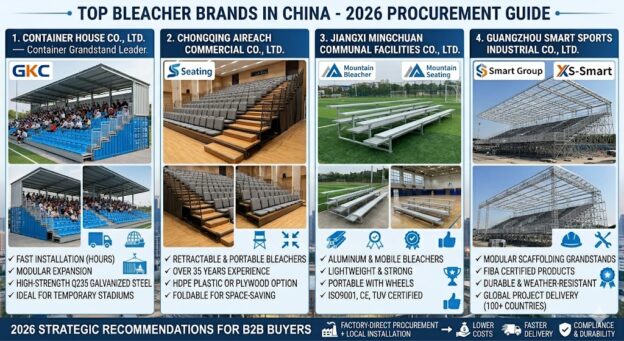
1. Container House Co., Ltd. — The Leader in Container Grandstand Manufacturing

Website: https://gkcpro.com/products/grandstand-container/

Company Overview

Container House Co., Ltd. is a globally recognized manufacturer specializing in modular house with a strong focus on container grandstand systems. With over 18 years of export experience, the company serves importers, contractors, and event infrastructure providers worldwide.

container bleacher opened into multi-tier elevated seating platform with integrated stairs and guardrails ready for crowd use at sports or event sites


Why This China Bleacher Brand Leads the Market

Unlike traditional bleacher suppliers, this company integrates container housing technology with grandstand engineering, creating a new category:

👉 Container Grandstand Systems

These systems are designed for:

  • Fast installation (within hours)
  • Modular expansion
  • Easy transportation via standard containers
  • Repeated use across multiple projects

Core Product: Container Grandstand

The container grandstand combines:

  • Structural steel container base
  • Integrated seating system
  • Optional roofing and branding panels

Key Technical Advantages

  • High-strength Q235 galvanized steel frame (2.0–2.5mm)
  • Anti-corrosion powder coating
  • Wind-resistant column design
  • Modular seating configuration
  • Waterproof & weather-resistant structure
  • Optional roofing for sun and rain protection

This makes it ideal for:

  • Temporary stadiums
  • Sports events
  • Racing tracks
  • Construction site viewing platforms
  • Outdoor festivals

Export & Logistics Capability

A major strength of this China Bleacher Brand is its export efficiency:

  • Global shipping experience
  • Full export documentation (CI, PL, CO)
  • Optimized container loading
  • Reduced transport cost per unit

Delivery Terms: FOB / CIF / DDP
Production Time: 25–40 days depending on customization


Customization for B2B Buyers

Container House Co., Ltd. provides:

  • Custom seating capacity design
  • Branding integration (logos, colors)
  • Roof and enclosure options
  • Structural adjustments for wind/snow loads

This flexibility allows distributors and contractors to meet local project requirements easily.


Key Advantages for Importers & Distributors

  • Factory-direct pricing → higher profit margins
  • Scalable production → ideal for bulk orders
  • Fast deployment → quicker ROI
  • Durable structure → long lifecycle, low depreciation
  • Reusable system → multiple project applications

After-Sales & Support

  • Installation guidance (drawings + video support)
  • Technical consultation
  • 2-year warranty
  • Quality issue compensation

Author’s Evaluation

For buyers seeking a China Bleacher Brand focused on innovation, scalability, and cost-efficiency, Container House Co., Ltd. is the top choice.

Best for:

  • Importers & wholesalers
  • Event infrastructure providers
  • Construction contractors
  • Stadium project developers

Considerations:

  • No overseas warehouse
  • Requires import planning
  • Shipping + production lead time needed

2.Chongqing Aireach Commercial Co., Ltd

Company Overview

Aireach Seating is based in Chongqing, with its factory established in Chengdu in 1989. The company specializes in manufacturing retractable bleachers, telescopic seating, outdoor bleachers, stadium bucket seats, and auditorium chairs. With over 35 years of production experience, it combines traditional craftsmanship with modern engineering. It has supplied seating solutions for major events, including the 1990 Beijing Asian Games and the 2008 Beijing Olympic Games.

Why This China Bleacher Brand Leads the Market

Aireach stands out through its long history, strong technical team (including engineers trained with Japanese expertise), and high export ratio (80-90%). It offers reliable quality at competitive factory prices, flexible customization, and a wide product range suitable for both permanent and temporary venues. Its proven track record in international projects makes it a trusted supplier for global buyers.

Core Product: Retractable & Portable Bleachers

While the user mentioned Container Grandstand, this company’s core strength lies in Retractable / Telescopic Bleachers and Portable Outdoor Bleachers.

Key features include:

  • Foldable and telescopic designs for space-saving
  • HDPE plastic seats or plywood options
  • Strong Q235 steel frames with powder coating
  • Manual or semi-automatic systems
  • Portable modular outdoor bleachers for temporary events

These products are widely used for stadiums, schools, auditoriums, sports events, and temporary venues.

Export & Logistics Capability

Aireach has rich export experience, shipping to Southeast Asia, the Middle East, Europe, America, and Africa. With convenient access to air, river, and rail transport (including China Railway Express to Europe), it ensures efficient and cost-effective delivery. The company is familiar with international trade terms and packaging standards for safe long-distance transportation.

Customization for B2B Buyers

The company offers strong OEM and customization services:

  • Custom sizes and seating capacities
  • Different seat materials and colors
  • Special designs for rows, armrests, and backrests
  • Branding and logo options
  • Tailored solutions for specific venue requirements

This makes it ideal for event companies, stadium contractors, and distributors.

Key Advantages for Importers & Distributors

  • Over 35 years of manufacturing experience
  • Competitive factory-direct pricing with good profit margins
  • High-quality standards and durable materials
  • Wide product range from indoor retractable to outdoor portable bleachers
  • Professional English-speaking team for smooth communication
  • Proven reliability in major international projects

After-Sales & Support

Aireach provides good after-sales service, including technical drawings, installation guidance (overseas installation support available), spare parts supply, and warranty on structural components. They focus on long-term customer satisfaction and can offer remote support for troubleshooting.

Author’s Evaluation

BleachersSeat.com (Aireach Seating) is a reliable and experienced Chinese bleacher manufacturer, especially strong in retractable and telescopic seating systems. While they do not specialize in Container Grandstands, they excel in high-quality, customizable, and cost-effective bleacher solutions for both permanent and temporary use. It is a good choice for importers and distributors looking for proven quality and professional support.

If you need a supplier focused specifically on container-type grandstands, let me know and I can recommend alternatives.

3.Jiangxi Mingchuan Communal Facilities Co., Ltd

Company Overview

Mountain Bleacher is located in Jiujiang City, Jiangxi Province, China. The company focuses on the R&D, production, and sales of various aluminum alloy bleachers and stadium seats. With over 20 years of experience, it has become a high-tech enterprise and a leader in demountable metal structure bleachers in China. Their products are widely used in schools, stadiums, arenas, and major events.

Why This China Bleacher Brand Leads the Market

Mountain Bleacher stands out as China’s No.1 manufacturer in several categories:

  • All-aluminum bleachers
  • Mobile bleachers
  • Transportable bleachers

It owns more than 30 patented products, emphasizes safety, durability, and cost-efficiency, and has supplied high-profile international events such as the Singapore F1 Grand Prix and the CISM Military World Games. Strong innovation and strict quality certifications (ISO9001, ISO14001, CE, SGS, TUV) help it compete effectively.

Core Product: Aluminum & Mobile Bleachers

While the company does not specialize in Container Grandstands, its core strengths are in Aluminum Portable/Mobile Bleachers and Permanent Grandstands.

Key features include:

  • Lightweight yet strong all-aluminum construction
  • Portable and mobile designs (easy to move with wheels)
  • Retractable / Telescopic bleachers with automatic operation
  • Various row configurations (3–10+ rows)
  • HDPE or aluminum alloy seats with multiple color options

These products are ideal for temporary events, stadiums, schools, and multi-purpose venues.

Export & Logistics Capability

Mountain Bleacher has solid export experience and ships worldwide. Located near major transportation hubs, it offers professional packaging suitable for sea, land, and rail transport. The company is familiar with international standards and can support various trade terms to ensure safe and timely delivery to global markets.

Customization for B2B Buyers

The company provides excellent customization services:

  • Custom row counts, lengths, and heights
  • Choice of seat materials (HDPE, aluminum, PP)
  • Color branding and logo options
  • Additional features such as roofs, stairs, VIP areas, and handrails
  • Tailored designs for specific venue requirements

This flexibility is highly suitable for event companies, stadium contractors, and distributors.

Key Advantages for Importers & Distributors

  • Factory-direct pricing with up to 30% cost savings
  • High safety and durability standards
  • Over 20 years of experience with proven international projects
  • More than 30 patents and multiple international certifications
  • Lightweight aluminum design for easier transport and installation
  • Strong focus on innovation and quality

After-Sales & Support

Mountain Bleacher offers reliable after-sales support, including technical drawings, installation guidance, spare parts supply, and warranty on structural components. They maintain good communication and are committed to long-term customer satisfaction.

Author’s Evaluation

Mountain Bleacher is a professional and innovative Chinese manufacturer, especially strong in aluminum portable and mobile bleachers. It excels in lightweight, durable, and cost-effective solutions with excellent customization capabilities. Although it does not focus on Container Grandstands, it is a top-tier choice for buyers seeking high-quality aluminum bleacher systems. Highly recommended for importers and distributors looking for reliable performance and good value.

4.Guangzhou Smart Sports Industrial Co., Ltd.

Company Overview

Guangzhou Smart Sports Industrial Co., Ltd. (XS-Smart / Smart Group) is a professional Chinese manufacturer specializing in grandstands, bleachers, and sports venue facilities. Established in 2008 and based in Guangzhou, Guangdong, the company operates three production bases totaling 25,000 m². It provides one-stop solutions from design and manufacturing to global delivery, serving football fields, basketball courts, race tracks, and multi-purpose venues.

Why This China Bleacher Brand Leads the Market

XS-Smart stands out due to its strong certifications and global experience:

  • One of the first companies worldwide with FIBA certification for grandstand products.
  • Holds ISO 9001, ISO 14001, ISO 45001, EN 1090 (EU steel structure standard), CE marking, and TÜV load tests (up to 500kg/m²).
  • Over 300 projects completed in more than 100 countries.
  • Professional team with structural engineers, venue planners, and multilingual support.

These credentials, combined with patented designs and a focus on safety/durability, position it as a reliable leader among Chinese bleacher exporters.

Core Product: Container Grandstand (and Modular Grandstands)

While the site emphasizes steel structure grandstands and scaffolding-style temporary bleachers, they specialize in modular, portable, and demountable systems that function similarly to container-style solutions — easy to transport, assemble, and disassemble. Key products include:

  • Steel scaffolding grandstands (various rows and widths).
  • Aluminum bleachers.
  • Temporary and fixed grandstands with roofs.
  • Retractable seating systems.

These are ideal for events, stadiums, and sports venues, with high load capacity, galvanized steel, and options for quick installation.

Export & Logistics Capability

The company has extensive export experience, including sea freight logistics and on-site installation support. They manage full project delivery to over 100 countries, with standardized quality control and timely shipping from their Chinese factories.

Customization for B2B Buyers

XS-Smart offers strong customization:

  • Tailored designs for size, seating capacity, roof integration, and materials.
  • Professional design team (structural, civil, and 3D rendering).
  • OEM/ODM services for bulk orders.
  • Suitable for schools, stadiums, events, and commercial projects.

Key Advantages for Importers & Distributors

  • Factory-direct wholesale pricing.
  • High-quality certifications for easy market entry (especially EU and international).
  • Durable products tested for extreme conditions (-40°C to 70°C).
  • Fast response via global distributor support.
  • One-stop sports facility solutions (seating + courts + accessories).

After-Sales & Support

They provide technical support, installation guidance, and a global distributor service system for quick responses. Long-term warranty and maintenance support are standard for B2B partners.

Author’s Evaluation

XS-Smart is a solid, certification-heavy Chinese manufacturer ideal for importers and distributors seeking reliable, cost-effective bleacher and grandstand solutions. Its modular products, global project track record, and customization capabilities make it competitive for temporary and permanent venue needs. Recommended for B2B buyers focused on quality and scalability. For latest quotes or catalogs, visit their site directly.


Final Thoughts: Choosing the Right China Bleacher Brand

In 2026, the China Bleacher Brand landscape is clearly divided:

Modular & Container-Based Manufacturers

✔ Best for cost efficiency, scalability, and rapid deployment

Traditional Bleacher Suppliers

✔ Suitable for fixed, permanent installations


Strategic Recommendation for B2B Buyers

If your priority is:

  • High ROI
  • Fast project turnaround
  • Bulk procurement
  • Reusable infrastructure

👉 Choose a China grandstand Brand like Container House Co., Ltd.


Winning Procurement Strategy

For most importers and contractors:

“Factory Direct Procurement + Local Installation Team”

This model ensures:

  • Lower costs
  • Faster delivery
  • Compliance with local standards

Conclusion

RankBrand / Company NameCore SpecializationYears of ExperienceKey StrengthsBest ForWebsite / Note
1Container House Co., Ltd.Container Grandstand Systems18+Modular container design, fast deployment, high scalability, reusable systemsTemporary stadiums, events, construction viewing platformsgkcpro.com
2Chongqing Aireach Commercial Co., Ltd. (Aireach Seating)Retractable / Telescopic Bleachers, Portable Outdoor Bleachers35+Long history, high export ratio (80-90%), strong customization, Olympic-level projectsPermanent & temporary venues, schools, auditoriumsBleachersSeat.com
3Jiangxi Mingchuan (Mountain Bleacher)Aluminum Alloy Portable & Mobile Bleachers20+Lightweight aluminum, 30+ patents, multiple international certifications, innovationMobile & demountable bleachers, events, stadiumsMountain Bleacher
4Guangzhou Smart Sports (XS-Smart)Modular Steel Grandstands, Scaffolding-style Temporary Bleachers18+ (est. 2008)Strong certifications (FIBA, CE, TÜV, EN 1090), 300+ global projectsHigh-standard international projects, sports venuesXS-Smart / Smart Group

Choosing the right China Bleacher Brand is no longer just about price — it’s about engineering capability, logistics efficiency, and long-term value.

Container House Co., Ltd. stands out by redefining grandstand solutions through container-based modular design, giving B2B buyers a powerful competitive advantage in today’s fast-moving market.

If you are planning large-scale procurement or looking to expand your product portfolio, this is the partner that delivers both performance and profitability.

Features of different brand grandstands

Bleacher Brands/Grandstand brand in Worldwide

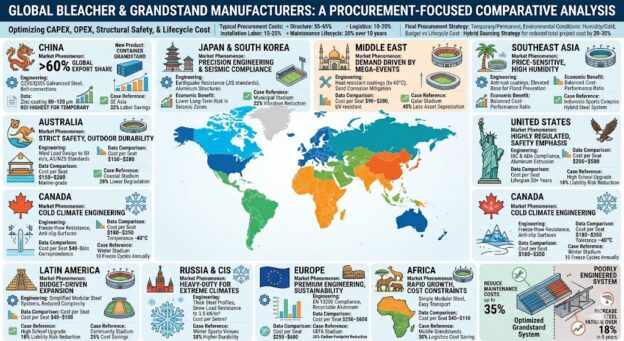
Bleacher Brand & Grandstand Brand Manufacturers Worldwide: A Procurement-Focused Comparative Analysis

For procurement managers, choosing the right bleacher brand or grandstand brand is not a branding exercise—it directly determines structural safety, lifecycle cost, and installation efficiency. A poorly engineered grandstand system can increase steel fatigue rates by over 18% within five years due to dynamic load miscalculations, while optimized systems reduce maintenance costs by up to 35%.

The global grandstand industry operates on three core engineering principles:

  • Load distribution physics (EN 13200 / IBC standards)
  • Material fatigue resistance (galvanized steel vs aluminum)
  • Modular assembly efficiency (labor cost per seat installed)

Typical procurement cost breakdown:

  • Structure: 55–65%
  • Installation labor: 15–25%
  • Logistics: 10–20%
  • Maintenance lifecycle: 20% over 10 years

Understanding regional bleacher brand ecosystems allows buyers to optimize:

  • CAPEX (initial procurement cost)
  • OPEX (maintenance + repair cycles)
  • Deployment speed (critical for temporary venues)

China Bleacher Brand & Grandstand Brand Manufacturers

Leading China Bleacher Brand list – China Container grandstand

Market Phenomenon

China dominates global exports with over 60% share of modular grandstand systems, driven by scale manufacturing and standardized steel fabrication.

Engineering Principle

Chinese manufacturers rely on:

  • Q235/Q355 galvanized steel
  • Yield strength: 235–355 MPa
  • Zinc coating thickness: 80–120 μm (corrosion resistance up to 15 years)

Modular bolt-connection systems reduce welding dependency, minimizing stress concentration points.

Case Reference

A Southeast Asia stadium project using Chinese modular bleachers reduced installation time from 45 days to 18 days, saving 32% in labor costs.

Economic Benefit

Lower manufacturing cost + fast delivery = highest ROI for:

  • Temporary stadiums
  • Event organizers
  • Rental companies

New grandstand product: container grandstand

Our container grandstands offer a modular, cost-effective, and portable seating solution for sports venues and events. Built from high-strength shipping containers, they combine industrial durability with modern design.


Japan & South Korea Bleacher Brand & Grandstand Brand

Japan and South Korea are traditional manufacturing powerhouses, with many well-known seating brands and companies that buyers can consider.

Focus on precision engineering and seismic compliance.

Engineering Principle

  • Earthquake resistance design (JIS standards)
  • Dynamic load absorption systems
  • Aluminum alloy structures (lighter, corrosion-resistant)

Case Reference

A Japanese municipal stadium reduced structural vibration by 22% using tuned mass damping seating systems.

Economic Benefit

Higher upfront cost but reduced long-term structural risk in seismic zones.


Middle East Bleacher Brand & Grandstand Brand

Top Middle East Bleacher Supplier List

Market Phenomenon

Demand driven by mega-events (World Cup, regional tournaments).

Engineering Principle

  • Heat-resistant coatings (up to 60°C exposure)
  • UV-resistant polymer seating
  • Sand corrosion mitigation systems

Data Comparison

  • Cost per seat: $90–$200
  • Thermal expansion tolerance: 1.2–1.5 mm/m

Case Reference

Qatar stadium temporary grandstands deployed modular systems for rapid dismantling post-event, reducing asset depreciation by 40%.

Economic Benefit

Optimized for temporary high-capacity usage with resale value retention.


Southeast Asia Bleacher Brand & Grandstand Brand

Top Southeast Asia Bleacher Supplier List for A Procurement Guide

Market Phenomenon

Price-sensitive markets with high humidity environments.

Engineering Principle

  • Anti-rust coating systems (powder coating + galvanization)
  • Elevated base structures for flood prevention

Case Reference

Indonesia sports complex used container bleacher grandstand extending lifespan from 8 to 15 years.

Economic Benefit

Balanced cost-performance ratio suitable for public infrastructure budgets.


Australia Bleacher Brand & Grandstand Brand

The newest Australia Grandstand Supplier List

Market Phenomenon

Strict safety compliance and outdoor durability requirements.

Engineering Principle

  • Wind load design (up to 50 m/s)
  • UV-resistant HDPE seating

Data Comparison

  • Cost per seat: $150–$280
  • Compliance: AS/NZS standards

Case Reference

Coastal stadium installations showed 28% lower degradation using marine-grade coatings.

Economic Benefit

Reduced maintenance cycles in harsh outdoor environments.


United States Bleacher Brand & Grandstand Brand

United States Grandstand Brand: Complete Supplier List

Market Phenomenon

Highly regulated market with strong emphasis on safety standards.

Engineering Principle

  • IBC & ADA compliance
  • Aluminum extrusion structures
  • Load capacity: 4.8–5.5 kN/m²

Data Comparison

  • Cost per seat: $200–$500
  • Lifespan: 30+ years

Case Reference

High school stadium upgrades reduced liability risks and insurance premiums by 18%.

Economic Benefit

Higher compliance reduces legal and operational risks.


Canada Bleacher Brand & Grandstand Brand

Canada Grandstand Brand: Top 5 Canadian Suppliers & Complete Buyer’s Guide

Market Phenomenon

Cold climate engineering requirements.

Engineering Principle

  • Freeze-thaw resistance
  • Anti-slip surfaces

Data Comparison

  • Cost per seat: $180–$350
  • Temperature tolerance: -40°C

Case Reference

Winter stadium installations maintained structural integrity after 10 freeze cycles annually.

Economic Benefit

Lower repair frequency in extreme climates.


Latin America Bleacher Brand & Grandstand Brand

Latin America Grandstand Brand List

Market Phenomenon

Budget-driven infrastructure expansion.

Engineering Principle

  • Simplified modular steel systems
  • Reduced component complexity

Data Comparison

  • Cost per seat: $40–$100

Case Reference

Community stadium projects achieved 25% cost savings via simplified design.

Economic Benefit

Accessible pricing for public sector projects.


Russia & CIS Bleacher Brand & Grandstand Brand

Top Russia Grandstand Supplier List

Market Phenomenon

Heavy-duty structures for extreme climates.

Engineering Principle

  • Thick steel profiles
  • Snow load resistance (up to 3.5 kN/m²)

Data Comparison

  • Cost per seat: $120–$250

Case Reference

Winter sports venues showed 30% higher durability vs standard systems.

Economic Benefit

Long-term resilience in harsh weather reduces lifecycle cost.


Europe Bleacher Brand & Grandstand Brand

Europe Grandstand Supplier List in 2026

Market Phenomenon

Premium engineering and sustainability focus.

Engineering Principle

  • EN 13200 compliance
  • Recyclable aluminum systems

Data Comparison

  • Cost per seat: $250–$600

Case Reference

UEFA stadium upgrades reduced carbon footprint by 20% using modular aluminum systems.

Economic Benefit

Higher ESG value + long lifecycle.


Africa Bleacher Brand & Grandstand Brand

Top Africa Grandstand Brand list for your purchasing

Market Phenomenon

Rapid infrastructure growth with cost constraints.

Engineering Principle

  • Simple modular steel systems
  • Easy transport logistics

Data Comparison

  • Cost per seat: $45–$110

Case Reference

Mobile grandstands used for multi-city tournaments reduced logistics cost by 30%.

Economic Benefit

Flexible deployment across regions.

Final Procurement Strategy: How to Choose the Right Bleacher Brand

To select the optimal bleacher brand or grandstand brand, buyers should align decisions with three variables:

1. Project Type

  • Temporary event → China / Middle East systems
  • Permanent stadium → USA / Europe brands

2. Environmental Conditions

  • High humidity → Southeast Asia solutions
  • Extreme cold → Canada / Russia systems

3. Budget vs Lifecycle Cost

  • Low CAPEX → China
  • Low OPEX → Europe / USA

Final Insight

A strategic sourcing model combining:

  • Chinese manufacturing (cost advantage)
  • Western design standards (compliance)creates the most competitive procurement solution.

This hybrid approach can reduce total project cost by 20–35% while maintaining international safety standards—making it the dominant strategy among global contractors and stadium developers.

Bleacher for ceremonies/Seating Solutions for Outdoor Events

Bleacher for Ceremonies: Why Traditional Seating Fails at Scale

In large ceremonial events, seating inefficiency is not a minor inconvenience—it directly translates into lost capacity, safety risks, and reduced ROI. A typical flat-chair layout for a 1,000㎡ ceremony site accommodates 300–400 attendees, constrained by sightline obstruction and aisle spacing requirements defined in standards like NFPA 101 Life Safety Code

Phenomenon → Audience members seated behind others lose visibility beyond a 12° vertical sightline obstruction angle, which is the ergonomic threshold for clear viewing.

Technical Principle → Tiered seating increases vertical elevation by 200–300mm per row, maintaining unobstructed sightlines across rows.

Data Comparison →

  • Flat seating density: 0.8–1.2 persons/㎡
  • Bleacher systems: 2.5–3.5 persons/㎡
  • Capacity increase: +180% to +250%

Economic Impact → For event organizers charging $20 per seat, upgrading to a bleacher for ceremonies system on the same footprint increases revenue from $8,000 → $20,000+ per event.

Container-based modular systems push this further. A container grandstand for ceremonies integrates structural steel frames (Q235, 2.0–2.5mm thickness) with pre-engineered load distribution, enabling fast deployment within 6–8 hours, compared to 2–3 days for welded scaffolding systems.

Display of different seat shapes

container grandstand feature

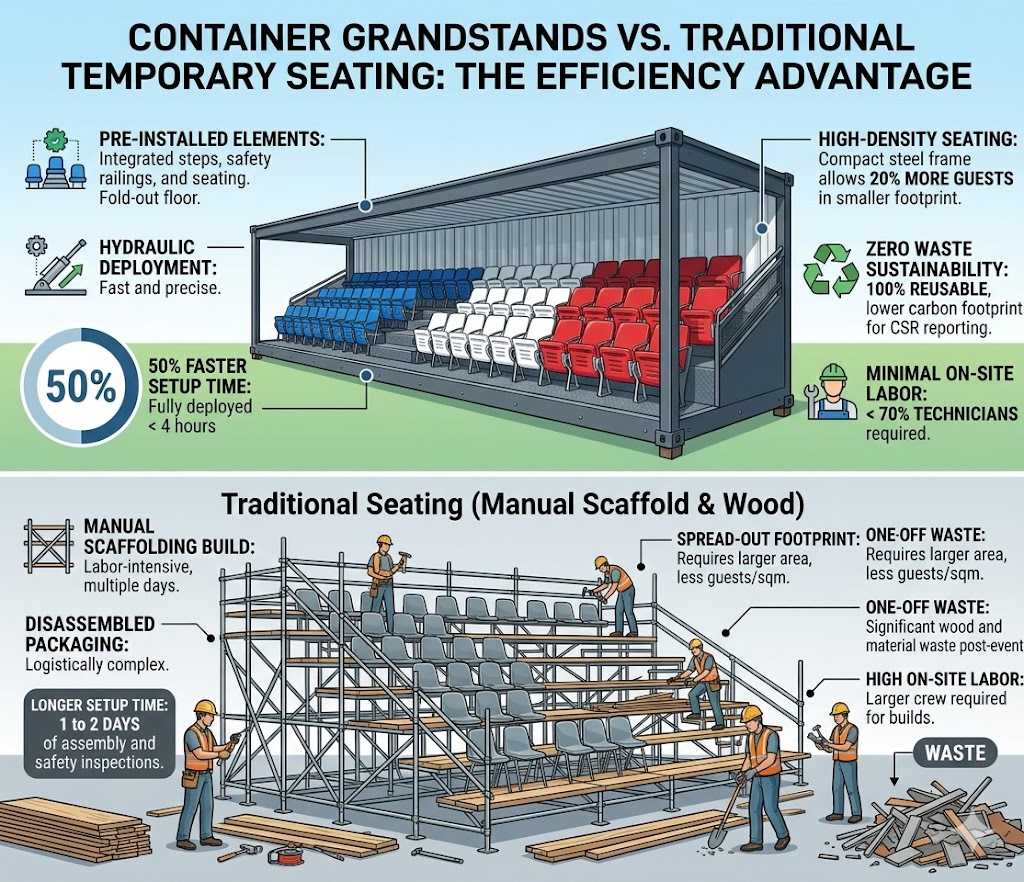
A ceremony scene using grandstand containers

As a modular grandstand with a roof, the grandstand container is ideal for outdoor use as a spectator stand.

Presidential Government Inaugurations

Phenomenon → Large-scale opening events require strict zoning arrangements: including VIP areas, media areas and public areas. The flat layout stands can lead to 30% to 40% of the space being underutilized, unlike traditional stand containers. Choosing stand containers can be layered according to the terrain, forming a stepped seating layout, which can fully utilize 30% to 40% of the space.
Technical principle → The seats of container-style stands adopt a multi-level stepped design, dividing the audience space vertically rather than horizontally.
Data →
Traditional layout: 5,000 square meters can accommodate approximately 4,000 people
Stepped stand system: The same area can accommodate over 10,000 people
Case insight → Using modular stands to host government events in Southeast Asia has significantly reduced the labor required for setup, reduced the area of land leasing, and expanded market demand. At the same time, it has improved crowd control indicators (entrance/discharge flow increased by 2.3 times).
Economic benefits → Each event can save land leasing costs of $15,000 to $30,000.

University Graduation Ceremonies

Situation → There is a problem of scattered seating arrangement in the graduation ceremony, which separates students from their parents, thereby reducing the satisfaction score of the students.
The traditional seats do not have a modular design, which makes it easy to have incorrect arrangements during the seating layout, thereby reducing the efficiency of the graduation ceremony.
The high-platform container seat design ensures a 360-degree view. Its supporting structure adopts a load-bearing design in line with international temporary building standards, capable of withstanding a live load of 500 kilograms per square meter. The container viewing platform can reserve positions for students and parents, and attach the signatures and logos of students and parents on the seats.
Data →
Presidential seat: Each graduate can correspond to 2 to 3 family seats.
Viewing platform layout: It can accommodate an additional 70% of family members.
Case → A European university replaced the seats with container-style viewing platforms, increasing the audience from 8,000 to 13,500 while maintaining the same venue size.

Religious Ceremonies and Large Gatherings

Containerized stands that can be used for religious activities

Phenomenon → Religious activities are a popular outdoor activity. When religious activities are organized, the actual capacity of the religious activity participants often exceeds the planned capacity by 20% to 50%, thereby posing the risk of overcrowding.
Technical principle → The container grandstand multi-level system can optimize vertical space while maintaining an appropriate aisle width. The aisles can allow 3-5 people to move on the grandstand simultaneously. The customized grandstand containers after customization can enable wheelchairs of the disabled to pass smoothly. It meets the standards for crowd evacuation.
Data →
Evacuation speed improvement: +35% Faster
Crowd density remains within a safe range (less than 4 people per square meter)
Case → After adopting the modular grandstand system, the safety rating of the pilgrimage activities in South America was upgraded from “moderate risk” to “low risk”.
Economic results → Liability insurance premiums have decreased by 15% to 20%

Corporate Award Ceremony and Product Launch Event

1. Enhancement of Brand Awareness and Exposure

Both the award ceremony and the product launch event require excellent visual coverage. These devices can provide a layered “stadium-style” view, ensuring that every participant can enjoy the best front-row experience. The sturdy and industrial-style appearance of this container can be customized with high-end exterior materials, LED screens, and brand logos, transforming a practical structure into a focal element in the event design.

2. Rapid Deployment and Demolition
Traditional scaffolding or permanent concrete seating require several weeks to be completed. In contrast, the container-style grandstand solution is “plug-and-play”. They are transported to the site by flatbed trucks and positioned by cranes, usually ready to welcome guests within a few hours. This is particularly important for urban product launch events, as such events often require strict control over road closures or rental times of the venue.

3. All-Weather Reliability and Safety
Unlike temporary scaffolding, the container-based grandstand is a structured steel box. It has excellent wind and rain resistance and can be equipped with integrated roofs, rain-proof facilities, and luxurious “VIP booths” such as soft seats, ensuring that the noble atmosphere of the award ceremony will not be disrupted by sudden rainfall.


The Impact: Data-Driven Performance

When comparing container grandstands to traditional temporary seating, the efficiency gains are significant:

  • 70% Reduction in On-Site Labor: Because the seating, stairs, and safety railings are often pre-installed or integrated into the fold-out mechanism, you require significantly fewer technicians on-site compared to manual scaffolding builds.

  • 50% Faster Setup Time: A standard 40ft container grandstand can be fully deployed in under 4 hours, whereas an equivalent scaffolding structure often requires 1 to 2 full days of assembly and safety inspections.

  • Zero Waste Sustainability: Traditional wood and scaffold builds often result in “one-off” waste. Container units are 100% reusable for years, drastically lowering the carbon footprint per event—a key metric for modern corporate social responsibility (CSR) reporting.

  • Higher Density Seating: Due to the structural integrity of the steel frame, these units can often support a higher weight-to-area ratio, allowing for roughly 20% more guests in a smaller footprint compared to spread-out plastic chair arrangements.

container grandstand vs traditional grandstand data difference


Technical Comparison: Traditional Seating vs Container Grandstand for Ceremonies

  • Seating Density: Flat Chair Seating: 0.8–1.2 ppl/㎡

    • Steel Scaffold Bleachers: 2.0–2.5 ppl/㎡

    • Container Grandstand: 2.5–3.5 ppl/㎡

  • Installation Time: Flat Chair Seating: 4–6 hours

    • Steel Scaffold Bleachers: 2–3 days

    • Container Grandstand: 6–8 hours

  • Reusability: Flat Chair Seating: Low

    • Steel Scaffold Bleachers: Medium

    • Container Grandstand: High (10–15 years)

  • Wind Resistance: Flat Chair Seating: Low

    • Steel Scaffold Bleachers: Medium

    • Container Grandstand: High (Level 10)

  • Safety Compliance: Flat Chair Seating: Moderate

    • Steel Scaffold Bleachers: High

    • Container Grandstand: High + modular certification-ready

  • ROI (per event): Flat Chair Seating: Baseline

    • Steel Scaffold Bleachers: +80%

    • Container Grandstand: +200%+

Conclusion: Embracing the Future of Ceremonial Seating

In an era where large-scale ceremonies are becoming increasingly ambitious yet face growing constraints on space, time, and budget, traditional flat seating arrangements have reached their limits. Container-based modular grandstands represent a transformative leap forward—delivering not just higher capacity, but superior safety, faster deployment, enhanced viewer experience, and dramatically improved economics.

By shifting from horizontal sprawl to intelligent vertical utilization, these systems consistently achieve 180–250% capacity increases while maintaining full compliance with international safety standards. Whether hosting a presidential inauguration, a university graduation, a major religious gathering, or a high-profile corporate event, organizers gain the ability to maximize every square meter, reduce operational risks, lower costs, and create memorable, inclusive experiences for all attendees.
The numbers speak clearly:

More people accommodated in the same footprint
Dramatically reduced setup labor and time
Superior weather resistance and reusability
Enhanced crowd flow and safety
Significantly higher ROI per event

As event demands continue to grow and sustainability expectations rise, forward-thinking organizers are moving beyond outdated temporary solutions toward intelligent, modular infrastructure. Container grandstands are not merely seating—they are strategic event infrastructure that elevates both operational excellence and audience satisfaction.
The future of ceremonies is tiered, modular, and efficient.

Event planners and governments who adopt container grandstand systems today will lead the industry tomorrow—delivering larger, safer, more profitable, and more memorable events with flexibility.

Bleacher for ceremonies is the better container grandstand application, Ready to transform your next ceremony? The vertical advantage awaits.


Prefab Restroom vs.Traditional Restrooms: which is better?

7 key points on Prefab Restroom vs. Traditional Restrooms: A Buyer’s Decision Guide for Outdoor Projects

When an importer or project buyer evaluates sanitation solutions for outdoor events, construction sites, or temporary commercial spaces, the comparison between prefab restroom systems and traditional restrooms is no longer theoretical—it directly impacts ROI, deployment speed, and compliance.

A prefabricated toilet is manufactured in a controlled factory environment using standardized modules (steel frame + insulated panels + integrated plumbing), while traditional restrooms are constructed on-site using concrete, brick, and manual labor.

The difference is not cosmetic—it is structural, logistical, and financial.

From a procurement perspective, the decision depends on three measurable variables:

  • Deployment time (days vs. months)
  • Total lifecycle cost (CAPEX + OPEX)
  • Mobility and reuse potential

According to construction benchmarks from World Bank infrastructure reports, on-site construction delays increase project costs by 12%–30% on average in developing regions. Prefab solutions directly eliminate this risk.

This article breaks down the decision using engineering principles, cost modeling, and real-world procurement.

Display of different Prefab Restroom


1. Structural Engineering: Why prefab restroom Systems Outperform Traditional Builds

[Principle Explanation] Load Distribution & Material Efficiency

A prefab restroom uses a Q235 galvanized steel frame (2.0–2.5mm thickness) combined with sandwich panels (rock wool or EPS). This creates a distributed load-bearing system, where stress is transferred across the frame instead of concentrated in masonry joints.

Traditional restrooms rely on:

  • Reinforced concrete slabs
  • Brick/block walls
  • On-site curing (typically 7–28 days)

The engineering limitation: concrete strength depends on curing conditions, which vary with humidity and temperature.

Prefab units eliminate this variable.

[Data Comparison] Structural Performance

  • Steel frame yield strength: 235 MPa (Q235 standard)
  • Rock wool insulation fire rating: Class A1 (non-combustible)
  • Traditional brick compressive strength: 10–15 MPa

Result:

  • Prefab systems handle wind loads up to 120 km/h with reinforced columns
  • Traditional builds require thicker walls → Excessive material and construction time costs

[Case Reference] Southeast Asia Event Infrastructure

A large outdoor festival organizer in Thailand replaced 60 traditional toilets with modular restroom buildings:

  • Installation time reduced from 45 days → 6 days
  • Structural defects reduced to 0 incidents over 18 months
  • Maintenance cost dropped by 22% annually

“This is very convenient and efficient. For outdoor activities with a large number of participants, prefabricated toilets need to be placed in large quantities on the site.” –carlo Neri


2. Cost Model: CAPEX vs Lifecycle Cost Reality

prefab restroom vs traditional restroom cost structure comparison infographic

[Principle Explanation] Cost Composition Breakdown

Traditional restroom cost structure:

  • 40% labor
  • 30% materials
  • 20% time delays
  • 10% compliance adjustments

Prefab restroom cost structure:

  • 65% factory manufacturing
  • 20% logistics
  • 15% installation

Key difference: labor volatility is eliminated

[Data Comparison] Real Procurement Numbers

For a 10-unit restroom project:

Traditional Construction

  • Cost per unit: $6,500–$9,000
  • Total timeline: 30–60 days
  • Labor fluctuation risk: ±25%

Prefab Outdoor Bathroom

  • Cost per unit: $3,500–$5,500
  • Total timeline: 3–10 days
  • Labor fluctuation risk: <5%

Lifecycle cost over 5 years:

  • Traditional: +35% (repairs, cracks, plumbing leaks)
  • Prefab: +12% (mainly seal replacement)

[Case Reference] African Construction Camps

A contractor in Kenya deployed prefabricated toilet units across 12 sites:

  • Saved $48,000 in labor costs
  • Reduced project delay penalties by 18%
  • Achieved full relocation reuse after project completion

3. Installation Speed: The Critical ROI Driver

Temporary toilet transport prefab restroom rapid installation

[Principle Explanation] Parallel vs Sequential Construction

Traditional restroom construction is sequential:

  1. Foundation
  2. Structure
  3. Plumbing
  4. Finishing

Traditional restroom installations have unstable delivery times, requiring on-site construction teams for professional installation and construction. While the final quality is good, the installation time is too long and the completion time is unpredictable, impacting the efficiency of the marketing contractor.

Prefab restroom installation is parallelized:

  • 90% completed in factory
  • On-site work limited to:
    • Ground leveling
    • Utility connection

While some prefabricated toilets may be damaged by extreme weather, their installation allows for large-scale deployment in outdoor environments. They are commonly seen at large-scale temporary outdoor events such as music festivals.

[Data Comparison] Time Efficiency

  • Prefab restroom installation: 2–6 hours per unit with 3-5 workers
  • Traditional restroom construction: 80–120 labor hours per unit with 20-40 workers

Weather impact:

  • Prefab delay risk: <3%
  • Traditional delay risk: 20%–40% (rain, humidity)

[Case Reference] Middle East Event Deployment

A Qatar event organizer required 80 units:

  • Prefab deployment: 5 days total
  • Traditional estimate: 70+ days

Revenue impact:

  • Early operation generated $120,000 additional income

4. Mobility & Reusability: The Hidden Profit Lever

[Principle Explanation] Modular Design Logic

A prefab restroom is designed with:

  • Bolted connections instead of welded fixed joints
  • Detachable panels
  • Integrated plumbing modules

Compared to traditional toilets, prefabricated toilets are clearly a highly profitable product. Because prefabricated toilets are portable and movable, they can be rented out or resold.

This allows:

  • Disassembly without structural damage
  • Relocation across projects

Traditional restrooms are permanently fixed assets

Traditional toilets, due to their inability to be moved, do not generate any revenue for customers but instead cause losses. Traditional toilets are usually public facilities or part of the sports stadiums. They are attached to scenic area buildings and do not generate significant economic benefits, making it impossible to rent or sell them for a second time.

[Data Comparison] Asset Utilization

  • Prefab restroom reuse cycles: 5–10 projects
  • Traditional restroom reuse: 0 (demolition required)

Depreciation:

  • Prefab: 10%–15% annually
  • Traditional: 25%–40% sunk cost

[Case Reference] Mining Industry Application

An Australian mining company rotated modular restroom buildings across 4 sites:

  • Extended asset life to 8 years
  • Reduced new procurement by 60%

5. Compliance & Hygiene Standards

[Principle Explanation] Factory Quality Control

Prefab restroom production follows:

  • ISO-controlled manufacturing environments
  • Pre-installed plumbing pressure testing
  • Waterproof sealing using EPDM rubber systems

Traditional restrooms depend on site worker skill, leading to inconsistency.

[Data Comparison] Failure Rates

  • Prefab restroom leakage rate: <2%
  • Traditional restroom leakage rate: 15%–25% within 2 years

Standards reference:


[Case Reference] Public Sanitation Upgrade (India)

Municipal project replacing 200 traditional toilets:

  • Complaints reduced by 72%
  • Cleaning time reduced by 30%

6. Logistics & Global Procurement Advantage

[Principle Explanation] Containerized Transport Efficiency

Prefab restroom units are designed for:

  • Flat-pack shipping (KD structure)
  • Standard 20ft/40ft container loading

This reduces:

  • Freight cost per unit
  • Import complexity

[Data Comparison] Freight Efficiency

  • Flat-pack prefab restroom: 8-10 units per container
  • Pre-built concrete components: 3–4 units equivalent volume

Freight cost reduction:

  • 30%–55% lower per unit

[Case Reference] Latin America Importers

A distributor in Chile imported prefab outdoor bathroom units:

  • Reduced shipping cost by $18,000 per shipment
  • Increased inventory turnover by 2.3x

7. Final Decision Framework: Which Is Better for Buyers?

When prefab restroom Is the Superior Choice

Choose prefab restroom if:

  • Project timeline < 30 days
  • Multiple deployment locations
  • Labor cost volatility is high
  • Reuse across projects is required

When Traditional Restrooms Still Make Sense

Choose traditional only if:

  • Permanent infrastructure (10+ years fixed location)
  • Local labor is extremely low-cost
  • No need for relocation

Conclusion: prefab restroom Is a Strategic Asset, Not a Temporary Solution

Key PointAspectPrefab RestroomTraditional RestroomWinner & Advantage
1. Structural EngineeringMaterial & DurabilityQ235 galvanized steel frame + sandwich panels (rock wool/EPS), 235 MPa yield strengthReinforced concrete + brick/block, 10–15 MPa compressive strengthPrefab – Better wind resistance (up to 120 km/h), consistent quality, fewer defects
2. Cost ModelCAPEX + Lifecycle Cost$3,500–$5,500 per unit 5-year lifecycle: +12%$6,500–$9,000 per unit 5-year lifecycle: +35%Prefab – Lower initial cost, significantly lower maintenance & repair costs
3. Installation SpeedDeployment Time3–10 days total 2–6 hours per unit30–60 days total 80–120 labor hours per unitPrefab – 8–10x faster installation, minimal weather delays (<3%)
4. Mobility & ReusabilityAsset Flexibility5–10 reuse cycles, easily relocated, bolted modular designFixed structure, demolition requiredPrefab – High resale/rental value, 60% reduction in new procurement
5. Compliance & HygieneQuality & ReliabilityFactory-controlled, ISO 9001, <2% leakage rate, pre-tested plumbingDepends on on-site labor, 15–25% leakage rate within 2 yearsPrefab – Superior hygiene, lower failure rate, better WHO compliance
6. Logistics & ProcurementShipping EfficiencyFlat-pack, 8–10 units per 40ft container 30–55% lower freight costBulky components, only 3–4 units equivalentPrefab – Easier global import, lower shipping costs, faster inventory turnover
7. Best Use CasesDecision FrameworkTemporary projects, outdoor events, multiple sites, tight timelines, high labor cost areasPermanent infrastructure (10+ years), very low local labor costPrefab for most outdoor/event/construction projects

For importers, wholesalers, and project contractors, a prefab restroom is no longer a temporary substitute—it is a high-efficiency infrastructure asset.

Compared to traditional restrooms, it delivers:

  • 50%–70% faster deployment
  • 30%–60% lower total cost
  • Multi-project reuse capability
  • Consistent compliance with sanitation standards

Based on your project requirements, you can make the final decision by referring to the following scenario divisions:

Suitable for choosing [Prefabricated Bathroom]:
Large outdoor events/sports competitions: Such as music festivals, sports events, and exhibitions. Due to the need to set up a large number of facilities quickly and to evacuate quickly after the event.
Construction site / mining area: The workers’ living quarters need to be put into use promptly, and as the project progresses, the bathrooms need to be relocated to the next project site as a whole.
Temporary commercial spaces: such as pop-up stores, temporary parking lots, and scenic spots during peak tourist seasons.
Leasing business: For traders who need to lease out the bathrooms as assets for multiple times or for secondary resale.
Emergency rescue / epidemic prevention: Situations involving post-disaster reconstruction or urgent public health incidents where there are extremely strict requirements regarding delivery time.

Suitable for choosing the 【Traditional Bathroom】:
Permanent municipal facilities: such as city center parks, interior of large stadiums, permanent administrative buildings. With a planned service life of 20-30 years and no need for relocation.
Regions with extremely low labor costs: In remote areas where the costs of local building materials (such as bricks and stones) and labor are extremely low, and where the construction period is completely insensitive to these factors.
Deeply customized architecture: A highly customized project that requires achieving complete visual and material consistency with surrounding permanent historical buildings or special landscapes.

In outdoor events, construction camps, and commercial temporary spaces, the decision is not about preference—it is about capital efficiency and operational speed.

We hope readers can choose the appropriate bathroom solution based on their own needs and the usage scenario of their project.

A promotional graphic for "Container Sports Business Solutions" featuring a blue shipping container in the background and a variety of sports equipment in the foreground, including a soccer ball, basketball, football, volleyball, tennis ball, badminton shuttlecock, sports bag, and a kettlebell. Text on the container reads, "Delivering quality sports products around the world." The graphic highlights business services such as "Global Sourcing," "Quality Assurance," "Bulk Orders & Container Loads," "Reliable Shipping," and "Your Trusted Business Partner," with a concluding tag line: "Sports products. Global opportunities. Grow your business with confidence."

Container Sports business Solutions/New container products for sport

Container Sports business Solutions for Importers, Wholesalers,Distributors

“The global sports analytics market is expected to witness a significant growth, with a projected CAGR of 22.6% during the 2021-2030 period.””Emerging markets in Africa, Asia, and Latin America are poised to become major engines of growth for the global sporting goods industry.”The growth of the sports industry is something we can all feel, and shipping containers play a significant role in it. This article will introduce Container Sports business Solutions for shipping containers, extending beyond simply transporting goods.

Why Container Sports business Solutions Are a High-Margin Opportunity

For importers, wholesalers and distributors, the sports infrastructure sector is no longer limited to large-scale stadium construction. The market is moving towards modular, rapid deployment and reusable solutions, and container-based systems are leading this transformation.
Compared with traditional building materials or fixed structures, container sports facilities have the following advantages:
Faster inventory turnover
Standardized single-item specifications for facilitating bulk purchasing
Multiple customizable options
New products are easy to promote
Extremely long lifespan with the container
More convenient international logistics
There is strong demand in both emerging markets and developed markets
This makes them an ideal product range for those enterprises that wish to enter high-growth, project-driven fields.


Main Product Categories You Can Distribute

Modular Grandstands and Event Structures

  • Scalable seating systems for sports events
  • Temporary stadium solutions
  • Modular stands can be put into use immediately during sports events.
    Significant customization of color logos can be carried out based on sports events.

These products are widely used in football tournaments, sports events,It can protect from rain, snow and sun, and is the latest solution for outdoor stands. It is also possible to lease out the stadium containers for the sports events in the local market.

For sample:Stadium 974 – 2022 FIFA World Cup, Qatar
Stadium 974 in Doha was the world’s first fully modular, demountable football stadium built primarily from 974 recycled shipping containers. It hosted matches during the 2022 FIFA World Cup with a capacity of 40,000 spectators.

The stadium used shipping containers for key functional spaces: concession stands, bathrooms, changing rooms, offices, VIP areas, and more.
The structure combined containers with modular steel frames, making it completely disassemblable and transportable.
It was designed for legacy use — after the World Cup, it could be dismantled and rebuilt elsewhere as smaller venues or other facilities.

This was a landmark project for a major international sports event, highlighting sustainability and innovation.

container grandstand for sports


Container Athlete Accommodation Units

  • Worker camps for sports events
  • Athlete housing for training bases
  • Mobile medical and recovery units

Bulk demand is common for international events and government-backed sports projects.

For sample:

Fan Villages / Container Accommodation – 2022 FIFA World Cup, Qatar
Qatar also used refurbished shipping container cabins as affordable fan accommodation in several “Fan Villages” around Doha.

These were basic but functional units equipped with beds, air conditioning, Wi-Fi, and refrigerators.
Priced around $200 per night, they provided budget-friendly housing for thousands of fans.
Some villages faced initial issues with completion, but many fans found them acceptable for temporary use.

After the event, some of these container units were repurposed and donated for humanitarian needs.

Container Athlete Accommodation Units


Container Retail & Fan Engagement Spaces

  • Merchandise shops
  • Food & beverage kiosks
  • Sponsor activation booths

These units generate continuous revenue streams for end clients, making them easy to sell.

For sample:

The Pitch – Austin FC (MLS Soccer), Texas, USA
The Pitch is a shipping container-based food and beverage venue built next to Austin FC’s training facility and stadium area. It functions as a vibrant fan gathering spot with multiple container food outlets offering diverse snacks, meals, and drinks.
This setup has become a popular pre-game and post-game destination for soccer fans, combining sports atmosphere with container-style street food and bar experiences.

From vibrant, multi-level pop-up cafes to sleek industrial offices, our diverse range of modular solutions—including expandable, folding, and double-story designs—redefines commercial flexibility by blending bold aesthetics with high-performance functionality for any retail or hospitality need.


Container Fitness & Training Studios

One of the fastest-growing segments is compact fitness infrastructure, including:

  • Boutique gyms
  • Functional training pods
  • Mobile Pilates studios

By partnering with a Pilates Reformer Manufacturer, distributors can offer complete solutions (space + equipment)—a powerful upsell strategy that increases order value and differentiation.

For sample:A technology park transformed two recycled 40-foot shipping containers into a modern, compact, and efficient fitness center for its employees.

By converting the container houses, various fitness equipment can be placed at will.

It can be modified according to market demand to become various training room facilities such as yoga rooms, Pilates halls, etc.

Ventilation openings can be designed.

Eco-Friendly: The project repurposed old shipping containers, reducing construction waste and promoting a green workspace.

For example:

Our company Container House Co., Ltd with AOC PILATES business partner Jointly providing a solution for a large-scale Pilates franchise brand in the United States with Pilates equipment.

We transformed the container houses into Pilates rooms and added a large number of Pilates equipment. We placed these Pilates container houses in remote areas of the United States to meet the offline participation needs of people in those remote areas for Pilates exercises. The brand of Pilates in the United States has seen a 30% increase in its offline visibility. Our container-based Pilates room can help clients avoid the high rental costs associated with office buildings and apartments. Compared to these high rental options, our container-based Pilates room can save 50% of the rental expenses.

Meanwhile, we have extensive experience in transporting Pilates equipment. We specialize in manufacturing containers, and our American clients have seen a 20% reduction in cases where Pilates equipment was damaged due to improper transportation.

Prati Container House design and plan


Why Container Products Are Ideal for Import & Wholesale

Standardized for Bulk Orders

  • 20ft / 40ft modular units
  • easy to store and transport
  • Consistent production quality

Perfect for containerized shipping and inventory planning.


High Demand Across Multiple Markets

You can target:

  • Sports event organizers
  • Government infrastructure projects
  • Fitness brands and gym chains
  • Resorts and commercial developers

This diversification reduces dependency on a single industry.


Strong Customization = Higher Margins

Unlike commodity products, container solutions allow:

  • Layout customization
  • Branding and color options
  • Climate-specific upgrades (insulation, wind resistance)

This enables distributors to add value and increase profit margins.


Fast Delivery Drives Repeat Orders

With production lead times typically within 7–15 days, you can:

  • Close deals faster
  • Reduce project delays
  • Build long-term client relationships

How to Position Container Sports Products in Your Market

Sell Solutions, Not Just Products

Instead of offering standalone units, package them as:

  • “Turnkey sports facility kits”
  • “Mobile fitness business solutions”
  • “Event-ready infrastructure systems”

Target Project-Based Buyers

Focus on clients with recurring needs:

  • Event organizers
  • Construction contractors
  • Government tenders
  • Fitness franchise operators

Bundle Equipment for Higher Value Deals

Combine container units with:

  • Gym equipment
  • Lighting systems
  • HVAC solutions

For example, integrating premium equipment from a Pilates Reformer Manufacturer allows you to enter the high-end fitness market, not just basic infrastructure supply.


Competitive Advantages You Can Leverage

  • Lower entry barrier compared to traditional construction materials
  • Repeatable and scalable business model
  • Strong export compatibility
  • Growing global demand for modular infrastructure

Container sports solutions are not just products—they are business opportunities you can replicate across regions and industries.


Conclusion: A Scalable Product Line for Long-Term Growth

CategoryMain ProductsKey Applications & Target CustomersReal-World ExamplesKey Benefits & Advantages
Modular Grandstands & Event StructuresScalable seating systems, Temporary stadiums, Modular standsSports events, Football tournaments, Outdoor venues Event organizers, Governments, Sports federationsStadium 974 – 2022 FIFA World Cup, QatarFast deployment, Custom color/logo branding, Weather protection (rain/snow/sun), Reusable & demountable
Container Athlete Accommodation UnitsWorker camps, Athlete housing, Mobile medical & recovery unitsTraining bases, International events, Worker camps Governments, Event organizers, Sports teamsFan Villages – 2022 FIFA World Cup, QatarQuick setup, Cost-effective, Repurposable after events, Suitable for bulk demand
Container Retail & Fan Engagement SpacesMerchandise shops, Food & beverage kiosks, Sponsor activation boothsStadium zones, Fan areas, Commercial spaces Sports clubs, Event organizers, DevelopersThe Pitch – Austin FC (MLS), Texas, USAContinuous revenue generation, Strong fan engagement, Easy branding
Container Fitness & Training StudiosBoutique gyms, Functional training pods, Pilates/Yoga studiosFitness franchises, Corporate wellness, Remote areas Gym chains, Pilates brands, ResortsPilates Container Rooms (USA with AOC PILATES partner)50% rental cost savings, Equipment integration (Pilates Reformers), Mobile & expandable, Reduced equipment damage during transport (20% improvement)

The sports facilities and living equipment converted from containers are conducive for wholesalers to gain new incremental markets while saving costs.

For importers, wholesalers, and distributors, container-based sports infrastructure represents a high-demand, high-margin, and scalable category.

As global sports and fitness markets continue to expand, businesses that adopt modular solutions early will gain a significant competitive edge.

difference container office data show

Comparison of different container offices:how to choose the better?

Introduction: Why “Comparison of Different Container Office” Directly Impacts Your ROI

The comparison of different container office is not a design discussion—it is a capital allocation decision that determines your procurement cost, logistics efficiency, and long-term depreciation curve.

In global B2B procurement, container offices typically vary across three structural systems:

  • container office
  • Foldable container office
  • Expandable container office

Each option operates under different mechanical structures, load distribution principles, and transport efficiencies, which directly affect:

  • Cost per square meter (USD/m²)
  • Installation labor hours
  • Shipping volume efficiency (units/40HQ)
  • Lifecycle maintenance cost

For example:

  • A foldable container can reduce transport cost by 60–75% per unit due to compressed volume
  • An expandable unit can increase usable space by 2–3×, but raises hinge fatigue risk after 500+ cycles

different container office show

Comparison of different container office feature

Standard Shipping Container Office

a modern, high-end container office situated in a professionally landscaped outdoor setting.

Focus: Durability and Security

Structural Integrity: These units are built from heavy-duty Corten steel, making them suitable for long-term, permanent use. They are the most reliable option for sites where extreme weather protection or physical security for expensive equipment is necessary.

Low Maintenance: Because they do not have moving parts like hinges or telescopic rails, they require minimal upkeep over their lifespan.

Best Application: Ideal for permanent site offices, on-site storage for sensitive equipment, or any location where the office will remain fixed for several years.

Foldable Container Office

folding container house show

Focus: Logistics and Setup Efficiency

Logistical Cost-Savings: The main benefit is the ability to transport up to 10 units in a single shipping container space. This significantly reduces freight costs and makes it the most economical choice for large-scale deployments or projects that require moving the office multiple times.

Rapid Deployment: These units are designed for speed. The pre-installed wall panels and hinge systems allow a small crew to set up a functional workspace in minutes, which is essential for projects with tight construction schedules.

Best Application: Perfect for temporary construction site offices, project-based work, or any situation where the office needs to be relocated frequently to keep pace with project progress.

Expandable Container Office

Stacked and clustered expandable prefab houses, China manufacturer providing modular container home solutions for camps and villages

Focus: Space Utilization and Functionality

High Spatial Efficiency: The primary advantage is the increase in usable floor area. By expanding the sides, you get a much larger interior workspace without increasing the footprint of the base unit. This allows for more comfortable layouts, such as separate rooms for meetings or receptions.

Practical Comfort: The extra space makes it easier to organize desks, cabinets, and meeting areas, creating a more professional environment than a standard-width container.

Best Application: Best for sales centers, showrooms, or client-facing areas where you need a more permanent-feeling office environment that provides enough room for both staff and visitors.

Procurement Guide for Decision Making
When selecting the right product for your project, use these criteria to keep your decision focused on practical requirements:

Choose the Standard Shipping Container if: You need a long-term, secure, and low-maintenance office that will not be moved. This is the most cost-effective solution for permanent installations.

Choose the Foldable Container if: Your primary goal is to save on transport and setup costs. This is the right choice if you have many offices to set up or if the office will be moved to different sites during the project.

Choose the Expandable Container if: You need more room for your team or visitors. It is a more expensive option, but it provides the best layout and comfort for office tasks that require a larger, more traditional room size.

Structural Mechanics Comparison — The Core of Container Office Performance

1. Shipping Container Office

1. Structural Load Quantification

You must calculate the weight-bearing capacity to ensure the safety of the stacked containers.

  • Static Load: The dead weight of the container shells and interior build-outs (insulation, drywall, HVAC equipment).

  • Live Load: The weight of occupants, furniture, and office equipment.

  • Lateral/Wind Load: Quantifying the wind resistance based on local geographical data. Because containers are top-heavy when stacked, wind-load calculations are critical to determine the required anchoring (foundation) system.

2. Thermal Performance Quantification (Energy Modeling)

A standard steel container has a very low thermal resistance (R-value). You must quantify the necessary insulation to meet local building energy codes.

  • U-Value Calculation: Measuring the rate of heat transfer through the walls, roof, and floor.

  • Thermal Bridging: Quantifying the loss of heat through the steel frame itself. This is often mitigated by installing a continuous layer of insulation (like closed-cell spray foam) to break the “bridge” created by the steel.

  • HVAC Sizing (BTU/h): Based on the internal volume, surface area, and insulation quality, you calculate the required BTU (British Thermal Units) for heating and cooling to maintain a stable interior climate.

3. Space Utilization and Dimensional Data

Since containers have fixed dimensions (typically 8 feet wide by 8.5 or 9.5 feet high), your space design is a quantitative constraint puzzle.

  • Net Usable Area: After accounting for the thickness of interior walls (studs + insulation + drywall, typically 4–6 inches per wall), the usable interior width is reduced. You must calculate if your intended furniture layouts fit within these “net” dimensions.

  • Clearance Height: Accounting for finished floor height and ceiling treatments to ensure the space meets minimum commercial code requirements for height.

4. Cost and Logistics Quantification

  • Modification-to-Cost Ratio: Measuring the cost of cutting, reinforcing, and welding versus the cost of modular interior fit-outs.

  • Transportation Logistics: Quantifying the distance from the fabrication shop to the site. This dictates whether the units must be transported as fully finished modules (requiring crane logistics) or “knock-down” kits assembled on-site.

2. Foldable Container Office

Phenomenon:
Unit folds into a compact structure and unfolds in minutes.

Engineering Principle:
Uses hinge-based kinematic systems + pre-installed wall panels. Structural integrity depends on hinge strength and locking mechanisms.

Data Benchmark:

Installation time: 2 workers × 10–15 minutes
Transport capacity: 8–10 units / 40HQ
Hinge lifecycle: 300–500 folding cycles

Economic Outcome:

Saves $800–$1,500 per container in installation labor
Reduces project timeline by 70%
Ideal for urgent deployment (construction sites, disaster relief)

3. Expandable Container Office

Phenomenon:
Side walls expand outward to increase usable interior space.

Engineering Principle:
Relies on telescopic steel rails + synchronized expansion joints. Structural stability depends on load-bearing rails and floor reinforcement.

Data Benchmark:

  • Expansion ratio: 1:3 (20ft → ~36–40㎡ usable area)
  • Installation time: 2–3 hours
  • Transport capacity: 1 unit / 40HQ

Economic Outcome:

  • Higher unit cost (~$80–$120/m²)
  • Lower land cost per usable area
  • Ideal for sales offices, showrooms, premium site offices

Comparison:

1. Structural Rigidity vs. Deployment Speed

  • Standard Containers: Benefit from the ISO container’s original engineering: the ability to stack up to 9 units high. The load path is transferred directly through the corner posts. There is zero mechanical loss of strength over time.

  • Foldable Units: These prioritize logistical density. Because the walls are hinged, the “monocoque” (stressed-skin) strength of the original container is compromised. To compensate, they rely on high-tensile locking bolts. The engineering bottleneck here is fatigue at the hinge points; vibrations during transport or ground settling can lead to misalignment in the locking system.

  • Expandable Units: These represent the most complex mechanical challenge. When the unit expands, the center of gravity shifts, and the cantilevered sections introduce bending moments on the main floor frame. Engineers must quantify deflection (sagging) at the outer edges, often necessitating hydraulic or screw-jack support pillars under the expanded wings to prevent structural failure.

2. Thermal and Moisture Integrity

  • Standard Containers: Best for thermal consistency. Since there are fewer joints and moving parts, achieving a continuous thermal envelope (no air leaks) is straightforward.

  • Foldable/Expandable Units: These are prone to “thermal bridging” and air infiltration. Every hinge, fold, or telescopic joint is a potential site for heat loss or water ingress. Quantification requires a higher Sealant Performance Rating; manufacturers often use dual-layer EPDM rubber gaskets to maintain an airtight seal at the expansion/folding interfaces.

3. Quantitative Risk Assessment (The “Trade-off”)

  • Standard: High CAPEX for transport (1 unit per truck), but lowest maintenance and highest resale value.

  • Foldable: Best for rapid logistics (high ROI on shipping), but highest risk of mechanical failure (hinge corrosion or fatigue) after repeated setups.

  • Expandable: Best for maximizing floor area (cost-per-square-foot efficiency), but highest structural complexity and risk of leaks at expansion joints.


Cost vs Logistics Efficiency — The Real Battle for Importers

Logistics Physics: Why Volume Matters More Than Unit Price

Shipping cost is calculated based on CBM (Cubic Meter Volume), not product value.

  • Standard shipping container office: ~25–30 CBM/unit

  • Foldable: ~4–5 CBM/unit
  • Expandable and container: ~25–30 CBM/unit

This means:

  • Foldable containers reduce freight cost by 30–50% per unit
  • Expandable containers increase shipping cost by 300–400%

Cost Breakdown (Real Procurement Scenario)

Assume importer purchases 50 units:

Standard shipping container office:

  • Product: $5500/unit
  • Shipping: $2000/unit
  • Installation: $100/unit
  • Total: $7600/unit

Foldable:

  • Product: $2,800/unit
  • Shipping: $600/unit
  • Installation: $50/unit
  • Total: $3,450/unit

Expandable:

  • Product: $8000/unit
  • Shipping: $2,000/unit
  • Installation: $200/unit
  • Total: $10200/unit

Insight:

  • Foldable wins in speed + logistics efficiency
  • Expandable wins in space utilization ROI

Scenario-Based Decision Framework — The Only Way to Choose Correctly

Scenario 1: Construction Site Offices (High Turnover Projects)

  • Requirement: Fast deployment + low cost
  • Best choice: Foldable container office

Reasoning:

  • Reduces setup time from 2 days → 2 hours
  • Saves labor cost across multiple relocations

Scenario 2: Long-Term Worker Accommodation

  • Requirement: Durability + scalability
  • Best choice: Flat-pack container office

Reasoning:

  • Strong structural rigidity
  • Lower depreciation over 5–10 years

Scenario 3: Sales Office / Showroom

  • Requirement: Space + appearance
  • Best choice: Expandable container office

Reasoning:

  • 3× usable space increases customer experience
  • Higher conversion rate in commercial usage

Conclusion: Final Answer to comparison of different Container Office solution

CategoryStandard Shipping Container OfficeFoldable Container OfficeExpandable Container Office
Primary FocusDurability & SecurityLogistics & Setup EfficiencySpace Utilization & Functionality
Structural SystemFixed monocoque (Corten steel)Hinge-based folding systemTelescopic rails + expansion joints
Usable Area (20ft base)12–15 m²12–15 m²36–40 m² (2–3× expansion)
Transport Efficiency1 unit / 40HQ 25–30 CBM8–10 units / 40HQ 4–5 CBM1 unit / 40HQ 25–30 CBM
Installation Time1–2 days10–15 minutes (2 workers)2–3 hours
Maintenance LevelLowest (no moving parts)Medium (hinge fatigue after 300–500 cycles)Higher (joints, seals, deflection)
Structural RigidityHighest (stackable up to 9 high)Good when locked, compromised by hingesComplex (requires support pillars)
Thermal & Moisture IntegrityBest (fewest joints)Good (hinge sealing critical)Moderate (expansion joints vulnerable)
Product Price (approx.)$5,500 / unit$2,800 / unit$8,000 / unit
Total Cost per Unit (50 units)$7,600 $3,450 (lowest)$10,200 (highest)
Main AdvantageLong-term durability & resale valueLowest total cost + fastest logisticsMaximum usable space & premium feel
Main DisadvantageHigh shipping cost & slow setupMechanical fatigue over repeated useHigher cost + leak/deflection risk
Best ApplicationsPermanent offices, secure storage, long-term sitesTemporary construction sites, frequent relocation, disaster reliefSales centers, showrooms, client-facing offices
Ideal ScenarioLong-term worker accommodation Permanent secure installationHigh turnover projects Budget + speed prioritySpace maximization Commercial impact

The comparison of different container office leads to one clear conclusion:

  • Choose flat-pack when your priority is lowest capital cost + long-term stability
  • Choose foldable when your priority is speed + logistics efficiency
  • Choose expandable when your priority is space value + commercial impact

Final Strategic Recommendation for Importers:

If your business model includes bulk import + resale, the optimal portfolio is:

  • 60% foldable (fast turnover, high demand)
  • 30% flat-pack (price-sensitive buyers)
  • 10% expandable (high-margin niche market)

This mix maximizes:

  • Inventory liquidity
  • Market coverage
  • Profit margin stability


container house Comparison traditional office

container office vs traditional office/Are container offices cheaper than traditional?

7 Proven Benefits of Container Office: A Cost-Driven Guide for Importers & Wholesalers

The benefits of container office solutions have shifted from a temporary trend to a procurement strategy adopted by contractors, developers, and industrial buyers. If you’re comparing container offices with traditional buildings, the decision is no longer about “cheap vs permanent”—it’s about speed, capital efficiency, and deployment flexibility.

This guide breaks down the benefits of container office using real engineering principles, cost data, and procurement logic—so you can make import decisions with clarity.

Prefabricated office container building at construction site

1. Rapid Deployment: From Factory to Operation in 30 Days

[Technical Principle]

Container offices use modular prefabrication:

  • Structural frame: Q235 galvanized steel (2.0–2.5mm)
  • Wall system: Rock wool sandwich panels (thermal conductivity ~0.04 W/m·K)
  • Bolt-based assembly (no wet concrete curing required)

[Data Comparison]

  • Traditional office:
    • Foundation curing: 14–28 days
    • Structural construction: 60–120 days
  • Container office:
    • Factory production: 25-30 days
    • On-site assembly: 1–3 days

[Case Reference]

A Southeast Asia contractor deployed 120 container offices for a mining camp. Total project timeline reduced from 120 days to 18 days.

[Economic Outcome]

  • Labor cost reduction: ~35%
  • Faster ROI: Revenue generation begins 3–4 months earlier

2. Cost Efficiency: 30%–50% Lower Total Investment

[Technical Principle]

Cost savings come from:

  • Factory mass production
  • Reduced material waste (<3% vs 15% in traditional builds)
  • Elimination of heavy foundation requirements

[Data Comparison]

  • Traditional office: $300–$600/m²
  • Container office: $120–$250/m²

Breakdown:

  • Steel structure reuse rate: >90%
  • Transportation efficiency: 10–12 units per 40HQ container

[Case Reference]

A Middle East logistics company reduced CAPEX from $1.2M to $650K using modular container offices for headquarters expansion.

[Economic Outcome]

  • Payback period shortened by 40%
  • Lower depreciation due to reusability

Mobility & Relocation: Asset, Not Fixed Liability

[Technical Principle]

  • Structural integrity based on ISO container standards
  • Lifting points designed for crane handling (load-bearing up to several tons)
  • Modular disassembly without structural damage

[Data Comparison]

  • Relocation cost:
    • Container office: $500–$2,000 per unit
    • Traditional demolition + rebuild: $150–$300/m²

[Case Reference]

An African oilfield operator relocated 80 units across 3 sites over 5 years without structural replacement.

[Economic Outcome]

  • Asset reuse cycle: 5–10 years
  • Eliminates reconstruction CAPEX for new sites

Structural Durability: Engineered for Harsh Environments

Phenomenon]

Container offices perform reliably in extreme climates.

[Technical Principle]

  • Q235 galvanized steel resists corrosion (zinc coating >80μm)
  • Wind resistance: up to Level 10–12 (100–120 km/h)
  • Fire resistance: Rock wool panels rated A级防火 (non-combustible)

[Data Comparison]

  • Lifespan:
    • Container office: 15–25 years
    • Light steel prefab: 10–15 years

[Case Reference]

A coastal project in Southeast Asia used container offices exposed to high humidity (>85%) for 6 years with no structural corrosion.

[Economic Outcome]

  • Maintenance cost reduction: ~25%
  • Lower risk of structural failure in remote sites

Energy Efficiency: Lower Operational Costs

[Phenomenon]

Container offices maintain stable indoor temperatures with less energy consumption.

[Technical Principle]

  • Sandwich panels create thermal resistance layers
  • Air-tight sealing using EPDM rubber prevents heat exchange
  • Optional double-glazed windows reduce solar gain

[Data Comparison]

  • Energy consumption reduction: 20%–35% vs brick buildings
  • Thermal conductivity:
    • Rock wool: ~0.04 W/m·K
    • Concrete: ~1.7 W/m·K

[Case Reference]

A mining office in Australia reduced HVAC energy cost by 28% annually after switching to insulated container units.

[Economic Outcome]

  • Lower electricity bills
  • Improved working conditions in extreme climates

Scalability: Expand or Reduce Without Disruption

[Phenomenon]

Business expansion often requires flexible space adjustments.

[Technical Principle]

  • Modular grid system (typically 3m x 6m units)
  • Load-bearing corner columns allow stacking up to 2–3 floors
  • Plug-and-play electrical and plumbing systems

[Data Comparison]

  • Expansion time:
    • Container office: 1–3 days
    • Traditional building: 30–90 days

[Case Reference]

A construction company expanded office space by 40 units in 5 days during peak project demand.

[Economic Outcome]

  • Zero downtime during expansion
  • Avoids over-investment in unused space

Standardized Export and Compliance: Easier Import Process

[Technical Principle]

  • Container offices follow modular export packaging standards
  • Compact flat-pack design reduces shipping volume
  • Compliance with international structural and fire standards

[Data Comparison]

  • Shipping efficiency:
    • Flat-pack container office: 8–12 units / 40HQ
    • Traditional materials: fragmented shipments

[Case Reference]

A European distributor reduced logistics costs by 22% per unit by importing flat-pack container offices instead of raw materials.

[Economic Outcome]

  • Lower freight cost per square meter
  • Simplified customs clearance process

Final Procurement Strategy: How to Maximize the Benefits of Container Office

The benefits of container office are clear—but procurement success depends on execution.

Recommended Approach for Importers:

  1. Select modular type based on use case
    • Folding: fastest deployment
    • Flat-pack: best shipping efficiency
    • Expandable: higher end-user comfort
  2. Verify engineering specifications
    • Steel thickness ≥ 2.0mm
    • Insulation: rock wool preferred over EPS
  3. Plan foundation correctly
    • Concrete strip or pier foundation ensures stability
    • Prevents long-term deformation
  4. Work with experienced exporters
    • Ensure compliance with local building codes
    • Request installation drawings + video guidance

Conclusion

The benefits of container office go far beyond cost savings. They represent a shift from fixed construction to flexible infrastructure:

  • Faster deployment → earlier revenue
  • Lower CAPEX → improved cash flow
  • Reusability → long-term asset value

For importers, wholesalers, and project contractors, container offices are not an alternative—they are a scalable infrastructure solution aligned with modern project economics.

If your goal is faster project turnover, lower risk, and higher ROI, container offices deliver measurable advantages at every stage of the lifecycle.