Author Archives: jzxadmin

Container Grandstands in Urban Temporary Public Spaces: Applications and Use Cases

Container Grandstands in Urban Temporary Public Spaces: Applications and Use Cases

Urban land is not always used permanently. A vacant site may be available for a few months, an event venue may only operate for a season, or a sports facility may need additional spectator seating for a specific competition. In these situations, building a permanent grandstand is not always practical.

Container grandstands offer another approach. By combining container-based modules with spectator seating, stairs, guardrails, and other event facilities, a temporary site can be turned into a functional public space without committing to a permanent building.

For event organizers, contractors, sports facility operators, and importers, the value of a container grandstand is not simply the seating itself. Its modular structure can support different layouts, transportation methods, and uses over the life of the project.

Why Use Container Grandstands in Temporary Urban Spaces?

Temporary urban projects have different requirements from permanent stadiums.

A permanent grandstand is designed for one location and normally requires a long-term foundation and construction process. A temporary project may only need seating for several weeks, months, or a specific series of events.

A container-based grandstand can be considered when the project requires:

  • Temporary spectator seating
  • Fast deployment
  • Relocatable structures
  • Reusable modules
  • Flexible site layouts
  • Additional event facilities

The actual suitability depends on the site, local regulations, structural design, transportation requirements, and the planned period of use.

The key idea is simple:

Build for the current use without unnecessarily limiting the future use of the site.

Application Model 1: Temporary Sports Venues

Sports events are one of the most direct applications for container grandstands.

A football tournament, athletics competition, community sports event, or motorsport event may require more spectator capacity than the existing venue can provide.

A container grandstand can be positioned along the edge of the playing area and configured according to the available site.

Typical considerations include:

  • Number of seats
  • Distance from the playing field
  • Viewing angle
  • Access stairs
  • Guardrails
  • Spectator circulation
  • Roof requirements
  • Emergency access

For example, a local football tournament may only need additional seating for several weekends each year. Instead of constructing a permanent extension, an event organizer can consider a temporary modular seating solution.

The same modules may later be moved to another venue.

Application Model 2: Festivals and Outdoor Events

Outdoor festivals often use temporary infrastructure because the site changes from one event to another.

A container grandstand can provide elevated spectator seating for:

  • Music festivals
  • Cultural events
  • Food festivals
  • Outdoor performances
  • Public celebrations
  • Corporate events

The seating area can also be integrated with other temporary facilities.

For example, the lower or internal space of a container-based structure may be used for storage, staff facilities, ticketing, or event equipment, depending on the design.

This creates a more efficient use of the site than treating the grandstand as seating alone.

Application Model 3: Pop-Up Urban Public Spaces

One of the more interesting applications is the use of container structures in temporary urban spaces.

Cities often have vacant or underused sites that are waiting for future development. During this period, the site may still be used for community activities, cultural events, markets, exhibitions, or temporary recreation.

A modular container structure can support these temporary uses.

A simple project model could look like this:

Vacant site → Temporary event space → Community use → Relocation or redevelopment

The advantage is flexibility. The structure does not necessarily need to remain in the same location throughout its service life.

This makes container-based construction relevant to temporary urban development where the future use of the land is not yet fixed.

Application Model 4: Container Grandstands with Multi-Functional Spaces

A conventional temporary grandstand mainly provides seating.

A container grandstand can be designed around several functions.

Depending on the project, the structure may combine:

  • Spectator seating
  • Storage
  • Ticket offices
  • Equipment rooms
  • Staff areas
  • Retail spaces
  • Event facilities

This approach is particularly useful when the available site is limited.

Instead of adding separate temporary buildings for every function, the project can combine several uses within a modular system.

For an event organizer, this can simplify site planning and reduce the number of separate structures that need to be transported and installed.

Application Model 5: Waterfronts, Plazas and Seasonal Events

Urban waterfronts and public plazas are often used for seasonal activities.

Examples include:

  • Summer sports
  • Outdoor performances
  • Public screenings
  • Cultural festivals
  • Seasonal markets
  • Community events

A permanent grandstand may not be suitable for these locations because the site may need to return to its normal public use after the event.

A portable or container-based grandstand can provide temporary seating while keeping relocation in the project plan.

However, waterfront and open-plaza projects require careful attention to wind, ground conditions, pedestrian movement, drainage, and local regulations.

How to Plan a Container Grandstand for a Temporary Urban Space

The product should not be selected before the site requirements are understood.

1. Define the Seating Capacity

Start with the expected audience rather than the physical size of the container.

A project may require 50 seats, 100 seats, several hundred seats, or a larger modular arrangement.

The expected peak audience should also be considered.

2. Check the Available Site

Measure the site before ordering.

Important dimensions include:

  • Available length
  • Available width
  • Maximum height
  • Access roads
  • Setback areas
  • Emergency routes
  • Pedestrian circulation

The transport route should also be checked. A grandstand may fit on the final site but still be difficult to deliver if trucks or lifting equipment cannot reach the installation area.

3. Consider Sightlines

Spectators need a clear view of the activity.

The seating height, row arrangement, distance from the playing area, and position of structural elements can all affect visibility.

This is especially important for sports events.

A modular design should therefore be evaluated not only by seating capacity but also by how the seating interacts with the event area.

4. Plan Stairs, Access and Circulation

A grandstand is also a circulation system.

Spectators need to enter, find their seats, move between rows, and leave the structure safely.

The design should therefore consider:

  • Stairs
  • Walkways
  • Handrails
  • Guardrails
  • Entrances
  • Exits
  • Emergency routes

These elements should be included during the planning stage rather than treated as accessories after the seating layout has been decided.

5. Consider Weather Conditions

Outdoor temporary structures are exposed to local weather.

The design may need to account for:

  • Wind
  • Rain
  • Sun exposure
  • Snow in some regions
  • Temperature changes

A roof can improve spectator comfort, but it also adds weight and wind exposure.

Container Grandstand vs. Conventional Temporary Seating

Container grandstands are not automatically better than every other temporary seating system.

The right choice depends on the project.

Factor Container Grandstand Conventional Temporary Seating
Modularity High Varies
Relocation Possible Possible
Additional enclosed space Possible Usually limited
Transportation Container-based planning Depends on system
Reuse Suitable Suitable
Customization Project dependent Project dependent
Best suited for Multi-purpose temporary projects Temporary spectator seating

The main difference is not simply the seating itself.

A container-based system can potentially combine spectator seating with enclosed or service spaces, which may be useful for projects with limited land.

Transportation and Installation

Transportation needs to be considered before production.

For an international project, buyers should confirm:

  • Module dimensions
  • Total weight
  • Loading method
  • Shipping container requirements
  • Truck access
  • Unloading equipment
  • Installation equipment

Once the modules arrive, installation may involve positioning the units, connecting structural components, installing stairs and guardrails, and completing the seating and roof system.

The exact process depends on the design.

For container-based products, lifting equipment such as a crane may be required for unloading and positioning.

A supplier should provide appropriate installation drawings and instructions for the specific configuration.

Safety and Local Regulations

A temporary structure still needs to meet applicable safety requirements.

Depending on the location and project type, regulations may address:

  • Structural loads
  • Wind resistance
  • Occupancy
  • Guardrails
  • Stairs
  • Emergency exits
  • Fire safety
  • Accessibility
  • Temporary building permits

Requirements vary between countries and even between different types of projects in the same country.

For this reason, international buyers should not rely only on a generic product specification.

Before production, the project team should confirm which local standards and approval procedures apply.

The manufacturer can provide technical information and drawings, while the buyer, local engineer, contractor, or authority may need to verify the final compliance requirements.

Why Modularity Matters for Rental Businesses

Container grandstands can be particularly interesting for companies that provide temporary event infrastructure.

A rental company may use the same modular system for different customers throughout the year.

For example:

Football tournament → school sports day → outdoor festival → motorsport event

The required seating configuration can change between projects.

This makes modularity more than a design feature. It can become part of the business model.

Instead of purchasing a structure for one permanent venue, an event company can potentially use the same equipment across multiple locations and projects.

What Should Buyers Ask a Container Grandstand Manufacturer?

Before requesting a quotation, international buyers should prepare basic project information.

Useful information includes:

  • Project location
  • Event type
  • Required seating capacity
  • Site dimensions
  • Number of events
  • Expected duration of use
  • Roof requirements
  • Preferred seating layout
  • Transportation requirements
  • Installation conditions

Then ask the manufacturer for relevant technical information.

This may include:

  • Product drawings
  • Overall dimensions
  • Seating capacity
  • Structural specifications
  • Seat specifications
  • Product weight
  • Loading information
  • Installation instructions
  • Packaging details
  • Customization options

Providing this information early can help avoid major changes after production begins.

From Temporary Seating to a Flexible Urban Facility

The most interesting feature of a container grandstand is not simply that it can provide temporary seats.

Its value comes from combining several characteristics:

Modular + Relocatable + Reusable + Multi-functional

These characteristics make container grandstands worth considering for temporary sports venues, festivals, urban public spaces, waterfront events, and other projects where permanent construction may not be appropriate.

However, the system still needs to be designed around the actual project. Seating capacity, sightlines, access, weather conditions, transportation, installation, and local regulations all affect the final solution.

For importers, event contractors, sports facility companies, and rental businesses, the best approach is to start with the project requirements and then develop the container grandstand configuration around them.

Conclusion

Container grandstands provide one possible solution for creating temporary spectator seating and public activity spaces in urban environments.

Their modular format can support different seating capacities and layouts. Their container-based design can also allow the project to combine seating with storage or service functions when the design calls for it.

The strongest applications are not necessarily projects that need the cheapest possible seating. They are projects where flexibility, relocation, reuse, transportation, and multi-purpose use are important.

For an upcoming sports event, festival, public-space project, or temporary venue, buyers should evaluate the site first and then compare the available grandstand systems based on capacity, safety, logistics, installation, and long-term reuse.

For international projects, working with a manufacturer that can provide technical drawings, customization, export packaging, installation guidance, and project-specific information can make the procurement process easier.

A technical infographic titled "Container Grandstand Technical Parameters." The central image shows a 3D cutaway of a modified shipping container converted into a seating bleacher. Labels point to various technical features including a galvanized steel frame (Q235), modular seating platforms with specific dimensions (800mm pitch, 950mm tread), anti-slip stair systems, wind-resistant columns, and drainage/waterproof sealing systems. The bottom section illustrates how multiple modules can be used independently or connected for larger spectator systems.

Container Grandstand: A Practical Buying Guide for Sports and Outdoor Events

Container Grandstand: A Practical Buying Guide for Sports and Outdoor Events

A container grandstand is a portable spectator seating solution made by converting a standard shipping container into a covered or open seating structure. It can be used for sports fields, temporary events, schools, festivals, race tracks, and other venues where permanent seating is not required.

For importers, event companies, stadium contractors, and distributors, buying a container grandstand is not simply about choosing the number of seats. The container size, seating layout, roof structure, transport method, installation requirements, local regulations, and final application all affect the project cost and delivery process.

This guide explains the main factors to consider when sourcing a container grandstand for commercial or project use.

What Is a Container Grandstand?

A container grandstand is a spectator stand built around a shipping container structure. The container provides the main structural frame, while the upper or internal area can be modified to accommodate spectator seats, stairs, handrails, roofing, and other components.

Unlike traditional concrete grandstands, a container-based structure can be manufactured and transported as a relatively compact unit.

For B2B buyers, this creates several practical advantages:

  • Easier transportation between locations
  • Faster deployment at temporary venues
  • Factory-based manufacturing
  • Standardized container dimensions
  • Options for seating capacity and layout
  • Possibility of covered spectator seating
  • Suitable for rental and event businesses
  • Easier storage when the structure is not in use

The actual design should still be checked against the requirements of the destination country and the intended installation site.

Where Are Container Grandstands Used?

The application determines many of the design requirements.

Sports Events

Portable spectator stands are commonly considered for football, rugby, basketball, tennis, athletics, and other sporting events.

A container grandstand can provide additional seating when an existing stadium needs temporary capacity.

For sports facilities, buyers should pay particular attention to:

  • Viewing angle
  • Number of seats
  • Access stairs
  • Guardrails
  • Roof coverage
  • Player and spectator circulation
  • Emergency exits
  • Local safety requirements

Outdoor Events and Festivals

Event organizers often need temporary seating that can be installed and removed according to the event schedule.

Container spectator stands can be used for:

  • Music festivals
  • Community events
  • Outdoor performances
  • School competitions
  • Racing events
  • Ceremonies
  • Temporary sporting events

For these projects, transport and installation time can be as important as the seating capacity.

Schools and Training Facilities

Schools, sports clubs, and training centers may require additional spectator seating without constructing a permanent building.

A modular container grandstand can be considered when the site needs flexible seating or when future expansion is expected.

Event Rental Companies

Rental companies have different requirements from one-time project buyers.

They normally need products that can be transported repeatedly and used at different locations.

Important factors include:

  • Structural durability
  • Ease of transportation
  • Installation method
  • Maintenance
  • Seat replacement
  • Weather protection
  • Loading and unloading requirements

A supplier should therefore understand whether the buyer plans to use the grandstand for one project or as part of a rental fleet.

How Many Seats Can a Container Grandstand Provide?

Seating capacity depends on the container dimensions, seating arrangement, stair position, access requirements, and overall design.

A 40ft high cube container, for example, provides a compact base for a medium-size spectator stand.

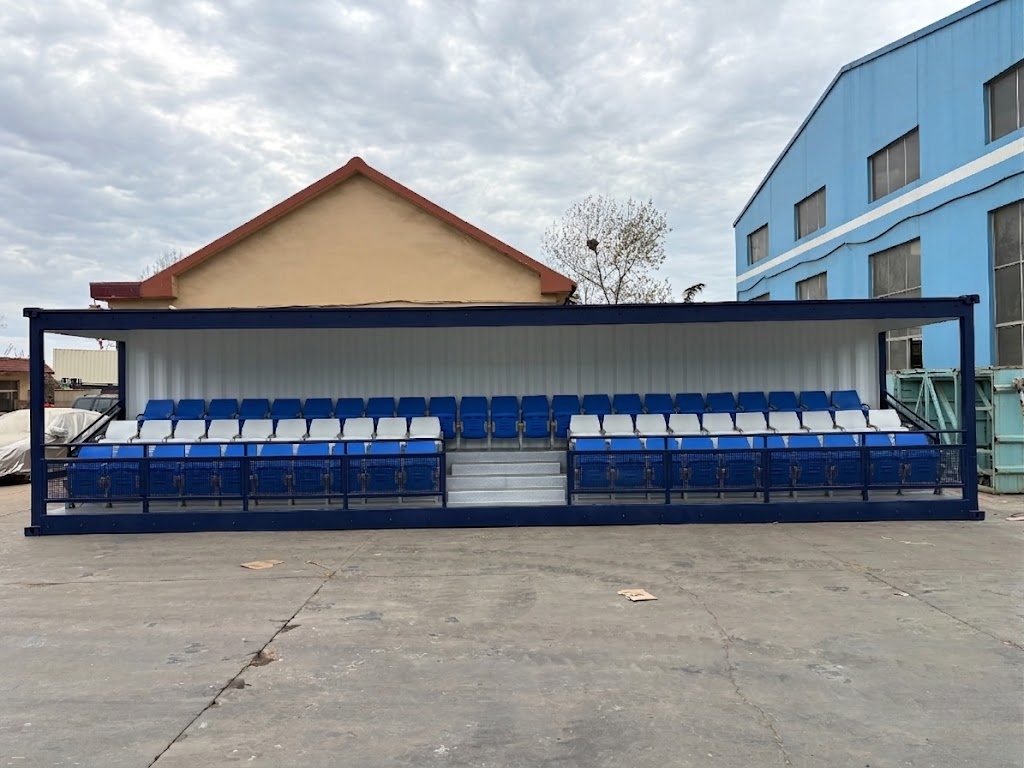
One practical configuration is a 40ft container grandstand with 63 seats. The unit can be equipped with HDPE or aluminum alloy seats, a roof, stairs, and optional guardrails.

For B2B purchasing, it is better to specify the required capacity before requesting a quotation.

Instead of asking only:

“How much is a container grandstand?”

provide the supplier with information such as:

  • Required number of seats
  • Container length
  • Covered or uncovered seating
  • Seat material
  • Required stairs
  • Guardrail requirements
  • Installation location
  • Quantity required
  • Destination port

This allows the factory to calculate the structure and transportation requirements more accurately.

Container Grandstand vs. Traditional Temporary Grandstand

The two solutions serve similar purposes, but their construction and logistics can be different.

Factor Container Grandstand Traditional Temporary Grandstand
Main structure Shipping container-based Modular steel/aluminum structure
Transportation Container logistics Component-based transport
Factory production High Depends on supplier
Deployment Relatively compact Requires assembly
Storage Compact container format Disassembled components
Customization Seats, roof, stairs, rails Usually highly modular
Suitable applications Events, sports, temporary venues Events, stadiums, sports facilities

The correct choice depends on the project requirements. Buyers should compare the complete delivered cost rather than looking only at the factory quotation.

What Should You Check Before Ordering?

A quotation should include more than the number of seats and unit price.

1. Container Size

Confirm whether the product is based on a 20ft, 40ft, or 40ft high cube container.

The external dimensions affect:

  • Transport
  • Site access
  • Shipping
  • Installation
  • Final seating layout

2. Seat Material

For outdoor projects, ask about:

  • UV resistance
  • Weather resistance
  • Seat fixing method
  • Replacement options
  • Color choices

If the grandstand will be used frequently, seat durability becomes an important operating cost.

3. Roof Structure

A roof can provide protection from sun and rain.

However, adding a roof also affects:

  • Overall height
  • Wind load
  • Transport dimensions
  • Structural requirements
  • Local approval requirements

The roof should therefore be included in the design from the beginning rather than treated as an afterthought.

4. Stairs and Handrails

Spectator access needs to be considered carefully.

Ask the supplier to confirm:

  • Number of stairs
  • Stair width
  • Handrail design
  • Guardrail height
  • Access position
  • Connection method

Local building and event regulations may specify additional requirements.

5. Container Condition

If a shipping container is used as the structural base, clarify whether the supplier uses:

  • New containers
  • Used containers
  • New high cube containers
  • Modified standard containers

This can affect both appearance and structural condition.

How Is a Container Grandstand Manufactured?

A factory-produced container grandstand normally goes through several stages.

Step 1: Container Preparation

The container is inspected and prepared for modification.

Openings and structural changes are completed according to the approved design.

Step 2: Structural Modification

Additional steel components may be added to support the seating platform, stairs, roof, and other components.

The structure should be checked before surface treatment.

Step 3: Surface Treatment

The steel components are cleaned and protected against corrosion.

Depending on the design, different coating or paint systems may be used.

Step 4: Seat Installation

Seats are installed according to the approved layout.

The factory should check seat spacing and fixing points before final inspection.

Step 5: Roof and Safety Components

Roof panels, guardrails, stairs, and other components are installed.

Step 6: Factory Inspection

Before shipment, the supplier should check dimensions, welding or bolted connections, seat installation, doors, stairs, and other visible components.

For larger B2B orders, buyers can also arrange a pre-shipment inspection.

How Is a Container Grandstand Transported?

Transportation is one of the main issues that importers need to consider.

The factory location, destination port, container dimensions, and final installation site all influence the logistics plan.

For international orders, the supplier should be able to provide information about:

  • Factory loading
  • Container dimensions
  • Gross weight
  • Loading method
  • Port handling
  • Shipping options
  • Destination port
  • Unloading requirements

For example, a 40ft container grandstand can be designed around standard container logistics. This can simplify international shipping compared with transporting a large permanent structure.

However, the buyer should still confirm the shipping line’s requirements before placing a large order.

How Long Does Installation Take?

Installation time depends on the final configuration and site conditions.

A factory can complete most manufacturing work before shipment. This reduces the amount of work required at the destination.

A typical installation may require:

  • Crane or lifting equipment
  • Basic power tools
  • Hand tools
  • Measuring tools
  • Several workers

For B2B projects, the supplier should provide installation drawings or instructions before shipment.

This is particularly important when the importer plans to install the product through a local contractor.

What Information Should You Send to a Factory?

A detailed inquiry helps the factory provide a more useful quotation.

You can send the following information:

Project: Container Grandstand
Quantity: 5 units
Capacity: 60–70 seats per unit
Container: 40ft High Cube
Roof: Required
Seats: HDPE
Guardrails: Required
Stairs: Required
Application: Football stadium
Destination:
Delivery: CIF [Port Name]

If you have a site drawing, event layout, or reference image, send it with the inquiry.

This is much more effective than sending only the keyword “container grandstand price.”

What Should Importers Look for in a Supplier?

For B2B buyers, the supplier’s manufacturing capability is an important part of the purchasing decision.

Before ordering, consider asking:

  • Is the company a direct manufacturer?
  • Where is the production facility?
  • Can they provide factory photos or videos?
  • What container models do they manufacture?
  • Can they customize seating capacity?
  • Can they provide production drawings?
  • What inspection process is available?
  • What is the normal production lead time?
  • Can they handle export packaging and loading?
  • Have they supplied similar products to overseas markets?
  • Can they provide installation instructions?

A supplier that understands both manufacturing and export logistics can reduce communication between the factory, freight forwarder, installer, and final customer.

Container Grandstand for Importers and Distributors

For distributors and rental companies, the product should be evaluated as a business asset rather than only as a construction product.

The key questions are different:

Can it be transported easily?

Can it be reused?

Can replacement seats and components be supplied?

Can different configurations be produced?

Can the factory support repeat orders?

Can the supplier maintain consistent specifications?

These questions become especially important when purchasing multiple units.

A distributor may start with a small order for one project and later need several units with the same dimensions and appearance. Production consistency can therefore be more important than a small difference in the first quotation.

Container Grandstand Purchasing Checklist

Before confirming an order, check the following:

  • Container size confirmed
  • Seating capacity confirmed
  • Seat material confirmed
  • Seat layout approved
  • Roof design confirmed
  • Stair design confirmed
  • Guardrails confirmed
  • Structural drawings reviewed
  • Surface treatment confirmed
  • Overall dimensions confirmed
  • Weight confirmed
  • Installation method confirmed
  • Loading method confirmed
  • Shipping terms confirmed
  • Destination port confirmed
  • Inspection requirements confirmed
  • Warranty terms confirmed
  • Spare parts requirements confirmed

This checklist can help prevent specification differences between the quotation and the final product.

Why Work With a Container Grandstand Factory?

For importers and project contractors, buying directly from a factory can simplify the communication process.

A direct manufacturer can normally discuss:

  • Product dimensions
  • Structural changes
  • Seat configuration
  • Roof options
  • Custom colors
  • Production drawings
  • Factory inspection
  • Packaging and loading
  • Repeat orders

At Container House Co., Ltd, we manufacture container-based products for overseas B2B customers and can discuss container grandstand configurations according to the required seating capacity, application, and shipping requirements.

For projects that require a 40ft container grandstand, covered bleacher, or container spectator stands, buyers can provide the required seat quantity, destination country, and project application for a factory quotation.

Final Thoughts

A container grandstand is not simply a container with seats installed inside it. The structure, seating layout, roof, stairs, safety components, transportation, and installation all need to work together.

For importers, distributors, event companies, and contractors, the most useful approach is to define the project requirements before comparing quotations.

Start with the required seating capacity and application. Then confirm the container size, structural design, roof, seats, access system, transportation method, and installation requirements.

A clear specification helps the factory calculate the product correctly and gives the buyer a more reliable basis for comparing suppliers.

Grandstand for festival crowd load zones and stress distribution under peak audience density

Container Grandstand: A Practical Buying Guide for B2B Projects

Container Grandstand: A Practical Buying Guide for B2B Projects

A container grandstand is a practical seating solution for sports venues, outdoor events, schools, festivals, and temporary facilities. For B2B buyers, however, choosing a container grandstand is not simply about the number of seats.

Importers, distributors, event rental companies, and contractors also need to consider transport, installation, seating capacity, weather protection, structural design, customization, and long-term maintenance.

This guide explains the key points to check before ordering a container grandstand from a manufacturer.

What Is a Container Grandstand?

A container grandstand is a spectator seating structure built by modifying a shipping container or using a container-based structural system.

Unlike conventional temporary bleachers, the container format combines several functions into one transportable unit. Depending on the design, a unit can include:

  • Spectator seats
  • Steps and access areas
  • A steel roof
  • Guardrails
  • Structural columns
  • Container walls and flooring
  • Storage or enclosed space below the seating area

For international buyers, the container format can also simplify transportation because the product is based on standard container dimensions.

A 40ft container grandstand, for example, can provide a relatively large seating capacity while keeping the overall structure suitable for container logistics.

Why Are Businesses Buying Container Grandstands?

The main reason is flexibility.

A permanent stadium structure requires significant civil construction. Traditional temporary bleachers may require separate structural components, transport arrangements, and installation work.

A container grandstand can combine the main structure and spectator seating into a more compact product.

This can be useful for businesses working on:

  • Football and rugby events
  • Outdoor sports competitions
  • School sports facilities
  • Community stadiums
  • Festivals and concerts
  • Temporary event venues
  • Racing events
  • Sports clubs
  • Construction-site recreation facilities
  • Rental and event equipment businesses

For rental companies, portability can also be important. The same seating unit may be used at different events instead of being permanently installed at one location.

What Should B2B Buyers Check Before Ordering?

The cheapest quotation is not necessarily the easiest product to import or install.

Before comparing suppliers, buyers should check several technical and commercial factors.

1. Seating Capacity

Start with the required number of spectators.

A supplier may offer different seating configurations depending on the available container size and layout.

For example, a 40ft container grandstand can be configured for dozens of spectators. One of our standard configurations provides 63 seats.

The actual capacity should be confirmed from the supplier’s technical drawing rather than estimated from photographs.

Ask for:

  • Total seating capacity
  • Seat dimensions
  • Row spacing
  • Number of rows
  • Stair dimensions
  • Access routes
  • Overall dimensions

This information is also useful when checking local venue requirements.

2. Roof Design

Outdoor spectators need protection from sun and rain.

A covered container grandstand normally uses a steel roof structure above the seating area. The roof design should be checked together with the overall structure rather than treated as a simple accessory.

For international projects, buyers should ask about:

  • Roof material
  • Roof dimensions
  • Support structure
  • Drainage
  • Wind-load requirements
  • Local weather conditions

For example, our 40ft container grandstand configuration can use a Corten steel roof of approximately 25 m².

The final roof design can vary according to the project.

3. Structural Design

The structural system is one of the most important points in a B2B purchase.

A supplier should be able to provide technical information instead of only product photographs.

Depending on the project, buyers may need drawings showing:

  • Main frame
  • Columns
  • Beams
  • Stairs
  • Guardrails
  • Seat supports
  • Roof supports
  • Connection points
  • Floor structure

If the grandstand will be installed permanently or used in a location with demanding weather conditions, local engineering requirements should be checked before production.

4. Seat Material

The seats are another important specification.

Common options include plastic, HDPE, and aluminum alloy seats.

For outdoor projects, buyers should consider:

  • UV resistance
  • Weather resistance
  • Cleaning requirements
  • Seat durability
  • Color options
  • Replacement availability

For distributors, replaceable seat components can also make after-sales service easier.

Container Grandstand vs. Traditional Temporary Bleachers

These two solutions can serve similar purposes, but the purchasing process is different.

Factor Container Grandstand Traditional Temporary Bleachers
Main structure Container-based structure Modular steel structure
Transportation Container-oriented logistics Component-based transport
Seating Integrated into the structure Installed separately
Roof Can be integrated Often separate
Installation Pre-assembled components More on-site assembly
Mobility Suitable for relocation Depends on design
Customization Seating, roof, color and layout Depends on supplier
Storage Container structure can provide enclosed space Usually requires separate storage

This does not mean one system is suitable for every project.

The right choice depends on site conditions, required capacity, transportation, installation requirements, and local regulations.

Why Container Dimensions Matter for Importers

For B2B buyers, transportation can significantly affect the total project cost.

A product that looks inexpensive at the factory may become expensive after inland transportation, port handling, sea freight, customs clearance, and local delivery.

This is why buyers should ask suppliers for the packed dimensions and shipping information before confirming an order.

Important information includes:

  • External dimensions
  • Internal dimensions
  • Tare weight
  • Gross weight
  • Loading method
  • Container type
  • Number of units per shipment
  • Loading plan

Can a Container Grandstand Be Customized?

Yes. B2B projects often require changes to the standard configuration.

Depending on the manufacturer, customization may include:

  • Number of seats
  • Seat material
  • Seat color
  • Roof design
  • Guardrails
  • Stair arrangement
  • Exterior color
  • Branding
  • Internal layout
  • Additional storage space

However, customization should be discussed before production.

A simple change to the seat layout may affect the structure, access routes, weight distribution, or shipping dimensions.

For this reason, a professional supplier should confirm the technical drawing before manufacturing.

What Documents Should You Ask the Supplier For?

International buyers should not rely only on a product catalogue.

Before placing a bulk order, request documents that help you evaluate the product and prepare for local approval.

Depending on the project, these may include:

  • Product drawings
  • Technical specifications
  • Material specifications
  • Seat specifications
  • Structural calculations where applicable
  • Loading information
  • Installation instructions
  • Packing information
  • Inspection documents
  • Photos or videos of completed projects

Local building and event regulations can vary significantly between countries and even between different project types.

The supplier can provide product documentation, but the buyer or local engineering team should confirm the requirements that apply to the final installation.

How Is a Container Grandstand Installed?

Installation requirements depend on the design.

A factory-assembled container grandstand can reduce the amount of work required on site. However, the installation still needs suitable lifting equipment and a prepared site.

Before delivery, check:

  1. Site access
  2. Foundation or ground conditions
  3. Crane access
  4. Installation space
  5. Electrical requirements, if applicable
  6. Local safety requirements
  7. Final anchoring requirements

For B2B projects, installation instructions should be supplied with the product.

The buyer should also confirm who is responsible for site preparation, lifting, anchoring, and final inspection.

What Should Importers Ask a Container Grandstand Factory?

When comparing manufacturers, use the same questions for every supplier.

A practical RFQ can include:

Product

  • What is the seating capacity?
  • What container size is used?
  • What seat materials are available?
  • Is the roof included?
  • Are guardrails included?

Engineering

  • Can you provide technical drawings?
  • What structural materials are used?
  • Can the design be modified?
  • Can you provide project-specific drawings?

Production

  • Where is the product manufactured?
  • What is the normal production lead time?
  • Can you support bulk orders?
  • What quality inspection is performed before shipment?

Export

  • What countries have you supplied?
  • Can you provide export packing information?
  • What are the shipping dimensions and weight?
  • Can you work with the buyer’s freight forwarder?

Installation

  • Is the unit delivered assembled or in sections?
  • What lifting equipment is required?
  • Are installation drawings provided?
  • What site preparation is required?

These questions help separate a manufacturer with an established production process from a trading company that mainly resells products.

A Practical Example: 63-Seat Container Grandstand

One standard configuration we manufacture is a 40ft container grandstand with 63 spectator seats.

The configuration includes:

  • 40ft high-cube container structure
  • 63 seats
  • Steel roof
  • Steps
  • Optional guardrails
  • Container-based structural design

For export projects, we normally confirm the final specifications and drawings with the buyer before production.

This is important because the same basic product may need different configurations for a school, football club, event rental company, or temporary sports venue.

How to Choose a Container Grandstand Manufacturer

For an importer or distributor, supplier selection should focus on the complete purchasing process rather than the catalogue price alone.

Look at:

Manufacturing capability
Can the supplier actually manufacture the structure and complete the required modifications?

Technical support
Can the factory provide drawings, specifications, and installation information?

Customization
Can the seating capacity, roof, colors, and other project details be adjusted?

Quality control
Does the supplier inspect the structure and finished product before shipment?

Export experience
Does the supplier understand container loading, shipping dimensions, and export documentation?

Communication
Can the supplier clearly confirm specifications before production?

A good RFQ should make these points easy to compare.

Conclusion

A container grandstand can be a useful option for businesses that need portable or semi-permanent spectator seating for sports and outdoor events.

For B2B buyers, the key is to evaluate more than the number of seats or factory price. Structural design, roof protection, seating materials, transportation, installation, documentation, customization, and local requirements all affect the final project.

If you are sourcing container grandstands for resale, rental, sports facilities, or an event project, start with the required seating capacity and site conditions. Then ask the manufacturer for a technical drawing, shipping specifications, production lead time, and quotation based on your actual project.

Container House Co., Ltd. manufactures container-based spectator stands for export projects and can discuss seating capacity, roof configuration, customization, and shipping requirements with international buyers.

Portable Grandstands for Outdoor Events: Applications, Benefits and Buying Guide

Portable Grandstand for Outdoor Events: Flexible Seating Solutions for Sports and Events

A portable grandstand gives event organizers a practical way to add spectator seating without building a permanent stadium structure. It can be used for football matches, school sports, festivals, motorsport events, community activities, and other outdoor gatherings.

Unlike permanent stadium seating, a portable grandstand can be transported, assembled, dismantled, and reused at another location. This makes it useful for events where the venue, audience size, or seating requirements may change from one project to another.

For importers, event companies, sports facility contractors, and rental businesses, the main questions are usually not just about appearance. Seating capacity, transport, installation, safety, weather protection, customization, and local regulations all need to be considered before placing an order.

What Is a Portable Grandstand?

A portable grandstand is a temporary or relocatable spectator seating structure designed for events and sports venues.

The structure normally includes several key components:

  • Structural frame
  • Spectator seating
  • Steps and access areas
  • Guardrails and handrails
  • Roof or weather protection, when required
  • Supporting and connection components

The modular design allows sections to be combined according to the available site and required seating capacity.

Some portable grandstands are built as independent modular steel structures. Others use modified shipping containers or container-based modules as part of the structure.

The right configuration depends on the project rather than simply choosing the largest available seating system.

Why Use a Portable Grandstand for Outdoor Events?

Outdoor events often have temporary or changing requirements. A permanent grandstand may not make sense for a two-day football tournament, annual festival, school competition, or temporary sports venue.

A portable grandstand can provide several practical benefits.

1. Faster Deployment

A modular system can be manufactured and prepared before it reaches the event site. Once delivered, the sections can be assembled according to the planned layout.

This can reduce the amount of construction work required at the venue compared with building a permanent concrete or steel spectator stand.

2. Flexible Seating Capacity

Different events need different numbers of seats.

A small school tournament may need only a few dozen seats, while a large outdoor event may require several hundred or more.

A modular grandstand allows the seating arrangement to be planned around the expected audience and available space.

3. Easier Transportation

Portability is one of the main reasons event companies consider this type of seating.

The transportation plan should be considered before ordering. Buyers need to check:

  • Module dimensions
  • Total weight
  • Loading method
  • Truck or container requirements
  • Unloading equipment
  • Access to the event site

For international buyers, the transport dimensions can directly affect the landed cost of the project.

4. Reusable for Multiple Events

A portable grandstand can be dismantled after an event and transported to another location.

This can be particularly useful for:

  • Event rental companies
  • Sports facility operators
  • Festival organizers
  • Schools and universities
  • Contractors
  • Temporary venue providers

Instead of treating the grandstand as a one-time structure, the buyer can plan for repeated use.

Where Can Portable Grandstands Be Used?

Portable grandstands are not limited to traditional stadiums.

Football and Rugby Events

Football and rugby fields often require temporary spectator seating during tournaments, local competitions, and special events.

The grandstand can be positioned along the side of the playing field while leaving the central playing area unobstructed.

Athletics Events

Athletics competitions may require additional spectator capacity around a running track.

A modular seating system can be arranged according to the available viewing areas.

Motorsport Events

Motorsport venues often need temporary seating for specific races or events.

Portable spectator stands can provide additional viewing positions without permanently changing the venue.

Music Festivals

Outdoor concerts and festivals may require temporary seating for VIP areas, families, guests, or general spectators.

The configuration can be planned around the stage, audience flow, and site layout.

School and University Events

Schools and universities may use portable grandstands for sports days, football matches, graduation events, and annual competitions.

The ability to reuse the seating for different events can be important when the venue has limited permanent infrastructure.

Community Events

Local festivals, ceremonies, cultural events, and public gatherings can also benefit from temporary outdoor seating.

How to Choose the Right Portable Grandstand

Choosing a portable grandstand should start with the event requirements rather than the product itself.

1. Determine the Required Seating Capacity

Start with the expected number of spectators.

Do not simply calculate the maximum possible capacity. Consider how many seats will actually be needed and whether additional capacity may be required for future events.

For example, a rental company may prefer a modular configuration that can be expanded or reduced for different customers.

2. Check the Available Site

Measure the available area before selecting a grandstand.

Important dimensions include:

  • Overall length
  • Overall width
  • Available height
  • Distance from the playing field
  • Entrance and exit areas
  • Emergency access routes

The site should also be checked for vehicle access and unloading requirements.

3. Consider Sightlines

A good spectator stand needs to provide a clear view of the event.

The seating arrangement, platform height, row spacing, and viewing angle all affect the spectator experience.

For sports events, the position of the grandstand relative to the playing area is particularly important.

4. Plan Access and Circulation

Seats are only one part of the system.

Spectators need safe and convenient access to:

  • Stairs
  • Walkways
  • Entrances
  • Exits
  • Handrails
  • Guardrails

These elements should be included in the design rather than added at the last stage.

5. Consider Weather Conditions

Outdoor grandstands are exposed to changing weather.

Depending on the location and project requirements, buyers may need to consider:

  • Rain
  • Strong wind
  • Sun exposure
  • Temperature
  • Snow loads in some regions

A roof or canopy can provide additional protection for spectators, but it also changes the structural and transportation requirements.

Portable Grandstand vs. Permanent Grandstand

The two solutions serve different purposes.

Feature Portable Grandstand Permanent Grandstand
Mobility Can be relocated Usually fixed
Installation Modular assembly Permanent construction
Reuse Suitable for multiple sites Normally tied to one venue
Construction period Generally shorter Generally longer
Site flexibility High Lower
Suitable for temporary events Yes Less practical
Customization Modular Project-specific
Infrastructure requirements Usually lower Usually higher

A permanent grandstand may be appropriate for a stadium with long-term and stable seating requirements.

A portable grandstand is more relevant when the venue or event requirements can change.

What About Container Grandstands?

A container grandstand is one type of modular spectator seating solution.

Instead of building the entire system as a conventional permanent stand, modified shipping containers can form part of the structure or provide integrated spaces beneath the seating area.

This approach can offer additional functionality.

For example, the space below or within the container modules may be used for:

  • Storage
  • Ticket offices
  • Equipment rooms
  • Event facilities
  • Commercial spaces
  • Staff areas

For international projects, the container format can also make transportation and handling easier to plan.

However, buyers should confirm the exact structural design, dimensions, seating capacity, materials, and applicable local requirements before ordering.

How Much Does a Portable Grandstand Cost?

There is no single price for a portable grandstand.

The final cost depends on several factors, including:

  • Seating capacity
  • Overall dimensions
  • Structural design
  • Seat material
  • Roof requirements
  • Guardrails
  • Stairs
  • Customization
  • Packaging
  • Transportation
  • Installation
  • Local site requirements

For international projects, buyers should also consider the difference between the factory price and the final landed cost.

A quotation should clearly state what is included. For example, check whether the price covers the grandstand structure only or also includes seats, roof, stairs, accessories, packaging, and installation support.

What Should International Buyers Ask a Manufacturer?

If you are importing a portable grandstand, asking the right questions before placing an order can prevent problems later.

Product Questions

Ask for:

  • Product dimensions
  • Seating capacity
  • Structural materials
  • Seat specifications
  • Weight
  • Roof specifications
  • Guardrail details
  • Stair configuration
  • Available customization

Manufacturing Questions

Ask whether the manufacturer can provide:

  • Factory production photos
  • Product drawings
  • Quality inspection information
  • Packaging details
  • Installation instructions
  • Previous project information

Export and Logistics Questions

For international orders, confirm:

  • Shipping dimensions
  • Loading method
  • Container requirements
  • Delivery terms
  • Port information
  • Installation requirements
  • Spare parts availability

It is also useful to provide the manufacturer with your destination country and project location early in the quotation process.

Safety and Local Regulations

Portable does not mean that safety requirements can be ignored.

Before installation, buyers should check the regulations that apply to the project location.

Depending on the country and venue, requirements may cover:

  • Structural safety
  • Wind loads
  • Live loads
  • Guardrail height
  • Stair dimensions
  • Emergency exits
  • Fire safety
  • Accessibility
  • Temporary structure permits

The exact requirements vary by jurisdiction and project.

For this reason, a supplier should not simply claim that one standard design is suitable for every country. The buyer, project engineer, contractor, and local authorities may all have specific requirements to consider.

Portable Grandstand for Rental Businesses

Portable grandstands can also be considered as an asset for event rental companies.

A rental business may use the same modular seating system for several customers throughout the year.

For example:

Football tournament → school sports day → community festival → motorsport event

The layout can be changed according to the venue and required capacity.

This makes modularity particularly relevant to businesses that need to serve multiple event types rather than one permanent location.

How Is a Portable Grandstand Installed?

The installation process depends on the design.

A typical project may include:

  1. Site preparation
  2. Delivery and unloading
  3. Positioning of structural modules
  4. Connection and assembly
  5. Installation of seats
  6. Installation of stairs and guardrails
  7. Roof or canopy installation, if applicable
  8. Final inspection

The required equipment and manpower should be confirmed before delivery.

For container-based systems, lifting equipment may be required during unloading and positioning.

The supplier should provide installation drawings and instructions when the product requires on-site assembly.

Final Considerations Before Ordering

A portable grandstand is not simply a collection of seats. It is a temporary structure that needs to work with the event site, audience size, transportation plan, installation process, and local requirements.

Before requesting a quotation, prepare the basic project information:

  • Event type
  • Location
  • Required seating capacity
  • Available site dimensions
  • Expected event duration
  • Number of events per year
  • Roof requirement
  • Preferred seating configuration
  • Transportation requirements
  • Local regulations

The more information provided at the quotation stage, the easier it is for a manufacturer to recommend a suitable configuration.

Portable Grandstand for Your Next Outdoor Event

For sports organizers, contractors, event companies, and importers, a portable grandstand can provide a flexible way to increase spectator capacity without committing to a permanent stadium structure.

The most suitable solution depends on the event, site, capacity, transportation method, and local requirements.

If you are planning to import a portable grandstand, modular grandstand, or container grandstand, share your required seating capacity, project location, and site dimensions with the manufacturer. The supplier can then work with you on the structure, configuration, transportation, and customization requirements.

Modular Grandstand: Benefits, Applications and Design Options

Modular Grandstand: Benefits, Applications and Design Options

A modular grandstand provides a flexible way to create spectator seating for sports venues, temporary events, schools, clubs, festivals, and other public spaces. Unlike conventional permanent stadium structures, modular grandstands are made from prefabricated sections that can be assembled into different configurations, expanded when required, and in many cases dismantled or relocated.

As organizations look for more flexible alternatives to permanent construction, modular spectator seating has become an increasingly practical solution for both short-term and long-term applications.

From a small football club stand to a large temporary event structure, the modular approach allows capacity, layout, access, roofing, seating, and additional facilities to be adapted to the requirements of each project.

What Is a Modular Grandstand?

A modular grandstand is a spectator seating structure manufactured from standardized or customized components that can be assembled into a complete seating system.

Typical components include:

  • Structural frames
  • Elevated seating platforms
  • Individual seats or benches
  • Stairs and aisles
  • Handrails and guardrails
  • Accessible seating spaces
  • Roof structures
  • Side and rear panels
  • Flooring systems
  • Service or storage areas

The main advantage of modular construction is that individual sections can be combined to create different lengths, capacities, and layouts.

For example, a sports club may begin with a relatively small grandstand and later add additional modules as attendance increases.

Key Benefits of a Modular Grandstand

1. Flexible Seating Capacity

One of the biggest advantages of a modular grandstand is its ability to accommodate different spectator capacities.

Depending on the system, modules can be arranged to provide seating for:

  • Small community events
  • School sports
  • Local football matches
  • Regional tournaments
  • Professional sports
  • Festivals
  • Outdoor performances

This flexibility allows the seating capacity to be matched more closely to the actual needs of the venue.

2. Faster Installation

Many modular grandstands use prefabricated components manufactured before arriving at the project site.

This can reduce on-site construction compared with building a conventional permanent spectator stand from scratch.

Installation may involve:

  1. Preparing the site
  2. Positioning structural components
  3. Connecting modular sections
  4. Installing seating
  5. Adding stairs and guardrails
  6. Installing roofing where required
  7. Completing safety inspections

Actual installation time depends on the capacity, design, site conditions, and local requirements.

3. Relocatable Design

A modular grandstand can be designed for relocation when the venue or event requirements change.

This makes modular seating particularly useful for:

  • Temporary sports venues
  • Stadium renovations
  • Construction projects
  • Touring events
  • Seasonal sporting facilities
  • Temporary competition venues

A relocatable structure can potentially be dismantled and reassembled at another location, subject to its design and applicable regulations.

4. Expandable Structure

Modularity makes future expansion easier.

Instead of constructing an entirely new grandstand, additional sections may be integrated into an existing system where the original design allows for expansion.

This can be valuable for growing:

  • Football clubs
  • Schools
  • Universities
  • Sports academies
  • Community facilities
  • Event venues

Planning expansion during the initial design stage is important because structural connections, circulation, foundations, and access routes may need to accommodate future modules.

5. Reduced Construction Complexity

Prefabricated modular systems can simplify the construction process by moving much of the manufacturing work into a controlled factory environment.

This can improve consistency and reduce the amount of fabrication required on site.

However, modular does not mean that engineering requirements can be ignored. The completed grandstand still needs to be designed for its intended loads, environmental conditions, site, and applicable regulations.

Applications of Modular Grandstands

Modular Grandstand for Football

Football is one of the most common applications for modular spectator seating.

A modular football grandstand can be used at:

  • Professional football grounds
  • Semi-professional clubs
  • Amateur football clubs
  • Training centers
  • Youth academies
  • Temporary competition venues
  • School football facilities

Depending on the design, a football grandstand can include covered seating, accessible spaces, media areas, hospitality zones, storage, changing facilities, and club offices.

The modular structure can also be useful when an existing stadium is undergoing renovation and additional spectator capacity is required temporarily.

Modular Grandstand for Athletics

Athletics venues often require clear sightlines toward the track and field areas.

A modular grandstand can be configured along the long side of an athletics track or around selected sections of the venue.

The design can incorporate:

  • Tiered seating
  • Covered spectator areas
  • Press or media spaces
  • Accessible seating
  • VIP areas
  • Event-management facilities

Modular Grandstand for Schools and Universities

Schools and universities frequently require spectator seating for sports days, football, athletics, rugby, and other competitions.

A modular grandstand can provide additional seating without requiring the construction of a large permanent stadium.

For educational institutions, factors such as safety, accessibility, maintenance, storage, and long-term flexibility are particularly important.

Modular Grandstand for Tournaments

Temporary tournaments can attract significantly more spectators than normal events.

A modular grandstand can be installed for:

  • Football tournaments
  • Tennis tournaments
  • Rugby competitions
  • Motorsports
  • Athletics meets
  • Multi-sport events

After the competition, the structure can potentially be dismantled or reconfigured for another event.

Modular Grandstand for Festivals and Outdoor Events

Modular seating is not limited to sports.

It can also be used for:

  • Music festivals
  • Cultural events
  • Outdoor performances
  • Corporate events
  • Community celebrations
  • Public ceremonies

In these applications, the grandstand can be positioned to provide elevated views of a stage, performance area, presentation zone, or central event space.

Modular Grandstand Design Options

There is no single modular grandstand design suitable for every project. The structure can be customized according to capacity, site conditions, audience requirements, and event type.

Open or Uncovered Grandstand

An open grandstand is a relatively simple configuration without a permanent roof.

Potential advantages include:

  • Lower structural complexity
  • Lower weight
  • Easier transportation
  • Lower initial cost
  • Simple installation

This option can be suitable for short-term events or locations where weather protection is not a primary requirement.

Covered Modular Grandstand

A roof provides protection from rain and direct sunlight.

A covered modular grandstand generally requires additional structural engineering because the roof introduces additional loads and can affect wind behavior.

Roof options can include different:

  • Roof spans
  • Materials
  • Profiles
  • Drainage systems
  • Side protection systems

For football and other outdoor sports, covered seating can provide a more comfortable spectator environment.

Container-Based Modular Grandstand

Container-based designs combine modular structural units with spectator seating.

The space beneath the seating area can potentially be configured as enclosed rooms.

Possible uses include:

  • Changing rooms
  • Club offices
  • Storage
  • Toilets
  • Hospitality
  • Catering
  • Media rooms
  • Equipment rooms

This approach can create more than just spectator seating—it can provide a compact modular sports facility.

Portable Modular Grandstand

Some modular grandstands are designed specifically for repeated assembly, dismantling, and transportation.

These systems are useful when seating needs to move between different venues or events.

Important design considerations include:

  • Component weight
  • Transport dimensions
  • Connection systems
  • Assembly sequence
  • Lifting requirements
  • Storage requirements
  • Reusability

Seating Options

The seating arrangement has a significant impact on spectator comfort and the appearance of the grandstand.

Common options include:

Bench Seating

Bench seating provides a relatively simple and space-efficient solution.

It can be suitable for:

  • Community sports
  • Training grounds
  • Schools
  • Local football clubs
  • Temporary events

Individual Stadium Seats

Individual seats can provide a more conventional stadium experience.

They may be selected for:

  • Football stadiums
  • Professional sports
  • Premium facilities
  • Long-term installations

Different colors and seat configurations can also be used for club branding.

VIP and Hospitality Seating

For larger venues, premium areas can be integrated into the modular design.

These may include:

  • Individual premium seats
  • Enclosed hospitality rooms
  • Lounges
  • Viewing platforms
  • Corporate areas

The exact configuration depends on the project requirements and available space.

Accessibility and Spectator Circulation

Good modular grandstand design must consider more than the number of seats.

Spectators need safe and convenient routes through the structure.

Important design elements include:

  • Entrance and exit points
  • Stairways
  • Aisles
  • Handrails
  • Guardrails
  • Accessible routes
  • Wheelchair spaces
  • Accessible viewing positions
  • Emergency evacuation routes

Accessibility requirements vary by country and project, so the final design should be checked against applicable local regulations and standards.

Safety Considerations for Modular Grandstands

Safety is one of the most important considerations when selecting a modular grandstand.

The structure may need to account for:

  • Spectator loads
  • Wind loads
  • Snow loads where applicable
  • Structural stability
  • Guardrail loads
  • Stair capacity
  • Emergency evacuation
  • Fire safety
  • Ground conditions
  • Accessibility requirements

In Europe, EN 13200-6 addresses demountable spectator stands. Other countries may use different standards, codes, or approval procedures.

A professional supplier should be able to provide relevant technical documentation and identify the standards applicable to the project.

Modular Grandstand Customization

One reason businesses choose modular grandstands is the ability to customize the structure.

Customization can include:

Capacity

The number of seats can be adjusted according to the expected audience.

Dimensions

The length, depth, and height can be adapted to the available site.

Roof

The roof can be added or configured according to weather and architectural requirements.

Seating

Different seating types, colors, and layouts can be specified.

Branding

Club logos, sponsor branding, signage, and color schemes can be incorporated into the design.

Integrated Facilities

For more complex projects, enclosed rooms can be integrated beneath or beside the seating structure.

This is particularly useful for football clubs and sports facilities that need both spectator seating and operational spaces.

Modular Grandstand vs. Permanent Grandstand

A modular grandstand and a permanent concrete or steel stadium structure serve different purposes.

Feature Modular Grandstand Permanent Grandstand
Installation Generally faster Usually longer
Relocation Possible with suitable designs Generally difficult
Expansion Modular systems can support expansion Often requires construction work
Initial construction Can be relatively simple More extensive
Customization High High
Long-term permanence Depends on design Designed for permanent use
Temporary events Well suited Less flexible
Stadium development Can supplement existing facilities Suitable for permanent infrastructure

The right solution depends on the intended service life, site, budget, planning requirements, and future development plans.

How Much Does a Modular Grandstand Cost?

The cost of a modular grandstand depends on several variables rather than simply the number of seats.

Major cost factors include:

  • Seating capacity
  • Structural material
  • Grandstand dimensions
  • Roof configuration
  • Seating type
  • Stairs and access systems
  • Guardrails
  • Accessibility requirements
  • Transportation
  • Installation
  • Site preparation
  • Engineering
  • Branding
  • Enclosed facilities
  • Local taxes and regulations

For this reason, suppliers normally provide project-specific quotations rather than one universal price.

If you are comparing modular grandstand suppliers, request a complete quotation that clearly identifies whether transportation, installation, engineering documentation, stairs, roofing, seating, and other components are included.

How to Choose a Modular Grandstand Supplier

Before placing an order, consider the supplier’s experience with similar projects.

Ask about:

  • Previous modular grandstand installations
  • Structural design and engineering
  • Applicable standards
  • Manufacturing capabilities
  • Installation services
  • Transportation
  • Warranty
  • Maintenance
  • Spare parts
  • Future expansion
  • Customization options

It is also useful to provide the supplier with as much information as possible, including the required capacity, site dimensions, location, event type, seating preferences, roof requirements, and expected period of use.

This allows the supplier to develop a more accurate proposal.

Why Modular Grandstands Are Becoming More Flexible

Modern modular grandstands are increasingly being treated as adaptable infrastructure rather than simply temporary seating.

A single modular system can potentially support several stages of a venue’s development.

For example, a sports club could:

  1. Install a small spectator stand.
  2. Add additional seating as attendance grows.
  3. Introduce a roof at a later stage.
  4. Add enclosed club facilities.
  5. Reconfigure the seating layout.
  6. Relocate the structure if the venue changes.

This flexibility can be particularly valuable where long-term development plans are uncertain.

Final Thoughts

A modular grandstand provides a flexible approach to spectator seating for sports, events, schools, clubs, and temporary venues.

Its main advantages include modular capacity, adaptable layouts, potential relocation, faster installation, and a wide range of design options. From simple uncovered seating to covered football stands and container-based sports facilities, modular systems can be configured for very different applications.

When planning a modular grandstand project, focus on more than the number of seats. Capacity, viewing angles, accessibility, structural safety, ground conditions, transportation, installation, weather protection, and future expansion should all be considered during the design stage.

With the right configuration, a modular grandstand can provide a practical spectator seating solution while allowing the venue to adapt as its requirements change.

Portable Grandstands for Football Events: Flexible Seating Solutions for Clubs and Tournaments

Portable Grandstands for Football Events: Flexible Seating Solutions for Clubs and Tournaments

Football is one of the world’s most popular sports, but not every football venue needs a permanent concrete stadium.

Local football clubs, youth academies, amateur leagues, training grounds, schools, universities, and tournament organizers may only need additional spectator seating for specific matches or seasons. In these situations, portable grandstands for football events provide a flexible alternative to permanent stadium construction.

A modern portable football grandstand can provide elevated spectator seating, clear sightlines, safe access, and professional match-day facilities while allowing the structure to be installed, expanded, dismantled, or relocated as requirements change.

Modular grandstand systems are already used for football clubs, stadiums, schools, arenas, and temporary sporting events, with seating capacity and layouts configurable to different venue conditions.

What Is a Portable Football Grandstand?

A portable football grandstand is a temporary or demountable spectator seating structure designed specifically for football pitches and other sports venues.

Depending on the project, a system may include:

  • Tiered spectator seating
  • Steel structural frames
  • Access stairs
  • Walkways and aisles
  • Guardrails and handrails
  • Accessible seating
  • Roof or weather protection
  • VIP seating
  • Media areas
  • Storage and service rooms

The main difference between a portable grandstand and a conventional permanent stand is flexibility.

Instead of being permanently integrated into a stadium, a modular stand can be assembled at a football ground and potentially dismantled and reused at another location.

Some modular systems are specifically designed for temporary and permanent installations, allowing clubs to increase capacity for particular events and reuse the structure for future matches.

Why Use Portable Grandstands for Football Events?

Football clubs can have very different seating requirements.

A small amateur club may need only a few dozen additional seats, while a tournament venue may need several hundred or several thousand additional spectator positions.

A portable grandstand allows the seating capacity to be matched more closely to the actual requirement.

1. Increase Match-Day Seating Capacity

One of the simplest reasons to install a portable football stand is to accommodate more spectators.

A club may experience higher attendance during:

  • Cup matches
  • Playoff games
  • Local derbies
  • Youth tournaments
  • International competitions
  • Exhibition matches
  • Championship events

Instead of constructing a permanent extension, a modular grandstand can provide additional seating for the required period.

Some commercial modular systems are available as individual seating blocks that can be connected to create larger banks of seats.

2. Fast Installation

Football venues often have limited time between matches and other activities.

A portable grandstand can be manufactured or prepared in advance and then assembled at the venue.

The installation process generally involves:

Site Preparation → Delivery → Structural Assembly → Seating Installation → Stairs and Guardrails → Safety Inspection → Match-Day Use

The exact installation time depends on the size and type of grandstand.

Some modular suppliers offer factory-built systems that are delivered substantially assembled, while other systems are assembled from modular frames on site.

3. Flexible Configuration

A football ground may change over time.

The club may expand its spectator capacity, renovate an existing stand, change the pitch layout, or temporarily increase seating for a tournament.

A modular grandstand makes these changes easier.

Depending on the system, sections can be:

  • Added
  • Removed
  • Reconfigured
  • Relocated
  • Combined with other modules

This makes portable grandstands particularly attractive to growing football clubs.

Portable Grandstands for Football Clubs

Football clubs are one of the key users of modular spectator seating.

Small and Amateur Football Clubs

Smaller clubs may not have the budget or land required for a permanent stadium development.

A compact portable grandstand can provide professional spectator seating while keeping the initial infrastructure relatively flexible.

It can be used for regular league matches, local tournaments, community events, and special fixtures.

Youth Football Academies

Youth football facilities frequently host tournaments involving multiple teams and visiting spectators.

Portable seating can provide additional capacity without permanently changing the training ground.

A modular system can also be moved or reconfigured as the academy develops.

Professional and Semi-Professional Clubs

Larger clubs may use temporary grandstands during stadium renovation or expansion.

For example, a portable stand can provide additional seating while a permanent section of the stadium is being upgraded.

This can help maintain spectator capacity during construction.

Portable Grandstands for Football Tournaments

Football tournaments can generate significantly higher attendance than regular league matches.

This makes temporary spectator seating particularly useful.

Tournament organizers may need to accommodate:

  • Spectators
  • Team officials
  • Coaches
  • Media
  • Sponsors
  • VIP guests
  • Match officials

A modular grandstand can be combined with other temporary facilities to create a complete tournament venue.

Container-based grandstand solutions can also integrate enclosed spaces below or beside the seating area for storage, offices, hospitality, and other event functions.

Football Grandstand Design Considerations

A successful football grandstand needs to do more than provide seats.

The design should consider the complete spectator experience.

Viewing Quality

Spectators need a clear view of the football pitch.

Important factors include:

  • Seating height
  • Row spacing
  • Distance from the pitch
  • Viewing angle
  • Grandstand depth
  • Position of barriers and structural elements

Elevated seating can provide better visibility over spectators in front and improve the overall viewing experience.

Access and Circulation

A football grandstand should provide clear routes for spectators to enter and leave their seating areas.

The layout may include:

Entrance → Concourse → Stair → Aisle → Seat

Emergency routes should also be clearly planned.

For larger stands, the number and width of stairs, aisles, exits, and access routes need to be designed according to the applicable local regulations and spectator capacity.

Accessibility

Accessibility should be incorporated into the design from the beginning.

Depending on local requirements, the grandstand may need accessible seating positions and suitable routes for wheelchair users and spectators with reduced mobility.

Some commercial football grandstand systems offer dedicated wheelchair seating options as part of the modular configuration.

Covered vs Open Football Grandstands

Football clubs can choose between open seating and covered grandstands depending on the location and event requirements.

Open Grandstands

An open grandstand can be a practical choice when:

  • The climate is relatively mild
  • The event is short
  • A lower-cost solution is preferred
  • Weather protection is not essential

Covered Grandstands

A roof can improve spectator comfort by providing protection from:

  • Rain
  • Strong sunlight
  • Wind
  • Other weather conditions

Covered seating may be particularly useful for clubs that host matches throughout the year.

However, adding a roof also affects structural design, wind loading, transportation, installation, and project cost.

Therefore, the decision should be based on the local climate and actual operating requirements.

Container-Based Football Grandstands

For football projects that require more than spectator seating, container grandstands can provide an integrated solution.

A container-based grandstand can combine elevated seating with enclosed spaces underneath.

These spaces can potentially be used for:

  • Club offices
  • Storage
  • Changing facilities
  • Media rooms
  • Hospitality
  • Toilets
  • Match-day operations
  • Commercial facilities

Some modular container grandstand systems are specifically marketed for football pitches, school sports grounds, tournaments, and other outdoor sports venues.

This approach can help clubs maximize the value of the footprint beneath the grandstand.

Safety Requirements for Football Grandstands

Safety should always be a priority when installing temporary spectator seating.

A professional football grandstand should be engineered for the expected conditions and comply with the regulations applicable to the project location.

Important considerations include:

Structural Loads

The structure needs to account for spectator loads and other applicable loads.

Wind Resistance

Outdoor football stands are exposed to wind, making wind loading and overall stability particularly important.

Guardrails

Guardrails and handrails should protect spectators at elevated areas, stairs, platforms, and exposed edges.

Emergency Evacuation

The stand should provide clearly defined evacuation routes appropriate for its capacity.

Ground Conditions

The installation surface needs to provide adequate support and stability.

Local Regulations

Requirements can vary between countries and jurisdictions.

For example, EN 13200-6 specifically addresses demountable spectator stands in Europe, while other regions may apply their own building, fire, accessibility, and event safety requirements.

The applicable requirements should therefore be confirmed before finalizing the design.

Portable Grandstand Seating Capacity

The required capacity is one of the first decisions a football club or event organizer should make.

A useful planning process is:

Expected Attendance → Required Seats → Number of Rows → Number of Modules → Overall Layout

The exact configuration will depend on the site and applicable regulations.

For example, one manufacturer offers modular football grandstand sections in different seating capacities, while other systems provide custom layouts according to the venue dimensions and required audience size.

This modular approach allows clubs to start with a smaller stand and potentially expand it as attendance increases.

Portable Grandstands During Stadium Renovation

Another important application is temporary seating during stadium redevelopment.

When an existing football stadium is being renovated, some seating areas may be unavailable for several months.

A temporary grandstand can help maintain spectator capacity during the construction period.

Potential applications include:

  • Temporary replacement seating
  • Additional hospitality seating
  • Temporary away-fan seating
  • Training ground spectator facilities
  • Tournament seating
  • Emergency capacity expansion

After construction is completed, the temporary structure can be removed or relocated.

How to Choose a Portable Grandstand for Football

Football clubs and event organizers should consider several factors before selecting a system.

Seating Capacity

Determine how many spectators need to be accommodated.

Site Conditions

Check the available footprint, ground conditions, vehicle access, and surrounding facilities.

Viewing Requirements

Consider the distance from the pitch and required seating height.

Weather

Determine whether a roof or additional weather protection is required.

Regulations

Check the structural, fire, accessibility, evacuation, and spectator safety requirements applicable to the venue.

Installation

Ask the supplier about installation time, labor requirements, lifting equipment, and site preparation.

Transportation

Check module dimensions, total weight, packing method, and transportation requirements.

Future Reuse

If the stand will be used at multiple football grounds, choose a system designed for repeated assembly and dismantling.

Portable Grandstand vs Permanent Football Stand

The choice between portable and permanent seating depends on the club’s long-term plans.

Feature Portable Grandstand Permanent Stand
Installation Faster Longer construction period
Mobility Relocatable Fixed
Reuse High potential Usually fixed to one venue
Flexibility High Lower
Initial infrastructure Generally simpler More extensive
Best for Temporary and changing requirements Long-term stadium use
Expansion Modular options available Requires construction work

For a club with a permanent long-term stadium plan, a permanent stand may ultimately be the better investment.

For temporary capacity, stadium renovation, tournaments, or growing clubs, a portable grandstand can provide greater flexibility.

Why Modular Grandstands Are a Long-Term Solution

Although portable grandstands are often described as temporary seating, their value can extend well beyond a single event.

A well-designed modular system can potentially be used for:

Match 1 → Dismantle → Transport → Match 2 → Reconfigure → Tournament → Reuse

This makes modularity particularly valuable for football clubs, event contractors, and sports facility operators.

The more frequently the system can be reused, the more useful the original investment can become.

Conclusion

Portable grandstands for football events provide a flexible way to increase spectator capacity without committing to a permanent stadium construction project.

They can be used by football clubs, youth academies, schools, tournament organizers, training grounds, and professional sports venues.

The main advantages include fast installation, flexible capacity, modular configuration, relocation, and potential reuse.

For football projects that also require enclosed facilities, container-based grandstands can combine spectator seating with storage, offices, hospitality, and other supporting spaces.

The right solution should always be selected according to the number of spectators, site conditions, viewing requirements, weather, safety regulations, transportation, installation schedule, and future reuse plans.

With the right design and engineering approach, a portable football grandstand can provide a professional spectator experience while giving clubs and event organizers the flexibility to adapt their facilities as their needs change.

This infographic explains that a container grandstand has a two-tier lifespan: the structural steel frame lasts 25 to 30 years, while the seating system wears faster and requires refurbishment every 10 to 15 years. Essentially, buyers should budget for a long-term frame that will outlast one or two seating cycles, relying on proper drainage, routine inspections, and rain covering to reach its maximum service life.

How to Choose the Right Portable Grandstand for an Outdoor Event

How to Choose the Right Portable Grandstand for an Outdoor Event

Choosing a portable grandstand is not simply a matter of counting seats. The right solution needs to fit the event size, site conditions, transport plan, installation schedule, local regulations, and future reuse requirements.

A grandstand that works well for a school sports day may not be suitable for a large football tournament. Likewise, a system designed for a one-week event may not be the best choice for a contractor who plans to reuse the grandstand at multiple venues.

For event organizers, contractors, sports clubs, and venue operators, the key is to evaluate the complete project before selecting a portable grandstand.

This guide explains the main factors to consider when choosing portable seating for outdoor events.

1. Start With the Number of Spectators

The first question is simple:

How many people need to sit in the grandstand?

Start with the expected audience rather than the available product size.

For example, a small community football match may only require a compact seating section. A regional tournament may need several grandstand blocks, while a large outdoor event may require seating on several sides of the field.

The required capacity affects:

  • Grandstand length
  • Number of seating rows
  • Number of sections
  • Number of entrances
  • Stair requirements
  • Emergency exits
  • Structural loads
  • Transportation volume

It is usually better to determine the target capacity first and then develop the grandstand configuration around it.

2. Measure the Available Site

The available space is just as important as the seating capacity.

Before ordering a portable grandstand, measure the proposed installation area and check the surrounding conditions.

Consider:

  • Available width and length
  • Ground level
  • Access roads
  • Vehicle access
  • Distance from the playing field
  • Existing buildings
  • Utility lines
  • Spectator entrances
  • Emergency access
  • Space for cranes or lifting equipment

Do not calculate the grandstand footprint alone.

A temporary seating structure also needs space for people to enter, leave, move between sections, and evacuate safely.

A few extra meters of circulation space can make a major difference during a busy event.

3. Consider the Event Type

Different events require different grandstand configurations.

Football Events

Football spectators usually need a clear view across the entire field.

Grandstands may be positioned along the sidelines or behind the goals depending on the venue layout.

Athletics

Athletics events often require seating beside a running track. The greater distance between spectators and the competition area can affect the required viewing height.

Motorsport

For motorsport, elevated seating can provide better visibility over safety barriers and other parts of the circuit.

The location of each grandstand section is therefore an important part of the design.

Festivals and Outdoor Performances

For festivals, the grandstand may need to work together with stages, VIP areas, commercial facilities, toilets, and temporary walkways.

The best solution is not always the largest grandstand. It is the one that fits the entire event layout.

4. Check the Viewing Angle

More seats do not necessarily mean a better grandstand.

Spectators need a reasonable view of the playing field, stage, or competition area.

The design should consider:

  • Row spacing
  • Seating elevation
  • Grandstand depth
  • Viewing angle
  • Distance from the activity area
  • Position of structural columns
  • Position of safety barriers

For sports events, the first few rows may have a different viewing experience from higher rows.

A professional grandstand design should therefore balance seating capacity with spectator visibility.

5. Evaluate the Ground Conditions

A portable grandstand may be temporary, but it still needs a suitable installation surface.

Before installation, check whether the site is:

  • Level
  • Stable
  • Firm enough for the expected loads
  • Accessible for construction equipment
  • Suitable for temporary foundations or supports

Grass, asphalt, concrete, compacted soil, and other surfaces can have different requirements.

If the site is uneven or has poor bearing conditions, additional preparation may be necessary.

This is one reason why a site survey should be completed before finalizing the grandstand design.

6. Check Structural and Wind Requirements

Outdoor grandstands are exposed to weather conditions that indoor seating does not face.

Wind is particularly important for temporary structures.

The design may need to account for:

  • Spectator loads
  • Dead loads
  • Wind loads
  • Snow loads where applicable
  • Seismic conditions
  • Dynamic crowd effects
  • Connection strength
  • Overall structural stability

The exact requirements depend on the project location and applicable building standards.

A portable grandstand should therefore be designed for the actual site rather than treated as a one-size-fits-all product.

For projects in areas with strong winds, coastal exposure, or severe weather, wind resistance should be discussed with the manufacturer or structural engineer before ordering.

7. Check Local Regulations

This is one of the most important steps when buying a portable grandstand for an overseas event.

Temporary does not automatically mean exempt from local regulations.

Depending on the country and event type, requirements may apply to:

  • Structural design
  • Fire safety
  • Emergency evacuation
  • Accessibility
  • Guardrails
  • Stairways
  • Electrical systems
  • Temporary building permits
  • Public assembly
  • Occupancy capacity

Requirements can vary significantly between countries and even between local authorities.

For an international project, the buyer should provide the supplier with the project location and intended use at the beginning of the design process.

This gives the manufacturer and local engineering team a better basis for checking the applicable requirements.

8. Think About Transportation Before Ordering

A portable grandstand is only useful if it can be moved efficiently.

Transportation can affect the total project cost, installation schedule, and choice of modular system.

Before placing an order, ask:

  • How many transport vehicles are required?
  • What are the dimensions of each module?
  • What is the weight of each component?
  • Can standard trucks be used?
  • Is a crane required?
  • How will the components be unloaded?
  • Where will the modules be stored after the event?

For international projects, transportation may involve road freight, container shipping, or a combination of both.

A supplier experienced in export projects should be able to provide packing information and coordinate the shipping requirements with the buyer.

9. Consider Installation Time

Event construction schedules are often tight.

The grandstand may need to be installed between other site activities, leaving only a limited construction window.

Ask the supplier for a realistic installation plan rather than relying only on a general claim such as “quick installation.”

The plan should clarify:

  • Required manpower
  • Lifting equipment
  • Installation sequence
  • Site preparation
  • Required tools
  • Safety inspection
  • Final commissioning

Factory-prepared modules can reduce the amount of work required on site, but the actual installation time still depends on the grandstand size and site conditions.

10. Decide Whether You Need a Roof

Outdoor events do not always require covered seating.

A roof can improve spectator comfort by providing protection from sun and rain, but it also adds structural requirements, transportation considerations, and cost.

Ask whether the event location and audience actually require weather protection.

A roof may be particularly useful for:

  • Football tournaments
  • Long-duration events
  • Hospitality seating
  • VIP areas
  • Locations with frequent rainfall
  • Hot climates

For a short daytime event in a mild climate, an open grandstand may be sufficient.

The decision should be based on the actual event conditions rather than simply choosing the most complex configuration.

11. Consider Accessibility

Modern event seating should provide suitable access for people with reduced mobility.

Depending on local requirements, the design may need to include:

  • Accessible seating positions
  • Suitable access routes
  • Ramps or lifts where required
  • Accessible toilets
  • Appropriate handrails
  • Clear circulation routes

Accessibility should be considered at the design stage rather than added after the grandstand has been manufactured.

12. Look at the Supporting Facilities

A grandstand does not operate independently from the rest of the event.

Depending on the project, you may also need:

  • Ticketing areas
  • Toilets
  • Storage
  • Security areas
  • First-aid facilities
  • Media rooms
  • Staff offices
  • VIP hospitality
  • Food and beverage areas

This is where container-based event facilities can be useful.

Container modules can provide enclosed service spaces beneath or beside a modular grandstand, allowing seating and event facilities to be planned as one system.

13. Think About Reuse

If you plan to use the grandstand only once, your purchasing priorities may be different from those of a rental company or event contractor.

For repeated use, consider:

  • How easily the structure can be dismantled
  • How components are transported
  • How modules are stored
  • Whether the layout can be changed
  • How components are maintained
  • Whether additional modules can be purchased later

For contractors and rental companies, reusability can be one of the most important factors in the purchasing decision.

A modular system that can be installed in different configurations may have greater long-term value than a system designed for only one site.

14. Compare the Total Project Cost

The cheapest quotation is not always the lowest-cost solution.

When comparing portable grandstands, consider the complete project cost:

Product + Shipping + Site Preparation + Installation + Equipment + Local Compliance + Storage + Future Reuse

For example, a lower-priced grandstand may require more on-site labor or additional lifting equipment.

Another system may have a higher purchase price but require less installation work and offer better reuse potential.

For B2B buyers, it is more useful to compare the total cost of ownership than the factory price alone.

15. Ask the Manufacturer the Right Questions

Before ordering a portable grandstand, ask the supplier for clear technical information.

Useful questions include:

About the structure

  • What is the structural system?
  • What is the maximum seating capacity?
  • What loads has the system been designed for?
  • How are the modules connected?

About installation

  • How many workers are required?
  • What lifting equipment is needed?
  • How long does installation normally take?
  • What site preparation is required?

About transportation

  • What are the packed dimensions?
  • What is the total shipping weight?
  • How many containers or trucks are required?

About customization

  • Can the seating capacity be changed?
  • Can the layout be adapted to the site?
  • Are roof, guardrail, stair, or accessibility options available?

About future use

  • Can the structure be dismantled?
  • Can it be reused at another location?
  • Can additional modules be added later?

These questions help buyers compare suppliers based on the complete solution rather than a product photo or a simple quotation.

Portable Grandstand Selection Checklist

Before placing an order, you can use the following checklist:

Factor What to Check
Seating capacity Expected number of spectators
Site Dimensions, access, and ground conditions
Event Sports, festival, ceremony, or other use
Viewing Distance, height, and viewing angle
Safety Loads, wind resistance, evacuation, guardrails
Regulations Local building and event requirements
Transportation Module dimensions, weight, and shipping
Installation Labor, crane, tools, and installation time
Roof Need for sun or rain protection
Accessibility Accessible seating and circulation
Facilities Toilets, storage, media, VIP, and other spaces
Reuse Dismantling, storage, and future relocation
Total cost Product, logistics, installation, and future use

Final Thoughts

Choosing the right portable grandstand for an outdoor event requires more than comparing seat numbers or product prices.

The right solution needs to match the event capacity, site conditions, viewing requirements, structural loads, local regulations, transportation method, installation schedule, and future reuse plans.

For a one-time community event, a simple modular seating system may be enough. For a professional sports tournament or event rental business, a more flexible system that can be transported and reconfigured multiple times may provide better long-term value.

For international buyers, the supplier’s experience with export packing, transportation, technical documentation, and project-specific requirements should also be considered.

A good portable grandstand is therefore not simply a set of temporary seats. It is a modular event infrastructure system designed around the specific needs of the venue and the people who will use it.

Portable Grandstand for Outdoor Events: Flexible Seating Solutions for Sports and Events

Portable Grandstand for Outdoor Events: Flexible Seating Solutions for Sports and Events

Outdoor sports competitions, festivals, school events, community activities, and large-scale public gatherings often require temporary spectator seating that can be installed quickly and adapted to different locations.

A portable grandstand provides a practical solution for these situations. Unlike permanent stadium seating, portable grandstands can be assembled, dismantled, transported, and reused for different events. Their modular design allows event organizers to create flexible seating arrangements without investing in permanent infrastructure.

From football matches and athletics competitions to outdoor festivals and corporate events, portable grandstands are becoming an increasingly popular choice for organizations looking for flexible, reusable, and cost-effective event seating solutions.

What Is a Portable Grandstand?

A portable grandstand is a temporary spectator seating structure designed to be installed at different event locations.

Depending on the design, a portable grandstand can include:

  • Tiered spectator seating
  • Steel support frames
  • Platforms and walkways
  • Stairs and access systems
  • Guardrails and handrails
  • Accessible seating areas
  • Roof or weather protection
  • Modular service units

The structure can be transported to an event site and assembled according to the available space and required seating capacity.

After the event, it can be dismantled and moved to another location.

This makes a portable grandstand particularly suitable for events that do not require a permanent stadium.

spectator stand container in china factory

Why Choose a Portable Grandstand for Outdoor Events?

Outdoor events often have changing requirements. The venue may be different from one event to another, while spectator numbers can also vary.

A portable grandstand provides flexibility that conventional permanent seating cannot easily offer.

1. Fast Installation

One of the main advantages of a portable grandstand is its fast installation process.

Most modular components can be manufactured and prepared before arriving at the event site. Installation can then focus on assembling the structural modules, connecting the seating platforms, installing stairs and guardrails, and completing safety inspections.

A typical process is:

Design → Factory Preparation → Transportation → Site Assembly → Safety Inspection → Event Use

This approach can significantly reduce the construction time required for temporary seating.

For events with strict schedules, fast installation can be an important advantage.

2. Flexible Seating Capacity

Portable grandstands can be designed in different sizes and configurations.

For a small local sporting event, a compact seating block may be sufficient.

For a larger competition, several grandstand sections can be installed around the field or competition area.

The seating arrangement can be adjusted according to:

  • Available site area
  • Expected audience size
  • Event type
  • Viewing requirements
  • Access requirements
  • Emergency evacuation routes

This flexibility makes portable grandstands suitable for both small and large outdoor events.

3. Easy Transportation

Portability is one of the defining characteristics of a modular grandstand.

Components can be transported by truck and, depending on the system, stored efficiently between events.

When designing a portable grandstand, transportation should be considered from the beginning.

Important factors include:

  • Component dimensions
  • Component weight
  • Loading requirements
  • Truck capacity
  • Lifting equipment
  • Storage space
  • Transportation distance

A well-designed system can be repeatedly transported between different event locations.

Portable Grandstands for Sports Events

Sports events are one of the most common applications for portable grandstands.

Football

Portable grandstands can provide additional spectator seating for football clubs, tournaments, training grounds, and temporary competition venues.

They can be installed along one or more sides of the field depending on the required capacity.

Additional modular units can also be used for media facilities, changing rooms, storage, ticketing, and hospitality.

Athletics

Athletics competitions often require seating along the sides of a running track.

A portable grandstand allows organizers to provide spectator seating without constructing a permanent stadium.

The modular structure can be adapted to different track layouts and event scales.

Tennis

Tennis tournaments can use portable seating around competition courts.

Depending on the event, grandstand sections can be installed behind the baseline or along the sides of the court.

Portable seating is especially useful for temporary tournaments and exhibition matches.

Motorsport

Motorsport events require large spectator areas but are often held at venues with changing layouts.

Portable grandstands can provide elevated viewing positions along racing circuits, straight sections, corners, or other strategic viewing areas.

School and Community Sports

Portable grandstands are also suitable for schools, universities, community sports clubs, and local competitions.

Instead of constructing permanent stadium seating, organizations can use modular seating when larger spectator capacity is required.

Portable Grandstands for Festivals and Outdoor Events

The application of portable grandstands extends beyond sports.

Music Festivals

Outdoor concerts and music festivals often require temporary audience seating for VIP guests, families, or general spectators.

Portable grandstands can be integrated with:

  • Stages
  • Hospitality areas
  • VIP platforms
  • Food and beverage areas
  • Ticketing facilities
  • Backstage facilities

The modular nature of the system allows the event layout to be changed for different festivals.

Cultural Events

Portable grandstands can be used for outdoor performances, cultural festivals, ceremonies, and public celebrations.

They provide elevated viewing positions while allowing the event site to return to its original condition after the event.

Corporate Events

Companies may use temporary seating for product launches, outdoor presentations, employee events, and promotional activities.

Portable grandstands can create a professional audience area without the need for permanent construction.

Portable Grandstand vs Permanent Grandstand

The choice between a portable and permanent grandstand depends largely on the intended use of the venue.

Feature Portable Grandstand Permanent Grandstand
Installation Fast Longer construction period
Mobility Can be relocated Fixed location
Reuse Designed for repeated use Usually remains in one location
Initial infrastructure Lower Higher
Flexibility High Limited
Site requirements Temporary Permanent
Suitable for Events and temporary venues Long-term stadiums

For a venue that operates throughout the year and requires permanent infrastructure, a conventional grandstand may be more appropriate.

For short-term or seasonal events, a portable grandstand can provide greater flexibility.

Modular Design of Portable Grandstands

Modularity is the foundation of a modern portable grandstand.

Instead of building the entire seating structure as one permanent unit, the grandstand is divided into standardized modules.

These modules can include:

  • Seating modules
  • Structural frames
  • Stair modules
  • Platform modules
  • Access modules
  • Guardrail systems
  • Roof modules

The modules can be assembled into different configurations depending on the project.

This approach makes it easier to scale the seating capacity and adapt the grandstand to different sites.

Safety Considerations for Portable Grandstands

Safety is one of the most important factors when selecting a portable grandstand.

Because grandstands are designed for large numbers of people, the structure must be engineered to withstand the expected loads and environmental conditions.

Important considerations include:

Structural Stability

The structure should be designed to handle spectator loads and environmental forces such as wind.

Guardrails and Handrails

Adequate protection should be provided along elevated platforms, aisles, stairs, and exposed edges.

Emergency Evacuation

The layout should provide clear and accessible evacuation routes.

Stair and Walkway Design

Stairs, aisles, and walkways should be designed according to the applicable local regulations and event capacity.

Foundation and Ground Conditions

The installation surface must be assessed to ensure adequate stability.

Weather Conditions

Outdoor grandstands may be exposed to strong wind, rain, sunlight, or snow depending on the location.

The final design should therefore comply with the relevant local building codes, structural standards, fire regulations, and event safety requirements.

Portable Grandstands and Sustainability

One of the biggest advantages of portable grandstands is their potential for repeated use.

A traditional temporary structure may be installed for one event and then discarded.

A reusable modular grandstand follows a different lifecycle:

Manufacture → Transport → Assembly → Event → Dismantling → Storage → Reuse

This can extend the useful life of the structure and reduce the need for new construction materials for every event.

However, sustainability should be evaluated across the entire lifecycle.

Factors such as transportation distance, material selection, manufacturing processes, energy consumption, maintenance, and reuse frequency all influence the environmental performance of a portable grandstand.

The more frequently a modular system can be reused, the greater its potential value as a sustainable temporary event solution.

How to Choose the Right Portable Grandstand

When selecting a portable grandstand, event organizers should consider several factors.

Seating Capacity

Determine the expected number of spectators before selecting the grandstand size.

Site Dimensions

Measure the available space and consider entrances, exits, emergency routes, surrounding buildings, and vehicle access.

Event Duration

Short-term events may require a different solution from seasonal or recurring events.

Transportation

Consider how the grandstand will be transported to and from the site.

Installation Requirements

Check whether cranes, lifting equipment, specialist installers, or additional site preparation will be required.

Safety Standards

Make sure the system can meet the structural, fire, accessibility, and public safety requirements applicable to the event location.

Reusability

If the grandstand will be used for multiple events, choose a modular system designed for repeated assembly and dismantling.

Portable Grandstand for Different Event Sizes

The flexibility of modular seating makes portable grandstands suitable for different event scales.

Small Events

Local sports competitions, school events, community activities, and small festivals may require only a compact seating unit.

Medium-Sized Events

Regional tournaments, outdoor performances, and university competitions may require multiple connected seating sections.

Large Events

Large sports competitions and festivals may use multiple grandstand blocks distributed around the event area.

The modular approach allows capacity to be increased without redesigning the entire structure.

The Future of Portable Event Seating

The future development of portable grandstands is closely connected with modular construction, digital design, sustainability, and improved event management.

Modern systems are expected to focus increasingly on:

  • Faster installation
  • Improved spectator comfort
  • Better accessibility
  • Lightweight structural components
  • Improved transportation efficiency
  • Modular service facilities
  • Sustainable materials
  • Reusable components
  • Digital design and BIM coordination

The development of these technologies will make temporary seating increasingly flexible and efficient.

Conclusion

A portable grandstand provides a flexible solution for outdoor sports, festivals, cultural activities, school competitions, corporate events, and other temporary gatherings.

Its main advantages include fast installation, flexible seating capacity, easy transportation, modular configuration, dismantling, and repeated use.

Unlike permanent stadium seating, portable grandstands can adapt to different venues and event requirements. They allow organizers to provide professional spectator facilities without making a permanent investment in a single location.

As demand for flexible event infrastructure continues to grow, portable and modular grandstands are likely to play an increasingly important role in temporary sports and event architecture.

For event organizers, sports clubs, contractors, and venue operators, choosing the right portable grandstand means balancing capacity, safety, site conditions, installation time, transportation, cost, comfort, and long-term reusability.

A well-designed portable grandstand is not simply temporary seating—it is a reusable event infrastructure solution designed to adapt to changing venues and changing event needs.

comparison of container grandstand vs traditional stadium construction cost and time

Container Grandstands vs. Traditional Temporary Grandstands: A Cost-Effectiveness Comparison

Container Grandstands vs. Traditional Temporary Grandstands: A Cost-Effectiveness Comparison

When planning a sporting event, concert, festival, school competition, or outdoor public gathering, temporary seating is often one of the largest infrastructure investments. Event organizers need to consider not only the initial purchase or rental price, but also transportation, installation, labor, storage, maintenance, flexibility, safety, and long-term reuse.

Two popular solutions are container grandstands and traditional temporary grandstands. While both can provide safe and efficient spectator seating, their economic characteristics are quite different.

For organizations that host recurring events or need a flexible spectator seating solution, understanding the total cost of ownership can make a significant difference.

This article compares container grandstands and traditional temporary grandstands from an economic perspective and explains which solution may provide better value for different event applications.


What Is a Container Grandstand?

A container grandstand is a modular spectator seating system designed around shipping-container-style modules or container-compatible structural units. These modules can integrate seating, stairs, railings, access areas, storage spaces, hospitality areas, or other event facilities.

https://images.openai.com/static-rsc-4/ni14s_VBMApglLncARqZwVp-6QrJ5Bl7UAK6uEvYJR91jIBEJUKinzkKdcOMb5wbxZfKVxerqhoY9WCiOjmSVi0o7O5Kqf_c1IfNYV6BlgNk7ubZUIu6w8ykRiwj-LaRi3Jo_en3aUt-SPphmTrvXiJnMmCyoTEtg1HJfDRR7YQXWwouTZfzJifOslOalOYd?purpose=fullsize

The key advantage of this concept is modularity.

Instead of treating the grandstand as a one-time temporary structure, container-based systems can be designed for repeated transportation, assembly, disassembly, and redeployment.

This makes them particularly attractive for:

  • Sports clubs
  • Football and rugby stadiums
  • Motorsport events
  • Outdoor concerts
  • Festivals
  • Schools and universities
  • Construction and industrial sites
  • Corporate events
  • Recurring sporting competitions

Depending on the design, a container grandstand can also combine spectator seating with functional spaces such as storage, VIP rooms, changing rooms, ticketing areas, or hospitality facilities.


What Is a Traditional Temporary Grandstand?

A traditional temporary grandstand is generally constructed from modular steel frames, aluminum components, platforms, beams, stairs, guardrails, and seating elements.

7

These structures are widely used because they are relatively flexible and can be adapted to different site conditions.

For a single short-term event, renting a conventional temporary grandstand can be an economical choice. However, when the same organization needs temporary seating repeatedly, the economics become more complex.

The real cost can include:

  1. Equipment rental or purchase
  2. Transportation
  3. Loading and unloading
  4. Assembly
  5. Skilled installation labor
  6. Disassembly
  7. Return transportation
  8. Storage
  9. Maintenance
  10. Reconfiguration costs

Therefore, the most important question is not simply:

Which grandstand has the lowest initial price?

A better question is:

Which grandstand provides the lowest total cost over its expected service life?


Initial Cost Comparison

The initial investment is usually the first factor considered by event organizers.

Traditional temporary grandstands may have a relatively low initial cost when rented for a single event. Because the equipment is reused by the rental provider, customers do not need to purchase the entire structure.

Container grandstands, on the other hand, may require a higher initial investment if purchased outright.

However, comparing the purchase price alone can be misleading.

Example

Suppose an event organizer needs spectator seating for several events every year.

A traditional temporary grandstand may require a rental fee each time it is used:

Rental cost × number of events × number of years

A container-based grandstand may require a larger initial investment but significantly reduce recurring rental expenses.

This means the economic advantage of container grandstands becomes more apparent as the frequency of use increases.


Transportation Costs

Transportation is another important component of temporary grandstand economics.

Traditional temporary grandstands consist of many individual structural components. These components may require multiple trucks, pallets, or specialized transport arrangements.

Every event can involve:

  • Delivery to the venue
  • Unloading
  • Internal transportation
  • Return transportation
  • Loading equipment

Container-based systems are designed around standardized modular units, which can simplify logistics.

6

Standardized container dimensions can make transportation planning more predictable and can allow organizations familiar with container logistics to integrate the grandstand into existing transportation systems.

For projects involving frequent relocation, this can create meaningful savings.


Installation and Labor Costs

Labor is often overlooked when comparing temporary seating systems.

A conventional temporary grandstand may require a team of trained workers to assemble hundreds or thousands of structural components.

The installation process can include:

  • Structural frame assembly
  • Platform installation
  • Seating installation
  • Stair installation
  • Guardrail installation
  • Bolting and connection checks
  • Final safety inspection

A container-based grandstand can potentially reduce the amount of on-site assembly because larger modules can be delivered substantially preassembled.

This can shorten installation time and reduce the number of workers required.

For venues with strict event schedules, this has an additional economic benefit: shorter installation periods mean less venue downtime.


Disassembly Costs

The same principle applies when an event ends.

Traditional temporary grandstands need to be dismantled piece by piece. This process consumes labor hours and requires careful handling of components.

Container-based systems can be designed for relatively efficient disassembly and relocation.

For organizations operating a traveling event series, reducing installation and dismantling time can have a significant effect on annual operating costs.


Storage Costs

Storage is another major difference.

Traditional temporary grandstand components are usually stored separately. A large seating system may require substantial warehouse or yard space.

The organization may need to manage:

  • Steel frames
  • Seating boards
  • Stairs
  • Railings
  • Bolts and connectors
  • Platforms
  • Accessories

Container-based systems offer an interesting alternative because the container itself can serve as part of the logistics and storage solution.

Depending on the design, some components or event equipment may be stored within the modules when they are not being deployed.

This can reduce handling and simplify inventory management.


Durability and Service Life

Economic performance also depends heavily on service life.

A grandstand that costs less initially but requires frequent replacement may ultimately be more expensive than a higher-quality system with a longer useful life.

Container-based grandstands can benefit from robust steel construction and modular engineering.

When properly designed, manufactured, installed, inspected, and maintained, these systems can be suitable for repeated deployment.

Traditional temporary grandstands can also have long service lives, especially when operated by professional rental companies and maintained correctly.

Therefore, durability should be evaluated based on:

  • Structural design
  • Material quality
  • Corrosion protection
  • Connection design
  • Seating materials
  • Maintenance requirements
  • Frequency of deployment
  • Environmental conditions

Maintenance Costs

Maintenance costs are another important part of the total cost of ownership.

Traditional temporary seating systems have many individual components and connections. Repeated assembly and disassembly can gradually increase wear on components.

Container grandstands may reduce the number of loose components involved in each deployment.

However, this does not mean maintenance can be eliminated.

All spectator seating systems should be regularly inspected for:

  • Structural damage
  • Corrosion
  • Loose connections
  • Damaged seating
  • Guardrail condition
  • Stair condition
  • Platform integrity
  • Weather-related deterioration

From an economic perspective, preventive maintenance is generally more cost-effective than emergency repairs or component replacement immediately before an event.


Flexibility and Reusability

One of the strongest economic arguments for container grandstands is reusability.

A temporary seating structure may be needed in different locations throughout the year.

For example:

Spring: Football tournament
Summer: Music festival
Autumn: Motorsport event
Winter: Corporate or community event

A modular container grandstand can potentially be relocated between venues.

This allows the same capital investment to generate value across multiple events.

Traditional temporary grandstands are also highly reusable, particularly when supplied by rental companies. However, the event organizer normally pays rental, transportation, and installation costs every time the system is deployed.


Cost per Event

For recurring events, cost per event is one of the most useful metrics.

A simplified calculation is:

Cost per Event = Total Lifecycle Cost ÷ Number of Events

For a purchased container grandstand:

Total Lifecycle Cost = Purchase Price + Transportation + Installation + Maintenance + Storage + Other Operating Costs

For a rented traditional temporary grandstand:

Total Lifecycle Cost = Rental Fees + Transportation + Installation + Disassembly + Other Event Costs

The actual numbers will vary considerably depending on seating capacity, location, event duration, labor rates, transport distance, and system specifications.

Nevertheless, the model demonstrates an important principle:

The more frequently a grandstand is used, the more important lifecycle cost becomes.


Container Grandstand vs. Traditional Temporary Grandstand

Cost Factor Container Grandstand Traditional Temporary Grandstand
Initial investment Usually higher when purchased Lower if rented
Recurring rental fees Low or none after purchase Usually applies to each event
Transportation Standardized modular logistics Multiple component loads may be required
Installation Potentially faster Often more labor-intensive
Disassembly Potentially faster Component-by-component
Storage Can be integrated into modular design Requires dedicated storage
Reusability Excellent for recurring events Excellent, especially through rental
Customization High High
Long-term ownership value Potentially high Depends on ownership/rental model
Best suited for Recurring events and long-term use One-off or occasional events

When Is a Container Grandstand More Economical?

A container grandstand is particularly attractive when several of the following conditions apply:

1. You host events regularly

If the grandstand will be used multiple times per year, purchasing a reusable system can reduce recurring rental expenses.

2. You need to relocate the seating

Organizations running events at different venues can benefit from modular transportation.

3. Installation time matters

If venue access is limited, faster deployment can reduce labor and operational costs.

4. You need additional functions

A container structure can potentially integrate seating with storage, hospitality, ticketing, or other spaces.

5. You want long-term asset value

Instead of paying rental fees for every event, the organization owns a reusable infrastructure asset.


When Is a Traditional Temporary Grandstand More Economical?

Traditional temporary grandstands can remain the better option in several situations.

One-time events

If an organization only needs seating for one event, purchasing a container grandstand may not make financial sense.

Very short-term projects

For a short project lasting only a few days, renting an existing temporary grandstand can minimize upfront expenditure.

No storage capability

Organizations without suitable storage or logistics infrastructure may find rental services more convenient.

Highly irregular demand

If seating is required only once every several years, rental can avoid the cost of owning and maintaining the equipment.


Total Cost of Ownership Matters More Than Purchase Price

When evaluating grandstand solutions, buyers should avoid focusing exclusively on the initial quotation.

A professional economic assessment should consider the entire lifecycle:

Purchase/Rental → Transportation → Installation → Operation → Maintenance → Storage → Relocation → Disassembly → Reuse

This is known as Total Cost of Ownership (TCO).

For long-term projects, TCO can provide a much more accurate picture of the real economic performance of a grandstand.


Safety and Compliance Should Never Be Reduced for Cost

Cost-effectiveness should never mean compromising safety.

Whether choosing a container grandstand or a traditional temporary grandstand, the system should be designed and installed according to the applicable local building codes, structural requirements, fire regulations, accessibility requirements, crowd-load requirements, and event safety standards.

Important considerations include:

  • Structural stability
  • Crowd loading
  • Guardrails
  • Stairways
  • Emergency exits
  • Accessibility
  • Fire safety
  • Wind loading
  • Local regulations
  • Professional inspection

A low-cost seating system that creates safety or compliance problems can become significantly more expensive in the long term.


Which Solution Offers Better Value?

There is no universal winner.

The most economical solution depends on how often the grandstand is used, how long it will be used, how far it needs to travel, and whether the buyer wants to own or rent the infrastructure.

Choose a container grandstand when:

  • You organize recurring events.
  • You need a long-term seating solution.
  • You want to reuse the same system at different locations.
  • Installation and dismantling time are important.
  • You want to reduce recurring rental expenses.
  • You value modularity and integrated functionality.

Choose a traditional temporary grandstand when:

  • You are organizing a one-off event.
  • 你只需要偶尔需要座位。
  • 你更喜欢租赁模式。
  • 你不想进行长期所有权管理。
  • 您的存储和维护能力有限。

结论

集装箱看台与传统临时看台的经济比较不应仅仅基于初始价格。

对于一次性或偶发性活动而言,传统的临时看台可能非常经济实惠,尤其是在租赁服务方便的情况下。

然而,对于需要反复部署、搬迁、快速安装和长期拥有的组织而言,集装箱看台可以提供显著的长期经济优势。

关键在于评估整个生命周期成本,而不是简单地比较购买价格。

对于活动组织者、体育俱乐部、体育场运营商、学校、大学和其他计划举办定期活动的组织来说,设计合理的集装箱看台可以将临时观众席从经常性的租赁支出转变为可重复使用的基础设施投资。

The Application of Container Grandstands in Temporary Event Structures

The Application of Container Grandstands in Temporary Event Structures

As sports events, festivals, cultural activities, and large outdoor events continue to grow worldwide, the demand for fast, flexible, and reusable temporary event structures is increasing. Traditional permanent stadiums are not always suitable for short-term events because they require significant investment, long construction periods, and permanent land use.

In this context, container grandstands and modular grandstand systems are becoming increasingly attractive solutions for temporary sports and event facilities.

With their standardized modules, transportation advantages, rapid installation, and potential for repeated use, container-based grandstands can provide flexible spectator seating for a wide range of temporary events.

This article explores the application of container grandstands in temporary event structures, including their advantages, applications, structural considerations, space planning, installation process, and sustainability.

What Is a Container Grandstand?

A container grandstand is a modular spectator seating system that uses container-based modules, modular steel structures, or a combination of both to create temporary seating facilities.

It is important to understand that a professional container grandstand is not simply a collection of standard shipping containers stacked together. A properly designed system needs to consider structural safety, audience loads, viewing angles, access routes, emergency evacuation, handrails, stairs, and other requirements for public events.

Depending on the project, container grandstands can generally be divided into several configurations.

1. Container and Steel Grandstand Combination

In this configuration, containers are mainly used as functional spaces, while the spectator seating is supported by a dedicated steel grandstand structure.

The container modules can accommodate:

  • Ticket offices
  • Storage rooms
  • Toilets
  • Media rooms
  • Staff offices
  • VIP areas
  • Commercial spaces

This solution is particularly suitable for large sporting events and multi-purpose temporary venues.

2. Modular Container Grandstand

Standardized modules are assembled according to the required seating capacity and site conditions.

The number of modules can be increased or reduced depending on the size of the event, making this approach suitable for temporary sports competitions, festivals, and other short-term events.

3. Modular Grandstand with Container Service Units

In this configuration, the grandstand provides spectator seating while container modules provide supporting facilities.

For example, a temporary football venue may include spectator seating, changing rooms, media facilities, toilets, storage areas, ticketing facilities, and commercial spaces within the same modular system.

This integrated approach can significantly improve the efficiency of temporary event facilities.

Why Are Container Grandstands Suitable for Temporary Events?

Temporary events have very different requirements from permanent stadium projects.

A permanent stadium may be designed for decades of operation, while a temporary event facility may only be required for several days, weeks, or months.

Therefore, construction speed, transportation, installation, dismantling, and reuse are particularly important.

Fast Installation

One of the major advantages of modular grandstands is their potential for rapid installation.

Many components can be prefabricated and prepared before arriving at the event site. On-site work can then focus mainly on lifting, assembly, connections, seating installation, and system commissioning.

This can significantly reduce the amount of traditional construction work required on site.

A typical installation process can be organized as:

Factory Production → Transportation → Site Preparation → Lifting → Assembly → Safety Inspection → Event Operation

This approach is particularly valuable when the construction period is limited by an event schedule.

Flexible Configuration

Container grandstands can be configured according to different site conditions and spectator capacities.

For example:

  • Small events can use a single modular grandstand.
  • Medium-sized events can use several independent seating blocks.
  • Large events can use multiple grandstands around a sports field.
  • Urban events can adapt the seating arrangement to irregular public spaces.

The modular nature of the system makes it easier to adjust the size and layout of the temporary venue.

Easy Transportation

Shipping containers were originally developed for efficient transportation, which gives container-based architecture an inherent logistical advantage.

When designing a modular grandstand, transportation should be considered from the beginning.

Important factors include:

  • Module dimensions
  • Module weight
  • Truck transportation
  • Lifting equipment
  • Loading and unloading
  • Storage
  • Transportation distance

A well-designed modular system can be transported from one event location to another and assembled again for future use.

Easy Dismantling and Reuse

One of the most important differences between temporary modular construction and conventional construction is the possibility of dismantling and reuse.

Instead of demolishing the structure after an event, a modular grandstand can be designed with mechanical connections that allow components to be disassembled.

The same modules may then be transported to another location and reconfigured for a new event.

This creates a more flexible building lifecycle:

Design → Manufacture → Transport → Assembly → Event → Dismantling → Transport → Reassembly

Applications of Container Grandstands

Container grandstands are not limited to football stadiums. They can be used for a wide range of temporary events.

Sports Events

Potential applications include:

  • Football matches
  • Basketball competitions
  • Tennis tournaments
  • Volleyball events
  • Athletics competitions
  • Motorsport events
  • Equestrian competitions
  • Outdoor sporting events

For events where spectator capacity changes from one location to another, modular grandstands can provide a practical solution.

Music Festivals

Music festivals often require temporary spectator areas and supporting facilities to be installed within a short period.

Container-based modules can be combined with stages, hospitality areas, ticketing facilities, toilets, commercial spaces, and backstage facilities.

This allows organizers to create a complete temporary event environment using modular construction.

Cultural and City Events

Temporary seating can also be used for:

  • City celebrations
  • Outdoor performances
  • Public ceremonies
  • Cultural festivals
  • Community events
  • Waterfront events

After the event, the grandstand can be dismantled and the public space returned to its original condition.

Exhibitions and Commercial Events

Container modules can provide both seating and enclosed functional spaces.

For example, a modular event facility can combine:

  • Grandstand seating
  • Exhibition areas
  • Brand activation spaces
  • Ticket offices
  • Retail units
  • Hospitality areas
  • Storage facilities

This makes modular container architecture suitable for commercial and promotional events as well as sports.

Space Planning for Container Grandstands

A successful temporary grandstand design should consider much more than the number of seats.

Audience circulation, viewing quality, accessibility, emergency evacuation, and supporting facilities all need to be considered.

Spectator Seating

The seating area is the core component of any grandstand.

Important design factors include:

  • Seating capacity
  • Row spacing
  • Viewing angles
  • Grandstand height
  • Seating layout
  • Walkways
  • Aisles
  • Guardrails
  • Accessibility

For large events, structural calculations should be carried out according to the applicable building regulations and event safety requirements.

Audience Circulation

Efficient circulation is essential for temporary stadium seating.

A typical circulation sequence is:

Entrance → Concourse → Stairs → Seating Aisle → Seat

During an emergency, the circulation system should provide a clear route:

Seat → Aisle → Stairs → Exit → Safe Area

The entrance, exit, spectator, athlete, staff, and service flows should be carefully organized to reduce congestion.

Using the Space Beneath the Grandstand

The area beneath a modular grandstand can also be used efficiently.

Depending on the project, it can accommodate:

  • Toilets
  • Storage
  • Event offices
  • Media rooms
  • Medical facilities
  • Commercial areas
  • Athlete facilities
  • VIP hospitality spaces

This can transform a simple temporary seating structure into a multifunctional event facility.

Structural Safety of Container Grandstands

Structural safety is one of the most important considerations when designing a container grandstand.

A standard shipping container is originally designed for cargo transportation. Its structural characteristics and design loads should therefore not automatically be considered equivalent to those required for a public spectator facility.

Professional engineering design is required when containers or modular steel systems are adapted for grandstand applications.

Key considerations include:

  • Dead loads
  • Spectator loads
  • Wind loads
  • Snow loads
  • Seismic loads
  • Dynamic crowd effects
  • Connection strength
  • Overall stability
  • Foundation conditions

For outdoor grandstands, wind resistance is particularly important because lightweight modular structures can be more sensitive to wind loads than conventional concrete stadium structures.

Modular Connections

The connection system is another important part of modular grandstand design.

Possible connection methods include:

  • Bolted connections
  • Mechanical connectors
  • Container corner fittings
  • Steel beam connections
  • Welded connections

Where repeated dismantling and reuse are important, mechanical and bolted connections can offer significant advantages because they allow modules to be separated without extensive destructive work.

Sustainability of Container Grandstands

Sustainability is becoming an increasingly important consideration in temporary architecture.

Traditional temporary structures may generate considerable waste when they are dismantled after an event.

A modular container grandstand can support a more circular approach to construction.

Instead of:

Build → Use → Demolish

the lifecycle can become:

Manufacture → Use → Dismantle → Transport → Reuse → Reconfigure

This approach can reduce the need for new construction materials and extend the useful life of individual modules.

However, sustainability should be evaluated across the entire lifecycle.

Important factors include:

  • Manufacturing energy
  • Material selection
  • Transportation distance
  • Installation energy
  • Operational energy
  • Dismantling
  • Reuse rate
  • Recycling
  • End-of-life treatment

Therefore, a container grandstand should not be considered sustainable simply because it is modular. Its overall environmental performance depends on how efficiently the modules are manufactured, transported, used, reused, and eventually recycled.

Advantages of Container Grandstands

The main advantages of container grandstands can be summarized as follows.

Fast Construction

Prefabricated modules can reduce the amount of work required on site.

Flexible Layout

The seating capacity and configuration can be adjusted according to the event and site.

Easy Transportation

Standardized modules can be transported between event locations.

Easy Dismantling

Modular connections can make post-event dismantling faster and more efficient.

Reusability

Modules can potentially be reused for multiple events.

Multifunctional Applications

Containers can provide toilets, storage, offices, media facilities, hospitality areas, and commercial spaces.

Suitable for Temporary Sites

They are particularly useful where permanent construction is unnecessary or impractical.

Future Trends in Modular Grandstand Design

The development of modular construction technology is expected to further expand the application of container grandstands.

Greater Standardization

Standard dimensions and connection systems can improve compatibility between different projects and make modules easier to reuse.

Digital Design and BIM

BIM and digital design tools can improve coordination between architecture, structural engineering, manufacturing, transportation, and installation.

Improved Comfort

Future modular grandstands are likely to incorporate better shading, ventilation, insulation, lighting, and weather protection.

Greater Sustainability

Low-carbon materials, energy-efficient systems, lifecycle assessment, and higher reuse rates will become increasingly important.

Multi-Functional Modular Facilities

Future container-based event facilities may combine spectator seating with commercial, hospitality, office, media, storage, and public-service functions.

Conclusion

Container grandstands offer a flexible approach to temporary event architecture.

Compared with conventional permanent stadium construction, modular grandstands can provide significant advantages in terms of rapid installation, flexible configuration, transportation, dismantling, and reuse.

Their applications extend beyond football and sports competitions to music festivals, cultural events, city celebrations, exhibitions, and commercial activities.

The most important value of container grandstands is not simply their use of shipping containers. Rather, it is the possibility of integrating modular design, prefabrication, efficient logistics, demountable construction, and circular reuse into a single building system.

As modular construction and sustainable architecture continue to develop, container grandstands are likely to become an increasingly important solution for temporary sports venues and event facilities.

For event organizers, architects, contractors, and modular building manufacturers, the key challenge will be to develop systems that combine structural safety, spectator comfort, efficient installation, attractive design, cost effectiveness, and long-term reusability.

A well-designed container grandstand can therefore be more than a temporary seating structure. It can become a flexible, reusable, and sustainable component of the future temporary event infrastructure.