Container Grandstands in Urban Temporary Public Spaces: Applications and Use Cases Urban land is not always used permanently. A vacant site may be available for a few months, an event venue may only operate for a season, or a sports facility may need additional spectator seating for a specific competition. In these situations, building a […]
Urban land is not always used permanently. A vacant site may be available for a few months, an event venue may only operate for a season, or a sports facility may need additional spectator seating for a specific competition. In these situations, building a permanent grandstand is not always practical.
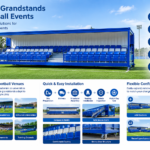
Container grandstands offer another approach. By combining container-based modules with spectator seating, stairs, guardrails, and other event facilities, a temporary site can be turned into a functional public space without committing to a permanent building.
For event organizers, contractors, sports facility operators, and importers, the value of a container grandstand is not simply the seating itself. Its modular structure can support different layouts, transportation methods, and uses over the life of the project.
Temporary urban projects have different requirements from permanent stadiums.
A permanent grandstand is designed for one location and normally requires a long-term foundation and construction process. A temporary project may only need seating for several weeks, months, or a specific series of events.
A container-based grandstand can be considered when the project requires:
The actual suitability depends on the site, local regulations, structural design, transportation requirements, and the planned period of use.
The key idea is simple:
Build for the current use without unnecessarily limiting the future use of the site.
Sports events are one of the most direct applications for container grandstands.
A football tournament, athletics competition, community sports event, or motorsport event may require more spectator capacity than the existing venue can provide.
A container grandstand can be positioned along the edge of the playing area and configured according to the available site.
Typical considerations include:
For example, a local football tournament may only need additional seating for several weekends each year. Instead of constructing a permanent extension, an event organizer can consider a temporary modular seating solution.
The same modules may later be moved to another venue.
Outdoor festivals often use temporary infrastructure because the site changes from one event to another.
A container grandstand can provide elevated spectator seating for:
The seating area can also be integrated with other temporary facilities.
For example, the lower or internal space of a container-based structure may be used for storage, staff facilities, ticketing, or event equipment, depending on the design.
This creates a more efficient use of the site than treating the grandstand as seating alone.
One of the more interesting applications is the use of container structures in temporary urban spaces.
Cities often have vacant or underused sites that are waiting for future development. During this period, the site may still be used for community activities, cultural events, markets, exhibitions, or temporary recreation.
A modular container structure can support these temporary uses.
A simple project model could look like this:
Vacant site → Temporary event space → Community use → Relocation or redevelopment
The advantage is flexibility. The structure does not necessarily need to remain in the same location throughout its service life.
This makes container-based construction relevant to temporary urban development where the future use of the land is not yet fixed.
A conventional temporary grandstand mainly provides seating.
A container grandstand can be designed around several functions.
Depending on the project, the structure may combine:
This approach is particularly useful when the available site is limited.
Instead of adding separate temporary buildings for every function, the project can combine several uses within a modular system.
For an event organizer, this can simplify site planning and reduce the number of separate structures that need to be transported and installed.
Urban waterfronts and public plazas are often used for seasonal activities.
Examples include:
A permanent grandstand may not be suitable for these locations because the site may need to return to its normal public use after the event.
A portable or container-based grandstand can provide temporary seating while keeping relocation in the project plan.
However, waterfront and open-plaza projects require careful attention to wind, ground conditions, pedestrian movement, drainage, and local regulations.
The product should not be selected before the site requirements are understood.
Start with the expected audience rather than the physical size of the container.
A project may require 50 seats, 100 seats, several hundred seats, or a larger modular arrangement.
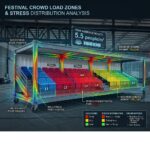
The expected peak audience should also be considered.
Measure the site before ordering.
Important dimensions include:
The transport route should also be checked. A grandstand may fit on the final site but still be difficult to deliver if trucks or lifting equipment cannot reach the installation area.
Spectators need a clear view of the activity.
The seating height, row arrangement, distance from the playing area, and position of structural elements can all affect visibility.
This is especially important for sports events.
A modular design should therefore be evaluated not only by seating capacity but also by how the seating interacts with the event area.
A grandstand is also a circulation system.
Spectators need to enter, find their seats, move between rows, and leave the structure safely.
The design should therefore consider:
These elements should be included during the planning stage rather than treated as accessories after the seating layout has been decided.
Outdoor temporary structures are exposed to local weather.
The design may need to account for:
A roof can improve spectator comfort, but it also adds weight and wind exposure.
Container grandstands are not automatically better than every other temporary seating system.
The right choice depends on the project.
| Factor | Container Grandstand | Conventional Temporary Seating |
|---|---|---|
| Modularity | High | Varies |
| Relocation | Possible | Possible |
| Additional enclosed space | Possible | Usually limited |
| Transportation | Container-based planning | Depends on system |
| Reuse | Suitable | Suitable |
| Customization | Project dependent | Project dependent |
| Best suited for | Multi-purpose temporary projects | Temporary spectator seating |
The main difference is not simply the seating itself.
A container-based system can potentially combine spectator seating with enclosed or service spaces, which may be useful for projects with limited land.
Transportation needs to be considered before production.
For an international project, buyers should confirm:
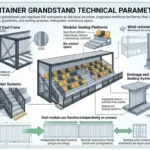
Once the modules arrive, installation may involve positioning the units, connecting structural components, installing stairs and guardrails, and completing the seating and roof system.
The exact process depends on the design.
For container-based products, lifting equipment such as a crane may be required for unloading and positioning.
A supplier should provide appropriate installation drawings and instructions for the specific configuration.
A temporary structure still needs to meet applicable safety requirements.
Depending on the location and project type, regulations may address:
Requirements vary between countries and even between different types of projects in the same country.
For this reason, international buyers should not rely only on a generic product specification.
Before production, the project team should confirm which local standards and approval procedures apply.
The manufacturer can provide technical information and drawings, while the buyer, local engineer, contractor, or authority may need to verify the final compliance requirements.
Container grandstands can be particularly interesting for companies that provide temporary event infrastructure.
A rental company may use the same modular system for different customers throughout the year.
For example:
Football tournament → school sports day → outdoor festival → motorsport event
The required seating configuration can change between projects.
This makes modularity more than a design feature. It can become part of the business model.
Instead of purchasing a structure for one permanent venue, an event company can potentially use the same equipment across multiple locations and projects.
Before requesting a quotation, international buyers should prepare basic project information.
Useful information includes:
Then ask the manufacturer for relevant technical information.
This may include:
Providing this information early can help avoid major changes after production begins.
The most interesting feature of a container grandstand is not simply that it can provide temporary seats.
Its value comes from combining several characteristics:
Modular + Relocatable + Reusable + Multi-functional
These characteristics make container grandstands worth considering for temporary sports venues, festivals, urban public spaces, waterfront events, and other projects where permanent construction may not be appropriate.
However, the system still needs to be designed around the actual project. Seating capacity, sightlines, access, weather conditions, transportation, installation, and local regulations all affect the final solution.
For importers, event contractors, sports facility companies, and rental businesses, the best approach is to start with the project requirements and then develop the container grandstand configuration around them.
Container grandstands provide one possible solution for creating temporary spectator seating and public activity spaces in urban environments.
Their modular format can support different seating capacities and layouts. Their container-based design can also allow the project to combine seating with storage or service functions when the design calls for it.
The strongest applications are not necessarily projects that need the cheapest possible seating. They are projects where flexibility, relocation, reuse, transportation, and multi-purpose use are important.
For an upcoming sports event, festival, public-space project, or temporary venue, buyers should evaluate the site first and then compare the available grandstand systems based on capacity, safety, logistics, installation, and long-term reuse.
For international projects, working with a manufacturer that can provide technical drawings, customization, export packaging, installation guidance, and project-specific information can make the procurement process easier.
Your email address will not be published. Required fields are marked *
 English