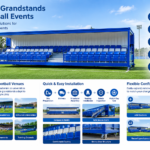
Container Grandstand: A Practical Buying Guide for B2B Projects A container grandstand is a practical seating solution for sports venues, outdoor events, schools, festivals, and temporary facilities. For B2B buyers, however, choosing a container grandstand is not simply about the number of seats. Importers, distributors, event rental companies, and contractors also need to consider transport, […]
A container grandstand is a practical seating solution for sports venues, outdoor events, schools, festivals, and temporary facilities. For B2B buyers, however, choosing a container grandstand is not simply about the number of seats.
Importers, distributors, event rental companies, and contractors also need to consider transport, installation, seating capacity, weather protection, structural design, customization, and long-term maintenance.
This guide explains the key points to check before ordering a container grandstand from a manufacturer.
A container grandstand is a spectator seating structure built by modifying a shipping container or using a container-based structural system.
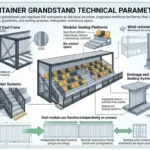
Unlike conventional temporary bleachers, the container format combines several functions into one transportable unit. Depending on the design, a unit can include:
For international buyers, the container format can also simplify transportation because the product is based on standard container dimensions.
A 40ft container grandstand, for example, can provide a relatively large seating capacity while keeping the overall structure suitable for container logistics.
The main reason is flexibility.
A permanent stadium structure requires significant civil construction. Traditional temporary bleachers may require separate structural components, transport arrangements, and installation work.
A container grandstand can combine the main structure and spectator seating into a more compact product.
This can be useful for businesses working on:
For rental companies, portability can also be important. The same seating unit may be used at different events instead of being permanently installed at one location.
The cheapest quotation is not necessarily the easiest product to import or install.
Before comparing suppliers, buyers should check several technical and commercial factors.
Start with the required number of spectators.
A supplier may offer different seating configurations depending on the available container size and layout.
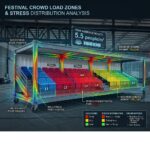
For example, a 40ft container grandstand can be configured for dozens of spectators. One of our standard configurations provides 63 seats.
The actual capacity should be confirmed from the supplier’s technical drawing rather than estimated from photographs.
Ask for:
This information is also useful when checking local venue requirements.
Outdoor spectators need protection from sun and rain.
A covered container grandstand normally uses a steel roof structure above the seating area. The roof design should be checked together with the overall structure rather than treated as a simple accessory.
For international projects, buyers should ask about:
For example, our 40ft container grandstand configuration can use a Corten steel roof of approximately 25 m².
The final roof design can vary according to the project.
The structural system is one of the most important points in a B2B purchase.
A supplier should be able to provide technical information instead of only product photographs.
Depending on the project, buyers may need drawings showing:
If the grandstand will be installed permanently or used in a location with demanding weather conditions, local engineering requirements should be checked before production.
The seats are another important specification.
Common options include plastic, HDPE, and aluminum alloy seats.
For outdoor projects, buyers should consider:
For distributors, replaceable seat components can also make after-sales service easier.
These two solutions can serve similar purposes, but the purchasing process is different.
| Factor | Container Grandstand | Traditional Temporary Bleachers |
|---|---|---|
| Main structure | Container-based structure | Modular steel structure |
| Transportation | Container-oriented logistics | Component-based transport |
| Seating | Integrated into the structure | Installed separately |
| Roof | Can be integrated | Often separate |
| Installation | Pre-assembled components | More on-site assembly |
| Mobility | Suitable for relocation | Depends on design |
| Customization | Seating, roof, color and layout | Depends on supplier |
| Storage | Container structure can provide enclosed space | Usually requires separate storage |
This does not mean one system is suitable for every project.
The right choice depends on site conditions, required capacity, transportation, installation requirements, and local regulations.
For B2B buyers, transportation can significantly affect the total project cost.
A product that looks inexpensive at the factory may become expensive after inland transportation, port handling, sea freight, customs clearance, and local delivery.
This is why buyers should ask suppliers for the packed dimensions and shipping information before confirming an order.
Important information includes:
Yes. B2B projects often require changes to the standard configuration.
Depending on the manufacturer, customization may include:
However, customization should be discussed before production.
A simple change to the seat layout may affect the structure, access routes, weight distribution, or shipping dimensions.
For this reason, a professional supplier should confirm the technical drawing before manufacturing.
International buyers should not rely only on a product catalogue.
Before placing a bulk order, request documents that help you evaluate the product and prepare for local approval.
Depending on the project, these may include:
Local building and event regulations can vary significantly between countries and even between different project types.
The supplier can provide product documentation, but the buyer or local engineering team should confirm the requirements that apply to the final installation.
Installation requirements depend on the design.
A factory-assembled container grandstand can reduce the amount of work required on site. However, the installation still needs suitable lifting equipment and a prepared site.
Before delivery, check:
For B2B projects, installation instructions should be supplied with the product.
The buyer should also confirm who is responsible for site preparation, lifting, anchoring, and final inspection.
When comparing manufacturers, use the same questions for every supplier.
A practical RFQ can include:
Product
Engineering
Production
Export
Installation
These questions help separate a manufacturer with an established production process from a trading company that mainly resells products.
One standard configuration we manufacture is a 40ft container grandstand with 63 spectator seats.
The configuration includes:
For export projects, we normally confirm the final specifications and drawings with the buyer before production.
This is important because the same basic product may need different configurations for a school, football club, event rental company, or temporary sports venue.
For an importer or distributor, supplier selection should focus on the complete purchasing process rather than the catalogue price alone.
Look at:
Manufacturing capability
Can the supplier actually manufacture the structure and complete the required modifications?
Technical support
Can the factory provide drawings, specifications, and installation information?
Customization
Can the seating capacity, roof, colors, and other project details be adjusted?
Quality control
Does the supplier inspect the structure and finished product before shipment?
Export experience
Does the supplier understand container loading, shipping dimensions, and export documentation?
Communication
Can the supplier clearly confirm specifications before production?
A good RFQ should make these points easy to compare.
A container grandstand can be a useful option for businesses that need portable or semi-permanent spectator seating for sports and outdoor events.
For B2B buyers, the key is to evaluate more than the number of seats or factory price. Structural design, roof protection, seating materials, transportation, installation, documentation, customization, and local requirements all affect the final project.
If you are sourcing container grandstands for resale, rental, sports facilities, or an event project, start with the required seating capacity and site conditions. Then ask the manufacturer for a technical drawing, shipping specifications, production lead time, and quotation based on your actual project.
Container House Co., Ltd. manufactures container-based spectator stands for export projects and can discuss seating capacity, roof configuration, customization, and shipping requirements with international buyers.
Your email address will not be published. Required fields are marked *

 English