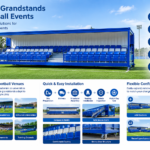
The Application of Container Grandstands in Temporary Event Structures As sports events, festivals, cultural activities, and large outdoor events continue to grow worldwide, the demand for fast, flexible, and reusable temporary event structures is increasing. Traditional permanent stadiums are not always suitable for short-term events because they require significant investment, long construction periods, and permanent […]
As sports events, festivals, cultural activities, and large outdoor events continue to grow worldwide, the demand for fast, flexible, and reusable temporary event structures is increasing. Traditional permanent stadiums are not always suitable for short-term events because they require significant investment, long construction periods, and permanent land use.
In this context, container grandstands and modular grandstand systems are becoming increasingly attractive solutions for temporary sports and event facilities.
With their standardized modules, transportation advantages, rapid installation, and potential for repeated use, container-based grandstands can provide flexible spectator seating for a wide range of temporary events.
This article explores the application of container grandstands in temporary event structures, including their advantages, applications, structural considerations, space planning, installation process, and sustainability.
A container grandstand is a modular spectator seating system that uses container-based modules, modular steel structures, or a combination of both to create temporary seating facilities.
It is important to understand that a professional container grandstand is not simply a collection of standard shipping containers stacked together. A properly designed system needs to consider structural safety, audience loads, viewing angles, access routes, emergency evacuation, handrails, stairs, and other requirements for public events.
Depending on the project, container grandstands can generally be divided into several configurations.
In this configuration, containers are mainly used as functional spaces, while the spectator seating is supported by a dedicated steel grandstand structure.
The container modules can accommodate:
This solution is particularly suitable for large sporting events and multi-purpose temporary venues.
Standardized modules are assembled according to the required seating capacity and site conditions.
The number of modules can be increased or reduced depending on the size of the event, making this approach suitable for temporary sports competitions, festivals, and other short-term events.
In this configuration, the grandstand provides spectator seating while container modules provide supporting facilities.
For example, a temporary football venue may include spectator seating, changing rooms, media facilities, toilets, storage areas, ticketing facilities, and commercial spaces within the same modular system.
This integrated approach can significantly improve the efficiency of temporary event facilities.
Temporary events have very different requirements from permanent stadium projects.
A permanent stadium may be designed for decades of operation, while a temporary event facility may only be required for several days, weeks, or months.
Therefore, construction speed, transportation, installation, dismantling, and reuse are particularly important.
One of the major advantages of modular grandstands is their potential for rapid installation.
Many components can be prefabricated and prepared before arriving at the event site. On-site work can then focus mainly on lifting, assembly, connections, seating installation, and system commissioning.
This can significantly reduce the amount of traditional construction work required on site.
A typical installation process can be organized as:
Factory Production → Transportation → Site Preparation → Lifting → Assembly → Safety Inspection → Event Operation
This approach is particularly valuable when the construction period is limited by an event schedule.
Container grandstands can be configured according to different site conditions and spectator capacities.
For example:
The modular nature of the system makes it easier to adjust the size and layout of the temporary venue.
Shipping containers were originally developed for efficient transportation, which gives container-based architecture an inherent logistical advantage.
When designing a modular grandstand, transportation should be considered from the beginning.
Important factors include:
A well-designed modular system can be transported from one event location to another and assembled again for future use.
One of the most important differences between temporary modular construction and conventional construction is the possibility of dismantling and reuse.
Instead of demolishing the structure after an event, a modular grandstand can be designed with mechanical connections that allow components to be disassembled.
The same modules may then be transported to another location and reconfigured for a new event.
This creates a more flexible building lifecycle:
Design → Manufacture → Transport → Assembly → Event → Dismantling → Transport → Reassembly
Container grandstands are not limited to football stadiums. They can be used for a wide range of temporary events.
Potential applications include:
For events where spectator capacity changes from one location to another, modular grandstands can provide a practical solution.
Music festivals often require temporary spectator areas and supporting facilities to be installed within a short period.
Container-based modules can be combined with stages, hospitality areas, ticketing facilities, toilets, commercial spaces, and backstage facilities.
This allows organizers to create a complete temporary event environment using modular construction.
Temporary seating can also be used for:
After the event, the grandstand can be dismantled and the public space returned to its original condition.
Container modules can provide both seating and enclosed functional spaces.
For example, a modular event facility can combine:
This makes modular container architecture suitable for commercial and promotional events as well as sports.
A successful temporary grandstand design should consider much more than the number of seats.
Audience circulation, viewing quality, accessibility, emergency evacuation, and supporting facilities all need to be considered.
The seating area is the core component of any grandstand.
Important design factors include:
For large events, structural calculations should be carried out according to the applicable building regulations and event safety requirements.
Efficient circulation is essential for temporary stadium seating.
A typical circulation sequence is:
Entrance → Concourse → Stairs → Seating Aisle → Seat
During an emergency, the circulation system should provide a clear route:
Seat → Aisle → Stairs → Exit → Safe Area
The entrance, exit, spectator, athlete, staff, and service flows should be carefully organized to reduce congestion.
The area beneath a modular grandstand can also be used efficiently.
Depending on the project, it can accommodate:
This can transform a simple temporary seating structure into a multifunctional event facility.
Structural safety is one of the most important considerations when designing a container grandstand.
A standard shipping container is originally designed for cargo transportation. Its structural characteristics and design loads should therefore not automatically be considered equivalent to those required for a public spectator facility.
Professional engineering design is required when containers or modular steel systems are adapted for grandstand applications.
Key considerations include:
For outdoor grandstands, wind resistance is particularly important because lightweight modular structures can be more sensitive to wind loads than conventional concrete stadium structures.
The connection system is another important part of modular grandstand design.
Possible connection methods include:
Where repeated dismantling and reuse are important, mechanical and bolted connections can offer significant advantages because they allow modules to be separated without extensive destructive work.
Sustainability is becoming an increasingly important consideration in temporary architecture.
Traditional temporary structures may generate considerable waste when they are dismantled after an event.
A modular container grandstand can support a more circular approach to construction.
Instead of:
Build → Use → Demolish
the lifecycle can become:
Manufacture → Use → Dismantle → Transport → Reuse → Reconfigure
This approach can reduce the need for new construction materials and extend the useful life of individual modules.
However, sustainability should be evaluated across the entire lifecycle.
Important factors include:
Therefore, a container grandstand should not be considered sustainable simply because it is modular. Its overall environmental performance depends on how efficiently the modules are manufactured, transported, used, reused, and eventually recycled.
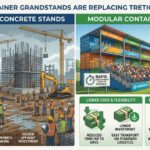
The main advantages of container grandstands can be summarized as follows.
Prefabricated modules can reduce the amount of work required on site.
The seating capacity and configuration can be adjusted according to the event and site.
Standardized modules can be transported between event locations.
Modular connections can make post-event dismantling faster and more efficient.
Modules can potentially be reused for multiple events.
Containers can provide toilets, storage, offices, media facilities, hospitality areas, and commercial spaces.
They are particularly useful where permanent construction is unnecessary or impractical.
The development of modular construction technology is expected to further expand the application of container grandstands.
Standard dimensions and connection systems can improve compatibility between different projects and make modules easier to reuse.
BIM and digital design tools can improve coordination between architecture, structural engineering, manufacturing, transportation, and installation.
Future modular grandstands are likely to incorporate better shading, ventilation, insulation, lighting, and weather protection.
Low-carbon materials, energy-efficient systems, lifecycle assessment, and higher reuse rates will become increasingly important.
Future container-based event facilities may combine spectator seating with commercial, hospitality, office, media, storage, and public-service functions.
Container grandstands offer a flexible approach to temporary event architecture.
Compared with conventional permanent stadium construction, modular grandstands can provide significant advantages in terms of rapid installation, flexible configuration, transportation, dismantling, and reuse.
Their applications extend beyond football and sports competitions to music festivals, cultural events, city celebrations, exhibitions, and commercial activities.
The most important value of container grandstands is not simply their use of shipping containers. Rather, it is the possibility of integrating modular design, prefabrication, efficient logistics, demountable construction, and circular reuse into a single building system.
As modular construction and sustainable architecture continue to develop, container grandstands are likely to become an increasingly important solution for temporary sports venues and event facilities.
For event organizers, architects, contractors, and modular building manufacturers, the key challenge will be to develop systems that combine structural safety, spectator comfort, efficient installation, attractive design, cost effectiveness, and long-term reusability.
A well-designed container grandstand can therefore be more than a temporary seating structure. It can become a flexible, reusable, and sustainable component of the future temporary event infrastructure.
Your email address will not be published. Required fields are marked *
 English