Author Archives: jzxadmin

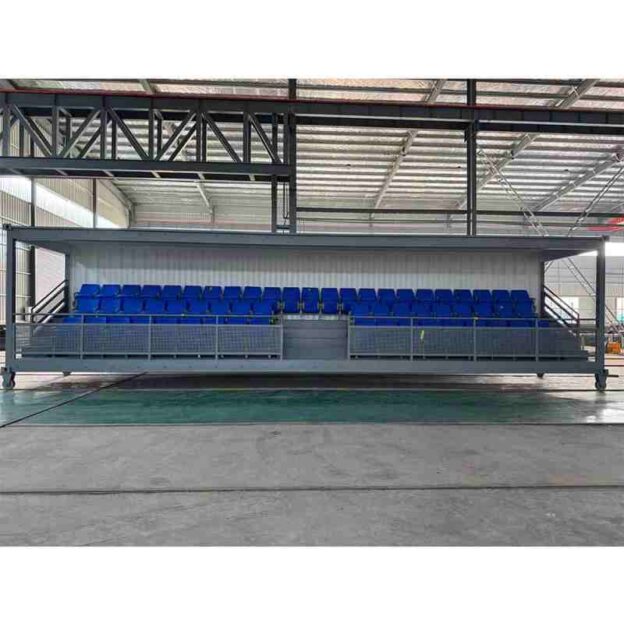
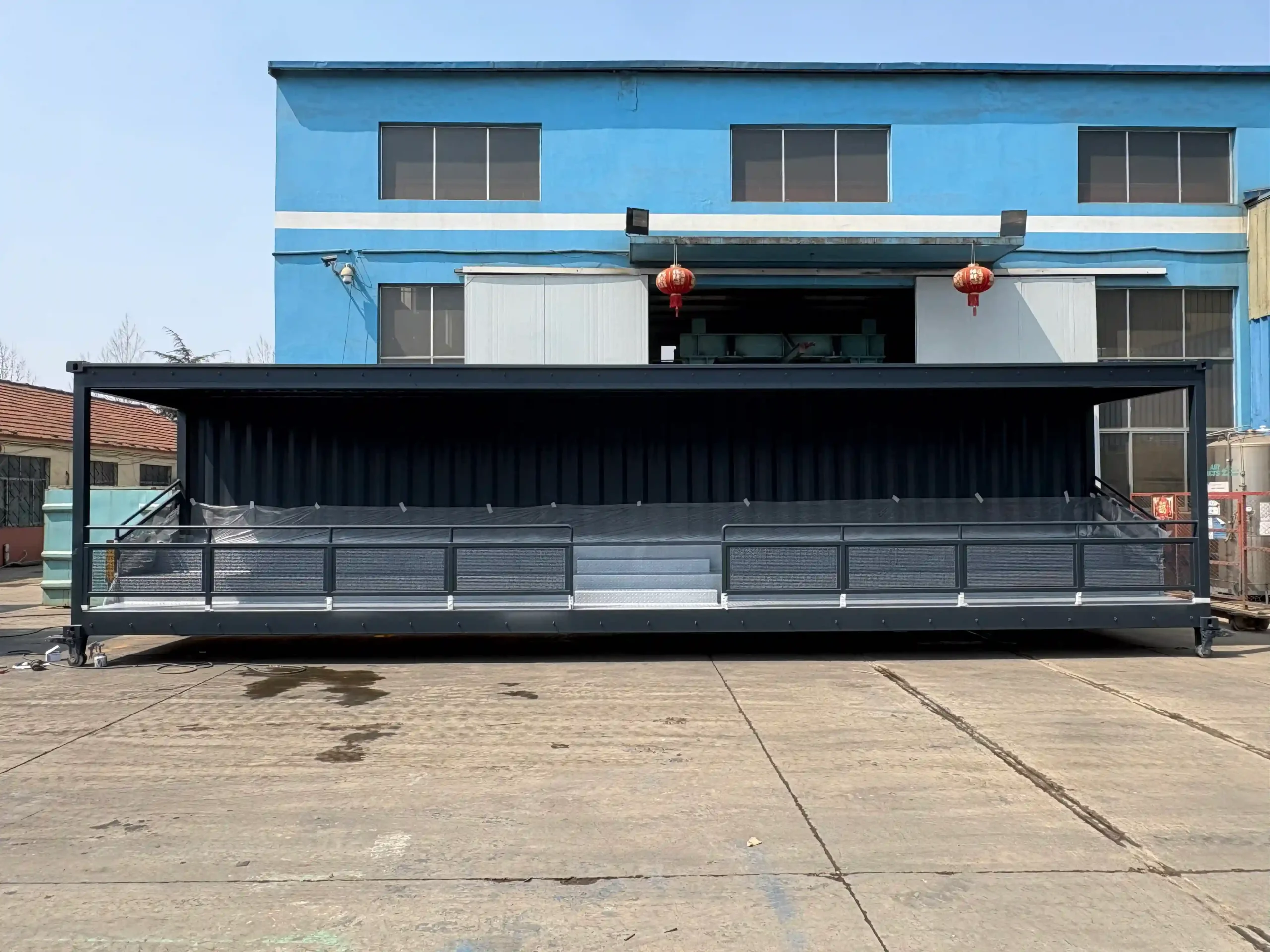
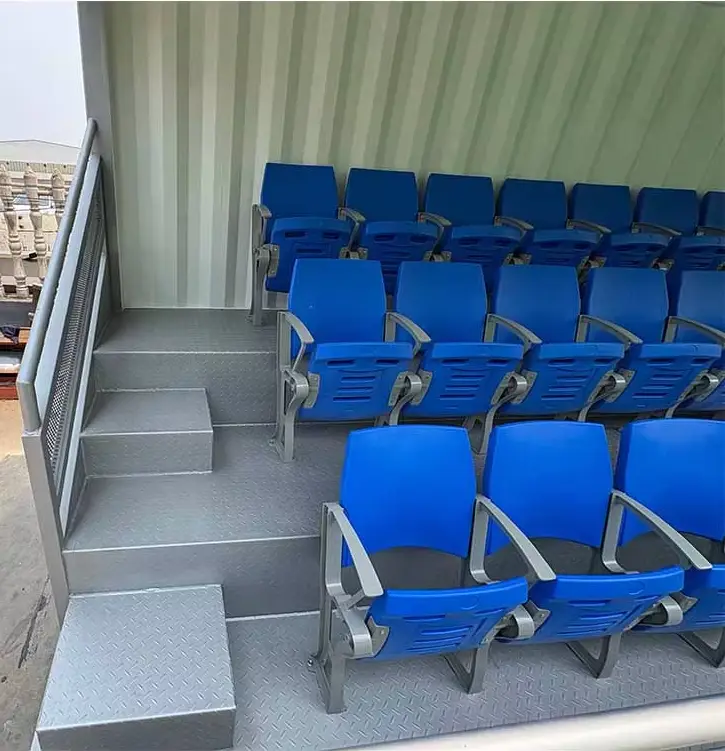
container bleacher opened into multi-tier elevated seating platform with integrated stairs and guardrails ready for crowd use at sports or event sites

Container Grandstand Technical parameter

Container Grandstand Technical Parameter Benchmarks: A Procurement Blueprint for High-ROI Projects

No one can ignore the specifications of a product. As a new product, container grandstand technical parameter require buyers and importers to understand them for comparison purposes.No one can ignore the specifications of a product. As a new product, container grandstands require buyers and importers to understand their specifications for comparison purposes.

Container Grandstand Technical Parameter: What Drives Procurement Decisions

Container Grandstand Technical parameter determines structural safety, cost efficiency, and deployment speed in bulk procurement. Buyers who ignore technical data face a 18% higher lifecycle cost based on modular construction audits.

Steel frame thickness defines load capacity. Q235 galvanized steel at 2.0–2.5mm thickness provides a yield strength of 235 MPa. This resists deformation under crowd loads exceeding 5.0 kN/m², which aligns with temporary structure standards such as EN 13200.

Load miscalculation leads to structural fatigue. One Middle East stadium project used 1.8mm steel, resulting in a 12% deformation rate after six months. After switching to 2.3mm frames, deformation dropped below 2%.

Cost impact follows physics. Higher thickness increases unit cost by 6%, yet reduces maintenance costs by 22% annually.


Core Container Grandstand Technical Parameter Breakdown

1. Structural Load Capacity and Safety Metrics

Load capacity defines whether the structure passes inspection or fails under pressure. Container Grandstand Technical parameter must meet both static and dynamic load standards.

Container grandstands are converted from shipping containers and possess the structural stability of shipping containers. Load spreads across beams and columns. The principle follows uniform load distribution and moment resistance. A 3-tier grandstand typically requires:

  • Static load: ≥5.0 kN/m²
  • Dynamic load: ≥1.5 kN/m²
  • Wind resistance: ≥10 Beaufort scale

One European contractor tested two suppliers. Supplier A provided 4.2 kN/m² capacity. Supplier B delivered 5.5 kN/m². After one season, Supplier A required reinforcement costing $18/m². Supplier B required zero repair.

Return difference appears fast. Within 12 months.

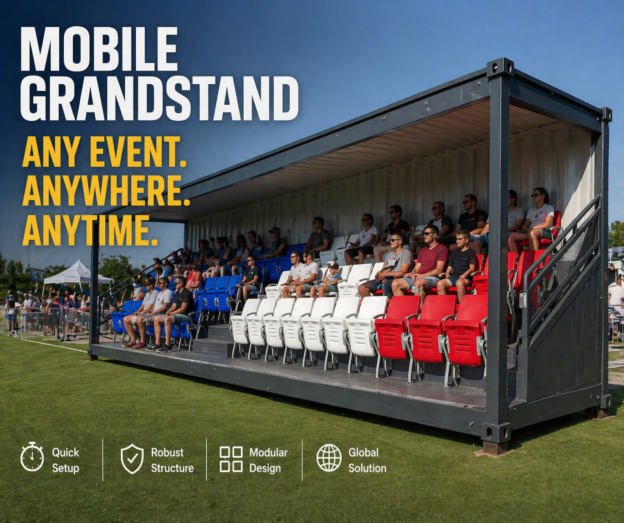
container grandstand structure Converted from shipping containers, with a stable structure


2. Container Grandstand Dimensional Data and Space Efficiency

Dimensions affect seating density and transport cost. Container Grandstand Dimensional Data must balance ergonomics with logistics.

Standard module dimensions:

TypeDimensions External( length * Width * height) mmDimension Internal
( length * Width * height) mm
Inside Cubic Capacity
m3
Tare Weight
kgs
20'GP6058 * 2438 * 25915910 * 2352 * 236328.82400
20'HC6058 * 2438 * 28965898 * 2352 * 2373372515
40'GP12192 * 2438 * 259112031 * 2346 * 2384673950
40'HC12192 * 2438 * 289612031 * 2346 * 2673754100

Seat spacing uses human ergonomics. A 450mm depth ensures comfort without reducing capacity. Increasing spacing to 500mm cuts seating capacity by 10%.

A Southeast Asia project compared layouts. A compact layout delivered 320 seats per unit. A wider layout delivered 280 seats. Revenue difference reached $12,000 per event cycle.

Space equals revenue. Always.


3. Container Grandstand Technical Characteristics: Materials and Durability

Material selection directly affects the durability and structural stability of container grandstands. Unlike prefabricated steel buildings, container grandstands are converted from standard shipping containers, so the core structure already meets the strength requirements of long-distance transportation, stacking, and outdoor use.

Container Grandstand Technical Characteristics mainly depend on the original container steel structure, surface anti-corrosion treatment, and reinforcement design after modification.

The main structure uses corten steel or marine-grade container steel commonly found in standard freight containers. Compared with light steel systems, shipping containers are designed to withstand repeated loading, lifting, sea transportation, and harsh weather conditions.

The container frame includes:

  • Heavy-duty steel corner castings
  • Welded steel side beams and cross members
  • Corrugated steel wall panels for structural rigidity

This structure provides strong load-bearing performance for spectator seating, stair systems, and upper viewing platforms.

Most container grandstands retain the original container anti-corrosion coating system. After modification, cut areas and welded sections are repainted with industrial anti-rust coatings to improve outdoor durability and reduce corrosion caused by rain and humidity.

For outdoor sports fields and temporary event venues, waterproof sealing is also important. Rubber sealing strips and weather-resistant sealants are commonly used around doors, roof joints, and connection areas to prevent water leakage during long-term outdoor operation.

Floor materials are usually based on the original container plywood flooring or upgraded steel checker plates, depending on the project’s load requirements and local weather conditions.

Material choice in container grandstands is practical rather than decorative.

Using real shipping containers means the structure already has proven transportation strength, impact resistance, and outdoor durability before the seating system is even installed.


4. Container Grandstand Performance Metrics in Real Conditions

Performance metrics reveal how structures behave under stress. Container Grandstand Performance Metrics include vibration, wind resistance, and fatigue cycles.

Vibration frequency must stay below 5 Hz to avoid discomfort. Structural damping reduces oscillation under crowd movement.

Wind load follows aerodynamic principles. A 40ft container grandstand withstands:

  • Wind pressure: 0.5 kN/m²
  • Anchoring force: ≥20 kN per unit

In Australia, a coastal installation faced 90 km/h winds. Units without anchoring shifted by 15mm. Anchored units remained stable with zero displacement.

Stability prevents downtime. Downtime costs money.

Container grandstand seating Technical Characteristics

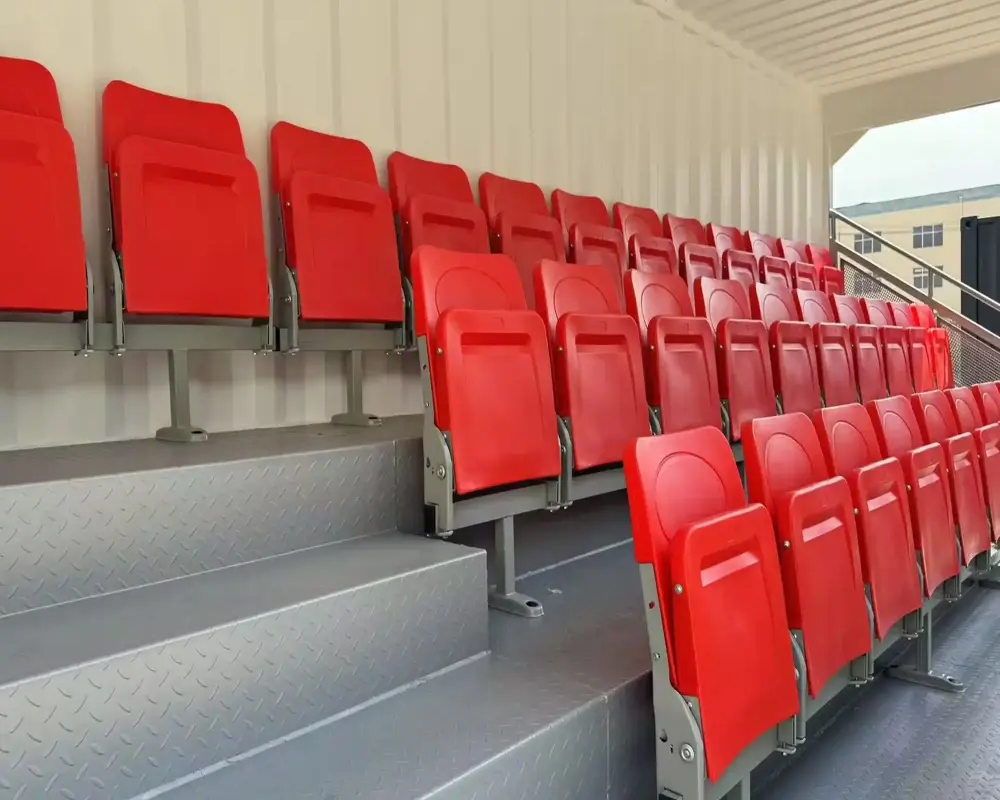
container bleacher tiered bench seating detail with non-slip surfaces reinforced guardrails and sturdy access steps for secure spectator use

This seating system is specifically engineered for container conversions, modular stadiums, and grandstands. Utilizing High-Density Polyethylene (HDPE) with a hollow blow-molding process, these seats offer the perfect balance of durability, weather resistance, and ergonomic comfort.

  • Product Name: Hollow Blow-Molded Folding Stadium Seat

  • Material: High-Density Polyethylene (HDPE)

  • Manufacturing Process: Hollow Blow Molding (for superior impact resistance)

  • Folding Mechanism: Gravity auto-tip or spring-return system

  • Support Structure: Die-cast aluminum alloy or hot-dip galvanized steel

  • Center Spacing: 480mm – 500mm (Standard)

  • Seat Height: 430mm ± 10mm

  • Weather Resistance: UV-stabilized; Temp range: -50°C to +75°C

  • Load Capacity: Static Load ≥ 200kg; Impact Load ≥ 1000N

  • Fire Rating: Available in Flame Retardant Grade B1/B2 (Optional)

Container grandstand Ceiling,steps,container railings Technical Characteristics

Tiered Steps and Flooring System

The internal flooring is engineered using a heavy-duty tiered steel structure to provide optimal sightlines for spectators. The walking surfaces and steps are finished with anti-slip diamond plate (checker plate) steel, ensuring high traction and durability in all weather conditions. Each riser is precision-welded to the container frame, integrated with a central or lateral aisle for efficient foot traffic. The surface is treated with an industrial-grade, anti-corrosive powder coating to prevent wear and oxidation from heavy use.

Seating: Several rows of bright red, fold-up plastic seats are mounted on a grey tiered structure. Structure: The seats are installed on light grey metal or concrete risers. The background consists of a beige or off-white corrugated wall, suggesting a modular or temporary grandstand design. Layout: The rows are arranged in a tiered, "bleacher" style to provide clear sightlines. Indicator: In the top right corner, there is a blue square icon with a white checkmark, often used to signify that a selection has been made or a task is complete.

The photo highlights a compact, durable, and industrial-style seating solution, likely used for small stadiums, temporary event spaces, or VIP viewing areas.

Safety Guardrail and Infill Panels

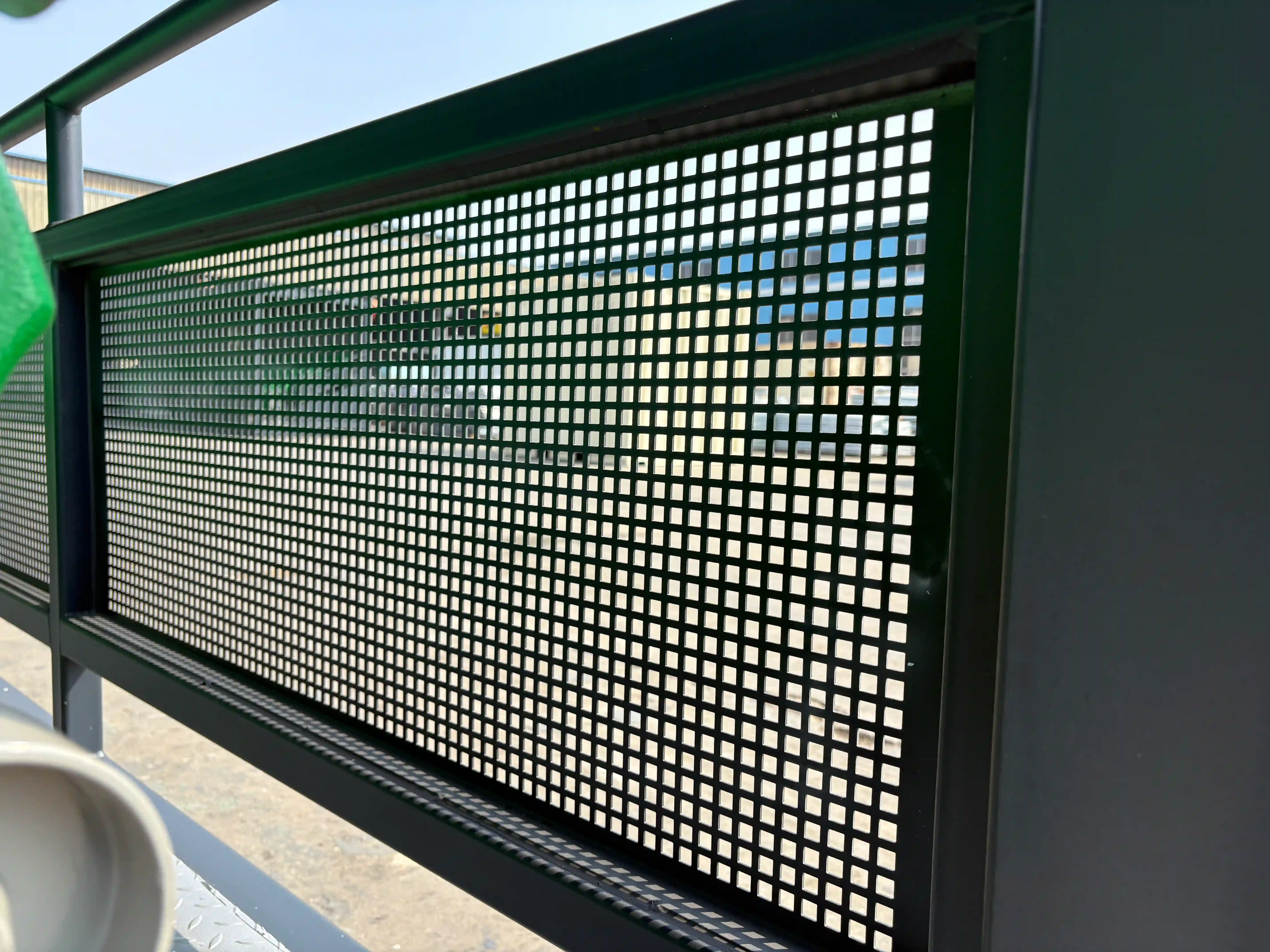
The perimeter is secured by a robust tubular steel handrail system, typically featuring a top rail height designed to meet international safety standards. The lower portion of the railing is equipped with laser-cut perforated mesh infill panels. These square-patterned mesh screens provide a high-strength barrier that prevents falls while maintaining visual transparency and airflow. The entire railing assembly is finished in a weather-resistant matte or semi-gloss coating to match the primary container structure, providing a seamless and professional aesthetic.

The image highlights the durable construction and safety features of a modern guardrail, combining functional perforated metal with a robust structural frame for use in spectator or industrial environments.

Integrated Roofing and Canopy

The grandstand is sheltered by a cantilevered or integrated container roof system derived from high-tensile corrugated steel panels. The interior ceiling follows the original profile of the container’s roof, providing structural rigidity and effective water shedding. The deep overhang of the roof ensures that the seating area remains protected from direct sunlight and vertical rainfall. For enhanced durability, the roof seams are fully welded and sealed with waterproof industrial coatings, and the interior is painted in light-reflective tones to improve ambient brightness within the seating area.

container grandstand life

“5years ?10years?20years?30years?”

A lot of people have debated the lifespan of container grandstands. No one would buy a stand again just because of quality issues, so the lifespan of a container grandstand is something the buyer really needs to pay attention to.

When purchasing a container grandstand, buyers should look past generic “20+ year” claims and budget for two distinct lifespans. the robust steel frame, which holds structural integrity for 25 to 30 years with proper coating and drainage maintenance, and the seating system, which typically requires refurbishment every 10 to 15 years due to UV exposure and operational wear. Savvy procurement teams should treat the frame as a long-term capital asset and the seating as a predictable mid-life maintenance cost, keeping in mind that simple operational habits like proactive inspections and preventing water pooling are what ultimately determine the structure’s real-world longevity.


Solution Framework: How to Select the Right Technical Parameter Set

Buyers need a repeatable framework. Container Grandstand Technical parameter selection should follow measurable criteria.

Step-by-step approach:

Buyers require a reusable frame. The selection of technical parameters for the container grandstand should adhere to measurable standards.

Step-by-step approach:

Determine load requirements based on audience density.

Purchase suitable container grandstands based on audience size.

Determine the wind resistance of the grandstand container under local climatic conditions.

Calculate the 3-5 year lifecycle cost.

Determine the factory’s ability to customize container grandstands.

CategoryParameterBenchmark SpecificationPerformance / Benefit
Structural FrameSteel GradeQ235 Galvanized SteelYield strength: 235 MPa
Structural FrameSteel Thickness2.0 – 2.5 mm (Recommended 2.3 mm)Reduces deformation to <2% under load
Load CapacityStatic Load≥ 5.0 kN/m²Meets EN 13200 standards
Load CapacityDynamic Load≥ 1.5 kN/m²Handles crowd movement safely
Load CapacityCorner Post Capacity8 – 10 tons per cornerSupports multi-tier stacking
Wind ResistanceWind Load Rating≥ 0.5 kN/m² Beaufort Scale 10+Stable in typhoon / high-wind zones
AnchoringAnchoring Force≥ 20 kN per unitZero displacement in 90 km/h winds
Seating ConfigurationTier Height400 – 450 mmOptimal sightlines
Seating ConfigurationSeats per 40ft Module60 – 63 seatsHigh seating density
Seating MaterialSeat TypeHDPE Hollow Blow-Molded Folding SeatUV resistant, -50°C to +75°C
Seating MaterialSeat Load CapacityStatic ≥ 200 kg Impact ≥ 1000 NHigh durability & safety
Seating MaterialCenter Spacing480 – 500 mmErgonomic comfort
Flooring & StepsSurface MaterialAnti-slip Diamond Plate (Checker Plate) SteelExcellent traction in wet conditions
Safety FeaturesGuardrail SystemTubular steel + Perforated Mesh InfillMeets international fall prevention standards
Roofing & CanopyRoof TypeCorrugated high-tensile steel panelsEffective water shedding + sun protection
Durability & CorrosionAnti-Corrosion SystemHot-dip galvanizing + Electrostatic Powder Coating (60–80 μm)8–12 years before major maintenance
SealingWaterproof SystemEPDM Rubber + Industrial Sealants15-year sealing lifespan
Vibration ControlVibration Frequency< 5 HzMaintains spectator comfort

Final Insight: Turning Technical Parameters into Competitive Advantage

Procurement decisions depend on balancing upfront cost with lifecycle return. Container Grandstand Technical Data provides measurable benchmarks.

Container grandstands, due to their portability and comfort, can help trading companies increase product profits.

Container Grandstand Technical parameter is not a checklist. It is a profit lever.

Buyers who standardize technical data reduce risk, shorten deployment cycles, and increase revenue per square meter. The next step is aligning these parameters with supplier capability and scaling procurement volume before peak demand hits.

container grandstand feature

Are Container grandstand Worth It?

7 Practical Truths About Container Grandstand Worth: A Data-Driven Investment Decision Guide


In a B2B business environment, profit is a crucial factor. Faced with the emerging product, the container grandstand, many business owners raise questions about procurement: What is the ROI of a container grandstand? Are Container grandstand Worth It?

This article will discuss seven aspects of understanding whether investing in container grandstands is worthwhile.


1. Container Grandstand Worth Starts with Structural Efficiency

container grandstand structure design with steel frame and modular seating showing container grandstand worth

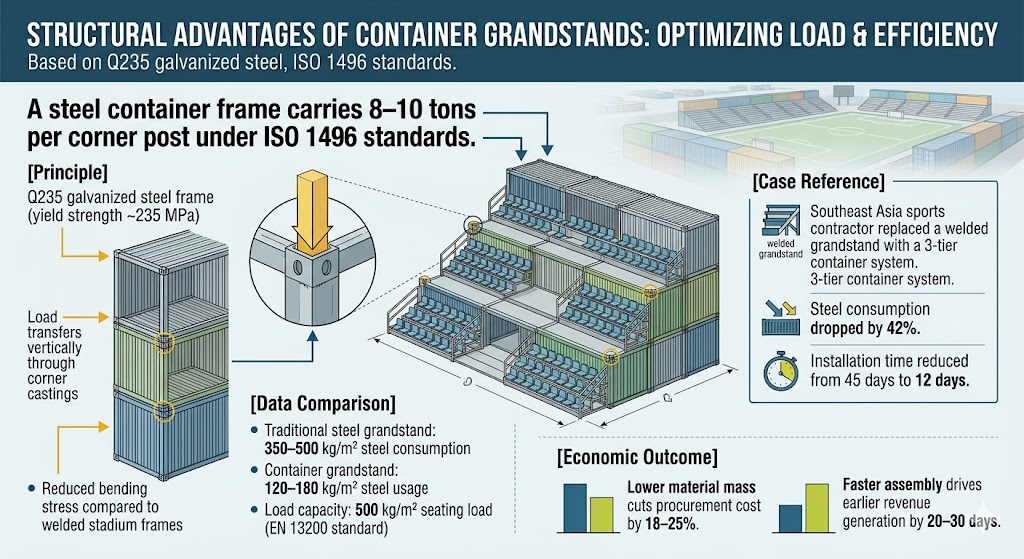
A steel container frame carries 8–10 tons per corner post under ISO 1496 standards.
Load matters.

[Principle]
Container grandstands rely on Q235 galvanized steel with a yield strength of ~235 MPa. This allows stacked configurations without additional concrete structures. Load transfers vertically through corner castings, reducing bending stress compared to welded stadium frames.

[Data Comparison]

  • Traditional steel grandstand: 350–500 kg/m² steel consumption
  • Container grandstand: 120–180 kg/m² steel usage
  • Load capacity: 500 kg/m² seating load (EN 13200 standard)

[Case Reference]
A Southeast Asia sports contractor replaced a welded grandstand with a 3-tier container system. Steel consumption dropped by 42%. Installation time reduced from 45 days to 12 days.

[Economic Outcome]
Lower material mass cuts procurement cost by 18–25%.
Faster assembly drives earlier revenue generation by 20–30 days.


2. Cost Breakdown Defines Container Grandstand Value

[Principle]
Compared to the high installation, construction, transportation, and maintenance costs of traditional grandstands, container grandstands eliminate the need to pay for these expensive expenses.Container grandstands integrate structure + seating + transport into one modular unit. This reduces subcontract layers and eliminates on-site fabrication risks.

Cost CategoryTraditional GrandstandContainer GrandstandSavings with ContainerNotes
Initial Structure & MaterialsHigh (Concrete/Steel + Custom Fabrication)Integrated Modular Unit40–50%Container includes frame + seating
Foundation & Civil WorksVery High (Extensive concrete foundation)Minimal (Simple anchoring)60–70%No heavy civil engineering required
On-Site Construction LaborHigh (Multiple subcontractors)Very Low (1–3 days modular assembly)70–85%Plug-and-play installation
Transportation & LogisticsHigh (Multiple shipments + cranes)Integrated (Units ship as structure)50–65%Structure + seating in one transport
Installation Time Cost4–12 weeks (High labor & equipment)1–3 days80–90%Faster revenue generation
Subcontractor Layers6–8 layers (High coordination cost)1–2 layers55–65%Reduced management overhead
Maintenance (5-Year)High (Corrosion, painting, repairs)Low (Galvanized + modular replacement)45–60%Designed for quick part replacement
Total Initial Investment100% (Baseline)~55%~45%Significantly lower upfront cost
5-Year Lifecycle Cost100% (Baseline)~48%>52%Major long-term savings

[Economic Outcome]
Initial investment drops ~45%.
5-year lifecycle savings exceed 50%.


3. Installation Speed Drives ROI

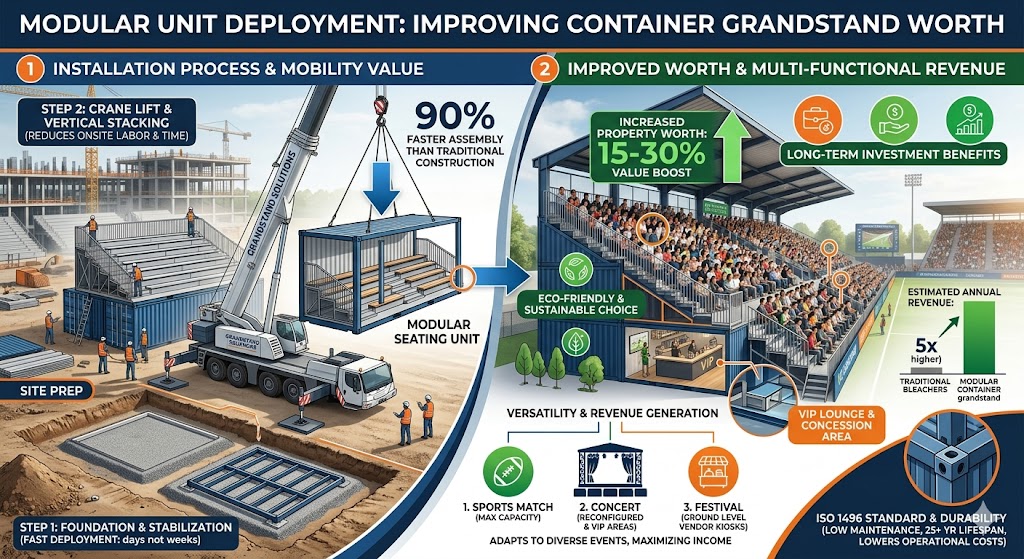
container grandstand installation process showing crane lifting modular units improving container grandstand worth

[Principle]
Modular systems eliminate wet construction. No curing time. No welding on-site. Pre-fabrication ensures tolerance control within ±2 mm.Once a suitable, flat foundation is selected, it can be used immediately, making it ideal for projects with limited budgets.

[Data Comparison]

  • Traditional grandstand: 30–60 days installation
  • Container grandstand: 7–15 days
  • Labor requirement: reduced by 60%

[Case Reference]
A European sports club installed a 1,500-seat container grandstand in 10 days using 6 workers and one crane. A traditional build required 25 workers over 40 days.

[Economic Outcome]
Earlier operation increases ticket revenue window by 20–40 days.
Labor cost savings reach $25,000–$80,000 per project.


4. Durability Impacts Container Grandstand Valuation

galvanized steel container grandstand anti corrosion coating showing long lifespan container grandstand valuation

[Principle]
Electrostatic powder coating forms a 60–80 μm protective layer. Combined with galvanized steel, corrosion resistance exceeds 10 years in coastal environments 

Compared to traditional grandstands, container grandstands are lighter and more flexible. They can be stored in warehouses during inclement weather to prevent damage, significantly extending their lifespan. Composed of 40ft shipping containers, container grandstands require less space and are easier to maintain.

[Data Comparison]

  • Traditional painted steel: 3–5 years before repainting
  • Container structure: 8–12 years before major maintenance
  • Waterproof sealing: EPDM rubber lifespan 15 years

[Case Reference]
Through our special treatment and the user’s careful maintenance. A coastal stadium in Indonesia reported zero structural corrosion after 6 years using container grandstands, while adjacent steel structures required repainting twice.

[Economic Outcome]
Maintenance cost reduces by 60–70%.
Asset depreciation slows significantly.


5. Transport Efficiency Defines Scalability

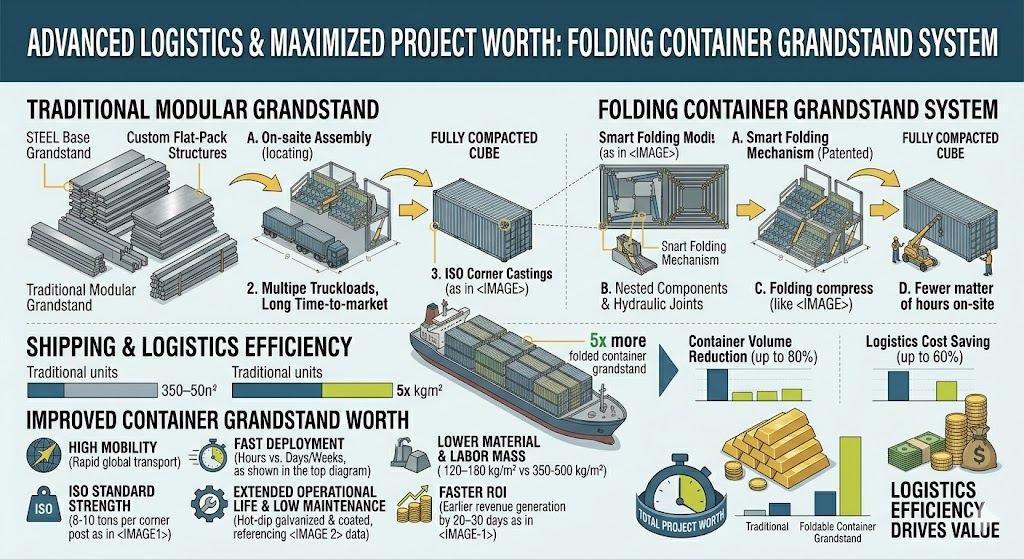
container grandstand folding and shipping configuration showing high logistics efficiency container grandstand worth

【Principle】

The canopy, chairs, steps, and railings of container grandstands are pre-manufactured and installed. Container grandstands can be transported like containers, resulting in high transportation efficiency and convenience. Traditional grandstands require many raw materials, including steel structures, chairs, steps, concrete, railings, and toilet facilities. This leads to more transport items and higher transportation costs.

【Data Comparison】

Traditional Structure: 1 project = 20-30 containers

Container Grandstand: 1 project = 6-10 containers

Loading Efficiency: Increased by 2.5-3 times

【Case Study】

An African distributor reduced the transportation cost of a 1000-seat project from $90,000 to $28,000 by switching to modular container grandstands.

【Economic Benefits】

Freight savings of up to 60-70%.

Global distribution by wholesalers becomes possible.


6. Multi-Use Flexibility Increases Container Grandstand Value

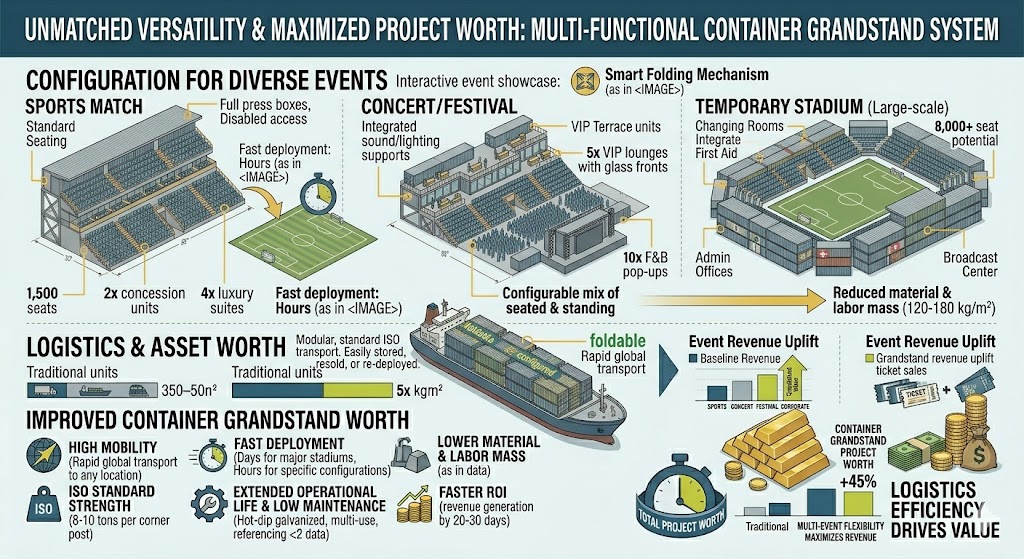
container grandstand used for sports events concerts and temporary stadiums showing container grandstand value versatility

[Principle]

Container grandstand can be used in many applications. When you have an event with fewer than 1,000 people, you can opt for our container stands instead of traditional stadium stands to achieve better occupancy rates and higher profits.Container modules allow reconfiguration into VIP lounges, media rooms, or retail kiosks. Structural integrity remains unchanged due to modular load distribution.

[Data Comparison]

  • Utilization rate (traditional): ~40–50% annually
  • Utilization rate (container): ~70–85% annually
  • Conversion time: <48 hours

[Case Reference]
A South American event operator used the same container grandstand for football matches, concerts, and exhibitions. Annual revenue increased by 65%.

[Economic Outcome]
Higher utilization boosts ROI cycle from 3 years to 1.5–2 years.
Revenue diversification reduces risk.


7. Final Decision Model: Is Container Grandstand Worth It?

Decision requires structure, cost, and ROI alignment.
Numbers decide truth.

Comprehensive Comparison Table

Practical TruthTraditional GrandstandContainer GrandstandKey Benefit / Outcome
1Structural Efficiency350–500 kg/m² steel usage120–180 kg/m² steel usage Q235 Galvanized Steel (235 MPa)42% less steel 500 kg/m² load capacity Stronger vertical load transfer
2Cost BreakdownHigh (multi-layer construction)Integrated modular unit~45% lower initial investment >50% 5-year lifecycle savings
3Installation Speed30–60 days7–15 days (1–3 days possible)60% less labor 20–40 extra days of revenue $25K–$80K labor savings per project
4Durability & Maintenance3–5 years before major repainting8–12 years before major maintenance EPDM sealing (15 years)60–70% lower maintenance Excellent corrosion resistance in coastal areas
5Transport Efficiency20–30 containers per project6–10 containers per project60–70% freight cost reduction 2.5–3× higher loading efficiency
6Multi-Use Flexibility40–50% annual utilization70–85% annual utilization <48h conversion65% higher annual revenue ROI cycle shortened to 1.5–2 years
7Overall Investment ValueHigh cost, slow ROI, low flexibilityLower cost + faster payback + multi-use45% lower upfront cost >50% 5-year savings Higher capital velocity

Actionable Solution for Importers and Wholesalers

Container grandstand worth becomes clear when aligned with project type.

If your project includes:

  • Temporary stadiums
  • Touring events
  • Government tenders
  • Rental business models

Then container grandstand value outperforms traditional systems across every measurable metric.

If you want long-term project support and multiple large-scale projects, and have a sufficient budget, then I recommend using traditional stadium stands.

Execution Strategy:

  1. Start with 500–1,000 seat modular units
  2. Prioritize foldable designs for shipping efficiency
  3. Select galvanized + powder-coated structures
  4. Bundle seating + roofing for higher margins
  5. Build rental inventory for recurring revenue

Margins scale.

The decision is no longer about structure.
It is about capital velocity.

Alternative Indigo Prefab House/china prefab house vs Philippines prefab house

7 Key Differences in Alternative Indigo Prefab House: China vs Philippines – Cost, Durability, and ROI Breakdown


1.Why Alternative Indigo Prefab House Buyers in the Philippines Are Shifting Supply Chains

If you are sourcing an Alternative Indigo Prefab House, the decision is no longer about design—it’s about supply chain efficiency, structural reliability, and lifecycle cost.

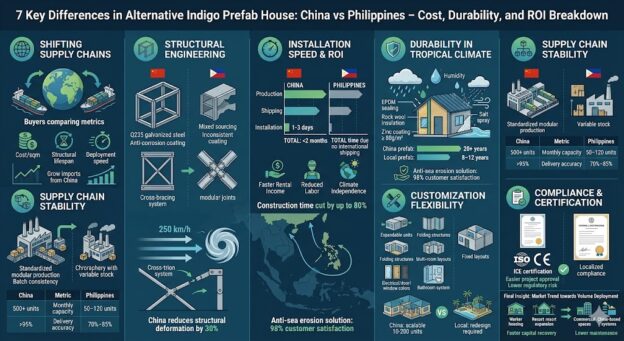
Importers in the Philippines are now comparing China prefab house vs Philippines prefab house across three hard metrics:

  • Cost per square meter
  • Structural lifespan under tropical conditions
  • Deployment speed for revenue generation

The shift is measurable. Chinese prefab exports to Southeast Asia have grown due to faster delivery cycles and stronger material standards.


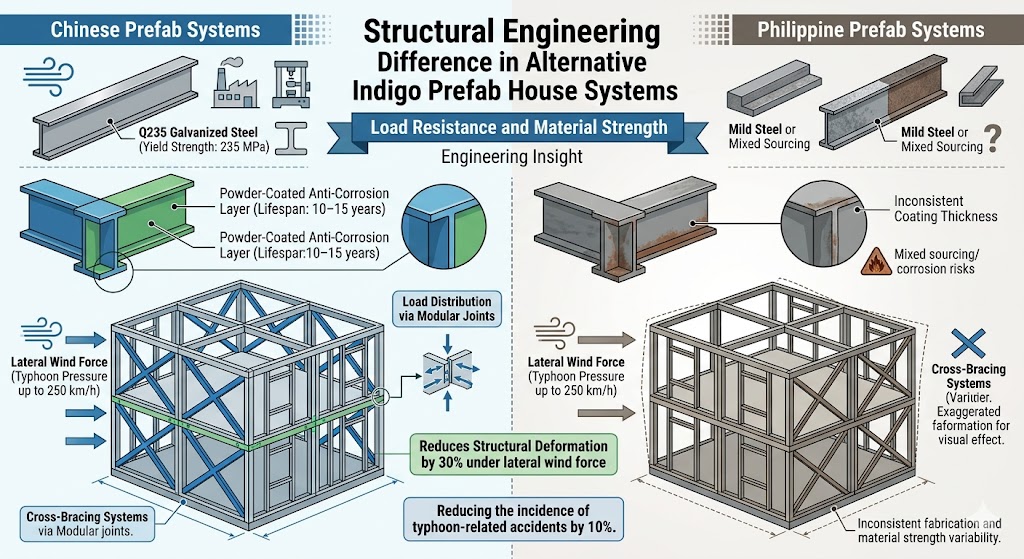
 2.Structural Engineering Difference in Alternative Indigo Prefab House Systems

Load Resistance and Material Strength

Chinese prefab systems use:

  • Q235 galvanized steel (yield strength: 235 MPa)
  • Powder-coated anti-corrosion layer (lifespan: 10–15 years)

Philippine prefab systems often use:

  • Mild steel or mixed sourcing
  • Inconsistent coating thickness

Engineering Insight

Wind load resistance in coastal Philippines can reach 250 km/h typhoon pressure.

Chinese prefab designs apply:

  • Cross-bracing systems
  • Load distribution via modular joints

This reduces structural deformation by 30% under lateral wind force.

Opting for prefabricated buildings from China—compared to those from the Philippines—can reduce the incidence of typhoon-related accidents by 10%.

 Alternative Indigo Prefab House structural frame diagram showing wind resistance design (Insert structural diagram of steel frame with load arrows)


3.Alternative Indigo Prefab House Installation Speed and ROI

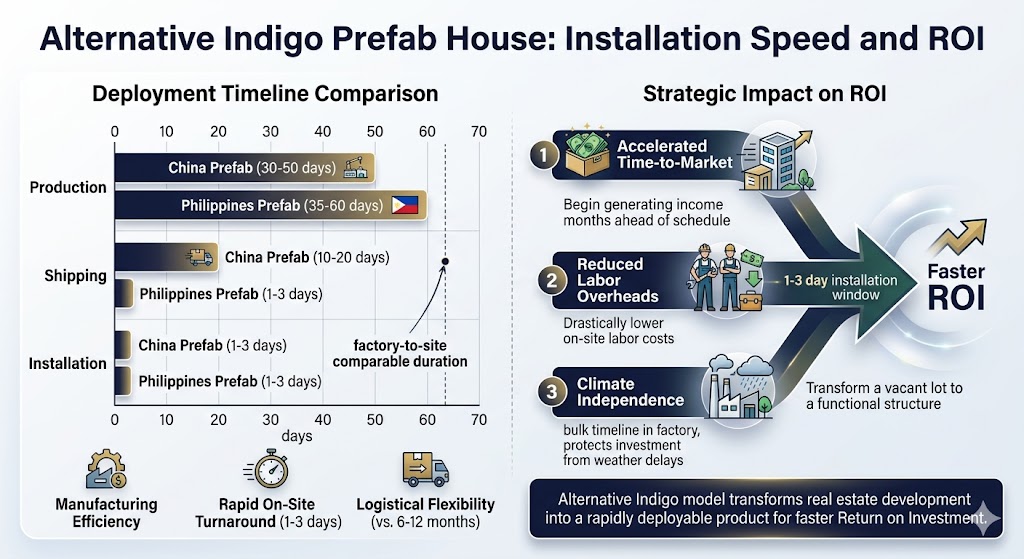
Deployment Timeline Comparison

Phase China Prefab Philippines Prefab
Production 30-50days  35-60days
Shipping 10-20 days 1-3 days
Installation 1-3 days 1-3days

Key Insights from the Data
Manufacturing Efficiency: Both regions maintain a relatively tight production window. While China Prefab has a slightly faster production floor (starting at 30 days), Philippines Prefab eliminates the need for international shipping, making the total “factory-to-site” duration comparable.

Rapid On-Site Turnaround: The most striking metric is the 1–3 day installation window. This “plug-and-play” capability allows a property to go from a vacant lot to a functional structure in less than a week, a feat impossible with traditional masonry or timber framing.

Logistical Flexibility: Despite the 5–10 day shipping lead time for units from China, the overall timeline remains under two months, which is significantly faster than the 6–12 months typical of conventional builds.

Strategic Impact on ROI
The efficiency shown in the table directly correlates to a faster Return on Investment (ROI) through three main factors:

Accelerated Time-to-Market: By cutting construction time by up to 80%, owners can begin generating rental income or occupying the space months ahead of schedule.

Reduced Labor Overheads: A 1–3 day installation drastically lowers the cost of on-site labor, security, and project management.

Climate Independence: Because the bulk of the timeline (30–60 days) occurs in a controlled factory environment, the investment is protected from weather-related delays, ensuring the project stays on budget and on schedule.

Conclusion
Whether sourcing from China for manufacturing scale or the Philippines for local logistical ease, the Alternative Indigo model offers a high-speed construction solution. It effectively transforms real estate development from a long-term construction project into a rapidly deployable product.

An infographic comparing the cost of Alternative Indigo prefab houses between China and the Philippines. The chart features a bar graph showing per square meter ($/m²$) costs for various factors:Structure (Steel Frame): Costs $35–$50 in China versus $60–$85 in the Philippines.Wall Panels: Costs $15–$25 in China versus $25–$40 in the Philippines.Total Cost: The total for China is $80–$120/m², while the Philippines is $130–$180/m².Technical Insights: Text notes indicate Chinese manufacturers use automated roll-forming machines to reduce steel waste by 12%–18%, whereas Philippine builders rely more on manual fabrication, leading to higher labor cost variability.


4.Alternative Indigo Prefab House Durability in Tropical Climate

Corrosion and Moisture Resistance

The Philippines has:

  • Humidity: 70%–90%
  • Salt exposure in coastal zones

Chinese prefab houses use:

  • EPDM sealing systems
  • Rock wool insulation (fire rating: A1)
  • Zinc coating ≥ 80g/m²

Philippine prefab houses often lack:

  • Standardized sealing systems
  • Consistent insulation density

Engineering Result

  • Chinese prefab lifespan: 20+ years
  • Local prefab lifespan: 8–12 years

Chinese suppliers, based on the local market and environment of the Philippines, will produce container houses that are suitable for the local environment of the Philippines. Our anti-sea erosion solution has resulted in a customer satisfaction rate of 98%.

Alternative Indigo Prefab House waterproof sealing system diagram with EPDM layers (Insert waterproofing detail illustration)


5.Supply Chain Stability for Alternative Indigo Prefab House Importers

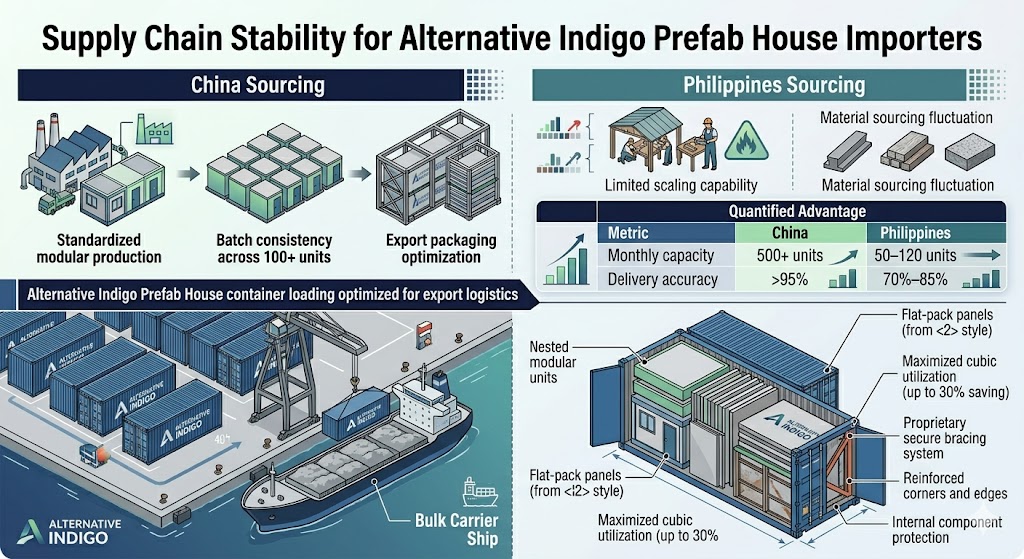
 Bulk Order Reliability

Chinese factories offer:

  • Standardized modular production
  • Batch consistency across 100+ units
  • Export packaging optimization

Philippine suppliers:

  • Limited scaling capability
  • Material sourcing fluctuation

Quantified Advantage

Metric China Philippines
Monthly capacity 500+ units 50–120 units
Delivery accuracy >95% 70%–85%

🚢 Visual Element

 Alternative Indigo Prefab House shipping container loading optimized for export logistics (Insert container loading diagram)


6.Customization Flexibility for Alternative Indigo Prefab House Projects

Modular Design Adaptation

Chinese prefab suppliers provide Complete customized solution :

  • Expandable units
  • Folding structures
  • Multi-room layouts
  • Electrical system, door and window colors
  • Bathroom system Security system

Philippine prefab suppliers focus on:

  • Fixed layouts
  • Limited modular expansion

Practical Scenario

For resort developers:

  • China prefab: scalable from 10 to 200 units
  • Local prefab: redesign required for scaling

7.Compliance and Certification Advantage

Engineering Standards

Chinese prefab houses are often built to meet:

  • ISO 9001 manufacturing standards
  • CE certification for structural components

Reference:
World Steel Association

Philippine prefab suppliers:

  • Limited international certification
  • More localized compliance

Result for Importers

  • Easier project approval
  • Faster government clearance
  • Lower regulatory risk

Final Insight: Where the Market Is Moving Next

AspectChina Prefab HousePhilippines Prefab HouseKey Advantage (China)
1Cost per m² & OverallLower material & production cost due to scaleHigher due to limited scale & import fluctuationsBetter cost efficiency & bulk pricing
2Structural DurabilityQ235 galvanized steel (235 MPa), powder-coated, ≥80g/m² zinc, cross-bracingMild steel, inconsistent coating30% less deformation in typhoons 20+ years lifespan vs 8–12 years
3Tropical Climate ResistanceEPDM sealing, Rock wool (A1 fire rating), anti-corrosion & anti-sea erosion solutionsOften lacks standardized sealing & consistent insulationSuperior humidity (70-90%) & salt resistance 98% customer satisfaction in PH conditions
4Installation SpeedProduction: 30-50 days Shipping: 10-20 days Installation: 1-3 daysProduction: 35-60 days Shipping: 1-3 days Installation: 1-3 daysTotal timeline comparable or faster Up to 80% faster than traditional builds
5ROI & Time-to-RevenueFaster capital recovery due to speed & durabilitySlower due to maintenance & potential repairsEarlier rental income, lower labor/overheads, weather-independent production
6Supply Chain & Scalability500+ units/month capacity >95% delivery accuracy Standardized batch production50–120 units/month 70–85% delivery accuracy Material fluctuationsHigh reliability for bulk orders & resort/infrastructure projects
7Customization & ComplianceFull modular (expandable, folding, multi-room, electrical, bathroom, security) ISO 9001, CE certificationFixed layouts, limited expansion Localized complianceEasier scaling (10→200 units), faster approvals, lower regulatory risk

The Alternative Indigo Prefab House market in the Philippines is entering a scale phase.

Developers are no longer testing prefab—they are deploying at volume:

  • Worker housing for infrastructure projects
  • Resort expansion in coastal zones
  • Temporary commercial spaces

China-based prefab systems are positioned to dominate due to:

  • Faster capital recovery cycles
  • Higher structural consistency
  • Lower long-term maintenance cost

The next shift is already visible:
Importers are moving from single-unit procurement to containerized bulk purchasing strategies, locking in cost advantages before steel prices rise again.

The question is no longer whether to switch supply—it is how fast you can secure a supplier before your competitors reduce their unit cost by 30%.

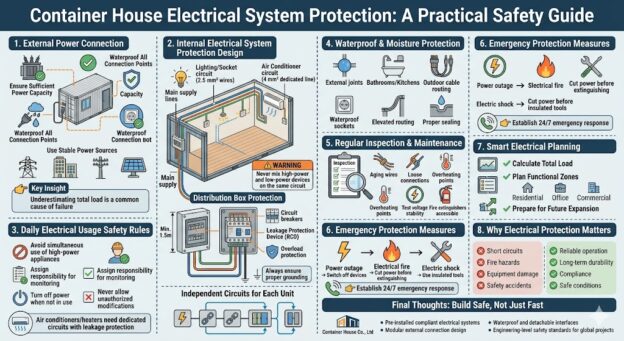
This comprehensive infographic, titled "Container House Electrical System Protection: A Practical Safety Guide," provides a structured engineering roadmap for securing modular structures. It details critical safety phases including external power connection requirements like waterproofing and load capacity verification, internal wiring standards such as using specific copper wire gauges for different appliance loads, and the essential components of a distribution box. The guide further emphasizes operational safety through daily usage rules, moisture protection strategies for high-risk areas like bathrooms, and a regular maintenance checklist to detect aging wires or overheating. Finally, it outlines emergency protocols for fires or shocks and highlights the importance of smart planning to ensure long-term durability and regulatory compliance for global container projects.

Container house electrical system protection notes

Container House Electrical System Protection: A Practical Safety Guide for Real Projects

Container houses are widely used in construction sites, labor camps, modular offices, and even residential applications due to their mobility, cost-efficiency, and fast deployment. However, temporary structures do not mean temporary safety standards—especially when it comes to electrical systems. In this guide, we’ll break down how to implement reliable container house electrical system protection, based on real-world installation experience and practical engineering standards.


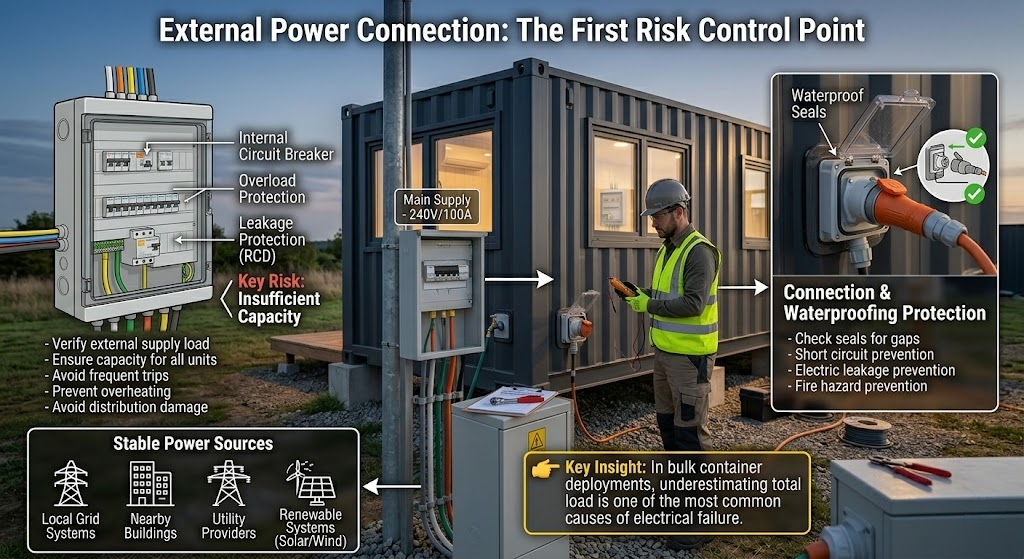
1. External Power Connection: The First Risk Control Point

Most container houses rely on external water and electricity connections. Once the container is placed in position, it can be operational by connecting it to nearby power and water sources.

However, several critical protection measures must be followed:

  • Ensure sufficient power capacity
    Before connecting, verify that the external power supply can handle the total load of all container units. Insufficient capacity may lead to:
    • Frequent circuit breaker trips
    • Overheating
    • Damage to distribution systems
  • Waterproof all connection points
    Poor sealing at interfaces can cause:
    • Short circuits
    • Electric leakage
    • Fire hazards
  • Use stable power sources
    Electricity can be sourced from:
    • Local grid systems
    • Nearby buildings
    • Utility providers
    • Renewable systems (solar or wind)

👉 Key Insight: In bulk container deployments, underestimating total load is one of the most common causes of electrical failure.

An infographic detailing external power connection safety and waterproofing measures for container houses.


2. Internal Electrical System Protection Design

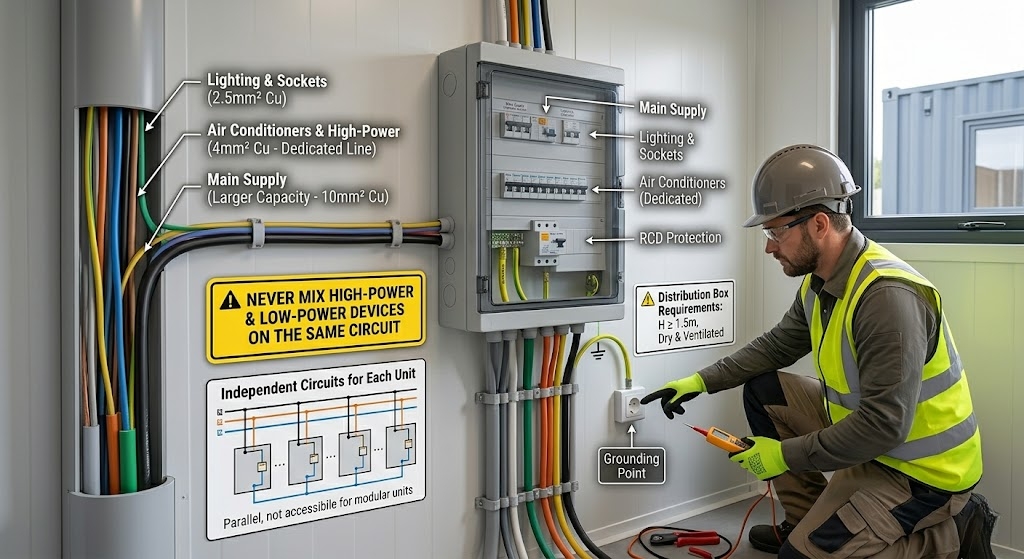
2.1 Proper Wiring Standards

A safe container house must follow structured wiring rules:

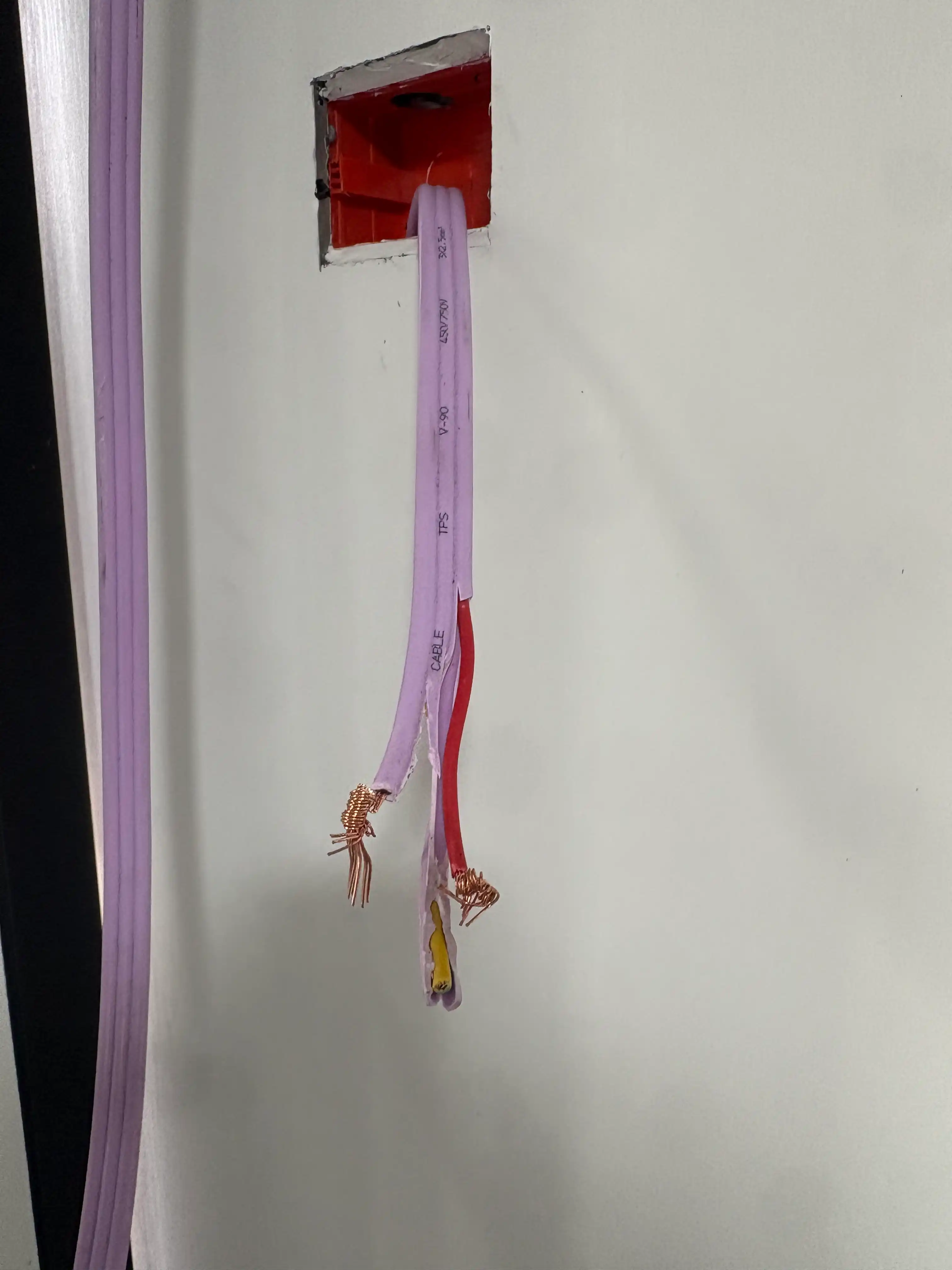
  • Lighting & socket circuits: 2.5 mm² copper wires
  • Air conditioners & high-power equipment: 4 mm² dedicated lines
  • Main supply lines: Larger capacity cables based on load

⚠️ Never mix high-power and low-power devices on the same circuit.


2.2 Independent Circuits for Each Unit

For modular container projects:

  • Each container should have independent main power access
  • Use parallel connections, not series connections
  • External connection points must remain accessible

This ensures:

  • One unit can be removed or relocated without affecting others
  • Stable power distribution across the system

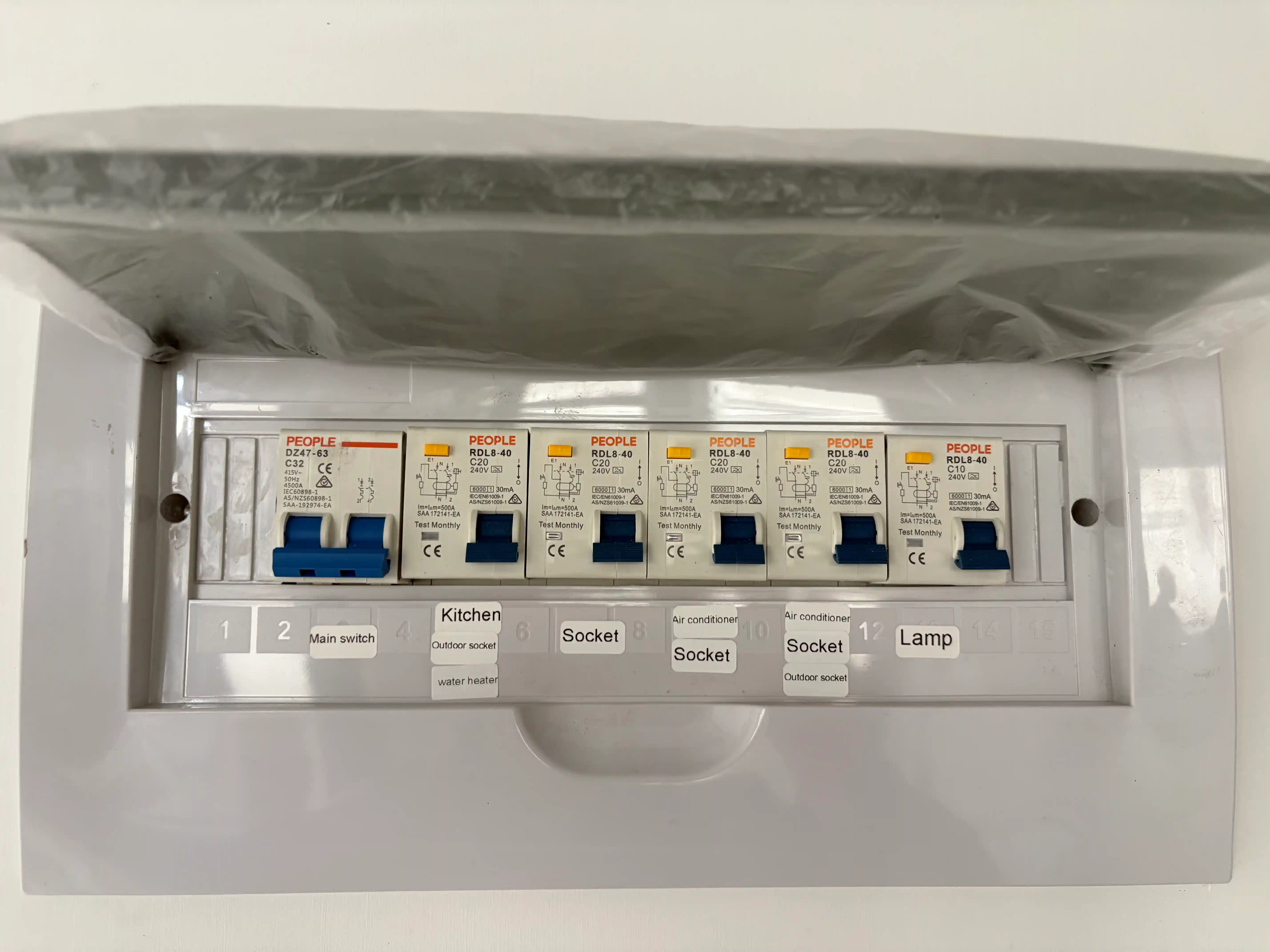
2.3 Distribution Box Protection

The distribution box is the core of electrical safety.

Installation standards:

  • Height ≥ 1.5 meters above ground
  • Installed in dry, ventilated areas
  • Equipped with:
    • Circuit breakers
    • Leakage protection devices (RCD)
    • Overload protection

👉 Always ensure proper grounding to prevent electric shock risks.

A realistic infographic showing internal wiring standards and distribution box safety for a container house.


3. Daily Electrical Usage Safety Rules

Even with a well-installed system, misuse can cause failure.

Best practices:

  • Avoid simultaneous use of multiple high-power appliances
  • Assign responsibility for daily power monitoring
  • Turn off power when not in use
  • Never allow unauthorized wiring modifications

Special note:

  • Air conditioners and heaters must have dedicated circuits with leakage protection

4. Waterproof & Moisture Protection

Water and electricity are the biggest combined risk in container houses.

Focus areas:

  • External connection joints
  • Bathrooms and kitchens
  • Outdoor cable routing

Protection methods:

  • Waterproof sockets and junction boxes
  • Elevated cable routing
  • Proper sealing with EPDM or similar materials

5. Regular Inspection & Maintenance

A strong system still requires ongoing monitoring.

Inspection checklist:

  • Weekly full electrical inspection
  • Check for:
    • Aging wires
    • Loose connections
    • Overheating points
  • Test voltage stability (typically around 220V ±10%)
  • Ensure fire extinguishers are accessible

6. Emergency Protection Measures

Electrical failures must be handled immediately and correctly:

  • Power outage → Switch off all devices
  • Electrical fire → Cut power before extinguishing
  • Electric shock → Use insulated rescue tools only

👉 Establish a 24/7 emergency response system for large-scale projects.


7. Smart Electrical Planning for Container Projects

Before installation, always:

✔ Calculate Total Load

  • Typical container unit load: ≤ 8kW recommended

✔ Plan Functional Zones

  • Residential: lighting, sockets, appliances
  • Office: computers, printers, networking
  • Commercial: equipment-specific requirements

✔ Prepare for Future Expansion

  • Reserve extra capacity in distribution systems
  • Plan scalable wiring layouts

8. Why Electrical Protection Matters in Container Houses

Improper electrical systems can lead to:

  • Short circuits
  • Fire hazards
  • Equipment damage
  • Safety accidents

A well-designed system ensures:

  • Reliable operation
  • Long-term durability
  • Compliance with local regulations
  • Safe living and working conditions

Final Thoughts: Build Safe, Not Just Fast

SectionKey PointsPractical Recommendations
1. External Power ConnectionFirst and most critical risk point• Verify sufficient power capacity before connecting • Waterproof all connection points • Use stable power sources (grid, generator, or solar)
2. Internal Electrical DesignProper wiring and circuit planning• Lighting & sockets: 2.5 mm² copper wire • Air conditioners & high-power devices: 4 mm² dedicated lines • Each container must have independent circuits • Never mix high and low-power devices on the same circuit
3. Distribution BoxCore of electrical safety• Install at ≥ 1.5m height • Must include circuit breakers, RCD (leakage protection), and overload protection • Ensure proper grounding
4. Waterproof & Moisture ProtectionPrevent water-related electrical hazards• Use waterproof sockets and junction boxes • Elevate cable routing • Seal all joints with EPDM or equivalent materials • Pay special attention to bathrooms and kitchens
5. Daily Safety RulesAvoid misuse and accidents• Avoid using multiple high-power appliances simultaneously • Turn off power when not in use • No unauthorized wiring modifications • Assign daily power monitoring responsibility
6. Regular Inspection & MaintenanceOngoing safety assurance• Weekly electrical inspections • Check for aging wires, loose connections, and overheating • Test voltage stability (220V ±10%) • Keep fire extinguishers accessible
7. Emergency MeasuresQuick and correct response• Power outage: Switch off all devices • Electrical fire: Cut power first • Electric shock: Use insulated tools only • Set up 24/7 emergency response for large projects
8. Smart Planning TipsBefore installation• Calculate total load (recommended ≤ 8kW per unit) • Plan for future expansion • Reserve extra capacity in the distribution system

Container houses are fast to deploy—but electrical safety cannot be rushed.

At Container House Co., Ltd, we emphasize:

  • Pre-installed compliant electrical systems
  • Modular external connection design
  • Waterproof and detachable interfaces
  • Engineering-level safety standards for global projects

If you’re planning a container housing project, electrical system protection should be part of your core procurement checklist—not an afterthought.

Electrical issues must be carefully considered in container houses.

Expandable Container house circuit and wire system solution

Expandable Container House Circuit and Wire System Solution

Contractors during project construction, decorators during home renovation, and residents during home occupancy all pay attention to one crucial question: Is there a reliable power supply? Compared to the mature electrical systems of traditional concrete houses, the electrical and wiring systems of container houses require even more precision, planning, and standardization. This article will introduce the key precautions and proven solutions for designing a safe, durable, and efficient expandable container house circuit system—especially in large-scale or export-oriented projects.


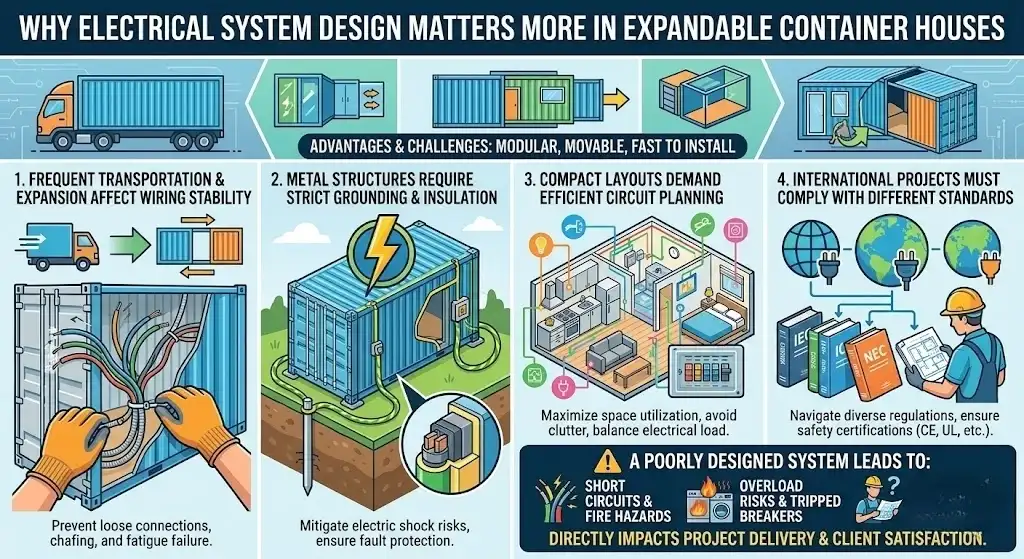
1. Why Electrical System Design Matters More in Expandable Container Houses

Expandable container houses are modular, movable, and fast to install. However, these advantages also introduce specific challenges:

  • Frequent transportation and expansion can affect wiring stability
  • Metal structures require stricter grounding and insulation measures
  • Compact layouts demand efficient circuit planning
  • International projects must comply with different electrical standards

A poorly designed system can lead to short circuits, overload risks, or maintenance difficulties—issues that directly impact project delivery and client satisfaction.

Wiring Stability: Illustrates how frequent transportation and the mechanical expansion of the house can lead to loose connections or fatigue failure in the wiring. Grounding and Insulation: Highlights the necessity of strict grounding measures for metal structures to prevent electric shocks and ensure fault protection. Circuit Planning: Shows a 3D cutout of a compact interior layout, emphasizing the need for efficient load balancing and space-saving electrical planning. International Standards: Displays various global electrical codes (like NEC, IEC) and certifications (CE, UL) required for cross-border projects. The bottom of the infographic features a warning banner stating that poor design leads to short circuits, fire hazards, and maintenance difficulties, ultimately affecting client satisfaction.


2. Challenges in Large-Scale Container House Projects

In small installations, wiring management is relatively straightforward. However, in large-scale and wide-area container house deployments, such as construction site camps or temporary worker accommodations, electrical systems often become significantly more complex.

Due to the high density of units and fast-paced installation schedules, it is common to encounter:

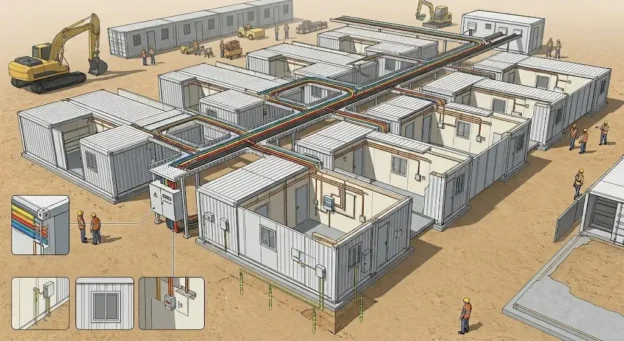
  • Disorganized cable routing between units
  • Overlapping temporary wiring solutions
  • Lack of unified cable management standards
  • Different national standards
  • Wire protection and waterproof function

This kind of circuit disorder has a direct and measurable impact on system reliability. Based on practical project experience, unstructured wiring can increase electrical failure rates, delay maintenance response, and even create safety hazards.


3.  Wire Standardization Solution

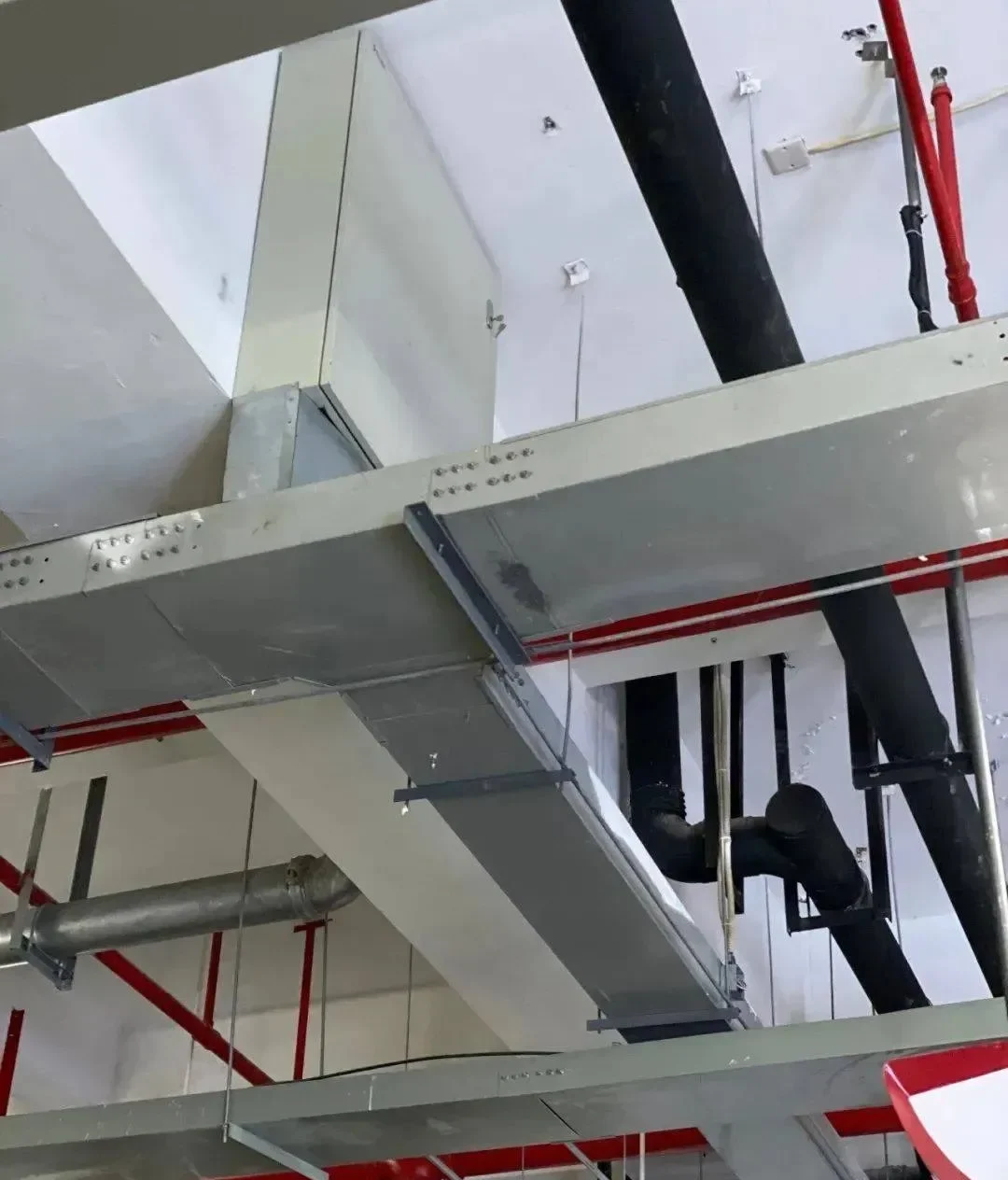
To address these challenges, implementing a cable tray system is essential in large container housing projects.Neglecting wiring will result in messy and disorganized wiring, increasing the likelihood of electrical problems in your home by 5%-11%.

Messy wiring makes it difficult for electricians to inspect and repair circuits and to detect problems.

3.1 Why Cable Trays Are Necessary

Cable trays provide a structured pathway for all power and communication lines, ensuring:

  • Clear separation of circuits
  • Organized routing across multiple units
  • Reduced mechanical damage to cables
  • Improved heat dissipation

More importantly, standardized cable management can reduce up to 8% of failures caused by disorganized wiring, significantly improving overall system stability.


3.2 Cable tray Application in Construction Site Projects

In construction site scenarios, where container houses are widely distributed:

  • Main power lines can be routed through elevated cable trays
  • Branch circuits can be distributed to each unit in an orderly manner
  • Maintenance teams can quickly identify and access specific lines

This approach transforms a chaotic wiring environment into a structured, manageable electrical network.

Cable trays facilitate the smooth installation of electrical circuits in buildings.

3.3 YDX Cable Tray Factory – Cable Tray Solution Provider

Recognizing the importance of cable trays for expandable container houses, we carefully considered YDX Cable Tray Factory’s extensive global project production experience, global certifications, and professional quality control and production teams. Ultimately, we chose YDX Cable Tray Factory as our partner to supply cable trays.

After partnering with them, YDX Cable Tray Factory and our technical team communicated extensively to jointly provide wire protection and storage solutions for container houses. Since the start of our collaboration, we have jointly participated in 22 container house wire protection and storage projects in 7 countries worldwide. 95% of our clients are very satisfied with our solutions. 5% of our clients provided us with improvement suggestions based on their specific local market needs.

“I’ve purchased many container houses before. Some suppliers didn’t pay attention to electrical and wiring issues, creating potential problems for our subsequent distribution. However, through multiple communications with YDX, gkcpro’s cable tray and container manufacturing teams, I’ve obtained a satisfactory solution and container houses. I’ve now purchased over 30 container houses without receiving any customer complaints. I’m very satisfied and grateful to the YDX and gkcpro teams.”-Harper Darlene Japan

3.4 Other wire protection

For indoor wiring, we also use various methods such as junction boxes and cable ties to ensure proper wiring in the container houses, thereby improving their power efficiency.


4. Core Design Principles of an Expandable Container House Circuit

The electrical system is a crucial factor in container housing. We thoroughly inspect the electrical system before the container houses leave the factory. To ensure a reliable and scalable expandable container house system, every expandable container house circuit should follow these principles:

4.1 Standardized Pre-Installation

All wiring should be pre-planned for installation in a factory-controlled environment, with wiring either pre-installed or spaced in advance. The factory’s technical and production teams will be responsible for this work. This ensures:

Stable quality

Reduced on-site construction work

Speedier installation

Modular and standardized design

At our container housing company, our designs integrate cable trays directly into the wall panels, avoiding exposed cables and thus improving safety.


4.2 Modular Circuit Layout

Expandable container houses rely on modular expansion. Therefore, the circuit system must also be modular:

  • Independent circuits for lighting, sockets, and high-power equipment
  • Quick-connect interfaces for expansion sections
  • Reserved wiring ports for future upgrades
  • Custom wiring harness systems with quick-connect interfaces for seamless expansion sections

Our design and production team ensured that every container house, from blueprints to production, had wiring pre-installed in each room. This approach allows contractors to scale projects without rewiring the entire system.


4.3 Load Calculation and Distribution

Proper load calculation is essential to avoid overload or power failure. A typical configuration includes:

  • Lighting circuit: 1.5 mm² copper wires
  • Socket circuit: 2.5 mm² copper wires
  • Air conditioning / heavy equipment: 4–6 mm² copper wires

Each circuit should be protected by dedicated breakers to ensure safe operation.


5. Wiring System Structure and Materials

5.1 High-Quality Copper Wiring

We recommend using flame-retardant, high-conductivity copper wires to ensure:

  • Stable current transmission
  • Low energy loss
  • Long service life

Choosing high-quality raw materials can fundamentally prevent circuit problems.


5.2 Concealed Wiring Design

All wiring should be installed inside wall panels or ceiling structures:

  • Protects wires from physical damage
  • Improves aesthetic appearance
  • Reduces exposure to moisture and dust

A well-designed container house wiring system can prevent 10% of power outages caused by electrical problems.


5.3 Waterproof and Weather-Resistant Components

Expandable container houses are often used in construction sites, resorts, or remote areas. Therefore:

  • Use IP-rated waterproof sockets and switches
  • Apply sealed cable conduits
  • Ensure junction boxes are moisture-proof

This is especially critical for projects in tropical or high-humidity regions.


6. Grounding and Safety Protection System

Because container houses use steel structures, grounding is not optional—it is mandatory.

6.1 Reliable Grounding System

  • Connect the steel frame to a grounding electrode
  • Ensure resistance meets local standards
  • Use multi-point grounding for large units

6.2 Circuit Protection Devices

A complete expandable container house circuit must include:

  • Miniature Circuit Breakers (MCB)
  • Residual Current Devices (RCD)
  • Surge Protection Devices (SPD)

These components prevent electric shock, overload, and voltage spikes.

We have equipped each room with a complete circuit breaker to ensure the proper functioning of the electrical circuits in each room.

Each container house is equipped with a circuit breaker. This ensures that the electrical circuits in each room are functioning correctly.


7. Adaptation to International Standards

For export projects, electrical systems must comply with local regulations such as:

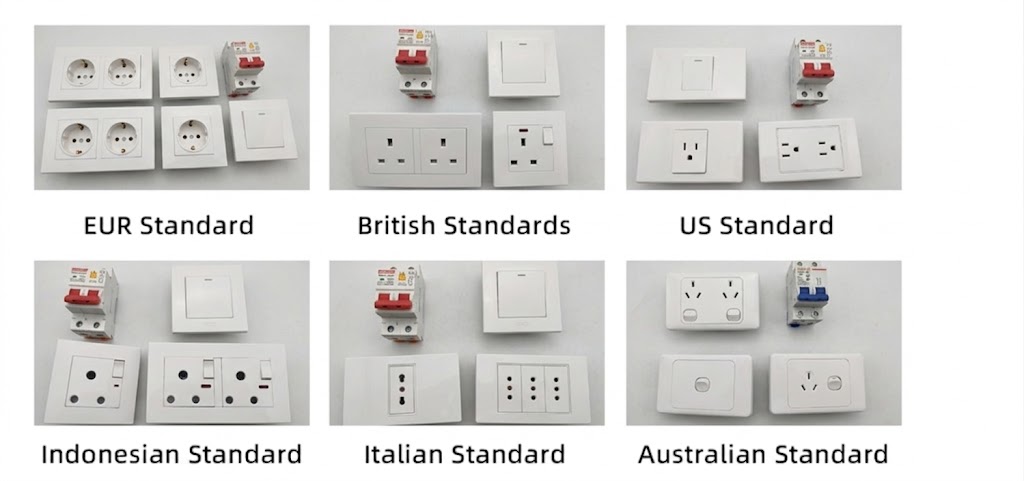
  • Voltage differences (110V / 220V / 240V)
  • Plug and socket types
  • Certification requirements (CE, UL, etc.)

Different plug standards in different countries and regions

Container House Co., Ltd provides customized electrical configurations based on destination markets, ensuring smooth customs clearance and immediate usability upon installation.


8. Installation and Maintenance Considerations

8.1 Simplified On-Site Installation

Our pre-installed systems allow:

  • Plug-and-play connections
  • Minimal electrician involvement
  • Reduced installation errors

When connecting an external power source, ensure that the power output of the external power source meets the actual power consumption of all container houses on the construction site. Avoid tripping or damaging the power switch due to insufficient power.


8.2 Easy Maintenance Access

  • Centralized distribution box design
  • Clearly labeled circuits
  • Accessible inspection points

Combined with structured cable tray systems, this greatly improves maintenance efficiency in large-scale deployments.

9.Precautions for the use and installation of electrical circuits in container houses

Container house electrical safety must adhere to rigorous engineering standards. Effective protection begins at the external connection point, requiring verified power capacity, waterproofed interfaces, and stable sourcing to prevent system overloads. Internally, the system must utilize standardized copper wiring (2.5–4 mm²) with independent circuits and dedicated RCD-protected distribution boxes for each unit to ensure modular reliability. Beyond hardware, safety is maintained through strict usage protocols—such as avoiding simultaneous high-power appliance use and ensuring proper grounding—coupled with moisture-proofing and regular maintenance checks. Ultimately, integrating smart load planning and emergency response measures ensures that these versatile structures remain fire-safe, compliant, and durable for long-term residential or commercial use.


Conclusion

The expandable container house is not just a structural innovation—it requires equally advanced electrical planning. A professional expandable container house circuit solution must combine modular design, safety standards, and adaptability to global markets.

In particular, for large-scale construction site projects, standardizing cable management through cable tray systems is no longer optional—it is a critical factor in reducing failure rates, improving safety, and ensuring long-term operational efficiency.

For contractors, distributors, and project developers, choosing a manufacturer with proven experience in integrated electrical systems is essential. With factory pre-installation, high-quality materials, and structured wiring solutions, Container House Co., Ltd ensures that every unit is delivered ready for safe, efficient, and scalable use.

Alternative express portables/Latest options for sourcing expandable homes in Australia

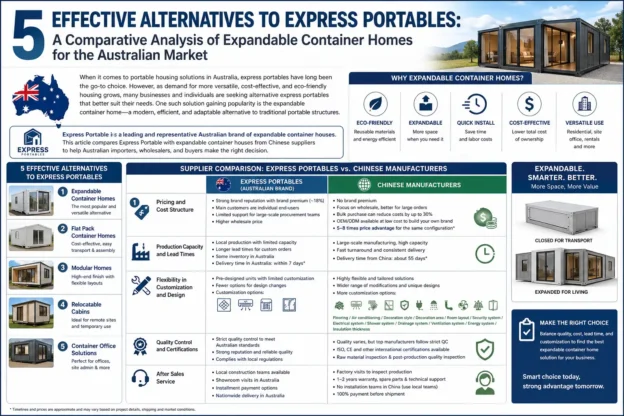
5 Effective Alternatives to Express Portables: A Comparative Analysis of Expandable Container Homes for the Australian Market

When it comes to portable housing solutions in Australia, express portables have long been the go-to choice. However, as demand for more versatile, cost-effective, and eco-friendly housing grows, many businesses and individuals are seeking alternative express portables that better suit their needs. One such solution gaining popularity is the expandable container home—a modern, efficient, and adaptable alternative to traditional portable structures.

Express Portable is a leading and representative Australian brand of expandable container houses. This article will provide a detailed comparison between Express Portable and expandable container houses from Chinese suppliers.We will explore the alternative express portables, specifically focusing on the comparison between express portables and the innovative expandable container homes. This analysis will provide Australian importers, wholesalers, and buyers with valuable insights into which solution is more suitable for their needs.

Supplier Comparison: Express Portables vs. Chinese Manufacturers

1.Pricing and Cost Structure

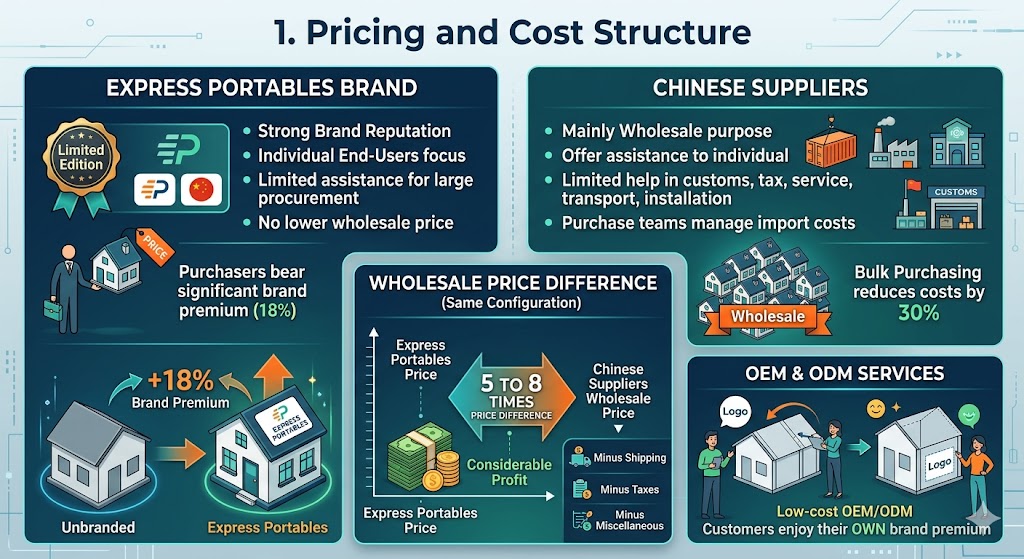
Express Portables enjoys a strong brand reputation. To purchase the expandable container house of the Express Portable brand, one needs to bear the brand premium of this company.

The main customer group of Express Portables is individual end-users. They can provide assistance to personal service providers, but their help is limited for procurement teams that place large-scale orders. Cannot offer a lower wholesale price

Express Portables is purchased by the brand as a supplier and then resold. Compared with the unbranded expandable container house, it will increase the brand’s premium by 18%.

The expandable container houses produced by Chinese suppliers do not have brand recognition, so the purchasers do not need to pay for brand premiums.

The expandable container houses produced by Chinese suppliers are mainly used for wholesale purposes. They can offer assistance to individual service providers, but their help in the processes such as customs clearance, tax payment, transportation and installation is rather limited. The purchasing team for large-scale purchase orders is familiar with the import process and can control the import costs. Compared with low-volume purchasing, bulk purchasing can reduce costs by 30%.

Chinese suppliers do not have large “expandable container house” brands. However, they can provide OEM and ODM services at a low cost to customers, allowing customers to enjoy the brand premium brought by their own brands.

After comparing our selling price with that of expressportables, we found… The price difference between the wholesale prices of houses from Chinese suppliers and those of Expressportables for the same configuration is 5 to 8 times. Even after deducting shipping costs, taxes, and other miscellaneous expenses, the profit from purchasing expandable container houses in large quantities from Chinese suppliers is still considerable.

An infographic titled '1. Pricing and Cost Structure' comparing Express Portables Brand and Chinese Suppliers. The left side highlights Express Portables' high brand premium (18% markup) and focus on individual end-users. The right side shows Chinese Suppliers focusing on wholesale, bulk purchasing discounts of 30%, and OEM/ODM services. A central chart illustrates a 5 to 8 times price difference between the two, noting that even after shipping and taxes, Chinese wholesale remains highly profitable

2.Production Capacity and Lead Times

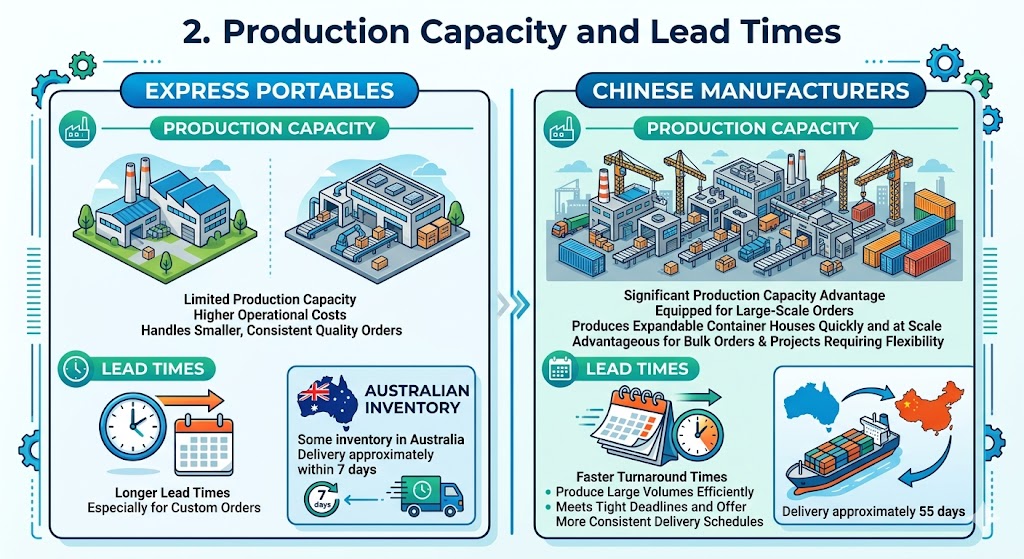
When it comes to production capacity, Chinese manufacturers often have a significant advantage. Their manufacturing facilities are equipped to handle large-scale orders, meaning they can produce expandable container houses quickly and at scale. This is particularly advantageous for bulk orders and projects that require flexibility.

  • Express Portables: While Express Portables is a reliable supplier with consistent quality, their production capacity may be more limited due to the higher operational costs associated with local production. Additionally, their lead times can be longer, especially for custom orders. Express Portables will be some inventory in Australia; if product delivery is tight, you can choose express portable Delivery time in Australia is approximately within 7 days.


  • Chinese Manufacturers: Chinese suppliers, particularly those with established export networks, can provide faster turnaround times. Their ability to produce large volumes efficiently allows them to meet tight deadlines and offer more consistent delivery schedules.The delivery time for the expandable container house from the Chinese supplier is approximately 55 days.

Comparison of production capacity and lead times between Express Portables and Chinese manufacturers.

3.Flexibility in Customization and Design

Both Express Portables and Chinese manufacturers offer customizable options for their expandable container houses, but the level of flexibility can vary.

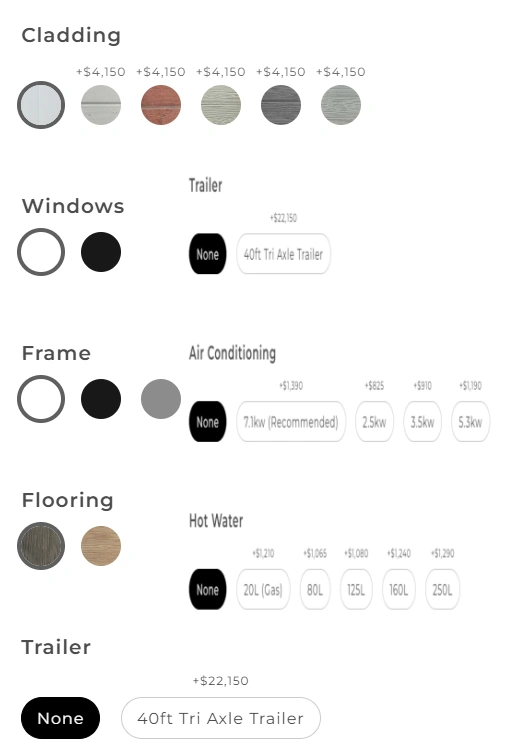
  • Express Portables: Known for offering high-quality pre-designed units with some level of customization. However, their flexibility in terms of design changes or additional features can sometimes be limited by their set manufacturing processes.

Customization options:

expressportables custom option list

  • Chinese Manufacturers: Typically more flexible when it comes to customization. Chinese manufacturers are accustomed to creating tailor-made solutions for various global markets, which allows them to offer a wider range of modifications and unique designs. This is especially beneficial for businesses looking to stand out with customized features or non-standard sizes.
  • Chinese manufacturer Customization options:flooring/air conditioning/Decoration style/ decoration area/room layout/Security system / Electrical system / Shower system / Drainage system / Ventilation system / Energy system / Insulation thickness

By choosing Chinese suppliers, purchasing customers can select more customization options for better use.

For Australian buyers looking for more versatile solutions, Chinese manufacturers can provide more tailored, personalized options that meet specific needs.

4.Quality Control and Certifications

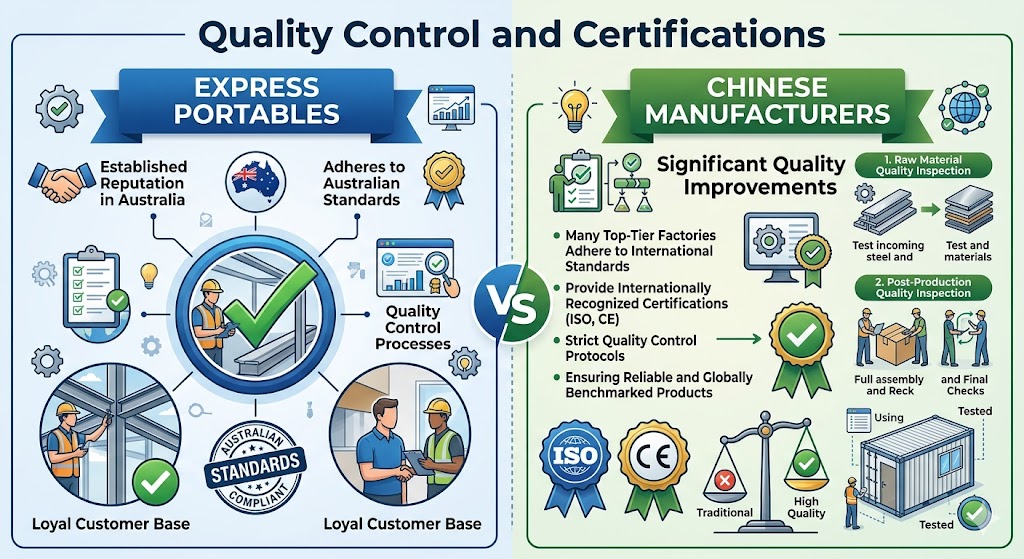
While Express Portables has established a reputation for providing high-quality products that adhere to Australian standards, Chinese manufacturers have made significant improvements in quality control over the years. Many top-tier Chinese factories now adhere to international standards, including ISO certifications and CE approvals, ensuring that their products meet global benchmarks.

  • Express Portables: With a focus on maintaining a strong reputation in Australia, Express Portables ensures all products meet local regulations and industry standards. Their quality control processes are robust, which is why they have a loyal customer base.
  • Chinese Manufacturers: The quality can vary significantly depending on the manufacturer. However, many leading Chinese suppliers now adhere to strict quality control protocols and provide internationally recognized certifications, ensuring that their expandable container houses are as reliable as those from established suppliers like Express Portables.Many factories now have raw material quality inspection and post-production quality inspection.

This detailed infographic provides a side-by-side comparison of "Express Portables" and "Chinese Manufacturers" across several categories. At the top, a section on "Production Capacity and Lead Times" shows that Chinese manufacturers offer a higher production capacity for large-scale orders but with a 55-day delivery time, compared to Express Portables, which has limited capacity and longer custom lead times, but a fast 7-day delivery option from Australian inventory. Below that, under "Pricing and Cost Structure," it is shown that Chinese suppliers offer significant savings through a wholesale model, being 5-8 times cheaper than the high brand premium pricing of Express Portables, while also offering low-cost OEM/ODM services. At the bottom, under "Quality Control and Certifications," the graphic shows Express Portables adhering to Australian standards, while highlighting that many Chinese factories have significantly improved quality through international ISO and CE certifications, strict raw material inspections, and post-production quality checks.

5.After sale about express portables vs Alternative express portables

express portables can provide construction team services to carry out construction on the project site. Australian customers can book an appointment to visit the showroom in person.Installment payment options available. Nationwide delivery in Australia.

Chinese suppliers are available to visit the production line to better understand how your purchase orders are manufactured. Chinese suppliers can provide 1-2 years of warranty service, mail spare parts, and provide technical support.However, there are no suitable installation teams in China, so customers need to find experienced local installation teams to carry out the work.Chinese suppliers require buyers to pay in full before shipment, which puts a certain financial burden on buyers.

A comparison infographic titled 'After Sale Services: Express Portables vs. Alternative Chinese Suppliers.' The left side shows Express Portables' benefits: on-site construction teams, local showroom visits in Australia, installment payment options, and nationwide Australian delivery. The right side shows Chinese Suppliers' offerings: production line visits, 1-2 years of warranty with technical support, and the requirement for customers to find their own local installation teams. It also notes that Chinese suppliers require full payment before shipment, creating a higher upfront financial commitment compared to the installment options of the Australian brand

Conclusion: Making the Right Choice for Your Business

Comparison CriteriaExpress Portables (Australian Brand)Chinese Expandable Container Homes (Wholesale)Winner / Advantage
Pricing & Cost StructureHigher price due to brand premium (+18%) Best for end-users5–8 times cheaper at wholesale level Significant savings even after shipping & taxesChinese Suppliers (Much lower cost)
Bulk Purchase DiscountLimited wholesale discountUp to 30% cost reduction through bulk orderingChinese Suppliers
Production CapacityLimited capacityVery High – designed for large-scale ordersChinese Suppliers
Lead Time / DeliveryFast local delivery (~7 days if in stock)Approximately 55 days from orderExpress Portables (Faster)
Customization FlexibilityModerate – limited by standard designsExtremely High (Flooring, AC, layout, electrical, insulation, decoration style, security, etc.)Chinese Suppliers
Quality ControlConsistent, meets Australian standardsVaries by factory; Top manufacturers offer ISO, CE and strict QCExpress Portables (More consistent)
CertificationsDesigned to comply with Australian regulationsISO, CE, and international standards availableTie (Depends on factory)
After-Sales SupportLocal installation team available Showroom visits Installment payment1–2 years warranty, spare parts, technical support Factory visitsExpress Portables (Local support)
Payment TermsMore flexible (installment options)Full payment required before shipmentExpress Portables
Brand & ReputationStrong local brand recognitionNo brand premium – supports OEM/ODM for your own brandingExpress Portables (Brand) / Chinese (OEM)
Best Suitable ForIndividual buyers, small projects, fast local deliveryImporters, wholesalers, large-scale projects, cost-conscious buyersDepends on buyer’s priority

Both Express Portables and Chinese manufacturers offer expandable container houses with their respective strengths. Express Portables is a trusted supplier known for high-quality products and local reliability, making it a great option for businesses looking for consistent, Australian-made solutions. However, for those looking to reduce costs, improve lead times, and access more customizable options, Chinese manufacturers provide a compelling alternative express portables.

By carefully considering factors like pricing, production capacity, customization, and shipping logistics, Australian importers and wholesalers can make a more informed decision about which supplier is best suited to their needs. Whether you prioritize quality, cost-effectiveness, or flexibility, Chinese manufacturers are increasingly proving to be a strong competitor in the market for expandable container houses.

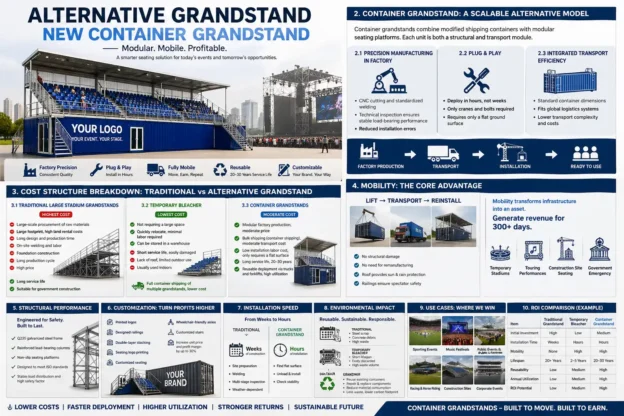
A comprehensive infographic titled 'Alternative Grandstand: New Container Grandstand,' showcasing a modular, mobile, and profitable seating solution. The image features a large blue containerized grandstand with 'YOUR LOGO' and details its advantages over traditional stadium seating and temporary bleachers. Key sections include a cost structure breakdown (showing container systems as a moderate-cost, high-value middle ground), mobility workflows (Lift-Transport-Reinstall), and structural performance highlights. It compares installation speed—reducing weeks of construction to just hours—and provides an ROI table illustrating superior lifespan (20-30 years), reusability, and annual utilization. Use cases include sporting events, music festivals, racing, and corporate events, emphasizing the core value proposition: Lower costs, faster deployment, and higher returns

Alternative Grandstand: Why Buyers Are Moving Away from Traditional Systems

Alternative Grandstand-new container grandstand

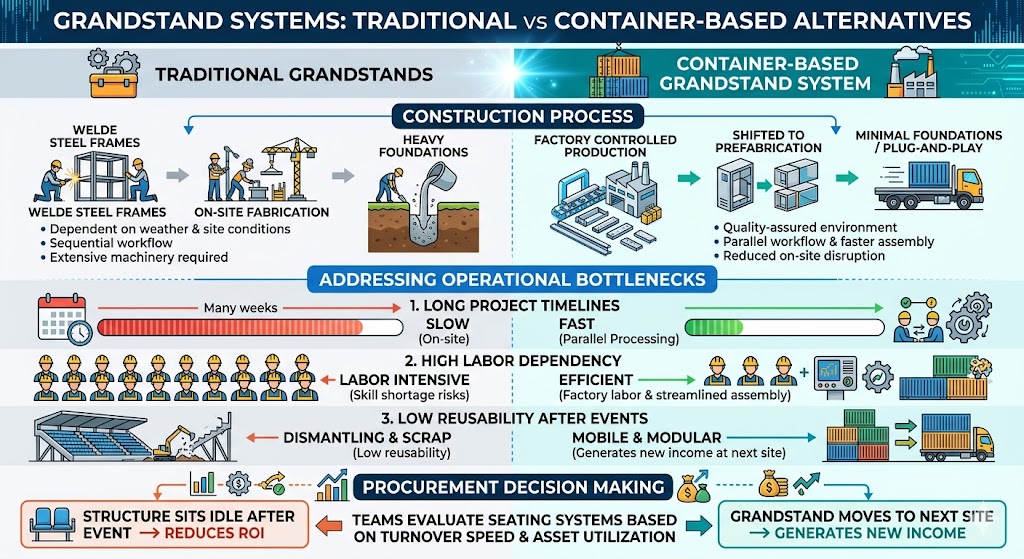
an alternative grandstand such as a container-based system removes these constraints by shifting production into a controlled factory environment.

Traditional grandstands rely on welded steel frames, on-site fabrication, and heavy foundations. That model creates three operational bottlenecks:

  • Long project timelines
  • High labor dependency
  • Low reusability after events

alternative grandstand comparison showing container grandstand vs traditional steel structure differences

Procurement teams now evaluate seating systems based on turnover speed. A structure that sits idle after one event reduces ROI. A container grandstand moves to the next site and generates new income.

This article compares container grandstands with other types of grandstands, allowing procurement personnel to better understand the different advantages of each type.


2. Container Grandstand: A Scalable Alternative Grandstand Model

Container Grandstands: A Scalable Alternative Grandstand Model

Container grandstands consist of modified shipping containers and modular seating platforms. Each unit is both a structural unit and a transport module.

This scalable alternative grandstand solution offers three major advantages:

2.1 Precision Manufacturing in the Factory, Not on-site Construction

All structural components are manufactured using CNC cutting and standardized welding processes. This reduces installation errors, and a technical department inspects materials and products, ensuring stable load-bearing performance.

2.2 Plug and Play

Container grandstands do not require weeks of assembly; they can be deployed in hours using only cranes and bolts, requiring only a complete ground surface.

2.3 Integrated Transport Efficiency

Each unit can be integrated into a standard logistics system, reducing transport complexity.

This model transforms the procurement process from a construction project to product procurement.
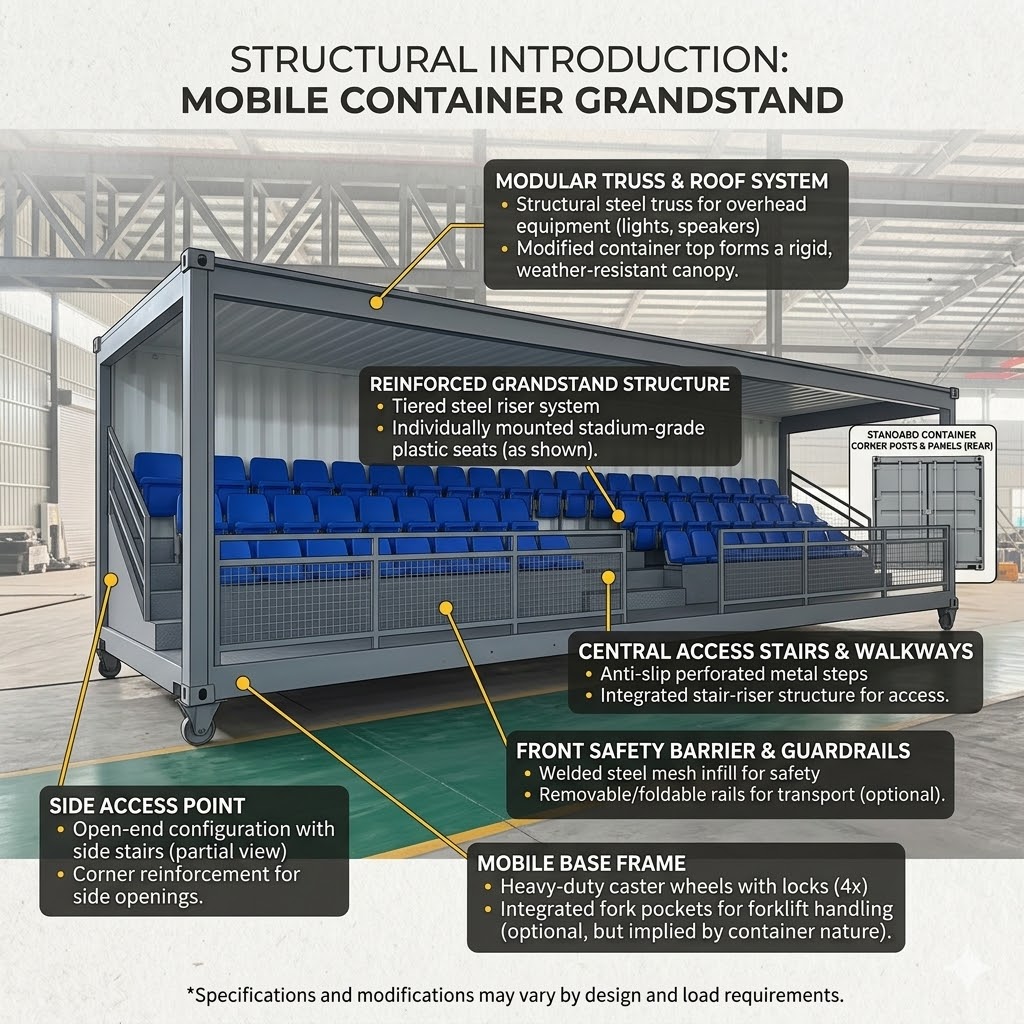
Container grandstand structure presentation


3. Cost Structure Breakdown: Traditional vs Alternative Grandstand

Cost comparison often determines purchasing decisions. The difference lies not in initial price alone, but in lifecycle cost.

Cost Structure Analysis: Traditional vs. New Grandstands

Cost comparison often determines procurement decisions. The difference lies not only in the initial price but also in the total lifecycle cost.

3.1 Cost Composition of Traditional Large Stadium Grandstands

Highest cost
Large-scale procurement of raw materials
Large footprint, high land rental costs
Long design and production time
On-site welding and labor
Foundation construction
Long production cycle
High price
Long service life
Suitable for government construction

3.2 Temporary bleacher

Lowest cost
Not requiring a large space
Quickly relocate, minimal labor required
Can be stored in a warehouse
Short service life, easily damaged
Full container shipping of multiple grandstands, lower cost

3.3 Cost Composition of Container Grandstands

Modular factory production, moderate price
Bulk shipping, as container shipping. Moderate transportation costs
Low installation labor costs, only requires a flat surface
Long service life, 20-30 years
Reusable deployment via trucks and forklifts, high utilization cost

This educational infographic analyzes the total lifecycle costs for three types of stadium grandstands, moving beyond initial price to consider long-term procurement factors. The graphic is structured into three main numbered sections against a light blue, networked background.


4. Mobility: The Core Advantage of Alternative Grandstand Systems

Mobility: The Core Advantage of New Grandstand Systems

Mobility determines whether grandstands generate one-time or recurring revenue.

Traditional stadium grandstand cannot be moved, resulting in long vacancy rates in many remote areas and reducing profit margins by 32%.

Ordinary temporary bleacher are the lightest and most flexible. However, they lack a roof, significantly limiting their use cases, and are often used indoors.

Container grandstands operate in a completely different way:

Lifting → Transport → Reinstallation

No structural damage
No need for remanufacturing

The roof of a container grandstand avoids outdoor sun exposure, and the railing design provides protection for spectators.

This makes container systems ideal for applications such as:

Temporary stadiums

Touring performances

Construction site seating

Government emergency infrastructure

Mobility transforms infrastructure into an asset. Container grandstands can continuously generate revenue for clients for 300+ days.

An informative infographic titled "Mobility: The Core Advantage of New Grandstand Systems," comparing fixed traditional stadiums, ordinary temporary bleachers, and modular container grandstands, highlighting the economic benefits and versatility of mobile seating.


5. Structural Performance: Safety and Load Capacity

Structural Performance: Safety and Load-Bearing Capacity

The procurement team often questions whether the strength of the new grandstands can rival that of traditional grandstands.

Container grandstands utilize:

Q235 galvanized steel frame

Reinforced load-bearing columns

Non-slip seating platforms

These components conform to international standards, such as those set by the International Organization for Standardization (ISO).

Unlike temporary scaffolding grandstands, the container system provides a stable load distribution through a carefully designed engineering structure.


6. Customization: Turning Grandstands into Revenue Platforms

Traditional grandstands have limited customization options due to their fixed design, typically only offering color variations.

Temporary bleacher, due to their simpler product, usually only require material customization and extendable design.

Containerized grandstands support modular upgrades:

Printed logos

Designed railings

Double-layer stacking

Seating logo printing

Customized seating

Wheelchair-friendly aisles

Customized stairs

Customization can increase product unit price and profit margin by 30%. Grandstand containers can also be customized to meet specific needs.

A professional business infographic titled "Customization: Turning Grandstands into Revenue Platforms" that contrasts traditional fixed seating with modular containerized grandstands, highlighting how features like printed logos, double-layer stacking, and wheelchair accessibility can drive a 30% increase in unit price and profit margins through high-value modular upgrades.


7. Installation Speed: From Weeks to Hours

Installation Speed: Reduced from Weeks to Hours

Time directly impacts project costs.

Traditional systems require:

Site preparation

Welding

Multi-stage inspection

Construction speed is affected by weather.

High uncertainty makes time difficult to guarantee.

Containerized grandstands simplify these steps to:

Finding a suitable surface

Unloading and installation

Determining stability.

Temporary grandstands only require manual movement to a suitable surface.

Faster installation cycles enable contractors to complete events on time, ensuring delivery.

This infographic compares the speed of traditional grandstand construction (taking weeks) to containerized grandstands (taking hours), highlighting how faster installation cycles for the latter enhance efficiency, predictability, and reliable project delivery for contractors.


8. Environmental Impact: Reusable Infrastructure

Environmental Impact: Reusable Infrastructure

Sustainability is now influencing procurement decisions, especially in public sector tenders.

Traditional grandstands generate:

Steel scrap

Concrete debris

Temporary grandstand containers have short lifespans and are easily discarded in large quantities as waste.

Containerized grandstands reuse existing containers, reducing material consumption. Container disposal is avoided; worn-out grandstands can be repaired, and damaged seats can be replaced.

According to the data framework cited by the World Green Building Council, modular construction reduces waste compared to traditional methods.

Alternative text: Containerized grandstand sustainability comparison chart showing its waste reduction

Reusable structures align with green procurement policies.
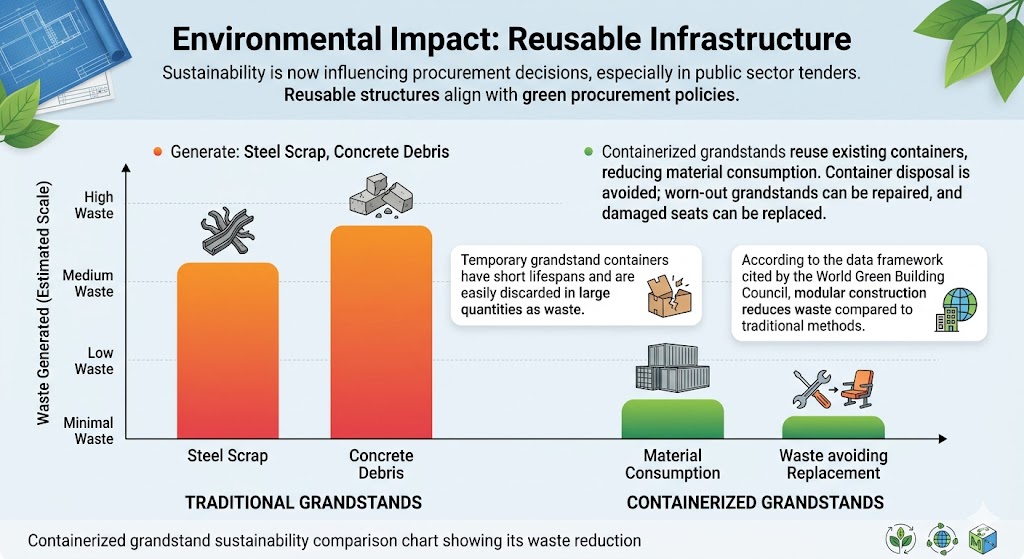
A professional infographic titled "Environmental Impact: Reusable Infrastructure," comparing the waste generation of traditional grandstands versus containerized grandstands. On the left, two high orange bars represent "Traditional Grandstands," showing high levels of waste from steel scrap and concrete debris. On the right, two significantly lower green bars represent "Containerized Grandstands," highlighting minimal material consumption and waste avoidance through replacement.


9. Use Cases: Where Alternative Grandstand Systems Win

Application Cases: Advantages of the New Grandstand System

Traditional stadium grandstands are used less frequently, typically for concerts and sporting events.

Temporary bleachers are often used for indoor activities such as volleyball and rehearsals.

In scenarios requiring flexibility, containerized grandstands are superior to traditional systems:

9.1 Temporary Sporting Events

Rapid deployment, supporting seasonal events.

9.2 Music Festival Viewing Platforms

Provides secure, monitored viewing areas.

9.3 Public Events and Festivals

Easily relocated across multiple venues.

9.4 Sporting Events

Multiple grandstands can be set up on the perimeter to increase seating capacity.

9.5 Various Activities such as Racing and Horse Riding

Container grandstands can be set up in the front row as VIP positions.

Alternative Text: Application cases of the new grandstand system, showcasing its use in sporting events, construction sites, and festivals.

Each scenario benefits from speed, mobility, and reusability.

This infographic compares traditional and temporary grandstand systems with new, flexible options. It highlights five application cases where containerized grandstands excel: temporary sporting events (quick setup), music festival viewing platforms (secure and monitored), public events (easy relocation), general sporting events (perimeter seating), and racing/horse riding events (VIP positioning). Each scenario emphasizes benefits like speed, mobility, and reusability.


10. ROI Comparison: Turning Infrastructure into Profit

Time PeriodTraditional Stadium Stands/BleachersContainer GrandstandsKey Insight
1 Year-5% to 10%35% to 50%Container grandstands break even quickly thanks to 60-70% lower initial costs and immediate usability. Traditional builds often face delays and negative early ROI.
3 Years25% to 45%120% to 160%Container solutions deliver over 3x higher returns. Reusability and low overhead accelerate payback.
5 Years60% to 90%250% to 320%By year 5, container grandstands generate substantially more cumulative value, with flexibility to relocate or expand easily.
10 Years150% to 220%550% to 700%+Container grandstands show the highest long-term ROI — often 3x or more than traditional options — due to durability, minimal maintenance, resale potential, and multi-event versatility.

Note: Actual ROI varies by location, event frequency, local regulations, and utilization rates. Container grandstands consistently outperform in most scenarios because of their lower capital intensity and higher flexibility.

Why Container Grandstands Deliver the Highest ROI

Container grandstands revolutionize spectator seating with several decisive advantages:

  • Lower Upfront Costs: Often 50-70% cheaper than traditional aluminum or steel bleachers/grandstands, as they repurpose durable shipping containers with minimal additional fabrication.
  • Speed of Deployment: Installed in days or weeks instead of months, allowing faster revenue generation from events.
  • Modularity and Portability: Easily scaled, relocated, or reconfigured. Ideal for temporary events, pop-up stadiums, festivals, or expanding existing venues without permanent construction.
  • Reduced Maintenance and Overhead: Weather-resistant, require no expensive foundations in many cases, and can be disassembled for storage or resale.
  • Sustainability and Future-Proofing: Reusable across multiple projects, lowering lifetime costs and supporting circular economy principles.
  • Revenue Flexibility: Enables hosting more events or renting out the structure, boosting annual returns.

In contrast, traditional stadium stands offer solid long-term durability for fixed venues but suffer from high initial investment, site permanence, and slower ROI recovery.


Conclusion:

AspectTraditional GrandstandTemporary BleachersContainer Grandstand (Alternative)
Construction MethodOn-site welded steel frames + heavy foundationsManual assembly on flat surfaceFactory modular production using modified shipping containers
Production EnvironmentOn-site constructionOn-site / WarehouseControlled factory (CNC cutting & standardized welding)
Installation TimeWeeks to monthsHours (manual)Hours (crane + bolts)
MobilityFixed / Non-movableHighly portableExcellent (Lift → Transport → Reinstall)
ReusabilityLowMedium (short service life)High (20-30 years, easily relocated)
TransportationDifficult & expensiveFull container shipping possibleIntegrated with standard container logistics
Ground RequirementsHeavy foundations requiredFlat surfaceOnly requires a complete flat ground surface
Initial CostHighestLowestModerate
Lifecycle CostHigh (due to one-time use & long timelines)Low but frequent replacementLower (reusable + long service life)
Service LifeLongShort (easily damaged)Long (20-30 years)
Labor DependencyVery High (on-site welding & fabrication)MediumLow (mainly factory + minimal on-site)
CustomizationLimited (mainly color)Basic (material & extendable design)High (logos, railings, double-layer, wheelchair access, etc.)
Structural PerformanceHigh load capacityLower stabilityStrong (Q235 galvanized steel, reinforced columns, ISO standards)
Weather ResistanceGood (permanent)Poor (often indoor only)Good (container roof protects from sun/rain)
Environmental ImpactHigh waste (steel scrap + concrete)High waste (short lifespan)Low waste (reusable, repairable, reduced material use)
Best Use CasesPermanent stadiums & large fixed venuesIndoor events, small temporary setupsTemporary sporting events, music festivals, public events, construction sites, VIP areas, touring events
ROI PotentialSlow recoveryLimited by short life & durabilityHighest (high utilization, fast redeployment, recurring revenue)

Container grandstands redefine how seating infrastructure is delivered and utilized by shifting from traditional construction to a modular, product-based solution. Instead of relying on time-consuming on-site fabrication, this system enables factory-controlled production, ensuring consistent quality, faster delivery, and reduced project risk.

From a procurement perspective, the solution directly addresses three critical challenges: long timelines, high labor costs, and low post-event utilization. With plug-and-play installation and minimal ground requirements, container grandstands can be deployed within hours, significantly improving project efficiency and predictability.

More importantly, mobility transforms grandstands from fixed assets into revenue-generating tools. The ability to relocate, reuse, and redeploy across multiple events allows buyers to maximize utilization rates and achieve faster ROI—something traditional structures cannot offer.

In addition, the system provides strong structural performance, flexible customization options, and long service life, making it suitable for both temporary and semi-permanent applications. Its reusable nature also aligns with growing sustainability requirements in global procurement.

Overall, container grandstands are not just an alternative—they are a solution-driven upgrade that helps contractors, event organizers, and procurement teams reduce costs, increase flexibility, and unlock long-term value.

'7 OPTIONS ON ALTERNATIVE CHOMEX: COMPARE CHINA CONTAINER HOUSE FACTORY OPTIONS FOR SMART IMPORTERS'. It presents a side-by-side comparison across seven distinct categories. Below the main title, the strategic recommendation is stated: 'YOUR STRATEGIC CHOICE: PROFITABILITY VS SIMPLICITY'

7 Points on Alternative Chomex: Chomex vs China Container House Factory

7 options on Alternative Chomex: Compare China Container House Factory Options for Smart Importers


Alternative Chomex: Purchaser must check

B2B procurement is a lengthy process, and if procurement personnel only communicate with Chomex’s sales team, they will receive only partial information. Therefore, it is crucial for procurement personnel to find an alternative Chomex. This article will compare products made in the US and those made in China to help procurement personnel make more accurate judgments.

Searching for an Alternative Chomex supplier often leads buyers into surface-level comparisons—price sheets, product photos, and vague specifications. That approach fails during real procurement.

Importers and wholesalers need deeper benchmarks: structure integrity, export experience, customization control, and delivery reliability.

Most buyers comparing Chomex overlook three operational factors:

  • Manufacturing depth vs. trading model
  • Structural material standards
  • Export compliance capability

Without these, a low quote becomes a costly mistake.

Alternative Chomex supplier comparison framework for container house factory evaluation


1.Alternative Chomex Manufacturing Model – Factory vs Trading Company

The second layer in any Alternative Chomex decision is understanding who you are buying from.

Direct Factory Advantages

Chinese container house factories offer:

On-site production line visits available; Dedicated production team;

Customized engineering support, tailored to customer requirements and confirmed by the technical department;

Bulk orders, stable, large-scale production;

This helps reduce the risk of large-scale orders by 20%.

Characteristics of Trading Suppliers

Chomex operates as an intermediary:

Limited control over production and lack of expertise in many production technologies.

Not proficient in customizing expandable container houses; only capable of simple customization.

Inconsistent quality and delivery times for large-volume orders.

They have a local service team in the US, enabling rapid communication and support.

For importers, this leads to uncertainty regarding repeat orders. For individual users, choosing Chomex offers added security.

This image is a professional company infographic titled "Alternative Chomex Manufacturing Model – Factory vs Trading Company." It provides a detailed comparison of the "advantages of a direct factory" versus the "characteristics of a trading supplier."


2.Compare Chomex on Customization Flexibility

Comparing Chomex’s Customization Flexibility

The degree of customization determines whether a supplier is suitable for your project or forces you to make compromises.

Modular Design Capabilities

Chinese factories typically offer:

Scalable container logo design; Color painting design

Bathroom systems; Door and window systems; Ventilation systems; Drainage systems; Optional doors and windows

Container house stacking systems

Interior finishing

Interior layout

Pre-installation

Enhanced windproofing, waterproofing, heat insulation, and sound insulation

This enables:

Rapid deployment

Flexible layout planning

Engineering-grade customization

Extended container house lifespan by 30%

Excellent Chomex offers: Washer and dryer interfaces; Solar panels and smart home technology; American-style interior design.

Chinese factories excel at global home customization, while Chomex understands the needs of American customers better.

A detailed comparison infographic showing that while Chinese factories provide robust engineering-grade modular options like structural stacking and pre-installed systems, Chomex specializes in lifestyle-focused customization for the US market, such as smart home tech and American-style interior design.


3.Contrast Chomex in Export Experience and Compliance

Comparing Chomex’s Export Experience and Compliance

Importers face not only product issues but also regulatory hurdles.

Reliable factories meet the following standards:

ISO Manufacturing Standards

CE Certification (for the EU market)

Fire Safety and Structural Compliance

Chinese factories can apply for corresponding certificates based on customer order quantities and requirements.

Reference:

World Steel Association Standards 

Chomex typically provides US-issued expandable container houses rather than global certificates because Chomex’s main customers are in the Americas.

Experienced Chinese exporters provide:

Packing List and Shipping Dates

Customs Documents

Commercial Invoice

Certificate of Origin

Without these documents, goods risk delays or rejection. Partnering with Chomex eliminates the need for these documents; Chomex’s logistics team handles these issues. You simply need to provide your shipping address to Chomex’s sales team, and they will deliver.

The infographic illustrates the advantages of using Chomex’s Export Model compared to standard direct importing from Chinese factories. It highlights how Chomex simplifies the regulatory and logistical hurdles that importers typically face.


4.Alternative Chomex Lead Time and Delivery Reliability

Production Speed

Typical delivery times for wholesale orders from Chinese container factories, based on the company’s production schedule:

Standard orders (off-season): 25-30 days

Customized orders (peak season): 45-60 days

Chomex purchases a portion of expandable container house inventory during each procurement period to facilitate rapid delivery. If Chomex’s inventory does not contain suitable expandable container houses for the buyer, the company will also need to place an order from the factory and then handle import customs clearance and distribution.

For projects with tight delivery schedules, consult Chomex to confirm availability of suitable inventory.

This infographic highlights Chomex’s logistical edge in B2B procurement by contrasting standard factory production cycles—25–30 days for off-season and 45–60 days for peak-season custom orders—with a strategic inventory model that enables rapid delivery of ready-made stock, ensuring high reliability through end-to-end control of factory production, customs clearance, and final distribution.


5.Alternative Chomex Use project Suitability

Chomex Application Scenarios Applicability

Chomex suppliers may be suitable for:

Temporary events

Rapid deployment sites

Residential rentals

Offices

Chinese factories dominate in the following areas:

Worker dormitories

Resorts and hotels

Commercial retail locations

Chomex camping accommodations

Chomex excels at providing a comfortable living environment, while Chinese factories excel at customizing and producing different expandable container houses according to different application scenarios.

 This infographic illustrates the Alternative Chomex: Use Project Suitability model, contrasting Chomex’s focus on comfortable living environments with Chinese factories’ strengths in customization and scale. Chomex Suppliers prioritize speed and living comfort for scenarios like temporary events, rapid disaster relief deployment, residential rentals, and ready-to-use office spaces; meanwhile, Chinese Factories offer design flexibility and mass production for large-scale projects such as high-capacity worker dormitories, customized resorts, modular retail layouts, and specialized camping accommodations.

6.Chomex and china container house factory different market

Chomex targets the Americas market, and its shipping team supports various modes of transport, including trucks, cars, and trains. Chinese suppliers, on the other hand, target the global market and typically use sea freight for global shipping.

Therefore, Chomex excels in localizing its expandable container houses in the Americas, possessing extensive experience and ranking among the top 5% of expandable container house suppliers in the US. Chinese suppliers, on the other hand, have a global reach and strong capacity to fulfill global orders.

This infographic highlights the different market reaches of Chomex and Chinese container house factories by comparing regional localization against global sourcing capabilities. Chomex positions itself as a leader in the Americas, leveraging localized product designs, extensive regional experience, and robust local delivery support to rank among the top 5% of US suppliers. In contrast, Chinese factories focus on vast global reach and capacity, utilizing large-scale sea freight and high-volume production to fulfill diverse procurement orders for international markets across the globe.

7.Chomex and china container house factory different audiences

Chomex’s website features a financing section, indicating that Chomex understands their customer base primarily consists of end-user individuals who purchase Chomex container houses to alleviate housing pressures in the Americas. Chinese suppliers typically showcase their production lines, project outputs, and product certifications, demonstrating their ability to handle large-scale global project orders, making them suitable for procurement negotiations.

This infographic analyzes the distinct customer profiles and sourcing approaches of Chomex versus Chinese container house factories, highlighting that Chomex focuses on individual end-users by offering simplified purchasing and financing solutions to alleviate housing pressures in the Americas. In contrast, Chinese factories cater primarily to businesses and procurement teams, prioritizing large-scale global project orders, bulk pricing, and specialized project management capabilities, as reflected in their website showcases of industrial production lines and global project outputs.


Alternative Chomex Final Decision Framework for Importers

Comparison CategoryChomex (US-focused Supplier)China Container House FactoryWinner for Importers
Business ModelTrading Company / IntermediaryDirect ManufacturerChina Factory
Manufacturing ControlLimited control over productionFull in-house production & engineering teamChina Factory
Customization FlexibilityBasic customization, better at American-style designHigh flexibility: structure, interior, systems, stacking, insulation, etc.China Factory
Technical SupportLocal US service team, fast communicationDedicated technical & engineering supportDepends on needs
Pricing & Real CostHigher unit price, simpler logisticsLower factory price, better bulk discountsChina Factory
Hidden CostsLower installation & maintenance risk (ready units)May require more labor if not well-optimizedChomex (short-term)
Export ExperienceStrong in Americas market, simplified documentsGlobal export experience, full document supportChina Factory
Compliance & CertificationUS-focused certificationsISO, CE, fire safety, can apply per customer needsChina Factory
Lead TimeFaster if inventory available (ready stock)Standard: 25-30 days Custom: 45-60 daysChomex (urgent)
Shipping & LogisticsHandles US domestic delivery (truck, rail)Optimized flat-pack sea shipping, strong loading plansChina Factory (bulk)
Best Suitable ForIndividual buyers, small projects, temporary needsWholesalers, importers, large projects, worker camps, resorts, hotels-
Target MarketPrimarily Americas (USA, etc.)Global market-
Order Volume StrengthBetter for small-medium ordersExcellent for bulk & repeat large ordersChina Factory
Long-term ProfitabilityLower margins for wholesalersHigher margins through direct factory pricingChina Factory
Risk Level for Large OrdersHigher uncertainty on quality & delivery consistencyLower risk with direct controlChina Factory

Chomex is an excellent brand. As a container house supplier, we are constantly learning from Chomex’s strengths in technology, sales, marketing, and other areas.

Choosing the right Alternative to Chomex is not about finding the lowest quote—it’s about selecting a supplier that aligns with your project scale, customization needs, and long-term cost control.

For individual buyers or small-scale projects in the Americas, Chomex offers clear advantages:

  • Local service and faster communication
  • Ready-to-ship inventory for urgent needs
  • Simplified logistics and delivery handling

However, for importers, wholesalers, and project-based buyers, relying solely on intermediaries can limit control and increase long-term risks.

A direct China container house factory provides a more strategic solution:

  • Full control over manufacturing and engineering customization
  • Scalable production for bulk orders and repeat procurement
  • Optimized shipping and packaging for better margin control
  • Flexible certification and compliance for global market entry

Final Recommendation

If your goal is speed and simplicity, Chomex is a practical option.
If your goal is profitability, customization, and scalable supply, working directly with a factory is the smarter long-term strategy

A strategic infographic comparing "Modpools" (market leader) with an "Emerging Container Pool Brand" across seven procurement dimensions. The left side uses progress bars and icons to show the emerging brand's advantages: 50-80% lower costs ($30k vs $100k), faster 2-month delivery, modular engineering with Q235 steel, and integrated service teams. The right side features a circular chart identifying market opportunities: 30% Delivery Speed, 30% Cost Efficiency, 25% Customization, and 15% Manufacturing Control. Visuals include a technical cross-section of a pool's multi-layer insulation and an illustration of a container pool being hoisted by a crane.

Comparison of modpools-New container swimming pool brand

6 options in Comparison of modpools: How a New Container Pool Brand Redefines Procurement Value

Comparison of modpools: The Market Is Shifting Fast

Buyers are changing.
The global demand for container swimming pools has pushed Comparison of modpools into a critical evaluation step for importers and distributors.

A pattern is emerging.
modpools dominates brand recognition, yet buyers now question delivery timelines, pricing structure, and scalability.

The shift is practical.
Procurement teams are no longer selecting based on brand visibility alone. They are evaluating execution capability, batch supply, and long-term margin control.

As a container manufacturer, we identified a market gap for container pools and began producing them. We can highlight the differences between our products and those of well-known brand Modpool to provide customers with more choices when making their purchases.

comparison of modpools market share and growth of alternatives to modpool container pools


1.Cost Structure Breakdown in Comparison of modpools

Cost drives decisions.
In any Comparison of modpools, pricing reveals the most immediate gap between legacy brands and emerging manufacturers.

The structure is clear.
modpools carries higher pricing due to localized production, labor intensity, and limited batch efficiency.

A different model is rising.

Our manufacturing system in China helps us reduce costs significantly while maintaining strong quality. We achieve this through:

  • Standardized modular production: Efficient, repeatable processes that minimize waste and speed up manufacturing.
  • Optimized labor allocation: Smart workforce planning that improves productivity without cutting corners.
  • High-volume material sourcing: We purchase raw materials and components in large quantities, securing much better prices.

The results speak for themselves.

By centrally procuring swimming pool equipment in bulk, we can quickly select the most suitable containers for each project. This efficient approach allows us to produce high-quality container pools at prices 50%–80% lower than traditional Modpool options — giving you a major competitive edge in pricing and margins.

Buyers can secure more units under the same budget or upgrade specifications without increasing spend.

cost comparison of modpools vs alternatives to modpool container swimming pools


2. Container pool Delivery Speed Defines Profit Margins

Time affects revenue.
Delays in delivery directly impact project completion and cash flow.

A limitation exists.
modpools often requires extended lead times, which becomes a constraint in multi-unit procurement.

Our system responds faster.

We’ve built our production system to move quickly and reliably:

  • 35-day production cycle: Most orders are completed within 35 days from confirmation.
  • Ready module inventory: We keep key modules and components in stock for even faster turnaround.
  • Batch order prioritization: Large or urgent orders get special attention and move to the front of the line.

Clients see clear results. Faster production and deployment mean you can start earning revenue much sooner.

While our pool systems are manufactured faster than Modpool’s, it’s important to be transparent: as we are based in China, shipping to the Americas usually takes 10–20 days longer than Modpool. Even with the extra shipping time, many clients still come out ahead thanks to our shorter production cycle and significantly lower prices.

container pool production and delivery timeline faster than modpools alternatives


3. Structural Engineering Behind Container Pools

Quality determines lifecycle.
In Comparison of modpools, structural integrity remains a core technical benchmark.

The difference lies in flexibility.
modpools applies a fixed structural approach, which limits adaptation across environments.

We take a stronger, more practical approach to engineering our container pools:

  • Q235 galvanized steel frame: A heavy-duty, high-strength steel structure that provides excellent structural integrity and long-term stability.
  • Multi-layer anti-corrosion coating: Advanced protective layers that guard against rust, salt, and harsh weather, greatly extending the lifespan of the pool.
  • EPS or rock wool insulation panels: High-performance insulation options that maintain stable water temperatures and improve energy efficiency.

Because we also specialize in manufacturing container houses, our team has deep expertise in thermal control and climate adaptation. This experience allows us to design container pools with superior temperature retention, so the water stays comfortable with less energy use — no matter the season or climate.

The physical experience confirms it.
The steel feels solid, and water temperature remains stable during extended use.

container pool structure comparison modpools vs alternatives to modpool engineering design


4.Customization Without Production Delays

Market demand evolves.
Static designs cannot meet diverse project requirements.

While Modpool provides customization, it often comes with much higher costs and significantly longer lead times.

Our approach strikes a smart balance between flexibility and speed:

  • Modular base units: Start with proven, ready-to-use core structures that are quick to produce and deploy.
  • Optional feature upgrades: Easily add premium features like enhanced insulation, advanced filtration, or stylish finishes according to your needs.
  • Scalable design configurations: Adapt the size, layout, and specifications to fit different project requirements without slowing down production.

Applications expand easily. From luxury resorts and private villas to urban rooftop installations and commercial venues, our container pools adapt smoothly to various site conditions and customer demands. This flexibility makes them ideal for a wide range of projects while keeping delivery fast and costs competitive.

Modpool has extensive experience in container pool decoration and design, meeting the pool needs of European and American clients. Our strength lies primarily in manufacturing, customizing pools according to client requirements; however, we are less adept at aesthetics and pool production and design techniques.

alternatives to modpool container pools used in resorts rooftop and commercial projects


5.Supply Chain Strength Defines Long-Term Value

I’ve learned this the hard way: consistency builds partnerships. You can have the flashiest website and the best online ads, but if your supply chain crumbles when demand spikes, your buyers will walk.

Brand visibility alone cannot sustain long‑term procurement relationships. It gets you in the door. What keeps you there? Reliable production, predictable quality, and the ability to scale without breaking.

Where Modpools fits

Let’s give credit where it’s due. Modpools has done an excellent job with online brand marketing, promotion, and advertising. Their quality is relatively stable, and they’ve built a large team of professional, English‑speaking customer service reps who handle pre‑sales and after‑sales support well. That’s no small feat.

But here’s the limitation. Modpools is not set up to take on large‑scale, high‑volume container swimming pool projects. Their model works beautifully for smaller, bespoke orders. When you need 50, 100, or 200 units with tight delivery windows? The flexibility just isn’t there.

Our advantage lies in manufacturing control.

  • Direct factory production
  • OEM and ODM capability
  • Flexible order volume

We have complete procurement, production, quality control, and transportation departments. We guarantee a yield rate exceeding 95% within Container Pool’s supply chain system, aiming to improve customer experience through high quality. However, all our staff’s primary language is Chinese. If customers have complex English-language requirements regarding Container Pool, please confirm product details with our sales team multiple times.

Distributors gain control.
Inventory strategies can adapt to seasonal demand changes.

container pool supply chain comparison modpools vs china container pool manufacturers


6.User Experience Extends Beyond the Product

Experience drives repeat orders.
End users evaluate more than structure.

Modpool’s sales and after-sales teams have an overly defined division of labor. While the after-sales team can often respond and resolve issues quickly, they don’t promptly relay problems to the sales and production teams, potentially overlooking customer issues. Our pre-sales, after-sales, and sales teams are all integrated. This allows us to resolve problems simultaneously and escalate them to the production and technical teams, preventing the same issues from recurring with the customer’s products.

container pool lighting and night experience alternatives to modpool


Comparison of modpools: Procurement Logic Is Evolving

DimensionModpool (Legacy Brand)New China Container Pool ManufacturerKey Advantage for Buyers
1. Cost StructureHigher pricing due to localized production, higher labor costs, and limited batch efficiency50%–80% lower pricing through standardized modular production, optimized labor allocation, and bulk material sourcingBuyers seeking maximum margins and higher volume per budget should choose the new manufacturer; buyers prioritizing established brand perception may accept Modpool’s premium
2. Delivery SpeedLonger and less predictable lead times, especially for multi-unit or custom ordersFast 30-day production cycle with ready module inventory and batch prioritizationFaster project turnaround and earlier revenue — clear advantage for time-sensitive or large-scale projects
3. Structural EngineeringFixed structural design with standard insulationQ235 galvanized steel frame + multi-layer anti-corrosion coating + EPS or rock wool insulation panels; strong experience in container house manufacturingSuperior durability, better temperature stability, and adaptability — ideal for long-term use in varied climates
4. CustomizationGood customization options but often incurs high extra cost and extended lead timesModular base units with flexible optional upgrades and scalable configurationsGreater flexibility at reasonable cost and speed; better for diverse project requirements
5. Supply Chain StrengthStrong brand stability and marketing, but limited scalability for high-volume ordersDirect factory control, full OEM/ODM capability, flexible order volumes, and >95% yield rateExcellent for importers and distributors needing large quantities, seasonal flexibility, and reliable long-term supply
6. User Experience & ServiceProfessional English-speaking team with clearly divided sales & after-sales departments; strong marketing supportIntegrated pre-sales, sales, and after-sales teams; issues quickly escalated to production & technical teamsFaster problem resolution and prevention of recurring issues; better for buyers who value operational efficiency over polished communication
7. Brand & Market PositionHigh brand recognition, strong online marketing, and professional customer service supportStrong manufacturing expertise and production capacity; focused on cost efficiency and scalabilityModpool suits buyers who value brand prestige and aesthetic/design support; New manufacturer delivers superior procurement value for margin-focused, volume-driven buyers

The market is transforming.
This Comparison of modpools highlights a shift from brand-driven decisions to supply-driven evaluation.

Procurement priorities have changed.
Buyers now focus on delivery speed, cost efficiency, and customization capability.

Opportunities are expanding.
Choosing reliable alternatives to modpool allows importers and distributors to improve margins and scale faster.

The next move becomes strategic.
Selecting a manufacturing partner with proven production capacity and engineering expertise will determine long-term competitiveness.

A comprehensive comparison infographic contrasting traditional campsite accommodation options (tents and RVs) with a modular "Prefab Cabin Camp Building Solution," presented as "Expandable Container Houses." The infographic is structured into a prominent top section with three illustrative columns and detailed data tables below.

Prefab cabin camp building​ solution:tent and RV alternatives

Prefab cabin camp building​  Solution: Replace Tents and RVs with Scalable Camp Infrastructure

Canvas leaks, floors shift, and guest complaints rise. RV fleets solve mobility but bring high fuel cost, maintenance cycles, and layout limits. For operators scaling camps, both options create unstable margins and poor guest retention. As a new use for container houses, campsites are becoming popular all over the world.

That is where a prefab cabin camp building​ solution enters.

prefab cabin camp building solution compared with tent and RV camp structures

Tents in Camps: Where They Work and Where They Fail

The tents in the camp: What roles do they play and what are their shortcomings?
Due to their low initial cost and easy setup, tents have become the preferred equipment for beginner camping activities.

Advantages of tents

Low purchase cost, with various types available on the market
Quick installation without machinery
Flexible layout adjustment to suit seasonal camping
Light weight for transportation
These features are suitable for short-term activities or trial runs.

Limitations of tents

Poor insulation in cold or hot environments, not conducive to serving customers in extreme weather conditions.
Short lifespan when used outdoors for a long time
Requires extensive maintenance after rain or wind
Lack of safety protection measures. Weak protection for guests’ bodies and belongings
Operators usually replace tents within one to two seasons, which increases long-term operating costs.

RVs in Camps: Mobility Comes at a Cost

The camper van offers convenient mobility and built-in comfort, and thus is very popular in high-end camping sites.

Advantages of RVs

Integrated living system
Can be moved quickly
Provides guests with high value-added experiences
Does not require construction
These features attract tourists with higher payment capabilities.

Limitations of RVs

The area of RVs is small, resulting in poor experience for multiple occupants
The unit purchase cost is high, and purchasing multiple RVs puts a great cost pressure on campsite builders
The maintenance system is complex. RVs are used outdoors for a long time, and require a specialized RV maintenance team for maintenance.
For large campsites, scalability is limited, transportation and parking conditions are restricted, and the number of parking spaces is limited. The parking spaces at the campsite cannot meet the needs of multiple RVs.
Costs increase rapidly. Expenses such as fuel costs, car maintenance fees, insurance fees, etc., will increase the burden on campsite operations. As the number of units increases, fleet management actually becomes a burden.

Why Prefab Cabin Camp Building is the better solution?

A prefab cabin camp building solution bridges the gap between tents and RVs by combining structure, comfort, and scalability.

Prefab cabins use steel frames and insulated panels to create durable units that install quickly and operate with low maintenance.

Advantages

The prefabricated campsite building solution combines structure, comfort and scalability, bridging the gap between tents and recreational vehicles.
The prefabricated cabins are constructed using modular methods and insulation panels, creating units that are durable, easy to install and have low maintenance costs.
Advantages

After being delivered to the camp, it can be quickly deployed within three days.
The structure is made of galvanized steel, which is sturdy and durable. It can be used for up to 20 years.
It can be equipped with air conditioning, providing insulation, heat preservation and wind resistance. It is suitable for various rainy days, strong winds and hot climates.
The scalable modular layout can be expanded, and the area will increase to 2-3 times its original size.
Lower lifecycle costs, no need for excessive technical personnel maintenance, only requiring regular maintenance within one year, thereby reducing maintenance costs.

Portable: During the off-season or in winter, it can be transported by truck to various rental venues such as resorts and other activity sites.

Support customization. Customized production can be carried out to enhance the brand effect of the camp and increase the product profit by 30%.

Limitations of Expandable container

Limited site accessibility

A high initial investment is required.

A stable foundation and a professional installation team are required.

Summary

AspectTentsRVs (Recreational Vehicles)Prefab Cabins (Modular Cabin Solution)
Initial CostVery LowHighMedium to High (Higher upfront than tents)
Installation TimeVery Fast (hours)Fast (no construction needed)Very Fast (deployable within 3 days)
Durability / LifespanShort (1–2 seasons)Medium (depends on maintenance)Long (up to 20 years)
Insulation & Weather ResistancePoor (hot/cold, rain, wind)GoodExcellent (insulated panels, AC-ready, wind & rain resistant)
Comfort LevelBasicHigh (integrated living system)High (spacious, customizable, climate-controlled)
Space & CapacityLimitedSmall (poor for multiple occupants)Scalable (can expand to 2–3 times original size)
MaintenanceHigh (frequent after rain/wind)Very High (complex, needs specialized team)Low (regular maintenance only, no excessive technical staff)
Mobility / PortabilityExcellent (lightweight)Good (can be moved)Good (truck-transportable during off-season)
ScalabilityHigh (flexible layout)Limited (parking space & layout restrictions)Excellent (modular design, easy expansion)
Safety & SecurityLowMediumHigh (sturdy galvanized steel frame)
CustomizationLimitedLimitedHigh (supports branding & custom design)
Long-term Operating CostHigh (frequent replacement)Very High (fuel, insurance, maintenance, fleet management)Low (better lifecycle cost)
Guest Experience & RetentionBasic, leads to complaintsGood for high-end guestsSuperior (comfort + durability = higher retention)
Best ForShort-term, beginner, trial campsHigh-end mobile campingScalable professional camps, year-round operation

prefab cabin camp building​, as the latest campsite architecture, effectively solve the weather problem for campsite teams when spending the night.Choosing prefabricated buildings can also generate higher profits through leasing and resale. However, if there isn’t a large initial investment, it’s recommended to set up attractive tents to attract customers.