7 Practical Truths About Container Grandstand Worth: A Data-Driven Investment Decision Guide In a B2B business environment, profit is a crucial factor. Faced with the emerging product, the container grandstand, many business owners raise questions about procurement: What is the ROI of a container grandstand? Are Container grandstand Worth It? This article will discuss seven […]
In a B2B business environment, profit is a crucial factor. Faced with the emerging product, the container grandstand, many business owners raise questions about procurement: What is the ROI of a container grandstand? Are Container grandstand Worth It?
This article will discuss seven aspects of understanding whether investing in container grandstands is worthwhile.
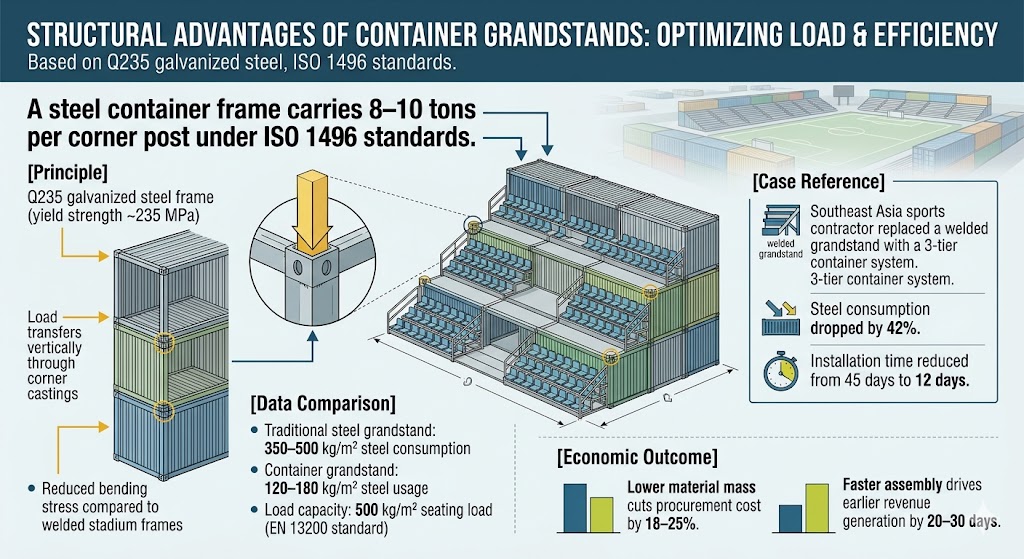
A steel container frame carries 8–10 tons per corner post under ISO 1496 standards.
Load matters.
[Principle]
Container grandstands rely on Q235 galvanized steel with a yield strength of ~235 MPa. This allows stacked configurations without additional concrete structures. Load transfers vertically through corner castings, reducing bending stress compared to welded stadium frames.
[Data Comparison]
[Case Reference]
A Southeast Asia sports contractor replaced a welded grandstand with a 3-tier container system. Steel consumption dropped by 42%. Installation time reduced from 45 days to 12 days.
[Economic Outcome]
Lower material mass cuts procurement cost by 18–25%.
Faster assembly drives earlier revenue generation by 20–30 days.
[Principle]
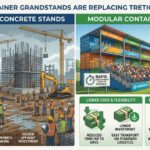
Compared to the high installation, construction, transportation, and maintenance costs of traditional grandstands, container grandstands eliminate the need to pay for these expensive expenses.Container grandstands integrate structure + seating + transport into one modular unit. This reduces subcontract layers and eliminates on-site fabrication risks.
| Cost Category | Traditional Grandstand | Container Grandstand | Savings with Container | Notes |
|---|---|---|---|---|
| Initial Structure & Materials | High (Concrete/Steel + Custom Fabrication) | Integrated Modular Unit | 40–50% | Container includes frame + seating |
| Foundation & Civil Works | Very High (Extensive concrete foundation) | Minimal (Simple anchoring) | 60–70% | No heavy civil engineering required |
| On-Site Construction Labor | High (Multiple subcontractors) | Very Low (1–3 days modular assembly) | 70–85% | Plug-and-play installation |
| Transportation & Logistics | High (Multiple shipments + cranes) | Integrated (Units ship as structure) | 50–65% | Structure + seating in one transport |
| Installation Time Cost | 4–12 weeks (High labor & equipment) | 1–3 days | 80–90% | Faster revenue generation |
| Subcontractor Layers | 6–8 layers (High coordination cost) | 1–2 layers | 55–65% | Reduced management overhead |
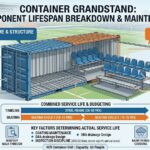
| Maintenance (5-Year) | High (Corrosion, painting, repairs) | Low (Galvanized + modular replacement) | 45–60% | Designed for quick part replacement |
| Total Initial Investment | 100% (Baseline) | ~55% | ~45% | Significantly lower upfront cost |
| 5-Year Lifecycle Cost | 100% (Baseline) | ~48% | >52% | Major long-term savings |
[Economic Outcome]
Initial investment drops ~45%.
5-year lifecycle savings exceed 50%.
[Principle]
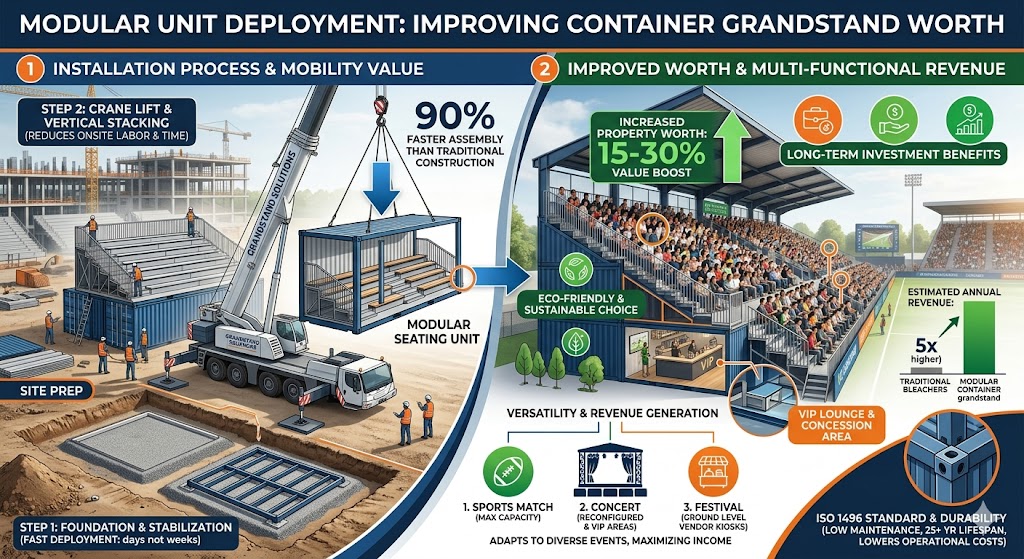
Modular systems eliminate wet construction. No curing time. No welding on-site. Pre-fabrication ensures tolerance control within ±2 mm.Once a suitable, flat foundation is selected, it can be used immediately, making it ideal for projects with limited budgets.
[Data Comparison]
[Case Reference]
A European sports club installed a 1,500-seat container grandstand in 10 days using 6 workers and one crane. A traditional build required 25 workers over 40 days.
[Economic Outcome]
Earlier operation increases ticket revenue window by 20–40 days.
Labor cost savings reach $25,000–$80,000 per project.

[Principle]
Electrostatic powder coating forms a 60–80 μm protective layer. Combined with galvanized steel, corrosion resistance exceeds 10 years in coastal environments
Compared to traditional grandstands, container grandstands are lighter and more flexible. They can be stored in warehouses during inclement weather to prevent damage, significantly extending their lifespan. Composed of 40ft shipping containers, container grandstands require less space and are easier to maintain.
[Data Comparison]
[Case Reference]
Through our special treatment and the user’s careful maintenance. A coastal stadium in Indonesia reported zero structural corrosion after 6 years using container grandstands, while adjacent steel structures required repainting twice.
[Economic Outcome]
Maintenance cost reduces by 60–70%.
Asset depreciation slows significantly.
【Principle】
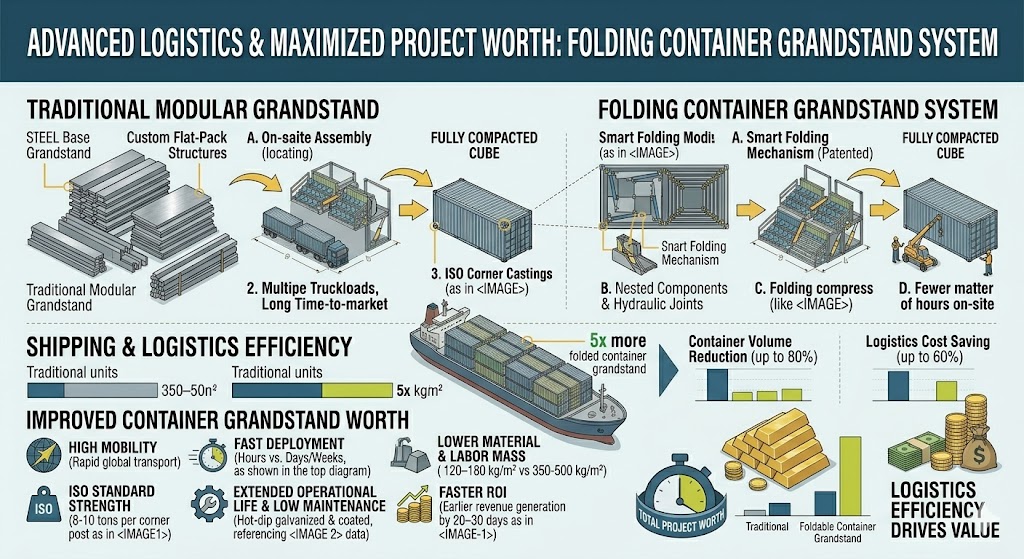
The canopy, chairs, steps, and railings of container grandstands are pre-manufactured and installed. Container grandstands can be transported like containers, resulting in high transportation efficiency and convenience. Traditional grandstands require many raw materials, including steel structures, chairs, steps, concrete, railings, and toilet facilities. This leads to more transport items and higher transportation costs.
【Data Comparison】
Traditional Structure: 1 project = 20-30 containers
Container Grandstand: 1 project = 6-10 containers
Loading Efficiency: Increased by 2.5-3 times
【Case Study】
An African distributor reduced the transportation cost of a 1000-seat project from $90,000 to $28,000 by switching to modular container grandstands.
【Economic Benefits】
Freight savings of up to 60-70%.
Global distribution by wholesalers becomes possible.
[Principle]
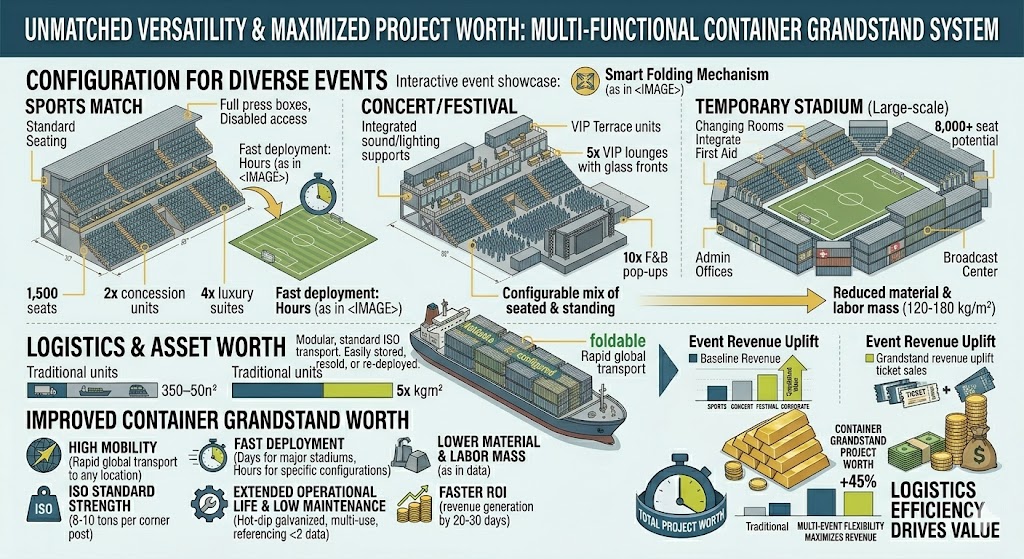
Container grandstand can be used in many applications. When you have an event with fewer than 1,000 people, you can opt for our container stands instead of traditional stadium stands to achieve better occupancy rates and higher profits.Container modules allow reconfiguration into VIP lounges, media rooms, or retail kiosks. Structural integrity remains unchanged due to modular load distribution.
[Data Comparison]
[Case Reference]
A South American event operator used the same container grandstand for football matches, concerts, and exhibitions. Annual revenue increased by 65%.
[Economic Outcome]
Higher utilization boosts ROI cycle from 3 years to 1.5–2 years.
Revenue diversification reduces risk.
Decision requires structure, cost, and ROI alignment.
Numbers decide truth.
| Practical Truth | Traditional Grandstand | Container Grandstand | Key Benefit / Outcome | |
|---|---|---|---|---|
| 1 | Structural Efficiency | 350–500 kg/m² steel usage | 120–180 kg/m² steel usage Q235 Galvanized Steel (235 MPa) | 42% less steel 500 kg/m² load capacity Stronger vertical load transfer |
| 2 | Cost Breakdown | High (multi-layer construction) | Integrated modular unit | ~45% lower initial investment >50% 5-year lifecycle savings |
| 3 | Installation Speed | 30–60 days | 7–15 days (1–3 days possible) | 60% less labor 20–40 extra days of revenue $25K–$80K labor savings per project |
| 4 | Durability & Maintenance | 3–5 years before major repainting | 8–12 years before major maintenance EPDM sealing (15 years) | 60–70% lower maintenance Excellent corrosion resistance in coastal areas |
| 5 | Transport Efficiency | 20–30 containers per project | 6–10 containers per project | 60–70% freight cost reduction 2.5–3× higher loading efficiency |
| 6 | Multi-Use Flexibility | 40–50% annual utilization | 70–85% annual utilization <48h conversion | 65% higher annual revenue ROI cycle shortened to 1.5–2 years |
| 7 | Overall Investment Value | High cost, slow ROI, low flexibility | Lower cost + faster payback + multi-use | 45% lower upfront cost >50% 5-year savings Higher capital velocity |
Container grandstand worth becomes clear when aligned with project type.
If your project includes:
Then container grandstand value outperforms traditional systems across every measurable metric.
If you want long-term project support and multiple large-scale projects, and have a sufficient budget, then I recommend using traditional stadium stands.
Execution Strategy:
Margins scale.
The decision is no longer about structure.
It is about capital velocity.
Your email address will not be published. Required fields are marked *
 English