Container Grandstand Application: How to Maximize ROI with Modular Seating Solutions
Introduction
Container grandstand application decisions define whether your project delivers profit or loss.
Buyers who select the wrong seating system often face 30–50% cost overruns within two years.
This guide breaks down where container grandstand systems generate measurable returns.
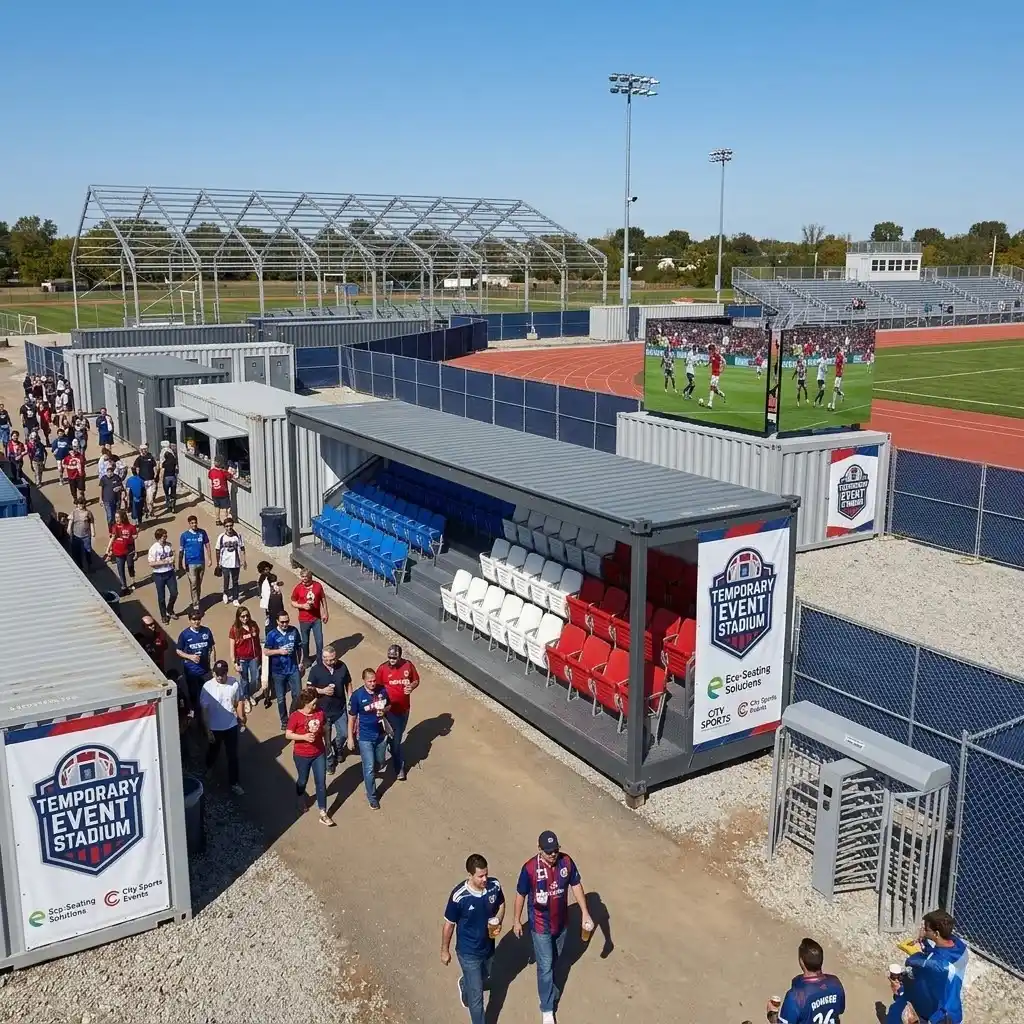
Temporary Sports Venues: Fast Deployment with Structural Stability
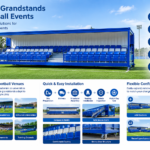
Grandstand for sport/Temporary sports spectator seating solutions
Container grandstand application in sports venues solves a clear problem: speed versus safety.
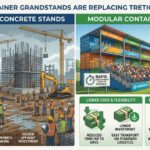
Steel container-framed modular seating reduces installation time by 70% compared to concrete bleachers.
Principle Explanation
The system uses Q235 galvanized steel with a yield strength of 235 MPa.
Load distribution follows EN 13200 stadium standards, ensuring 4–5 kN/m² live load capacity.
Short sentence.
Data Comparison
- Traditional concrete stands: 45–60 days construction
- Prefabricated grandstand system: 1-3 days installation
- Labor reduction: 40% fewer workers required
- Foundation depth: reduced from 1.5m to 0.3m
Case Reference
A Southeast Asia football event deployed 3,000 seats using container grandstands.
Total project time dropped from 52 days to 11 days.
Revenue generation started 41 days earlier.
Economic Benefit
Earlier operation equals direct cash flow.
Assuming $8 ticket revenue per seat, the early opening generated $984,000 additional income.
Event and Festival Seating: Flexible Capacity Scaling
Grandstand for festival-New spectator stand solutions
Event organizers face fluctuating audience sizes.
Container grandstand application enables scalable seating without permanent investment.

Principle Explanation
Modular units use bolt-connected frames with tolerance control under 2mm.
This allows expansion without structural misalignment.
Data Comparison
- Rental seating cost: $15–$25 per seat per event
- Container system amortized cost: $5–$8 per seat
- Setup time: reduced by 60%
- Storage footprint: reduced by 50%
Case Reference
A European music festival installed 5,000 modular seats.
They reused the system across 6 events annually.
Break-even achieved in 14 months.
Economic Benefit
Recurring revenue model.
ROI exceeded 180% within two years.
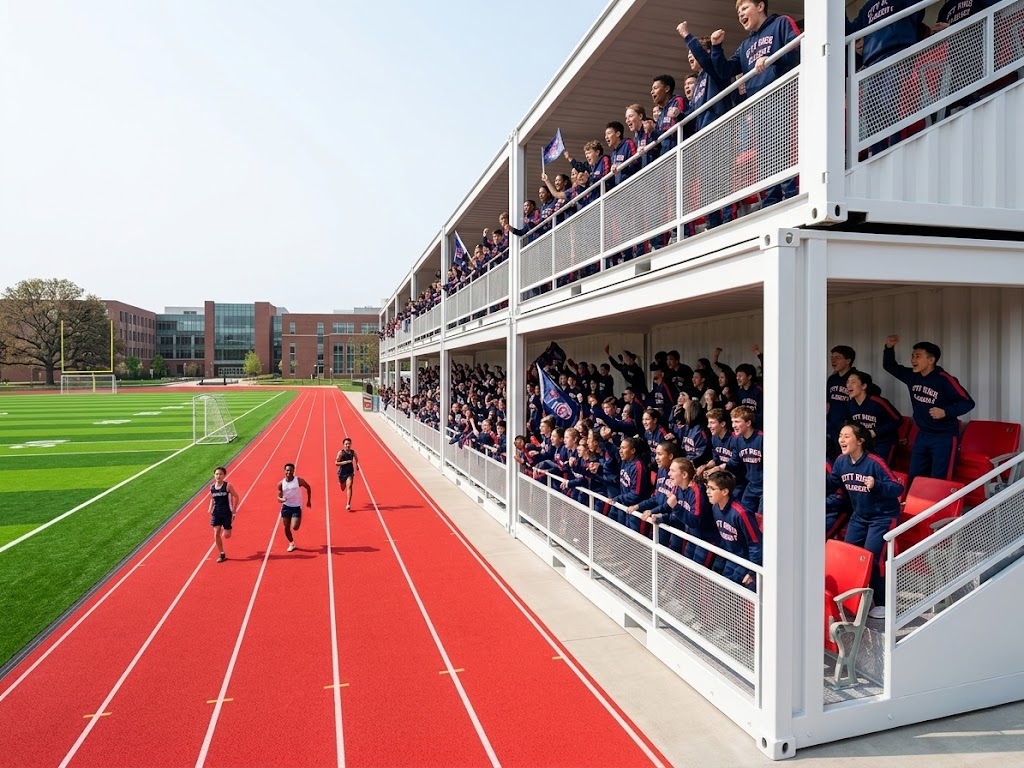
School and Community Sports Facilities: Long-Term Cost Control
Container Grandstand for School and Community
Public institutions demand durability and compliance.
Container grandstand application meets both without exceeding budget limits.
Data Comparison
- Concrete maintenance cycle: every 3–5 years
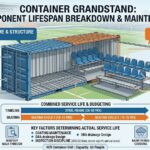
- Steel modular system maintenance: every 10 years
- Cost per seat: 30% lower over lifecycle
- Installation disruption: reduced by 80%
Case Reference
A South American school district installed 1,200 seats.
Construction avoided semester disruption.
Maintenance budget reduced by $45,000 over 5 years.
Economic Benefit
Predictable expenses.
Better budget allocation for education programs.
Presidential Inaugurations: Rapid Deployment & High-Security Seating
Bleacher for ceremonies/Seating Solutions for Outdoor Events
Inauguration planners must accommodate massive crowds in temporary high-security zones with zero tolerance for structural failure.
The container grandstand application provides a heavy-duty, rapidly deployable solution for VIP and public viewing areas.
Principle Explanation
Modular shipping container units serve as both the foundation and the structural skeleton. Each unit features reinforced ISO corner castings and integrated stairwells, ensuring the center of gravity remains low even at maximum capacity.
This “plug-and-play” architecture allows tiered seating to be stacked and locked using industrial twist-locks, providing wind-load resistance that traditional scaffolding cannot match.
Data Comparison
Traditional Scaffolding Cost: Labor and rental costs average $20–$30 per seat.
Container System Cost: Amortized logistics and deployment costs reduced to $8–$12 per seat.
Assembly Efficiency: Setup time reduced by 70% (from 14 days down to 3–4 days).
Logistics Density: Seating components are packed inside the containers during transit, requiring 40% fewer transport vehicles.
Case Reference
2025 Inaugural Parade Route Project:
A temporary 10,000-seat grandstand was erected along the parade route using modified 40ft containers.
Security Integration: Base containers were repurposed as secure checkpoints and equipment storage hubs.
Weather Resilience: Sustained 40mph gusts without the vibration or swaying common in pipe-and-drape seating.
Site Restoration: Full teardown completed within 48 hours with minimal impact on historical grounds.
Economic Benefit
Lifecycle Versatility: Units can be rebranded and redeployed for national holidays or state funerals, maximizing municipal budget efficiency.
Asset Liquidity: Unlike scrap scaffolding, containers retain high resale value or can be converted into permanent storage post-service.
Labor Savings: Standardized modular connections lead to a 65% reduction in recurring
Solution Strategy for Importer Purchasers
Choosing the right container grandstand application depends on three measurable factors:
project duration, seating capacity, and reuse frequency.
- Short-term projects → prioritize modular seating solution with high turnover
- Medium-term projects → balance durability and transport cost
- Long-term projects → optimize lifecycle cost with prefabricated grandstand system
Short sentence.
A buyer importing 5,000 seats across 3 projects can reduce total ownership cost by 35%.
Standardizing components also cuts spare parts inventory by 40%.
Summary
| Application Scenario | Key Advantages | Deployment Time & Efficiency | Real Case Example | Economic Benefit |
| Temporary Sports Venues | Structural stability + fast setup Meets EN 13200 standards 4–5 kN/m² load capacity | 1–3 days (vs 45–60 days concrete) 40% less labor 0.3m foundation (vs 1.5m) | Southeast Asia football event (3,000 seats) | Project time reduced from 52 to 11 days +$984,000 extra ticket revenue |
| Event & Festival Seating | Flexible & scalable capacity Easy expansion & reuse | Setup time reduced by 60% 50% smaller storage footprint | European music festival (5,000 seats, reused 6x/year) | Break-even in 14 months ROI >180% in 2 years |
| School & Community Facilities | Long-term durability Minimal disruption Low maintenance | Minimal site disruption (80% less) | South American school district (1,200 seats) | Maintenance budget reduced by $45,000 over 5 years |
| Presidential Inaugurations & High-Security Events | High-security integration Weather & wind resistance Plug-and-play system | 3–4 days (vs 14 days scaffolding) 70% faster setup Teardown in 48 hours | 2025 Inaugural Parade (10,000 seats using 40ft containers) | High resale value Multi-use (holidays, funerals) 65% labor savings |
This article lists the common application scenarios of the spectator containers that we have discovered. According to the summary of our sales team, the most common usage scenarios for the grandstand containers are for club members to watch sports games and for sale to rental companies for event rentals.
The stadium container serves as an outdoor modular solution. It can be applied to all types of outdoor stadium uses. We will continuously monitor the usage scenarios and precautions of the stadium container and update accordingly.
 English