Grandstand for School and Community Solutions: Cut Cost, Scale Capacity
A modern grandstand for School and Community must deliver speed, safety, and profit. Buyers no longer accept slow builds or fixed layouts. This guide explains how modular grandstand systems solve real procurement problems with engineering logic and measurable returns.
Why Traditional Grandstand for School and Community Projects Fail Under Budget Pressure
Concrete structures fail when budgets tighten. The numbers prove it.
Concrete grandstands cost between $350 and $600 per seat. A modular grandstand for School and Community averages $220 per seat. The difference exceeds 60 percent.
Here is the breakdown.
- Phenomenon: construction delays and capital lock
- Principle: cement hydration requires a 28-day curing cycle under ASTM standards
- Data: total build cycle reaches 90 to 150 days, while modular systems complete in 10 to 30 days
- Economic outcome: idle capital increases financing cost by 15 to 25 percent
Land usage also exposes inefficiency. Concrete designs require 0.75 square meters per seat. Modular systems reduce this to 0.55 square meters through tier optimization. That creates 27 percent more seating on the same land.
Case evidence:
A Southeast Asia school replaced a concrete system with a modular grandstand for School and Community.
- Capacity increased from 600 to 820 seats
- Build time reduced from 110 days to 20 days
- Annual ticket revenue increased by 38 percent
Revenue grows.
2. Structural Engineering Principles Behind Modular Grandstand for School and Community Systems
Steel systems solve stress distribution problems at the source.
Three engineering mechanisms drive performance.
Load Distribution Through Triangular Frames
- Phenomenon: point load causes structural fatigue in flat systems
- Principle: triangulation spreads force across multiple nodes
- Data: load capacity reaches 5.0 kN per square meter under EN 13200 standard
- Economic outcome: maintenance cost drops by 70 percent over ten years
Bolted Assembly System
Welded systems slow installation. Bolted systems accelerate deployment.
- Installation team: 6 workers
- Assembly speed: 6 to 8 hours per unit module
- Labor reduction: 50 percent compared to welded structures
This improves project turnover.
Anti-Corrosion Protection Layer
- Coating thickness: 80 to 120 microns
- Salt spray resistance: over 500 hours under ISO 9227 testing
Case:
A coastal school project used a modular grandstand for School and Community system.
- Corrosion rate reduced from 7 percent to below 1 percent annually
- Replacement cycle extended from 5 years to 15 years
- Lifecycle cost reduced by over 45 percent
Durability drives savings.
3. Capacity Planning Strategy for Grandstand for School and Community Projects
Wrong capacity leads to lost revenue or wasted investment.
Capacity must match real usage patterns.
Event Frequency Analysis
- School events: 12 to 20 per year
- Community events: 8 to 15 per year
Peak Load Calculation
Peak capacity must include a safety factor.
- Formula: average attendance multiplied by 1.3
- Example: 600 average attendance becomes 780 peak capacity
Space Efficiency Advantage
Modular systems reduce spacing while maintaining safety.
- Concrete: 0.75 square meters per seat
- Modular: 0.55 square meters per seat
- Gain: 27 percent more seats
Revenue Impact Calculation
- Ticket price: $5
- Additional seats: 180
- Events per year: 20
- Annual gain: $18,000
Case:
An African community installed a 1,000-seat modular grandstand for School and Community.
- Land saving reached 220 square meters
- ROI achieved in 14 months
- Event utilization increased by 32 percent
Efficiency converts to profit.
4. Logistics and Deployment Efficiency for Importers and Wholesalers
Transport design determines margin.
Flat-Pack Container Strategy
- One 40HQ container holds 120 to 150 seats
- Volume reduction reaches 65 percent
Shipping cost drops.
Installation Timeline Advantage
Concrete requires heavy equipment and long preparation. Modular systems avoid both.
- Modular installation time: 10 to 25 days
- Labor requirement: 6 to 8 workers
- Equipment: light lifting tools only
Compliance Standards
A qualified grandstand for School and Community must meet:
- EN 13200 for spectator safety
- ISO 9001 for manufacturing control
- Wind resistance of 120 kilometers per hour or higher
These reduce legal and operational risk.
Scalability After Installation
- Add 100 seats within one day
- Relocation cost stays below 15 percent of initial investment
Case:
A Latin America distributor imported modular grandstands.
- Delivered 450 seats in 12 days
- Split into three school projects
- Achieved 28 percent profit margin
5. How to Select the Right Grandstand for School and Community Supplier
Supplier selection determines defect rate and delivery time.
A reliable supplier must provide verifiable data.
Key Technical Requirements
- Steel grade: Q235 or higher
- Coating report: minimum 80 microns
- Load test certification: EN 13200 compliance
- Installation manual with manpower details
- Export history across at least five countries
Cost Breakdown Example for 500 Seats
- Product cost: $75,000
- Shipping cost: $8,000
- Installation cost: $5,000
- Total investment: $88,000
Concrete alternative exceeds $210,000.
Savings exceed $120,000.
Case:
A European importer switched to a modular grandstand for School and Community supplier.
- Defect rate reduced from 6 percent to 0.8 percent
- Delivery time reduced from 45 days to 12 days
- Customer satisfaction increased by over 30 percent
Quality control drives repeat orders.
Deployment Strategy: Turning Grandstand for School and Community Into a Revenue Asset
Execution defines financial outcome.
Step One: Site Preparation
- Ground leveling tolerance: within 5 millimeters
- Foundation type: concrete blocks or steel pads
- Time required: 2 to 3 days
Step Two: Installation Phase
- Frame assembly: 3 days
- Seating installation: 4 days
- Safety inspection: 1 day
Total deployment: under 10 days
Short.
Step Three: Revenue Activation
- Event scheduling starts immediately after inspection
- Payback period ranges from 12 to 18 months depending on usage frequency
Case:
A Middle East school deployed a 900-seat modular grandstand for School and Community.
- Installation completed in 9 days
- Hosted first event within 2 days
- Generated $22,000 revenue in first quarter
Fast deployment accelerates cash flow.
Summary
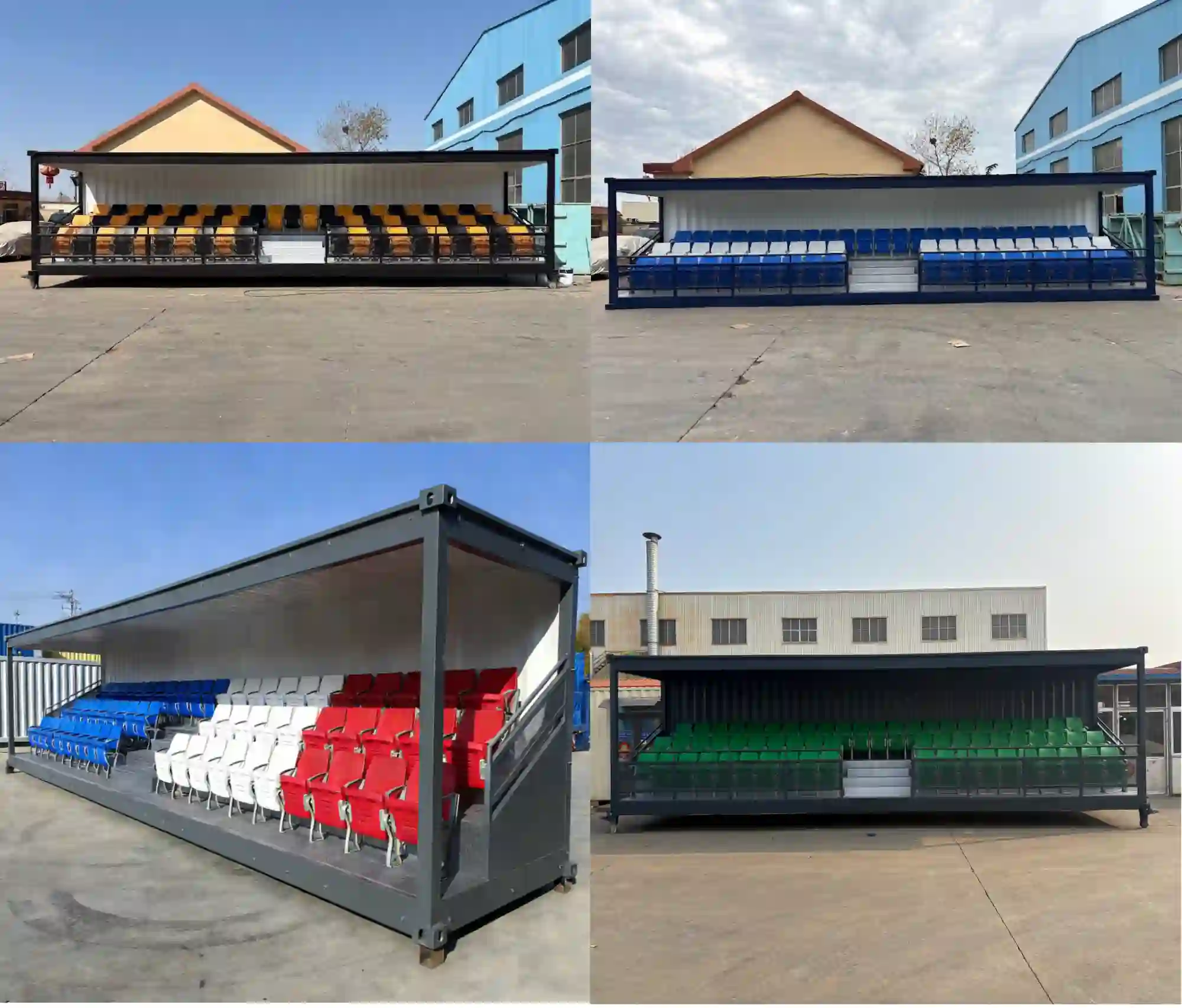
Each school’s and community project’s container bleachers include:
Layout design based on actual attendance data
Structural calculations based on local wind loads
Container loading optimization to reduce shipping costs

 English