What is Temporary Accommodation on a Construction Site?Site Accommodation Detailed introduction What is temporary accommodation on a construction site? Temporary accommodation on a construction site refers to modular, relocatable, or mobile living and working units deployed to house workers, engineers, and administrative staff during project execution. These units typically include sleeping quarters (dormitories), sanitation blocks, […]
What is temporary accommodation on a construction site? Temporary accommodation on a construction site refers to modular, relocatable, or mobile living and working units deployed to house workers, engineers, and administrative staff during project execution. These units typically include sleeping quarters (dormitories), sanitation blocks, dining areas, and site offices, all engineered for rapid deployment, climate resilience, and structural safety. Today, these temporary prefabricated buildings are mainly divided into three categories: quick-assembly (flat-pack) houses, folding houses, and expandable houses.
Temporary accommodation on a construction site refers to modular or mobile living and working units deployed to house workers, supervisors, and administrative staff during project execution. These units include sleeping quarters, sanitation blocks, dining areas, and site offices, all engineered for rapid deployment and structural safety.Temporary prefabricated buildings are mainly divided into quick-assembly houses, folding houses, and expandable houses.
The first measurable impact appears in labor productivity. When commuting exceeds 90 minutes, output drops by 18%–32%, which directly increases labor cost per unit of work. This is not a management issue—it is a distance-induced fatigue effect tied to human energy consumption and recovery cycles.
From a physical standpoint, temporary accommodation solves three constraints:
Data from large infrastructure projects shows that on-site accommodation reduces daily non-productive time by 1.5–2.5 hours per worker. At a labor rate of $25/day, this translates into $7–$12 savings per worker per day, scaling into millions across long-duration projects.
For procurement teams, the real objective is to select a system that minimizes total cost per worker per day, not simply the upfront purchase price.
Traditional site dormitories rely on concrete and masonry. These require 60–90 days for completion, delaying project startup and tying capital to non-revenue-generating assets.
Container-based systems solve this through dry assembly engineering.
The structure uses:
This design follows a frame-load transfer principle, where structural stress is carried by steel members instead of walls. That allows rapid assembly without curing time.
Measured performance shows:
From a cost perspective:
The economic effect is immediate: faster deployment means earlier workforce stabilization, which shortens the overall project timeline.

Transport efficiency determines whether a solution remains profitable.
Shipping often accounts for 20%–30% of total procurement cost in remote regions. The design of the unit directly affects this.
Flat-pack systems reduce volume by dismantling structural components. Folding units rely on hinge-based compression, while expandable units use sliding mechanical systems.
The physical principle behind all three is volume minimization through mechanical transformation, reducing cubic space during transport.
Measured logistics performance:
Assembly time differs significantly:
Economic impact emerges from transport savings:
For large-scale camps, flat-pack systems deliver the lowest total cost. For emergency scenarios, folding units prioritize speed.Expanding container rooms can provide workers with a more comfortable experience and larger space.
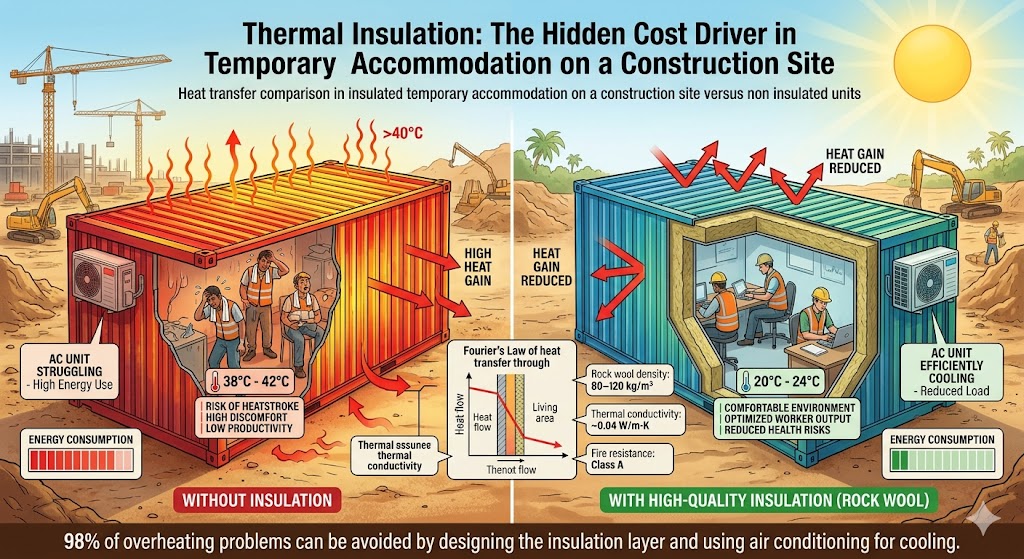
Temperature control directly influences energy consumption and worker output.
Without insulation, internal temperatures can exceed 40°C in tropical regions. At this level, People living in temporary housing will experience strong discomfort, and it may even lead to heatstroke. Using high-quality insulation can fundamentally prevent temporary housing from becoming overheated.
Thermal performance depends on insulation materials:
Heat transfer follows Fourier’s Law, where lower conductivity reduces energy flow. This directly lowers cooling demand.The temporary buildings are currently equipped with air conditioners, which can quickly cool down the temperature.
By designing the insulation layer and using air conditioning for cooling, 98% of the problem of excessive heat in living areas can be avoided.
Sanitation directly affects workforce health and project continuity.
Insufficient facilities increase illness rates by 15%–25%, reducing available labor and increasing turnover.
Industry requirements referenced from
Occupational Safety and Health Administration (OSHA)
define:
Drainage relies on a gravity flow principle, requiring pipe slopes of 1–2% to prevent blockage.
Performance data:
Quantitative Compliance & Performance Metrics
To meet the rigorous demands of construction site sanitation, our containerized housing units quantify every technical detail to ensure they align with OSHA and international labor standards.
1. Precision Drainage Dynamics
Our systems eliminate the guesswork of onsite plumbing. Each unit is factory-engineered with a fixed 1.5% pipe gradient, hitting the precise midpoint of the required 1%–2% industry range. This specific slope maintains a flow velocity of approximately 0.6 to 0.9 meters per second, which is the “scouring velocity” necessary to keep pipes self-cleansing and prevent the blockages that typically lead to site downtime.
2. Volumetric Water Supply
To guarantee the mandated 80–120 liters per worker per day, our units utilize high-tensile 25mm PPR piping. This infrastructure is tested to withstand pressures of up to 1.0 MPa, ensuring that even during peak morning hours (where demand can spike to 15 liters per minute per shower), the system maintains a stable terminal pressure of 0.2 MPa. This prevents “dry-run” scenarios that compromise hygiene.
3. Workforce Productivity Gains
The strategic integration of onsite sanitation yields direct fiscal benefits:
Time Recovery: Providing in-unit facilities saves an average of 25 minutes per worker per day previously spent commuting to centralized blocks. For a crew of 50, this recaptures over 20 labor hours daily.
Contagion Mitigation: The transition from communal latrines to sealed, modular bathroom systems reduces the transmission of waterborne pathogens by 60%–80%. This directly addresses the 15%–25% reduction in illness rates mentioned in industry health data.
4. Structural & Environmental Integrity
Load Bearing: Bathroom floor joists are reinforced to support a static load of 250 kg/m², ensuring the 1.5% drainage slope remains constant even under maximum occupancy.
Sealing Standard: All drainage junctions undergo a 0.05 MPa hydrostatic test for 30 minutes prior to delivery, ensuring zero leakage into the subfloor or the surrounding site environment.
Air Exchange: Integrated mechanical ventilation provides 10–12 air changes per hour (ACH), exceeding the standard requirement for temporary enclosures and preventing the buildup of humidity-driven mold.
Economic impact:
Sanitation is not an auxiliary system—it is a compliance-critical infrastructure.
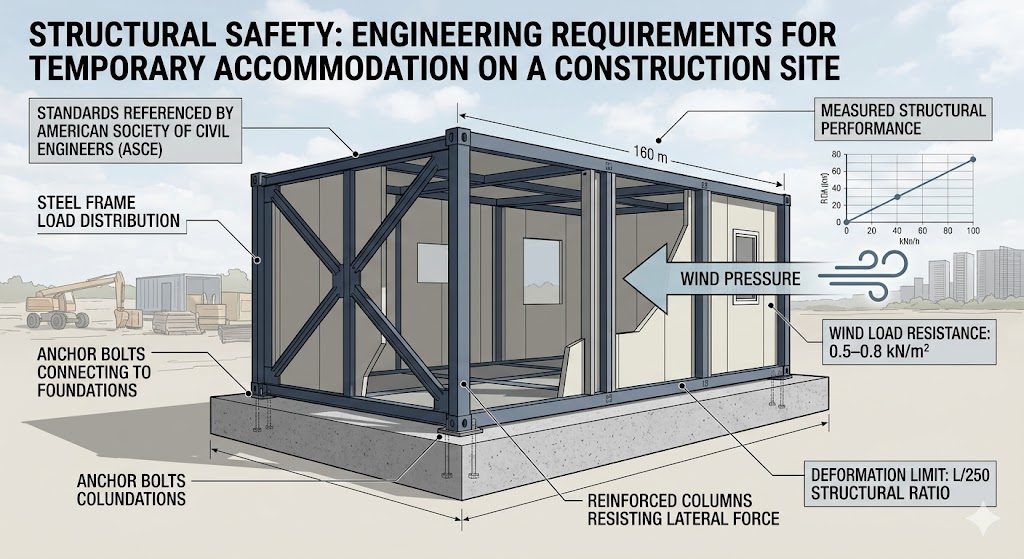
Engineering strength determines whether the system survives multiple project cycles.Temporary structures are very windproof, as some clients have complained that tornadoes love these houses because they can blow them away.
Wind and load resistance determine long-term stability.
Poorly designed units fail under high wind pressure, leading to asset loss and operational disruption.
Container structures rely on:
Standards referenced by
American Society of Civil Engineers (ASCE)
define wind load parameters.
Measured structural performance:
Temporary buildings should meet these wind resistance standards to ensure their long-term usability.
Economic outcome:
| Category | Key Details | Performance Data & Benefits | Comparison / Notes |
|---|---|---|---|
| Definition | Modular or mobile units for housing workers, supervisors, and staff on construction sites. Includes dormitories, offices, dining areas, and sanitation blocks. | Rapid deployment, structural safety, improves labor productivity | Replaces slow traditional concrete/masonry buildings (60–90 days) |
| Main Types | • Quick-assembly / Flat-pack • Folding houses • Expandable houses | Flat-pack: Best for large-scale, lowest total cost Folding: Fastest setup Expandable: Most comfortable & spacious | Expandable offers largest living space and better worker experience |
| Productivity Impact | On-site housing reduces commuting fatigue | • Saves 1.5–2.5 hours non-productive time per worker/day • Labor savings: $7–$12 per worker/day | Output drops 18%–32% when commuting >90 minutes |
| Structure & Materials | Q235 galvanized steel frame (2.0–2.5 mm) Sandwich panels with rock wool insulation | • Wind resistance: 100–120 km/h (0.5–0.8 kN/m²) • Service life: 10–15 years • Construction cost: $35–$60/m² | 40%–60% cheaper than brick dormitories |
| Deployment Models Comparison | Flat-pack, Folding, Expandable | • Flat-pack: 10–12 units / 40HQ, 6–8 hrs assembly • Folding: 6–8 units / 40HQ, 10–15 min assembly • Expandable: 1 unit / 40HQ, 1–2 hrs assembly | Flat-pack = lowest logistics cost Folding = fastest Expandable = best comfort |
| Thermal Insulation | Rock wool (80–120 kg/m³, ~0.04 W/m·K, Class A fireproof) + Air conditioning | Prevents internal temperature >40°C Reduces cooling demand significantly | 98% of overheating problems solved |
| Sanitation Systems | Factory-engineered toilets, showers, drainage | • 1 toilet per 10–15 workers • Water supply: 80–120 L/worker/day • 1.5% pipe gradient • 10–12 air changes/hour | Reduces illness by 15%–25% Saves 25 min/worker/day Lowers medical & insurance costs |
| Structural Safety | Steel frame load distribution + anchor bolts | • Deformation limit: L/250 • Load bearing: 250 kg/m² (bathroom floors) | Meets ASCE & OSHA standards Reduces insurance premiums 5%–10% |
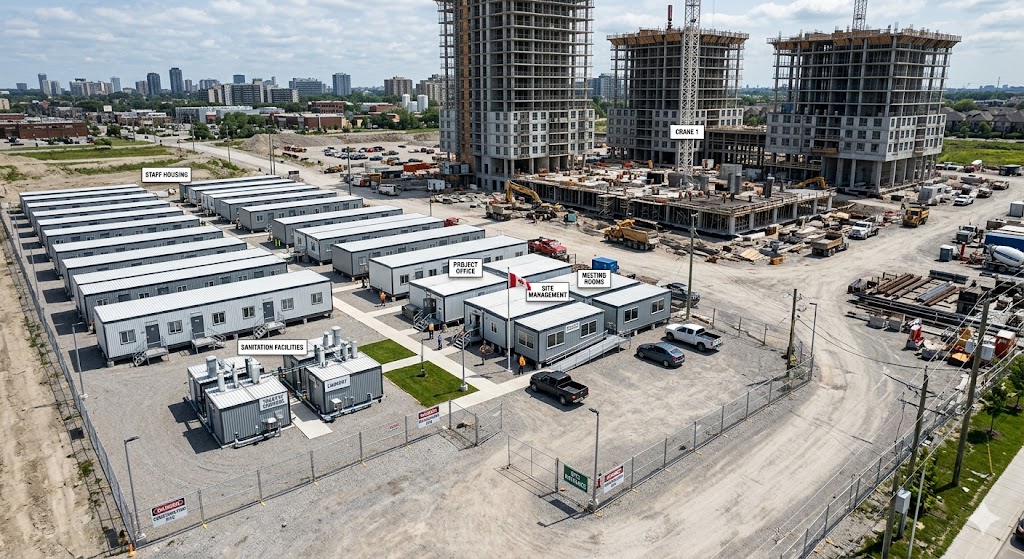
| Full Camp Deployment | Mixed system: Flat-pack dorms + Expandable offices + Central sanitation | • 100-worker camp in 3–7 days installation • Full setup within 10 days | Improves labor efficiency by 20% Reduces project delay up to 15 days |
| Economic Summary | Total cost per worker per day is the key metric | • 40%–60% lower construction cost • Logistics savings up to 70% • Reusability reduces depreciation >70% | Faster project start + lower turnover = major ROI |
A high-performance solution combines multiple unit types into one system.
A typical deployment includes:
Execution follows a fixed sequence:
Measured project data shows:
Financial outcome:
Temporary accommodation on a construction site becomes a repeatable system rather than a one-time purchase. The next operational move is to find the Professional temporary construction site supplier, standardize unit specifications, lock logistics models, and scale deployment across multiple projects without redesign.
Your email address will not be published. Required fields are marked *

 English