News

How to find temporary accommodation supplier?

05.12.2026

Key options for Choosing a Temporary Accommodation Supplier: A Practical Buyer’s Framework for Importers and Wholesalers Temporary prefabricated houses are an important part of the project on the construction site, ensuring that the construction workers have daily rest. Selecting the right temporary accommodation supplier defines your project margin, delivery speed, and long-term asset value.A wrong […]

Key options for Choosing a Temporary Accommodation Supplier: A Practical Buyer’s Framework for Importers and Wholesalers

Temporary prefabricated houses are an important part of the project on the construction site, ensuring that the construction workers have daily rest. Selecting the right temporary accommodation supplier defines your project margin, delivery speed, and long-term asset value.
A wrong supplier increases total cost by 18–35% across logistics, rework, and lifecycle maintenance.

This article will explain how to select a suitable Temporary Accommodation company based on the requirements of your own project and your own company.

temporary-accommodation-on-a-construction Common forms:expandable container house and flat packing container


Start with the Temporary Accommodation safety

For all products, safety is undoubtedly the most important factor.The following lists key safety considerations for temporary prefabricated structures. Choosing a supplier that can provide high-quality temporary housing for construction sites is important.

The first screening step is fire rating and structure. Skip marketing claims. Look at test data.

[Principle Explanation]
Fire safety depends on insulation core material. Rock wool achieves A (A1 non-combustible)a critical benchmark in standard fire tests of exterior wall assemblies, whereas EPS poses a significantly higher failure risk at lower temperatures. Due to its melting point above 1000°C. EPS burns at ~300°C. Structural stability depends on load distribution across steel columns. Wind resistance follows EN 1991-1-4 or similar standards.

[Data Comparison]

Rock wool panel: fire rating A1, density 100–120 kg/m³
EPS panel: fire rating B2, density 12–20 kg/m³
Steel frame (Q235, 2.3mm): wind resistance up to Level 10 (24.5 m/s)
Thin steel (1.2mm): failure risk increases by 40% under same load

The second step is to pay attention to the windproof level

[Principle Explanation]
Wind resistance in container structures is dictated by the structural yield strength and the integrity of corner connections. High-performance units utilize thick-gauge galvanized steel to lower the center of gravity and resist the lateral pressure of extreme weather. Anti-hurricane designs specifically focus on “uplift” prevention, utilizing reinforced base rails and specialized anchoring bolts to ensure the unit remains grounded during high-pressure cycles.

[Data Comparison]
A standard reinforced steel frame (3.0mm thickness) provides certified wind resistance up to Level 11 or 12 (speeds of 32.7 m/s), meeting “hurricane-proof” criteria for coastal areas. Conversely, a lightweight thin-steel frame (1.2mm–1.5mm) typically caps out at Level 8 or 9, where wind pressure exceeding 0.5 kN/m² creates a structural failure risk that is 45% higher than heavy-duty models.

Suppliers need to provide technical and production support

Supplier’s Manufacturing Capability: When a supplier has strong production and technical departments, they will: 1. Provide a complete set of solutions for temporary prefabricated buildings. 2. Offer production and technical support according to your customized requirements. 3. Support factory inspection services and have complete pre-sale and after-sale services. 4. Mass-produce prefabricated buildings, ensuring consistent product quality and reducing the likelihood of problems by 10%. 5.Complete and accurate temporary cabin delivery time
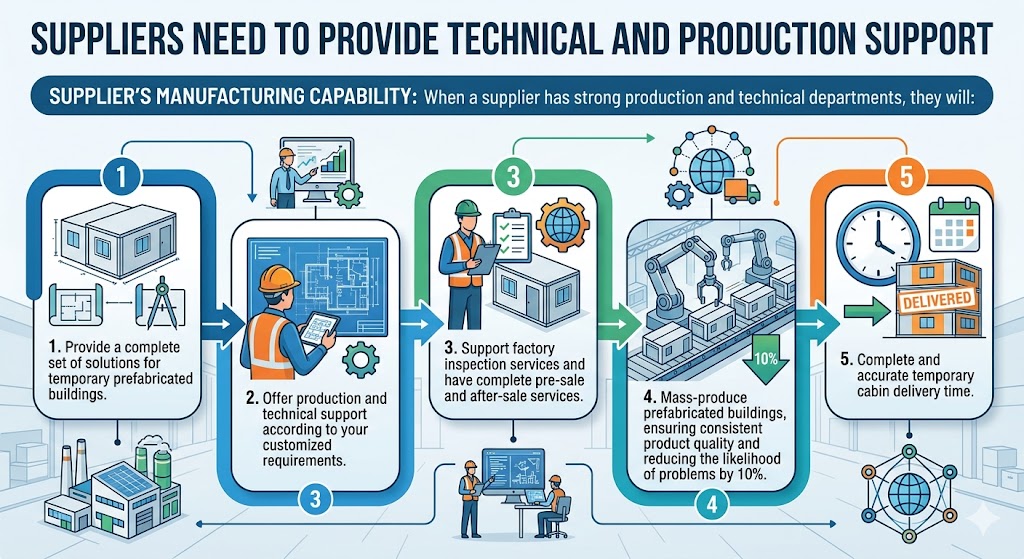
illustrates the five-step manufacturing capability process of a supplier with strong production and technical departments, starting with providing complete solutions for temporary prefabricated buildings and offering customized technical support based on specific requirements. The process continues with factory inspection services and comprehensive pre-sale and after-sale support, followed by mass production that ensures consistent quality while reducing potential problems by 10%, ultimately resulting in accurate and timely delivery of temporary cabins.


Compliance and Certification: Entry Barrier Defines Risk

A certified prefabricated building product represents verification by globally recognized authorities, ensuring third-party guarantees of quality and materials.

Uncertified temporary prefabricated buildings are prone to customs clearance and declaration issues.

Core certifications include ISO 9001 and the CE mark.

Approximately 30% of suppliers have missing documentation.

An example of delayed shipment:
21-day delay due to missing CE documentation
Port storage and fines totaling $9,500

Before shipping, it is essential to verify whether the supplier possesses internationally recognized certifications and the importer’s local certifications.
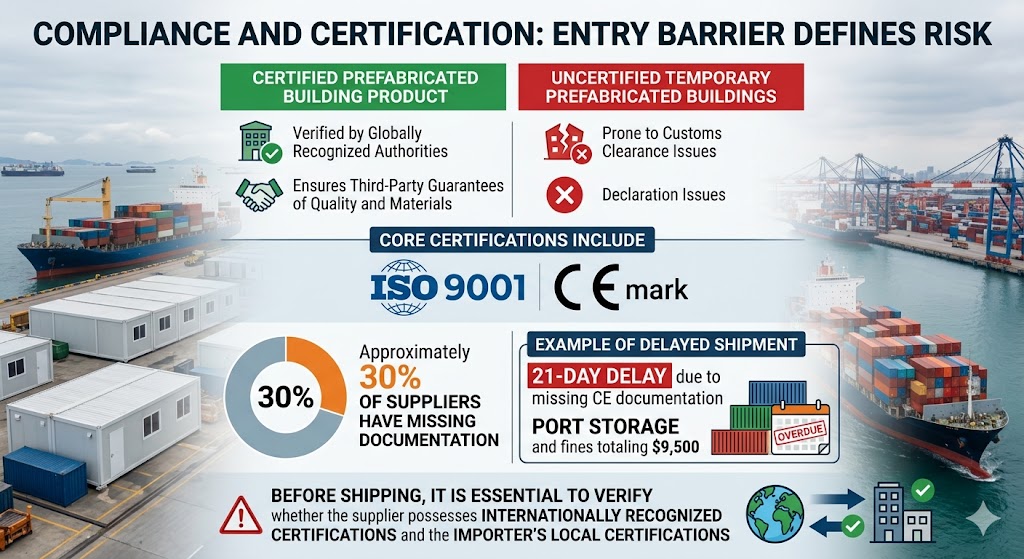
how compliance and certification mitigate risks in the prefabricated building industry by comparing certified products—which offer globally recognized quality guarantees—against uncertified ones that frequently face customs and declaration issues. It highlights that 30% of suppliers lack proper documentation and features a case study where missing CE mark or ISO 9001 certifications led to a 21-day shipment delay and $9,500 in fines. Ultimately, the graphic advises importers to verify all international and local certifications before shipping to avoid such costly logistical barriers.

Is there any case reference?

Select a supplier of temporary prefabricated structures that has prior experience supplying construction sites. A supplier with such project experience will readily understand the specific requirements you outline. Engaging with them will streamline your communication process and ensure you receive the most accurate pricing. Based on the specific conditions and operational needs of your site, they will pre-configure appropriate electrical systems and floor plans for the temporary housing units; furthermore, they will recommend the precise number of units required based on the size of your workforce.

iderations for different audiences

Professional suppliers can meet the needs of their clients based on their specific requirements.

wholesaler

The supplier will provide wholesalers with a wholesale price and a precise answer regarding product delivery time for wholesale projects. For large quantities, the supplier will offer the best packaging and shipping solutions to ensure savings in shipping time and costs.

importer

Ensure that the buildings are certified for both local and international markets, and that they can continue to be used after the project is completed.

Contractors

The supplier will provide contractors with a batch of readily usable temporary structures, which can be quickly assembled and put into use within one day. Customized production of temporary structures is supported to suit the specific terrain of the construction site. Workers’ living comfort is ensured by improving sound insulation, thermal insulation performance, ventilation, and lighting, thereby enhancing their quality of life.


Temporary Accommodation Price is not the The most important

During the procurement process, experienced buyers typically opt for the median quotation. This is because an excessively low price from a supplier often signals potential issues regarding product materials, certifications, or labor—factors that can compromise the service life and reusability of temporary structures, thereby accelerating the depreciation rate of fixed assets. Conversely, selecting an excessively high price suggests that the vendor may be a trading company, merely acting as an intermediary between the factory and the client to capture a profit margin.

The key factors for selecting suitable temporary site structures should be found here:

Recommended Supplier List

We have compiled a comprehensive list of temporary structure suppliers from around the globe, enabling buyers and importers to select the most suitable partners based on their specific requirements.

Conclusion: Turn Supplier Selection into a Measurable System

Evaluation DimensionKey CheckpointsRecommended Standard (Quality Supplier)Risk Warning (Avoid)Potential Impact
1. Safety PerformanceFire Rating Insulation Core Steel Thickness Wind ResistanceA1 Rock Wool (>1000掳C) Density 100-120kg/m鲁 3.0mm Q235 Steel Wind Resistance Level 11-12 (32.7m/s)EPS (B2, ~300掳C) 1.2-1.5mm Thin Steel Wind Resistance only Level 8-9Fire hazards, structural failure in extreme weather
2. Certification & ComplianceISO 9001 CE Marking Local Market CertificationsComplete and verifiable international + local certificationsMissing certifications (~30% of suppliers)Customs delays, fines, entry rejection
3. Manufacturing CapabilityProduction Scale Technical Support CustomizationOwn factory + professional technical team Factory audit supportTrading company only, no production capacityUnstable quality, no customization
4. Project ExperienceConstruction site supply casesProven experience with real project delivery and site-specific solutionsNo relevant project experienceInefficient communication, mismatched configurations
5. Delivery & ServiceDelivery Accuracy Pre- & After-sales SupportClear lead times + optimized packaging & logisticsVague promises, delays over 21 daysProject delays, extra costs
6. Pricing StrategyQuote Level Lifecycle CostMid-range pricing (best value)Extremely low (poor materials) or extremely high (middleman)Poor quality or eroded profit margins
7. Target UsersWholesalers Importers ContractorsWholesale pricing + best logistics Dual certifications + high durability 1-day fast installation + comfort optimizationCannot meet specific needsLow procurement efficiency, poor worker satisfaction

A professional temporary accommodation supplier delivers measurable engineering data, not claims.
Material grade, insulation system, production capacity, and logistics design define total project cost.

Importers and wholesalers applying this framework reduce cost by up to 40% while improving delivery speed and resale margin.

The next move is clear.
Audit your current temporary accommodation supplier, request data, verify factory, and test logistics efficiency before committing to your next bulk order.


Leave a Reply

Your email address will not be published. Required fields are marked *

Post Comment
Index