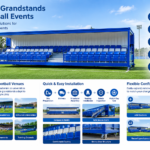
Portable Grandstands for Football Events: Flexible Seating Solutions for Clubs and Tournaments Football is one of the world’s most popular sports, but not every football venue needs a permanent concrete stadium. Local football clubs, youth academies, amateur leagues, training grounds, schools, universities, and tournament organizers may only need additional spectator seating for specific matches or […]
Football is one of the world’s most popular sports, but not every football venue needs a permanent concrete stadium.
Local football clubs, youth academies, amateur leagues, training grounds, schools, universities, and tournament organizers may only need additional spectator seating for specific matches or seasons. In these situations, portable grandstands for football events provide a flexible alternative to permanent stadium construction.
A modern portable football grandstand can provide elevated spectator seating, clear sightlines, safe access, and professional match-day facilities while allowing the structure to be installed, expanded, dismantled, or relocated as requirements change.
Modular grandstand systems are already used for football clubs, stadiums, schools, arenas, and temporary sporting events, with seating capacity and layouts configurable to different venue conditions.
A portable football grandstand is a temporary or demountable spectator seating structure designed specifically for football pitches and other sports venues.
Depending on the project, a system may include:
The main difference between a portable grandstand and a conventional permanent stand is flexibility.
Instead of being permanently integrated into a stadium, a modular stand can be assembled at a football ground and potentially dismantled and reused at another location.
Some modular systems are specifically designed for temporary and permanent installations, allowing clubs to increase capacity for particular events and reuse the structure for future matches.
Football clubs can have very different seating requirements.
A small amateur club may need only a few dozen additional seats, while a tournament venue may need several hundred or several thousand additional spectator positions.
A portable grandstand allows the seating capacity to be matched more closely to the actual requirement.
One of the simplest reasons to install a portable football stand is to accommodate more spectators.
A club may experience higher attendance during:
Instead of constructing a permanent extension, a modular grandstand can provide additional seating for the required period.
Some commercial modular systems are available as individual seating blocks that can be connected to create larger banks of seats.
Football venues often have limited time between matches and other activities.
A portable grandstand can be manufactured or prepared in advance and then assembled at the venue.
The installation process generally involves:
Site Preparation → Delivery → Structural Assembly → Seating Installation → Stairs and Guardrails → Safety Inspection → Match-Day Use
The exact installation time depends on the size and type of grandstand.
Some modular suppliers offer factory-built systems that are delivered substantially assembled, while other systems are assembled from modular frames on site.
A football ground may change over time.
The club may expand its spectator capacity, renovate an existing stand, change the pitch layout, or temporarily increase seating for a tournament.
A modular grandstand makes these changes easier.
Depending on the system, sections can be:
This makes portable grandstands particularly attractive to growing football clubs.
Football clubs are one of the key users of modular spectator seating.
Smaller clubs may not have the budget or land required for a permanent stadium development.
A compact portable grandstand can provide professional spectator seating while keeping the initial infrastructure relatively flexible.
It can be used for regular league matches, local tournaments, community events, and special fixtures.
Youth football facilities frequently host tournaments involving multiple teams and visiting spectators.
Portable seating can provide additional capacity without permanently changing the training ground.
A modular system can also be moved or reconfigured as the academy develops.
Larger clubs may use temporary grandstands during stadium renovation or expansion.
For example, a portable stand can provide additional seating while a permanent section of the stadium is being upgraded.
This can help maintain spectator capacity during construction.
Football tournaments can generate significantly higher attendance than regular league matches.
This makes temporary spectator seating particularly useful.
Tournament organizers may need to accommodate:
A modular grandstand can be combined with other temporary facilities to create a complete tournament venue.
Container-based grandstand solutions can also integrate enclosed spaces below or beside the seating area for storage, offices, hospitality, and other event functions.
A successful football grandstand needs to do more than provide seats.
The design should consider the complete spectator experience.
Spectators need a clear view of the football pitch.
Important factors include:
Elevated seating can provide better visibility over spectators in front and improve the overall viewing experience.
A football grandstand should provide clear routes for spectators to enter and leave their seating areas.
The layout may include:
Entrance → Concourse → Stair → Aisle → Seat
Emergency routes should also be clearly planned.
For larger stands, the number and width of stairs, aisles, exits, and access routes need to be designed according to the applicable local regulations and spectator capacity.
Accessibility should be incorporated into the design from the beginning.
Depending on local requirements, the grandstand may need accessible seating positions and suitable routes for wheelchair users and spectators with reduced mobility.
Some commercial football grandstand systems offer dedicated wheelchair seating options as part of the modular configuration.
Football clubs can choose between open seating and covered grandstands depending on the location and event requirements.
An open grandstand can be a practical choice when:
A roof can improve spectator comfort by providing protection from:
Covered seating may be particularly useful for clubs that host matches throughout the year.
However, adding a roof also affects structural design, wind loading, transportation, installation, and project cost.
Therefore, the decision should be based on the local climate and actual operating requirements.
For football projects that require more than spectator seating, container grandstands can provide an integrated solution.
A container-based grandstand can combine elevated seating with enclosed spaces underneath.
These spaces can potentially be used for:
Some modular container grandstand systems are specifically marketed for football pitches, school sports grounds, tournaments, and other outdoor sports venues.
This approach can help clubs maximize the value of the footprint beneath the grandstand.
Safety should always be a priority when installing temporary spectator seating.
A professional football grandstand should be engineered for the expected conditions and comply with the regulations applicable to the project location.
Important considerations include:
The structure needs to account for spectator loads and other applicable loads.
Outdoor football stands are exposed to wind, making wind loading and overall stability particularly important.
Guardrails and handrails should protect spectators at elevated areas, stairs, platforms, and exposed edges.
The stand should provide clearly defined evacuation routes appropriate for its capacity.
The installation surface needs to provide adequate support and stability.
Requirements can vary between countries and jurisdictions.
For example, EN 13200-6 specifically addresses demountable spectator stands in Europe, while other regions may apply their own building, fire, accessibility, and event safety requirements.
The applicable requirements should therefore be confirmed before finalizing the design.
The required capacity is one of the first decisions a football club or event organizer should make.
A useful planning process is:
Expected Attendance → Required Seats → Number of Rows → Number of Modules → Overall Layout
The exact configuration will depend on the site and applicable regulations.
For example, one manufacturer offers modular football grandstand sections in different seating capacities, while other systems provide custom layouts according to the venue dimensions and required audience size.
This modular approach allows clubs to start with a smaller stand and potentially expand it as attendance increases.
Another important application is temporary seating during stadium redevelopment.
When an existing football stadium is being renovated, some seating areas may be unavailable for several months.
A temporary grandstand can help maintain spectator capacity during the construction period.
Potential applications include:
After construction is completed, the temporary structure can be removed or relocated.
Football clubs and event organizers should consider several factors before selecting a system.
Determine how many spectators need to be accommodated.
Check the available footprint, ground conditions, vehicle access, and surrounding facilities.
Consider the distance from the pitch and required seating height.
Determine whether a roof or additional weather protection is required.
Check the structural, fire, accessibility, evacuation, and spectator safety requirements applicable to the venue.
Ask the supplier about installation time, labor requirements, lifting equipment, and site preparation.
Check module dimensions, total weight, packing method, and transportation requirements.
If the stand will be used at multiple football grounds, choose a system designed for repeated assembly and dismantling.
The choice between portable and permanent seating depends on the club’s long-term plans.
| Feature | Portable Grandstand | Permanent Stand |
|---|---|---|
| Installation | Faster | Longer construction period |
| Mobility | Relocatable | Fixed |
| Reuse | High potential | Usually fixed to one venue |
| Flexibility | High | Lower |
| Initial infrastructure | Generally simpler | More extensive |
| Best for | Temporary and changing requirements | Long-term stadium use |
| Expansion | Modular options available | Requires construction work |
For a club with a permanent long-term stadium plan, a permanent stand may ultimately be the better investment.
For temporary capacity, stadium renovation, tournaments, or growing clubs, a portable grandstand can provide greater flexibility.
Although portable grandstands are often described as temporary seating, their value can extend well beyond a single event.
A well-designed modular system can potentially be used for:
Match 1 → Dismantle → Transport → Match 2 → Reconfigure → Tournament → Reuse
This makes modularity particularly valuable for football clubs, event contractors, and sports facility operators.
The more frequently the system can be reused, the more useful the original investment can become.
Portable grandstands for football events provide a flexible way to increase spectator capacity without committing to a permanent stadium construction project.
They can be used by football clubs, youth academies, schools, tournament organizers, training grounds, and professional sports venues.
The main advantages include fast installation, flexible capacity, modular configuration, relocation, and potential reuse.
For football projects that also require enclosed facilities, container-based grandstands can combine spectator seating with storage, offices, hospitality, and other supporting spaces.
The right solution should always be selected according to the number of spectators, site conditions, viewing requirements, weather, safety regulations, transportation, installation schedule, and future reuse plans.
With the right design and engineering approach, a portable football grandstand can provide a professional spectator experience while giving clubs and event organizers the flexibility to adapt their facilities as their needs change.
Your email address will not be published. Required fields are marked *


 English