7 différences clés entre les kits de maisons fabriqués aux États-Unis et les maisons préfabriquées de Chine : Guide de décision pour l’acheteur Fatigué des coûts élevés ? De plus en plus d’Américains importent directement des maisons de Chine. Face à la hausse des dépenses de construction aux États-Unis, de nombreux acheteurs comparent désormais activement les kits de maisons fabriqués aux États-Unis avec les maisons préfabriquées de Chine afin de réduire la pression budgétaire […]
Fatigué des coûts élevés ? De plus en plus d'Américains importent directement leurs maisons de Chine. Face à la hausse des dépenses de construction aux États-Unis, de nombreux acheteurs comparent activement les kits de maisons américains avec les maisons préfabriquées chinoises afin de réduire la pression budgétaire tout en maintenant la qualité. Ce guide décompose les différences réelles entre l'importation de maisons préfabriquées de Chine et le choix de kits de maisons américains fabriqués localement.
Lorsque l'on compare les kits de maisons américains avec les maisons préfabriquées importées de Chine, les facteurs décisifs ne sont souvent pas les chiffres sur le devis, mais plutôt le coût dédouané, les délais de livraison et la stabilité du fournisseur. Une seule erreur de calcul peut anéantir vos marges bénéficiaires.
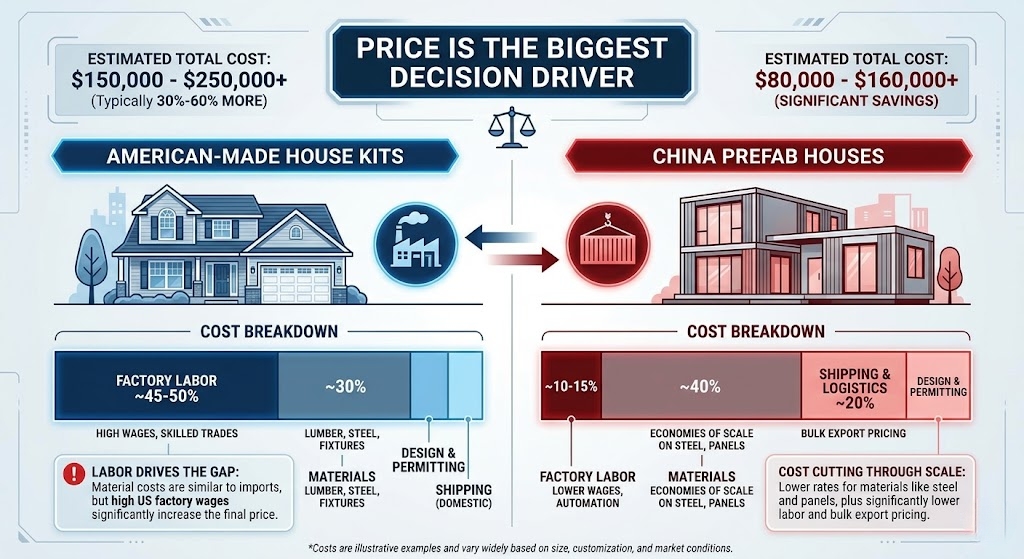
Le prix est le principal moteur de décision. Le principal moteur de décision est le prix. Aucun débat.
Les kits de maisons américains coûtent souvent 30 % à 60 % de plus que les unités préfabriquées importées. La main-d’œuvre explique cet écart. Le coût des matériaux reste similaire, mais les salaires des usines américaines font grimper le prix final.
Les maisons préfabriquées chinoises réduisent les coûts grâce à l’échelle. L’acier, les panneaux et la main-d’œuvre sont tous à des tarifs plus bas. La tarification en gros pour l’exportation réduit encore les coûts. La Chine dispose d’une ceinture industrielle de production de maisons-containers correspondante, ce qui permet un approvisionnement à grande échelle en matières premières et la sélection d’une main-d’œuvre adaptée à la production.
Pour les équipes d'approvisionnement, la vraie question n'est pas le prix — c'est le coût dédouané.
Ce devis alléchant d'un fournisseur chinois de maisons préfabriquées ? Ce n'est que le point de départ. Vous devez ajouter le transport maritime, les droits de douane, les frais portuaires et le camionnage intérieur jusqu'à votre site. Ensemble, ces frais supplémentaires ajoutent généralement 10 % à 25 % au prix de base d'une unité préfabriquée chinoise.
La Chine l'emporte généralement sur le coût initial, et cet écart est là où la marge commence — une marge pour personnaliser, absorber la volatilité du fret, ou surenchérir sur des concurrents qui dépendent de kits domestiques plus coûteux.
Alors, quel est le principal enseignement ? La Chine l'emporte sur le coût initial. Point final. Et c'est là que votre marge commence. L'écart entre ce que vous payez débarqué et ce que vous pouvez vendre ou valoriser le projet fini ? C'est du profit réel. Cela vous donne de la marge pour personnaliser, absorber la volatilité du fret, ou simplement surenchérir sur des concurrents coincés avec des kits domestiques plus chers.
Cela signifie-t-il que les kits américains ne sont jamais le bon choix ? Bien sûr que non. Si vous avez besoin d'une livraison la semaine prochaine, d'aucun tracas d'importation, ou d'une stricte conformité « Buy American », le calcul change. Mais pour la plupart des acheteurs en volume qui planifient à l'avance ? L'avantage du coût débarqué des préfabriqués chinois est difficile à ignorer.
Faites le calcul vous-même. Obtenez un devis CFR ou CIF complet, appelez votre transitaire, ajoutez une marge pour les droits de douane. Je pense que vous verrez ce que nous voyons : la marge commence ici.
Les retards tuent les affaires. Les retards de livraison sur une commande de 50 unités peuvent repousser un projet de 6 à 8 semaines — assez pour faire échouer une saison de construction.
Les fabricants américains offrent des délais de livraison nationaux plus courts, généralement de 4 à 8 semaines. Pas de risque de fret maritime. Pas de retards de dédouanement.
Les fournisseurs chinois de préfabriqués livrent la production en 20 jours. Produit hors saison. Rapide. Mais l’expédition prend 20 à 35 jours selon la destination.
Si votre projet se situe en Amérique du Nord et nécessite un déploiement rapide, les kits américains réduisent l’incertitude.
Si votre calendrier de projet permet une planification, les maisons préfabriquées chinoises montent en échelle plus rapidement pour les commandes en gros.
Réponse courte :
Si votre projet se situe en Amérique du Nord et nécessite un déploiement rapide, les kits américains réduisent l'incertitude. Si le calendrier de votre projet permet une planification, les maisons préfabriquées chinoises se déploient plus rapidement pour les commandes en gros.
Pour les projets avec un calendrier serré de seulement quelques semaines nécessitant une livraison ce mois-ci, les kits de maisons provenant des États-Unis sont le choix le plus sûr. Pour les commandes en gros de 20 unités ou plus — où le calendrier permet de planifier le fret maritime un à deux mois à l'avance — les maisons préfabriquées chinoises offrent un avantage plus significatif en termes de coût dédouané.
Les préoccupations concernant la qualité surgissent dans chaque transaction. Laissez-moi vous dire la vérité.
Je comprends. Vous regardez un devis de préfabriqué chinois, et au fond de votre esprit, vous vous demandez : “ Est-ce que cela va tenir aussi bien qu'une unité fabriquée aux États-Unis ? ”
Une préoccupation majeure pour de nombreux acheteurs est de savoir si la qualité des maisons préfabriquées fabriquées en Chine peut égaler celle des maisons produites dans les usines américaines. La réponse est oui — à condition de sélectionner le bon niveau de fournisseur.
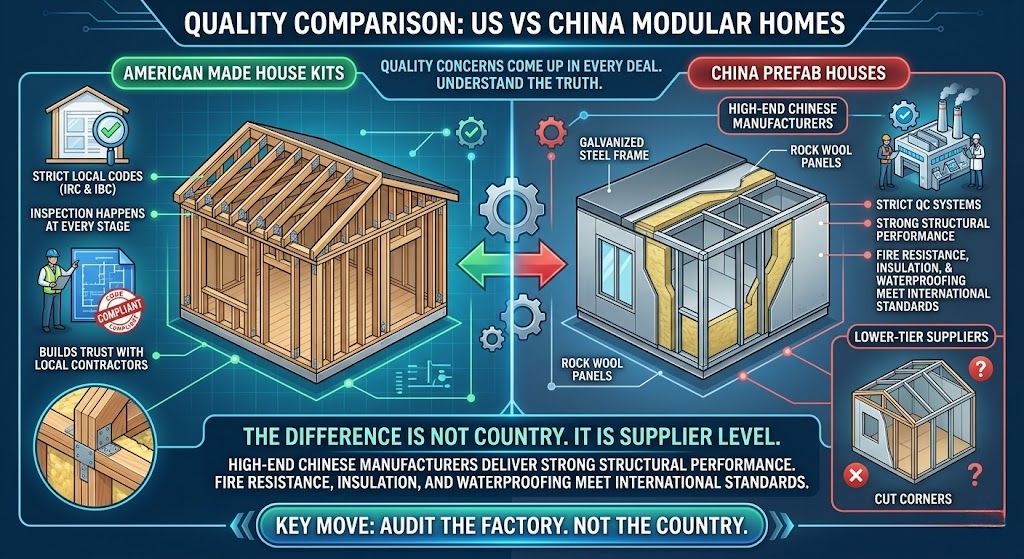
Les kits de maisons fabriqués aux États-Unis suivent des codes de construction locaux stricts —IRC, IBC, vous l'appelez. Des inspections ont lieu à chaque étape : charpente, électricité, isolation, visite finale. Ce niveau de supervision établit une grande confiance avec les entrepreneurs et inspecteurs locaux. Ils savent ce qu'ils obtiennent. Pas de surprises.
Les maisons préfabriquées chinoises varient considérablement selon le niveau du fournisseur.
Les usines de premier ordre utilisent des cadres en acier galvanisé qui ne rouillent pas, des panneaux de laine de roche qui isolent réellement et résistent au feu, et des systèmes de contrôle qualité stricts qui rivalisent avec tout ce qui se fait en Occident. Ces unités arrivent solides, d'équerre et prêtes pour le code.
Mais les fournisseurs de niveau inférieur rognent sur les angles. Acier fin. Mousse de qualité inférieure. Joints lâches. Vous économisez quelques sous au départ et vous payez plus tard avec des fuites, de la rouille et des maux de tête structurels.
Voici donc la vérité que personne ne veut dire à voix haute : la différence n'est pas le pays. C'est le niveau du fournisseur.
Un mauvais kit américain existe aussi – bien que rare. Et un fabricant chinois haut de gamme ? Ils offrent une performance structurelle solide, une vraie résistance au feu, une isolation appropriée et une étanchéité qui répond aux normes internationales. J'ai vu des unités survivre à des typhons, à la chaleur du désert et à des hivers glacials sans une seule défaillance.
La clé est de faire vos devoirs sur le fournisseur. Demandez les spécifications des matériaux. Exigez une inspection par un tiers. Visitez l'usine si vous le pouvez. Ne vous contentez pas de chercher le prix le plus bas.
Parce que lorsque vous vous approvisionnez auprès du bon fabricant chinois, vous ne sacrifiez pas la qualité. Vous obtenez un produit de qualité américaine à un coût débarqué qui a réellement du sens pour votre résultat net.
Action clé :
Auditez l’usine. Pas le pays. Lors du choix des fournisseurs chinois, n’insistez pas sur le principe de priorité au prix le plus bas. Choisissez plutôt des maisons-containers à prix moyens et assurez-vous de bien comprendre les matériaux utilisés dans les maisons-containers..
Ce qui a l'air bien sur le papier doit souvent être ajusté une fois sur le terrain. Peut-être que le client veut une chambre supplémentaire. Peut-être que la pente du toit doit changer pour la charge de neige. Peut-être qu'ils veulent la cuisine sur le mur opposé. Des petites choses qui font ou défont une vente.
Les kits de maisons américains ont tendance à vous résister sur ce point. Ils sont livrés avec des modèles fixes – choisissez parmi trois ou quatre agencements, choisissez une couleur, terminé. Vous voulez quelque chose de différent ? C'est un “ travail personnalisé ”. Et cela signifie des coûts plus élevés et des délais plus longs. J'ai vu des changements simples ajouter des semaines à la livraison. Pour un promoteur essayant de respecter une échéance, c'est un problème.
Les usines de préfabriqués chinoises fonctionnent sur un modèle complètement différent. Les systèmes modulaires sont conçus pour la flexibilité dès le départ. Agencements, tailles, configurations intérieures – vous pouvez modifier presque tout sans réinventer la roue. Les lignes de production sont configurées pour gérer efficacement les variations, pas pour les pénaliser.
Alors, que pouvez-vous réellement ajuster ? Beaucoup de choses :
Agencement des pièces – déplacer des murs, combiner des espaces, ajouter une avancée. Tout ce que le site exige.
Matériaux des murs – plaques de plâtre, contreplaqué, lambris, même du carrelage dans les zones humides. Échangez en quelques secondes.
Systèmes de toiture – plat, en pente, isolé, avec débords. Adaptez-vous au climat local.
Configuration électrique – prises, interrupteurs, éclairage, panneaux de disjoncteurs. Disposez-les comme votre marché l'attend.
Pour les promoteurs et les distributeurs, cette flexibilité débloque davantage de segments de marché. Vous n'êtes pas coincé à vendre la même boîte à tout le monde. Vous voulez cibler les locations de vacances haut de gamme ? Améliorez les finitions. Vous avez besoin de logements pour travailleurs à petit budget ? Réduisez l'essentiel. Un fournisseur, une ligne de production, des dizaines de variations de produits.
C'est le véritable avantage de s'approvisionner en Chine. Pas seulement le prix. La capacité de dire “ oui ” quand un client demande quelque chose de différent. Et dans ce métier, c'est comme ça que vous gagnez des clients fidèles.
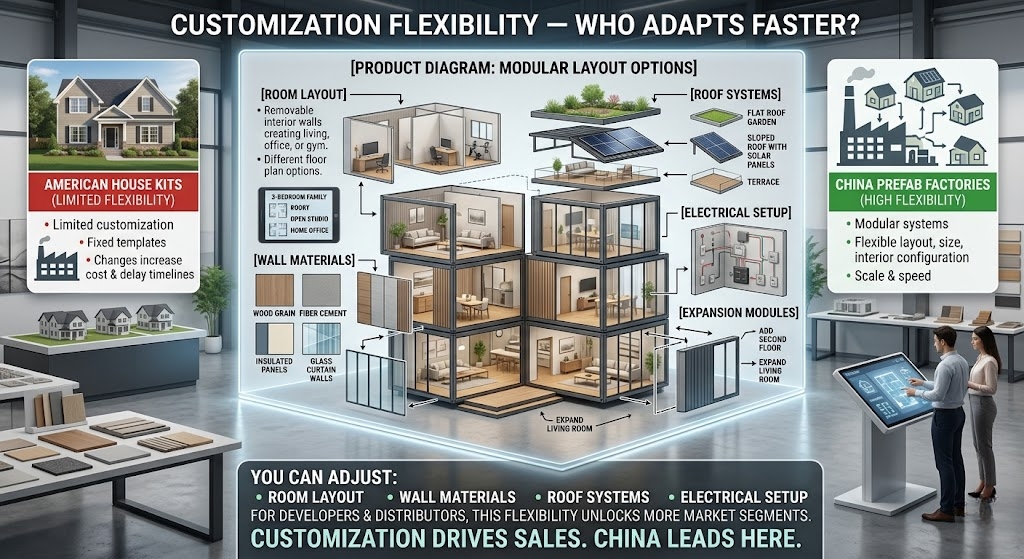
La personnalisation stimule les ventes.
Les usines chinoises ont entrepris de nombreux projets à grande échelle et possèdent une vaste expérience pour répondre aux divers besoins de personnalisation des clients mondiaux. De plus, en tant que centre manufacturier mondial, les économies de temps et de coûts en Chine pour l’approvisionnement en matières premières et la personnalisation des produits sont nettement inférieures à celles des États-Unis. Par conséquent, la Chine est mieux adaptée à la production personnalisée à grande échelle de maisons-containers.
Les maisons préfabriquées américaines reflètent une esthétique américaine unique, et leurs styles de design intérieur peuvent mieux répondre aux besoins des pays européens et américains. Les fournisseurs chinois, en revanche, manquent généralement d’innovation, ce qui entraîne une gamme plus homogène de styles de design intérieur.
Cette partie détermine le succès de l’exécution.
Les kits américains arrivent prêts pour un assemblage local. Les entrepreneurs comprennent le système. Aucune formation requise.
Les maisons préfabriquées chinoises nécessitent une planification d’installation claire. Les bonnes usines fournissent :
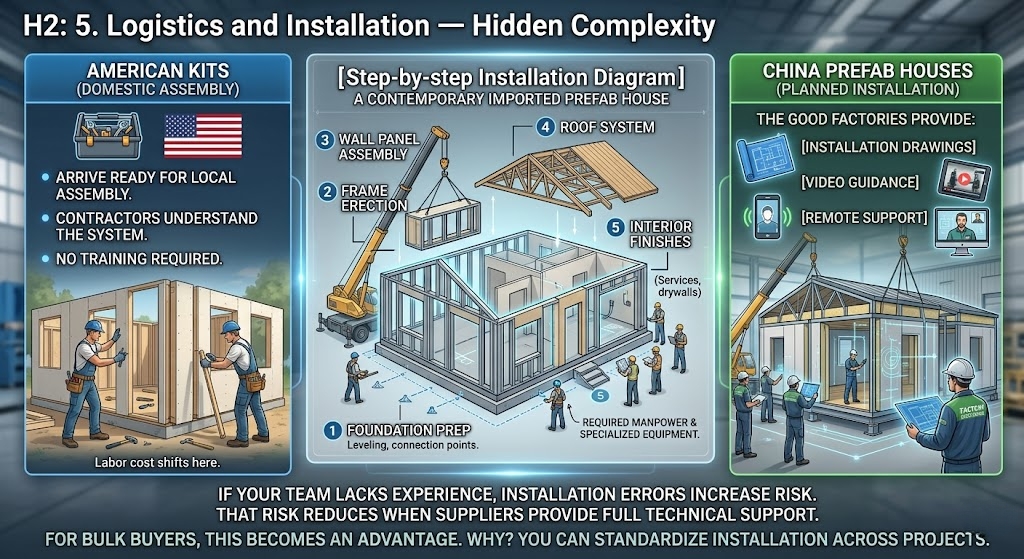
Vous regardez le prix d'un kit de maison américain par rapport à un préfabriqué chinois, et l'unité chinoise gagne presque toujours sur le coût initial. Mais la main-d'œuvre est l'élément imprévisible. Si votre équipe n'a jamais travaillé avec la construction modulaire auparavant – ou pire, n'a jamais vu de près un préfabriqué chinois – les erreurs d'installation peuvent rapidement gruger vos économies. Joints de travers, connexions de boulons manquées, contreventement inapproprié. De petites erreurs qui se transforment en gros maux de tête.
Ce risque diminue considérablement lorsque votre fournisseur fournit un support technique complet. Manuels d'assemblage, vidéos explicatives, même supervision sur site si la commande est suffisamment importante. Un bon fabricant chinois ne se contente pas d'expédier des boîtes. Ils vous aident à les assembler correctement.. Pour les acheteurs en vrac – promoteurs, distributeurs, entrepreneurs achetant 20, 50, 100+ unités – cela devient un avantage sérieux.
Parce que vous pouvez standardiser l'installation sur tous les projets.
Pourquoi ? Même quincaillerie, même séquence, mêmes tolérances. Formez votre équipe une fois, puis reproduisez ce processus chantier après chantier. Pas besoin de réinventer la roue. Pas besoin d'appeler le fournisseur pour demander « quel boulon va où » à chaque nouveau travail. Avec les kits américains, vous êtes souvent livré à vous-même après la livraison. Avec un fournisseur chinois de qualité qui offre un réel support, vous obtenez de la cohérence. Et la cohérence signifie un coût de main-d'œuvre par unité plus faible à long terme, moins de retours pour corrections et un roulement de projet plus rapide.. C'est l'avantage caché. Pas seulement le prix de la boîte. Le coût de la mise en terre, correctement du premier coup, à chaque fois.
C'est là que les transactions échouent. Et j'ai vu cela se produire plus souvent que je ne voudrais l'admettre.
Vous trouvez un excellent prix sur des maisons préfabriquées chinoises. Les chiffres fonctionnent. Le calendrier fonctionne. Tout le monde est excité. Puis quelqu'un pose la bonne question : « Est-ce certifié pour notre marché ? ».
C'est là que les affaires échouent. Et j'ai vu cela se produire plus souvent que je ne voudrais l'admettre. La conformité est l'endroit où de nombreux contrats d'importation de préfabriqués échouent.
Les maisons préfabriquées chinoises ? Une autre histoire. Elles doivent correspondre à vos réglementations de destination dès le départ. Cela signifie vérifier :“
Codes structurels – charges de vent, charges de neige, exigences sismiques. Ce qui fonctionne à Shanghai pourrait échouer en Floride.
Classements au feu – assemblages muraux, isolation, matériaux de plafond. Certains pays exigent l'ASTM E84, d'autres veulent l'EN 13501. Tests différents, scores de réussite différents.
Normes électriques – tension, méthodes de câblage, spécifications des disjoncteurs, mise à la terre. Une unité câblée pour 220V/50Hz ne passera pas l'inspection sur un marché en 120V/60Hz.
Classements au feu – assemblages de murs, isolation, matériaux de plafond. Certains pays exigent ASTM E84, d'autres veulent EN 13501. Des tests différents, des scores de réussite différents.
Alors, quel est le principal enseignement ? Ne sautez pas la conversation sur la conformité. Intégrez-la dans votre processus d'approvisionnement. Obtenez de la documentation. Testez des échantillons si nécessaire. Parce que l'unité la moins chère du monde ne vaut rien si vous ne pouvez pas l'installer légalement.
Faites cela correctement, et le préfabriqué chinois gagne toujours sur le prix. Mais vous devez d'abord gagner cette victoire du côté de la paperasse.“
Acheteur sérieux – évaluez trois choses : le coût du cycle de vie, la rapidité de déploiement et l'évolutivité.
Le prix n'est que le ticket d'entrée. Comment l'unité se comporte sur cinq ans, à quelle vitesse vous pouvez en mettre 50 sur le terrain, et si vous pouvez doubler ce nombre le trimestre prochain sans recommencer tout le processus d'approvisionnement ? C'est le vrai calcul.
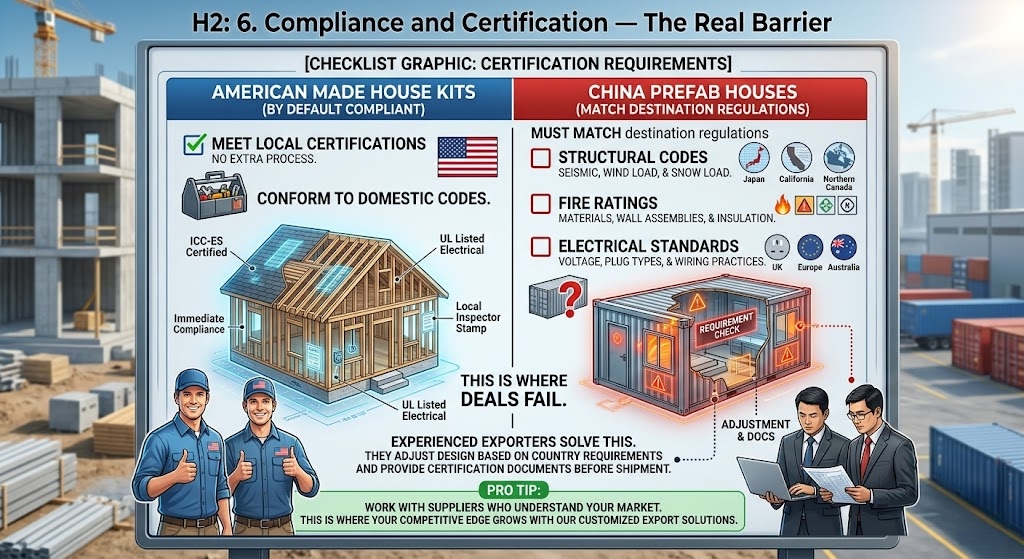
Les exportateurs expérimentés résolvent ce problème.
Ils ajustent la conception selon les exigences du pays et fournissent les documents de certification avant l'expédition.
Conseil pro :
Travaillez avec des fournisseurs qui comprennent votre marché.
C'est là que votre avantage concurrentiel grandit avec nos solutions d'exportation personnalisées.
Comme les fournisseurs chinois vendent leurs produits mondialement, ils n'ont demandé que les certifications mondiales connues pour les maisons modulaires. Cependant, ils n'ont pas demandé les certifications moins courantes pour d'autres marchés à travers le monde. Par conséquent, veuillez confirmer à l'avance avec les fournisseurs chinois s'ils disposent des certifications dont vous avez besoin.
Pour les acheteurs sérieux, trois facteurs comptent le plus : – 100 unités, délai serré, emplacement éloigné. Les fournisseurs chinois expédient par lots, s'empilent rapidement et gèrent le volume sans difficulté.
Le prix n'est que le point de départ. La performance de l'unité sur cinq ans, la rapidité avec laquelle 50 unités peuvent être déployées, et si ce nombre peut doubler le trimestre prochain sans relancer le processus d'approvisionnement — voilà le véritable calcul.
– boutiques éphémères, kiosques alimentaires, magasins mobiles. Déploiement rapide et relocalisation facile. Le préfabriqué chinois correspond au modèle commercial. Ce ne sont pas des constructions uniques. Ce sont des systèmes. Et la chaîne d'approvisionnement chinoise est construite pour alimenter des systèmes.
Camps de travailleurs Les kits américains ? Ils excellent dans un créneau différent :.
Stations balnéaires – une unité d'habitation accessoire (ADU) dans le jardin, une petite maison pour un parent, un chalet de week-end. Une unité, peut-être deux. Vous voulez un support local, des matériaux familiers et pas de paperasse d'importation.
Unités commerciales – un constructeur qui connaît le code, a une équipe prête et a besoin d'un kit qui arrive la semaine prochaine. Les kits américains sont prêts à l'emploi pour ce marché.
These aren’t one‑off builds. They’re systems. And the Chinese supply chain is built to feed systems.
American kits? They shine in a different lane:
Petites constructions résidentielles – an ADU in the backyard, a tiny home for a relative, a weekend cabin. One unit, maybe two. You want local support, familiar materials, and no import paperwork.
Projets d'entrepreneurs locaux – a builder who knows the code, has a crew ready, and needs a kit that shows up next week. American kits are plug‑and‑play for that market.
Voici donc une analyse honnête. Si vous êtes un promoteur construisant un village de 200 logements pour travailleurs, la préfabriqué chinoise est votre solution. Si vous êtes un propriétaire ajoutant un bureau dans votre jardin, achetez américain.
Des outils différents pour des tâches différentes. L'acheteur avisé sait simplement quel outil convient à quelle main.

Si vous importez à grande échelle, les marges augmentent rapidement.
Si vous construisez localement en petit volume, les kits américains réduisent les frictions.
Parlons des avantages et des inconvénients de l'achat d'une maison préfabriquée en Chine. Je vais rester clair et direct.
D'abord les avantages, car il y a beaucoup à apprécier.
Coût inférieur – C'est le point principal. Même après l'expédition et les droits de douane, le prix rendu est généralement bien inférieur à celui des kits domestiques. Pour les acheteurs en gros, les économies s'accumulent rapidement.
Production rapide – Une fois le design validé, la plupart des usines chinoises peuvent produire 20, 50, voire 100 unités en 30 à 45 jours. Essayez d'obtenir cela d'un constructeur local.
Personnalisation élevée – Vous voulez un agencement différent ? Un revêtement extérieur sophistiqué ? Une installation électrique spécifique ? Les systèmes modulaires chinois sont conçus pour être flexibles. Vous n'êtes pas limité à trois plans types.
Approvisionnement évolutif – Vous avez besoin de 10 unités maintenant et de 50 de plus le trimestre prochain ? Les fournisseurs chinois disposent de lignes de production capables de gérer le volume sans relancer le processus d'ingénierie. C'est énorme pour les promoteurs.
Passons maintenant aux inconvénients. Car rien n'est parfait.
Délai d'expédition – Vous dépendez d'un porte-conteneurs. Le transit typique de la Chine vers les États-Unis ou l'Europe est de 4 à 8 semaines, plus le dédouanement. Si vous avez besoin d'unités la semaine prochaine, c'est un problème.
Complexité de conformité – Vos codes de construction locaux peuvent différer des spécifications standard de l'usine. Vous devez spécifier à l'avance les charges de vent, les indices de résistance au feu, les normes électriques. Si vous omettez cette étape, vous pourriez vous retrouver avec des unités qui ne passent pas l'inspection.
Variation des fournisseurs – C'est le piège caché. Une usine chinoise de premier ordre utilise de l'acier galvanisé, de la laine de roche et un contrôle qualité strict. Une usine de bas niveau rogne sur l'épaisseur de l'acier et l'étanchéité. Elles ont la même apparence sur une brochure. Leurs performances sur site sont très différentes. C'est pourquoi vérifier votre fournisseur est non négociable.
En résumé ? La préfabriqué chinoise est judicieuse pour les acheteurs qui planifient à l'avance, font leurs devoirs sur les fournisseurs et ont besoin d'unités économiques et personnalisables à grande échelle. Si vous avez besoin de rapidité avant tout ou si vous achetez une seule unité pour votre jardin, vous devriez peut-être chercher ailleurs. Mais pour les projets en volume ? Les avantages l'emportent généralement.
| Aspect | Kits de Maisons Fabriqués aux États-Unis | Maisons Préfabriquées Chinoises | Point Clé / Gagnant | |
|---|---|---|---|---|
| 1 | Détail des Coûts | 30 % à 60 % plus cher (principalement dû aux coûts de main-d'œuvre américains plus élevés). Coûts des matériaux similaires. | Coût de base nettement inférieur grâce aux économies d'échelle, aux salaires plus bas et aux prix d'exportation en gros. Le coût à l'arrivée (expédition + droits) ajoute 10 % à 25 %, mais le total reste généralement inférieur. | La Chine gagne sur le coût initial et la marge. |
| 2 | Délai de Livraison | 4 à 8 semaines au total. Production nationale, pas de fret maritime ni de délais douaniers. | Production : 20-30 jours (très rapide). Fret maritime : 20-35 jours. | Américain pour un déploiement urgent/rapide. Chine pour des projets en gros planifiés. |
| 3 | Comparaison de la Qualité | Respect strict des codes IRC/IBC avec inspections par étapes. Grande confiance des entrepreneurs locaux. | Varie selon le fournisseur. Les usines de premier ordre utilisent de l'acier galvanisé, de la laine de roche et respectent les normes internationales pour le feu, l'isolation et l'étanchéité. Les niveaux inférieurs peuvent prendre des raccourcis. | Pas basé sur le pays — dépend du fournisseur. Auditez l'usine. |
| 4 | Flexibilité de Personnalisation | Limitée. Suit des modèles fixes ; les modifications augmentent les coûts et les délais. | Grande flexibilité. Les systèmes modulaires permettent des modifications faciles de la disposition des pièces, des matériaux des murs, des systèmes de toiture, de l'installation électrique et de l'extension. | La Chine mène — idéal pour les promoteurs et divers segments de marché. |
| 5 | Logistique & Installation | Arrive prêt pour l'assemblage local. Les entrepreneurs comprennent immédiatement le système — aucune formation requise. | Nécessite une planification. Les bons fournisseurs fournissent des plans détaillés, des guides vidéo et un support à distance. Des erreurs d'installation sont possibles sans expérience. | Avantage chinois pour les projets en gros/standardisés une fois l'équipe formée. |
| 6 | Conformité & Certification | Répond par défaut aux certifications locales (aucune étape supplémentaire). | Doit être ajusté aux codes de destination (structurels, incendie, électrique). Les exportateurs expérimentés fournissent les documents de certification avant expédition. | Américain plus simple. Chine Réalisable avec des fournisseurs expérimentés. |
| 7 | ROI & Stratégie Commerciale | Meilleur pour les petites constructions résidentielles et les projets d'entrepreneurs locaux. Moins de frictions mais des marges plus serrées. | Domine les projets de grande envergure (camps de travailleurs, resorts, unités de vente au détail). Marges plus élevées à grande échelle et meilleure extensibilité. | La Chine pour une croissance en volume/à forte marge. Américain pour les petits volumes/locaux. |
Votre avantage dépend de l'exécution.
Les kits de maisons fabriqués aux États-Unis par rapport aux maisons préfabriquées chinoises ne consistent pas à déterminer ce qui est universellement meilleur — il s'agit de ce qui correspond à votre projet.
Voici la logique de décision.
Choisissez les kits de maison fabriqués aux États-Unis si :
Choisir Maisons préfabriquées de Chine si :
La comparaison entre Kits de maisons fabriqués aux États-Unis contre maisons préfabriquées chinoises ne porte pas sur ce qui est meilleur.
Elle porte sur ce qui correspond à votre modèle commercial.
Votre adresse électronique ne sera pas publiée. Les champs obligatoires sont marqués *
 Anglais