7 Key Differences in American Made House Kits vs China Prefab House: A Buyer’s Decision Guide Tired of high costs? More and more Americans are importing homes straight from China. Facing rising construction expenses in the US, many buyers are now actively comparing American made house kits with China prefab houses to reduce budget pressure […]
Tired of high costs? More and more Americans are importing homes straight from China. Facing rising construction expenses in the US, many buyers are now actively comparing American made house kits with China prefab houses to reduce budget pressure while maintaining quality. This guide breaks down the real differences between importing prefab homes from China and choosing domestic American made house kits.
When comparing U.S. home kits with imported Chinese prefabricated houses, the deciding factors often aren’t the figures on the price quote, but rather the landed cost, delivery lead times, and supplier stability. A single miscalculation can wipe out your profit margins.
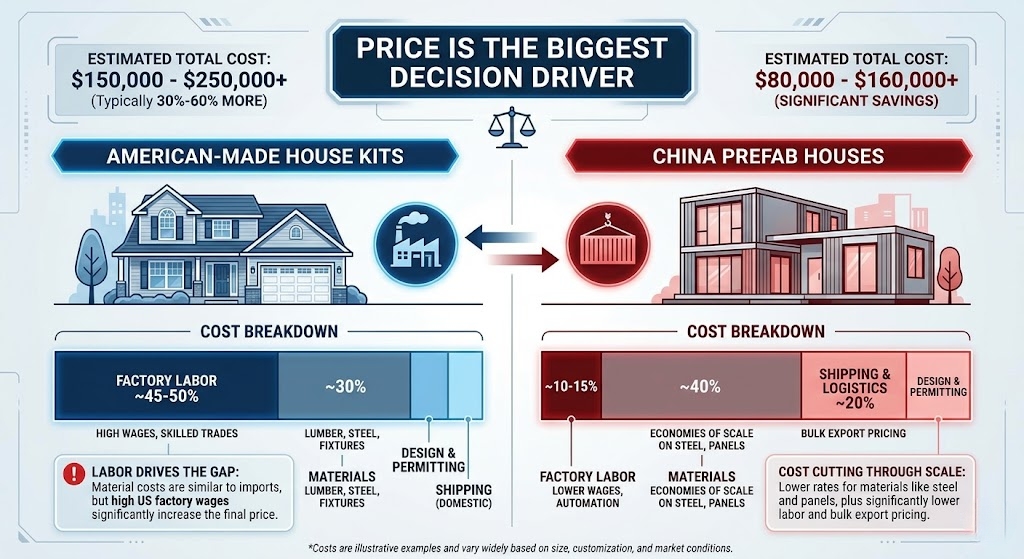
Price is the biggest decision driver.The biggest decision driver is price. No debate.
American house kits often cost 30%–60% more than imported prefab units. Labor drives that gap. Material cost stays similar, but US factory wages push the final price higher.
China prefab houses cut cost through scale. Steel, panels, and labor all run at lower rates. Bulk export pricing reduces cost further. China has a corresponding container house production industrial belt, which allows for large-scale procurement of raw materials and selection of suitable labor for production.
For procurement teams, the real question isn’t price — it’s landed cost.
That shiny quote from a Chinese prefab house supplier? It’s just the starting point. You’ve got to add shipping, duties, port fees, and inland trucking to your site. All together, those extras typically add 10% to 25% to the base price of a Chinese prefab unit.
China generally wins on upfront cost, and that gap is where margin starts — room to customize, absorb freight volatility, or outbid competitors relying on higher-cost domestic kits.
So what’s the takeaway? China wins on upfront cost. Period. And that’s where your margin starts. The gap between what you pay landed and what you can sell or value the finished project at? That’s real profit. It gives you room to customize, to absorb freight volatility, or to simply outbid competitors who are stuck with higher‑cost domestic kits.
Does that mean American kits are never the right choice? Of course not. If you need next‑week delivery, zero import hassle, or strict Buy American compliance, the math changes. But for most volume buyers who plan ahead? The landed‑cost advantage of Chinese prefabs is hard to ignore.
Do the math yourself. Get a full CFR or CIF quote, call your freight forwarder, add a buffer for duties. I think you’ll see what we see: the margin starts here.
Delays kill deals.Delivery delays on a 50-unit order can push a project 6-8 weeks behind schedule — enough to blow a construction season.
American manufacturers offer shorter domestic lead times, usually 4–8 weeks. No ocean freight risk. No customs clearance delays.
China prefab suppliers deliver production in 20 days Produced in off-season. Fast. But shipping takes 20–35 days depending on destination.
If your project sits in North America and requires fast deployment, US kits reduce uncertainty.
If your project timeline allows planning, China prefab houses scale faster for bulk orders.
Short answer:
If your project sits in North America and requires fast deployment, US kits reduce uncertainty. If your project timeline allows planning, China prefab houses scale faster for bulk orders.
For projects with a tight schedule of just a few weeks requiring delivery this month, U.S.-sourced housing kits are the safer choice. For bulk orders of 20 units or more — where the timeline allows scheduling sea freight one to two months in advance — Chinese prefabricated housing offers a more significant advantage in landed cost.
Quality concerns come up in every deal. Let me tell you the truth.
I get it. You’re looking at a Chinese prefab quote, and in the back of your mind, you’re wondering: “Is this going to hold up like an American-made unit?”
A major concern for many buyers is whether the quality of Chinese-made prefabricated homes can match that of homes produced in U.S. factories. The answer is yes—provided you select the right tier of supplier.
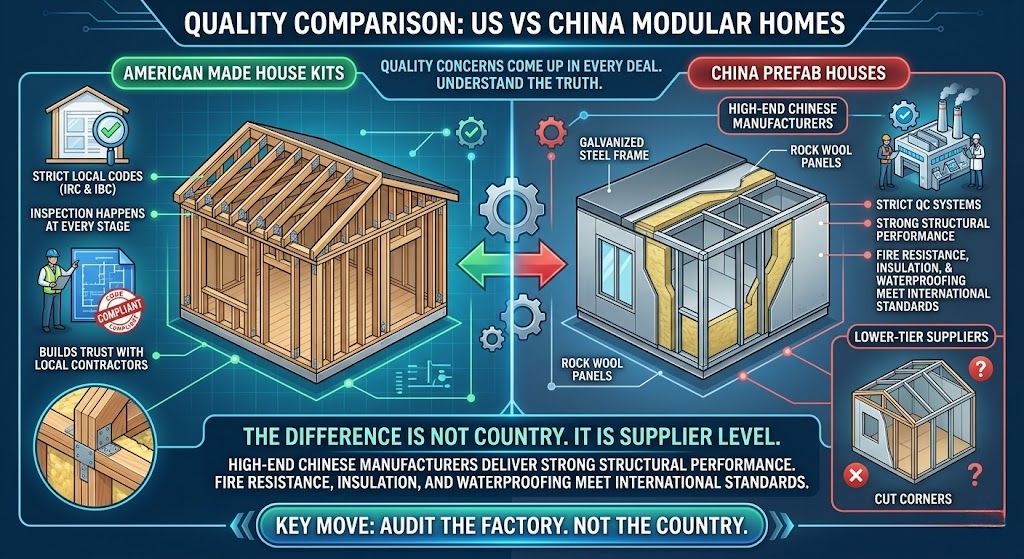
American-made house kits follow strict local building codes—IRC, IBC, you name it. Inspections happen at every stage: framing, electrical, insulation, final walkthrough. That level of oversight builds a lot of trust with local contractors and inspectors. They know what they’re getting. No surprises.
Chinese prefab houses vary significantly by supplier tier.
Top-tier factories use galvanized steel frames that won’t rust, rock wool panels that actually insulate and resist fire, and strict QC systems that rival anything in the West. Those units arrive solid, square, and code-ready.
But lower-tier suppliers cut corners. Thin steel. Substandard foam. Loose seals. You save a few bucks upfront and pay for it later with leaks, rust, and structural headaches.
So here’s the truth nobody wants to say out loud: the difference is not country. It is supplier level.
A bad American kit exists too—though rare. And a high‑end Chinese manufacturer? They deliver strong structural performance, real fire resistance, proper insulation, and waterproofing that meets international standards. I’ve seen units survive typhoons, desert heat, and freezing winters without a single failure.
The key is doing your homework on the supplier. Ask for material specs. Demand third‑party inspection. Visit the factory if you can. Don’t just chase the lowest price.
Because when you source from the right Chinese manufacturer, you’re not sacrificing quality. You’re getting an American‑grade product at a landed cost that actually makes sense for your bottom line.
Key move:
Audit the factory. Not the country.When choosing Chinese suppliers, do not insist on the principle of prioritizing the lowest price. Instead, choose container houses with average prices and make sure you fully understand the materials used in the container houses.
What looks great on paper often needs to shift once you’re on the ground. Maybe the client wants an extra bedroom. Maybe the roof pitch needs to change for snow load. Maybe they want the kitchen on the opposite wall. Little things that make or break a sale.
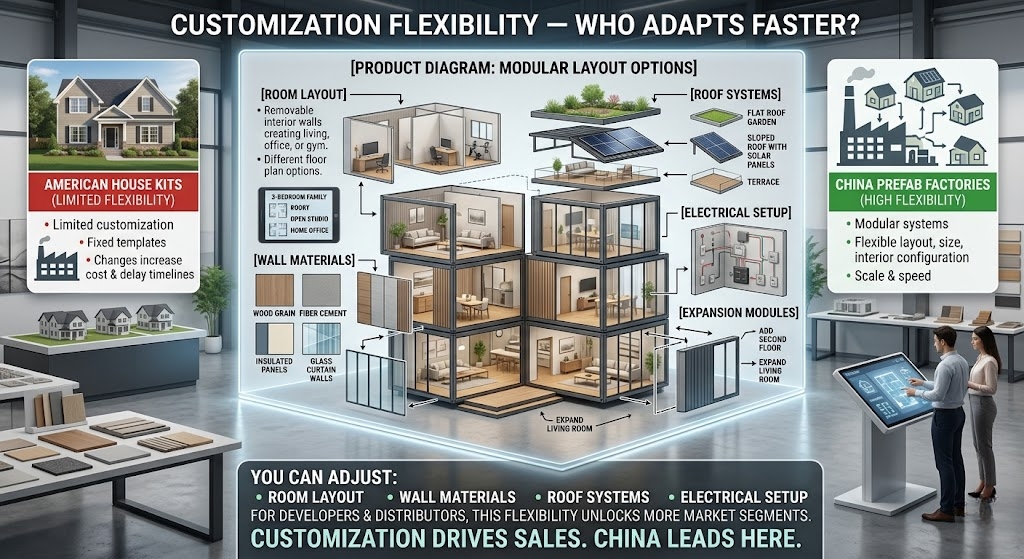
American house kits tend to fight you on that. They come with fixed templates—choose from three or four layouts, pick a color, done. Want something different? That’s a “custom job.” And that means higher costs and longer lead times. I’ve seen simple changes add weeks to delivery. For a developer trying to hit a deadline, that’s a problem.
China prefab factories operate on a completely different model. Modular systems are built for flexibility from the ground up. Layouts, sizes, interior configurations—you can tweak almost everything without reinventing the wheel. Production lines are set up to handle variation efficiently, not punish it.
So what can you actually adjust? Plenty:
Room layout – move walls, combine spaces, add a bump-out. Whatever the site demands.
Wall materials – drywall, plywood, paneling, even tile in wet areas. Swap in seconds.
Roof systems – flat, pitched, insulated, with overhangs. Match the local climate.
Electrical setup – outlets, switches, lighting, breaker panels. Lay it out how your market expects.
For developers and distributors, this flexibility unlocks more market segments. You’re not stuck selling the same box to everyone. Want to target high-end vacation rentals? Upgrade the finishes. Need budget workforce housing? Strip it down to the essentials. One supplier, one production line, dozens of product variations.
That’s the real advantage of sourcing from China. Not just the price. The ability to say “yes” when a client asks for something different. And in this business, that’s how you win repeat customers.
Customization drives sales.
Chinese factories have undertaken numerous large-scale projects and have extensive experience in meeting the diverse customization needs of global clients. Furthermore, as the world’s manufacturing hub, China’s time and cost savings in sourcing raw materials and customizing products are significantly lower than those in the United States. Therefore, China is better suited for large-scale customized production of container houses.
American prefabricated houses reflect a unique American aesthetic, and their interior design styles may better suit the needs of European and American countries. Chinese suppliers, on the other hand, generally lack innovation, resulting in a more homogenous range of interior design styles.
This part decides execution success.
American kits arrive ready for local assembly. Contractors understand the system. No training required.
China prefab houses require clear installation planning. The good factories provide:
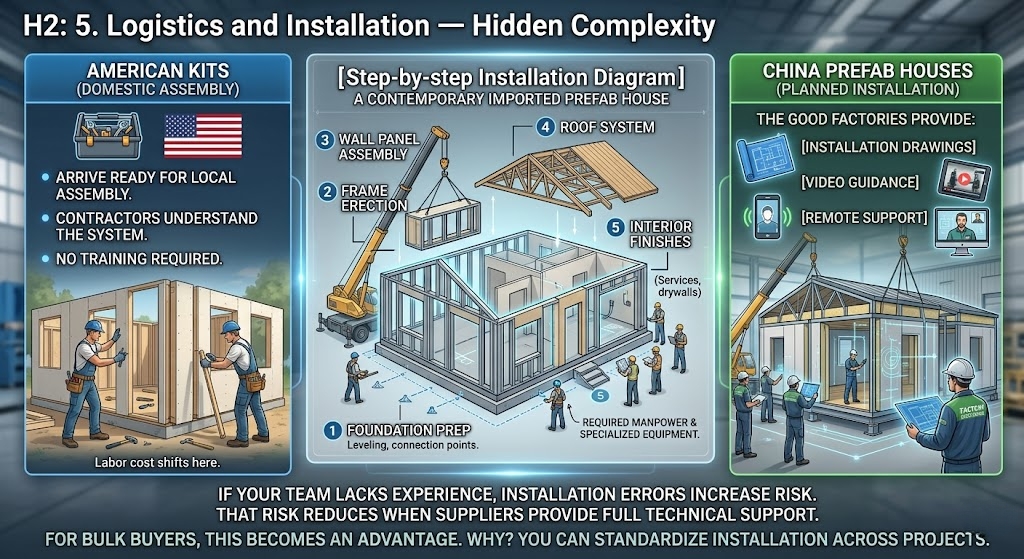
You look at the price of an American house kit versus a Chinese prefab, and the Chinese unit almost always wins on upfront cost. But labor is the wildcard. If your crew has never worked with modular construction before—or worse, never seen a Chinese prefab up close—installation errors can eat up your savings fast. Crooked seals, missed bolt connections, improper bracing. Small mistakes that turn into big headaches.
That risk drops dramatically when your supplier provides full technical support. Assembly manuals, video walkthroughs, even on-site supervision if the order is large enough. A good Chinese manufacturer doesn’t just ship boxes. They help you put them together right.
For bulk buyers—developers, distributors, contractors buying 20, 50, 100+ units—this becomes a serious advantage.
Why? Because you can standardize installation across projects. Same hardware, same sequence, same tolerances. Train your crew once, then replicate that process on site after site. No reinventing the wheel. No calling the supplier to ask “which bolt goes where” on every new job.
With American kits, you’re often on your own after delivery. With a quality Chinese supplier that offers real support, you get consistency. And consistency means lower labor cost per unit over time, fewer callbacks, and faster project turnover.
That’s the hidden edge. Not just the price of the box. The cost of putting it in the ground, right the first time, every time.
This is where deals fail. And I’ve watched it happen more times than I’d like to admit.Compliance is where many prefab import deals fail.
You find a great price on Chinese prefab houses. The numbers work. The timeline works. Everyone’s excited. Then someone asks the right question: “Is this certified for our market?”
American-made house kits have a built‑in advantage here. They meet local certifications by default—IRC, IBC, local amendments, the whole stack. No extra process. No surprise paperwork. You order it, you install it, the inspector signs off. That’s peace of mind you’re paying for.
China prefab houses? Different story. They have to match your destination regulations from the ground up. That means verifying:
Structural codes – wind loads, snow loads, seismic requirements. What works in Shanghai might fail in Florida.
Fire ratings – wall assemblies, insulation, ceiling materials. Some countries demand ASTM E84, others want EN 13501. Different tests, different passing scores.
Electrical standards – voltage, wiring methods, breaker specs, grounding. A unit wired for 220V/50Hz won’t pass inspection in a 120V/60Hz market.
Here’s where buyers get tripped up. A good Chinese supplier can build to your local codes. But you have to ask for it. Explicitly. Put it in the spec sheet. Have it checked by a local engineer before production starts. Because if you assume they’ll figure it out, that’s when deals fall apart—usually when the container lands and the local inspector says “no.”
So what’s the takeaway? Don’t skip the compliance conversation. Build it into your sourcing process. Get documentation. Test samples if you have to. Because the cheapest unit in the world is worthless if you can’t legally install it.
Do that right, and China prefab still wins on price. But you’ve got to earn that win on the paperwork side first.
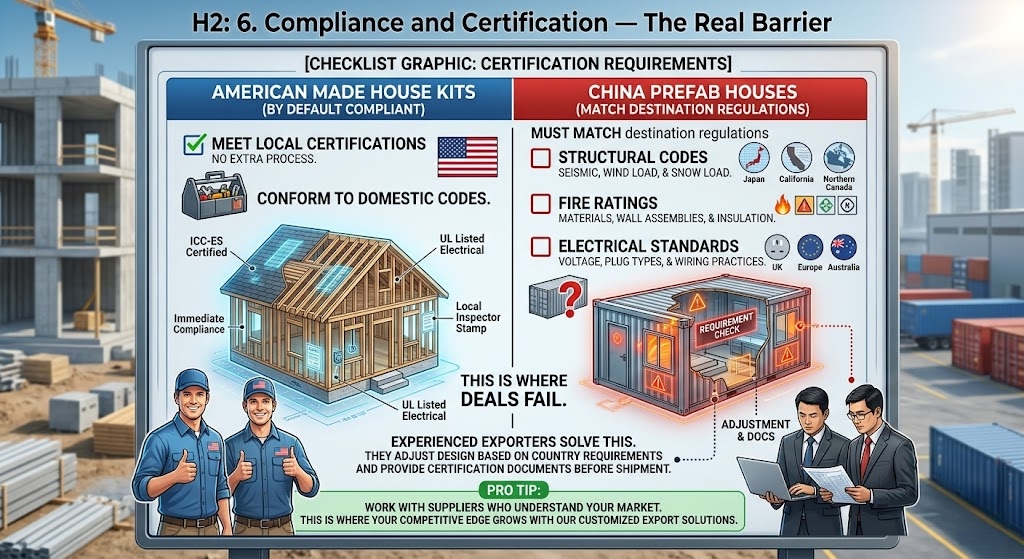
Experienced exporters solve this.
They adjust design based on country requirements and provide certification documents before shipment.
Pro tip:
Work with suppliers who understand your market.
This is where your competitive edge grows with our customized export solutions.
Since the Chinese suppliers sell their products globally, they have only applied for the well-known global certification for modular houses. However, they have not applied for the less common certifications for other markets around the world. Therefore, please confirm with the Chinese suppliers in advance whether they have the certifications you need.
For serious buyers, three factors matter most: lifecycle cost, deployment speed, and scalability.
Price is just the starting point. How the unit performs over five years, how fast 50 units can be deployed, and whether that number can double next quarter without restarting the sourcing process — that’s the real calculation.
China prefab houses dominate large‑scale projects for exactly those reasons. Think:
Worker camps – 100 units, tight deadline, remote location. China suppliers ship in batches, stack fast, and handle the volume without breaking a sweat.
Resorts – eco‑lodges, glamping units, staff housing. You need consistency across dozens or hundreds of identical units. China delivers that at scale.
Retail units – pop‑up shops, food kiosks, mobile stores. Fast deployment and easy relocation. China prefab fits the business model.
These aren’t one‑off builds. They’re systems. And the Chinese supply chain is built to feed systems.
American kits? They shine in a different lane:
Small residential builds – an ADU in the backyard, a tiny home for a relative, a weekend cabin. One unit, maybe two. You want local support, familiar materials, and no import paperwork.
Local contractor projects – a builder who knows the code, has a crew ready, and needs a kit that shows up next week. American kits are plug‑and‑play for that market.
So here’s the honest breakdown. If you’re a developer putting up a 200‑room workforce village, China prefab is your answer. If you’re a homeowner adding a backyard office, buy American.
Different tools for different jobs. The smart buyer just knows which tool fits which hand.

If you import at scale, margins expand fast.
If you build locally in small volume, US kits reduce friction.
Let’s talk about the pros and cons of buying a prefab home from China. I’ll keep it clear and straight.
Pros first, because there’s a lot to like.
Lower cost – This is the big one. Even after shipping and duties, you’re usually looking at a landed price well below domestic kits. For bulk buyers, the savings add up fast.
Fast production – Once you lock in the design, most Chinese factories can turn around 20, 50, even 100 units in 30 to 45 days. Try getting that from a local builder.
High customization – Want a different layout? Fancy exterior cladding? A specific electrical setup? Chinese modular systems are built to flex. You’re not stuck with three template floor plans.
Scalable supply – Need 10 units now and 50 more next quarter? Chinese suppliers have the production lines to handle volume without restarting the engineering process. That’s huge for developers.
Now the cons. Because nothing’s perfect.
Shipping time – You’re waiting on a container ship. Typical transit from China to the US or Europe is 4 to 8 weeks, plus customs clearance. If you need units next week, that’s a problem.
Compliance complexity – Your local building codes might be different from the factory’s standard specs. You have to specify wind loads, fire ratings, electrical standards upfront. Miss that step and you could end up with units that don’t pass inspection.
Supplier variation – This is the hidden trap. A top-tier Chinese factory uses galvanized steel, rock wool insulation, and strict QC. A low-tier one cuts corners on steel gauge and waterproofing. They look the same in a brochure. They perform very differently on site. That’s why vetting your supplier is non‑negotiable.
Bottom line? China prefab makes sense for buyers who plan ahead, do their homework on suppliers, and need cost-effective, customizable units at scale. If you need speed above all else or you’re buying a single unit for your backyard, you might look elsewhere. But for volume projects? The pros usually win.
| Aspect | American Made House Kits | China Prefab Houses | Key Takeaway / Winner | |
|---|---|---|---|---|
| 1 | Cost Breakdown | 30%–60% more expensive (mainly due to higher US labor costs). Material costs similar. | Significantly lower base cost due to scale, lower wages, and bulk export pricing. Landed cost (shipping + duties) adds 10%–25%, but total usually still lower. | China wins on upfront cost and margin. |
| 2 | Delivery Time | 4–8 weeks total. Domestic production, no ocean freight or customs delays. | Production: 20-30 days (very fast). Ocean shipping: 20–35 days. | American for urgent/fast deployment. China for planned bulk projects. |
| 3 | Quality Comparison | Strict adherence to IRC/IBC codes with stage-by-stage inspections. High trust with local contractors. | Varies by supplier. Top-tier factories use galvanized steel, rock wool, and meet international standards for fire, insulation, and waterproofing. Lower-tier may cut corners. | Not country-based — depends on supplier. Audit the factory. |
| 4 | Customization Flexibility | Limited. Follows fixed templates; changes add cost and delay. | High flexibility. Modular systems allow easy changes to room layout, wall materials, roof systems, electrical setup, and expansion. | China leads — ideal for developers and varied market segments. |
| 5 | Logistics & Installation | Arrives ready for local assembly. Contractors understand the system immediately — no training required. | Requires planning. Good suppliers provide detailed drawings, video guides, and remote support. Installation errors possible without experience. | China advantage for bulk/standardized projects once team is trained. |
| 6 | Compliance & Certification | Meets local certifications by default (no extra steps). | Must be adjusted to destination codes (structural, fire, electrical). Experienced exporters provide pre-shipment certification documents. | American simpler. China workable with experienced suppliers. |
| 7 | ROI & Business Strategy | Best for small residential builds and local contractor projects. Lower friction but tighter margins. | Dominates large-scale projects (worker camps, resorts, retail units). Higher margins at scale and greater scalability. | China for bulk/high-margin growth. American for small/local volume. |
Your advantage depends on execution.
American made house kits vs China prefab house is not about which is universally better — it’s about what fits your project.
Here is the decision logic.
Choose American made house kits if:
Choose China prefab houses if:
The comparison of american made house kits vs china prefab house is not about which is better.
It is about which fits your business model.
Your email address will not be published. Required fields are marked *

 English