Almost every buyer asks the same question during due diligence: how long will this actually last? It’s a fair question, and it’s also one that gets a vague answer more often than it should. Suppliers like to say “20+ years” without breaking down what that number actually covers. A container grandstand isn’t one single object […]
Almost every buyer asks the same question during due diligence: how long will this actually last? It’s a fair question, and it’s also one that gets a vague answer more often than it should. Suppliers like to say “20+ years” without breaking down what that number actually covers. A container grandstand isn’t one single object with one single lifespan — it’s a steel structure paired with a seating system, and the two age at different rates. If you’re comparing quotes or planning a budget for a stadium, sports club, or temporary event venue, it helps to separate these two questions before you look at the total number.
The frame is the part everyone assumes is permanent, and in a sense it’s not far off. A shipping container built to ISO freight standards starts life designed to survive stacking loads, ocean transport, and repeated handling, so the base steel is already overbuilt for a stationary seating structure. Once converted into a grandstand, the corrugated steel walls and floor structure are reinforced and the container is fixed in place rather than moved repeatedly, which actually reduces the fatigue stress it experiences compared to its original shipping role.
Under normal outdoor conditions, with a marine-grade primer, an intermediate coat, and a UV-resistant topcoat reapplied roughly every 5 to 8 years, a container grandstand frame holds structural integrity for 25 to 30 years. Coastal sites with salt exposure shorten that window unless the coating system is upgraded and inspection frequency increases. This lines up with published corrosion protection guidance from the American Institute of Steel Construction, which is the reference most structural engineers use when specifying coating systems and maintenance intervals for exposed steel structures.
What buyers sometimes miss is that the frame’s lifespan is directly tied to how the base container was sourced. A frame built from a heavily corroded used container, patched and repainted for a quick sale, will not hit the 25-year mark even with good maintenance. If a supplier can’t tell you the container’s prior cargo history and structural grade, that’s worth asking about before you sign.
Seats wear out faster than frames, and that’s normal — it’s not a defect, it’s just a different material category doing a different job. Most container grandstands use HDPE plastic seating, aluminum bench seating, or a mix depending on the tier and budget. HDPE holds up well against UV and impact but can become brittle in extreme heat cycling after 10 to 15 years without a UV stabilizer additive in the resin. Aluminum bench seating resists UV degradation entirely but is more sensitive to coastal corrosion at fastener points if stainless or coated hardware isn’t used.
In practice, we tell buyers to plan for one seating refurbishment cycle around year 12 to 15, whether that means reseating individual units or replacing full bench runs. This is standard across the bleacher and grandstand industry, not specific to container conversions — the seating replacement cycle is consistent with structural safety guidance published in the International Code Council’s bleacher and grandstand safety standards, which many venue operators use as a reference point for inspection and replacement planning regardless of the underlying structure material.
Buyers running events year-round, especially in hot or humid regions, tend to see seat wear closer to the 10-year mark. Buyers running seasonal venues, where the grandstand sits covered or unused for part of the year, often stretch that closer to 15 or even 18 years before seats need attention.
The gap between “worst case” and “best case” service life on a container grandstand usually comes down to three things: coating maintenance, drainage, and inspection discipline. Water pooling on the container roof or floor structure is the single most common cause of early corrosion we see reported by clients, and it’s almost always a drainage design issue rather than a material issue. A properly sloped floor and roof drainage system, specified at the manufacturing stage, prevents most of this before it starts.
Third-party structural durability data collected by the World Business Council for Sustainable Development on repurposed steel structures shows that scheduled inspection intervals, rather than material upgrades alone, account for the largest variance in structure lifespan across reused steel assets. That matches what we see in the field — two identical container grandstands, one inspected annually and one left alone for a decade, can end up five to ten years apart in usable structural life.
On the operations side, we usually recommend a monthly check-in once the grandstand is in active use — not a full inspection, just a walk-through to catch standing water, loose fasteners, or coating chips before they turn into rust spots. It takes an operations staff member twenty minutes and saves a lot of touch-up work later. During rainy periods, especially if the venue sees heavy or prolonged rainfall, covering exposed sections with tarps or waterproof sheeting is worth the extra effort. Container roofs and seating tiers that stay wet for days at a time are far more prone to corrosion at seams and fastener points than surfaces that dry out between rain events, so keeping water off the structure when it’s not in use matters more than most buyers expect going in.
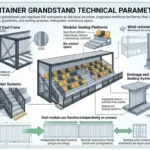
If you want the full technical breakdown of coating specifications, load ratings, and structural tolerances for our container grandstand builds, that’s covered in detail on our container grandstand technical parameters page. It’s worth reviewing before you finalize a spec, especially if your venue sits in a coastal or high-humidity region.
Put together, here’s the realistic picture: a well-built, well-maintained container grandstand frame runs 25 to 30 years. The seating system inside that frame typically needs one refurbishment around the 10 to 15 year mark. So the honest answer to “how long does it last” isn’t one number — it’s a frame that outlives one or two seating cycles, assuming basic maintenance is kept up.
For procurement teams, this usually means budgeting the frame as a long-term capital asset and the seating as a mid-life maintenance line item, rather than expecting to replace the whole unit at once. It also means asking suppliers for coating specifications and seat material grade separately, not just a single “lifespan” figure on a spec sheet.
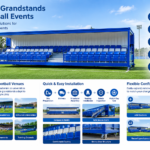
We build our 40ft container grandstands, seating 63 people per unit, with this two-tier lifespan in mind — reinforced frame construction paired with UV-stabilized seating that can be reseated without touching the structure. If you’re evaluating options for a stadium or club upgrade, our 40ft container grandstand has the full spec sheet and configuration options.
The steel frame typically lasts 25 to 30 years with routine coating maintenance. Seating usually needs refurbishment or replacement every 10 to 15 years, since it wears faster than the structural frame.
Yes, in almost every case. Seating materials are exposed to UV and foot traffic more directly than the frame, so most buyers plan for one or two seat refurbishment cycles across the life of a single frame.
Coastal or high-humidity conditions without a proper coating maintenance schedule cause the most damage. Skipped inspections, poor drainage design, and low-grade paint systems can cut usable frame life by a third or more.
Your email address will not be published. Required fields are marked *

 English