Alternative Grandstand - Nouvelle tribune conteneurisée : une tribune alternative telle qu'un système basé sur des conteneurs supprime ces contraintes en déplaçant la production vers un environnement d'usine contrôlé. Les tribunes traditionnelles reposent sur des charpentes en acier soudé, une fabrication sur site et des fondations lourdes. Ce modèle crée trois goulets d'étranglement opérationnels : des délais de projet longs, une forte dépendance à la main-d'œuvre, une faible réutilisabilité après les événements. Les équipes d'approvisionnement évaluent désormais [...]
une tribune alternative telle qu'un système basé sur des conteneurs supprime ces contraintes en déplaçant la production vers un environnement d'usine contrôlé.
Les tribunes traditionnelles reposent sur des charpentes en acier soudé, une fabrication sur site et des fondations lourdes. Ce modèle crée trois goulets d'étranglement opérationnels :
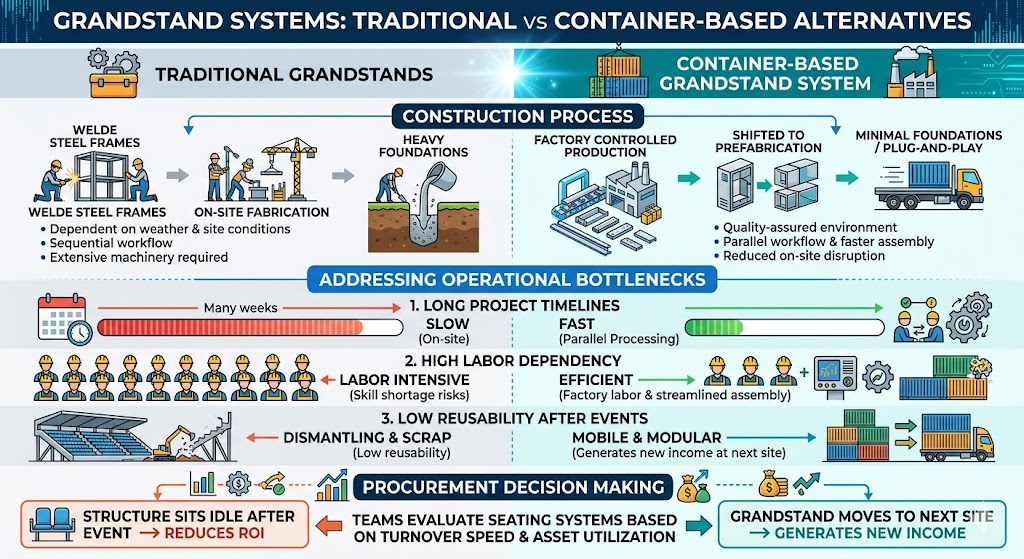
Les équipes d'approvisionnement évaluent désormais les systèmes d'assise en fonction de la rapidité de rotation. Une structure qui reste inutilisée après un événement réduit le retour sur investissement. Une tribune conteneurisée se déplace vers le site suivant et génère de nouveaux revenus.
Cet article compare les tribunes conteneurisées avec d'autres types de tribunes, permettant au personnel d'approvisionnement de mieux comprendre les différents avantages de chaque type.
Tribunes conteneurisées : un modèle de tribune alternative évolutif
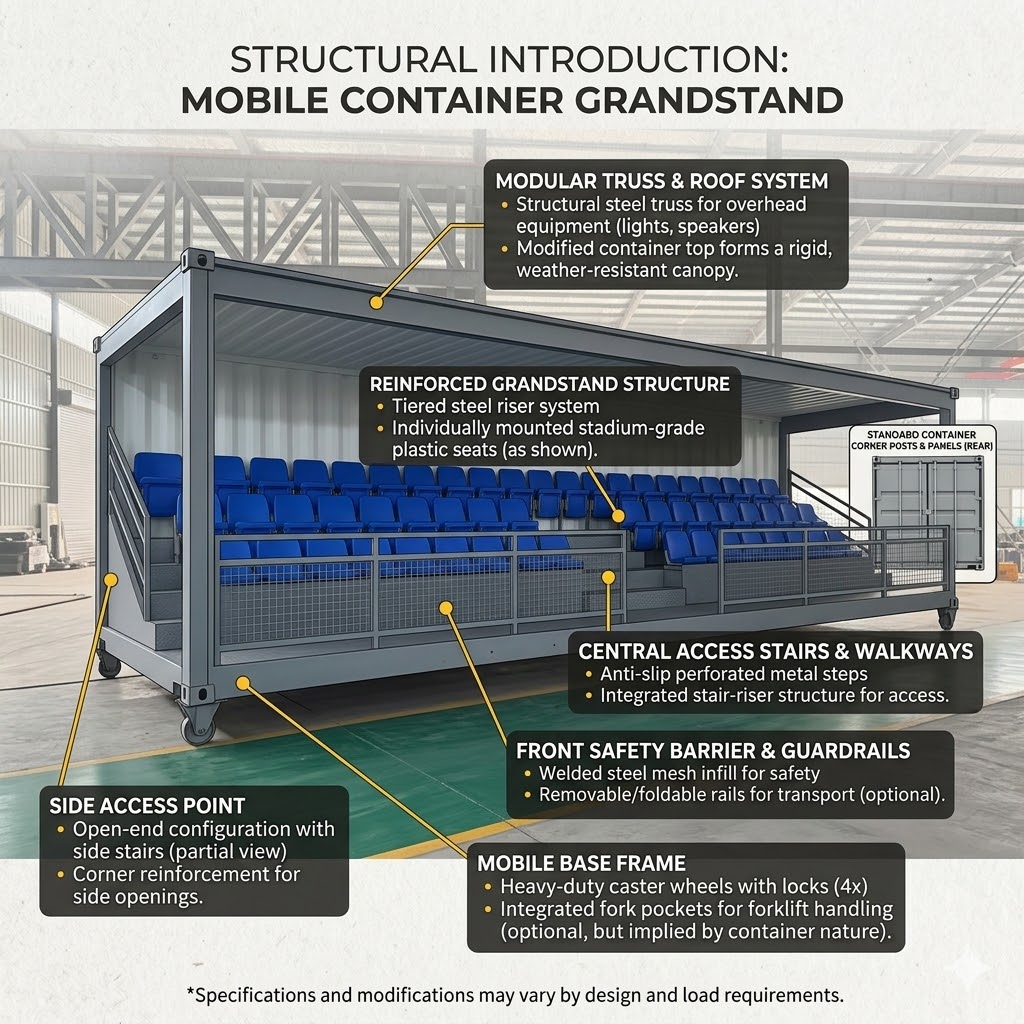
Les tribunes conteneurisées sont constituées de conteneurs maritimes modifiés et de plateformes d'assise modulaires. Chaque unité est à la fois une unité structurelle et un module de transport.
Cette solution de tribune alternative évolutive offre trois avantages majeurs :
Tous les composants structurels sont fabriqués à l'aide de découpage CNC et de processus de soudage standardisés. Cela réduit les erreurs d'installation, et un service technique inspecte les matériaux et les produits, garantissant une performance de charge stable.
Les tribunes conteneurisées ne nécessitent pas des semaines d'assemblage ; elles peuvent être déployées en quelques heures en utilisant uniquement des grues et des boulons, nécessitant seulement une surface de sol plane.
Chaque unité peut être intégrée dans un système logistique standard, réduisant ainsi la complexité du transport.
Ce modèle transforme le processus d'approvisionnement d'un projet de construction en un achat de produit.
La comparaison des coûts détermine souvent les décisions d'achat. La différence ne réside pas uniquement dans le prix initial, mais dans le coût du cycle de vie.
Analyse de la structure des coûts : tribunes traditionnelles vs nouvelles tribunes
La comparaison des coûts détermine souvent les décisions d'approvisionnement. La différence ne réside pas seulement dans le prix initial, mais aussi dans le coût total du cycle de vie.
Coût le plus élevé
Achat à grande échelle de matières premières
Grande emprise au sol, coûts de location foncière élevés
Longue durée de conception et de production
Soudage et main-d'œuvre sur site
Construction des fondations
Cycle de production long
Prix élevé
Une longue durée de vie
Adapté aux constructions gouvernementales
Coût le plus bas
Ne nécessite pas un grand espace
Relocalisation rapide, main-d'œuvre minimale requise
Peut être stocké dans un entrepôt
Durée de vie courte, facilement endommagé
Expédition complète en conteneur de plusieurs tribunes, coût réduit
Production modulaire en usine, prix modéré
Expédition en vrac, comme le transport maritime par conteneur. Coûts de transport modérés
Faibles coûts de main-d'œuvre d'installation, nécessite seulement une surface plane
Longue durée de vie, 20 à 30 ans
Déploiement réutilisable par camions et chariots élévateurs, coût d'utilisation élevé

Mobilité : l'avantage clé des nouveaux systèmes de tribunes
La mobilité détermine si les tribunes génèrent des revenus uniques ou récurrents.
Les tribunes de stade traditionnelles ne peuvent pas être déplacées, ce qui entraîne de longs taux d'inoccupation dans de nombreuses zones reculées et réduit les marges bénéficiaires de 32%.
Les gradins temporaires ordinaires sont les plus légers et les plus flexibles. Cependant, ils manquent de toit, ce qui limite considérablement leurs cas d'utilisation, et sont souvent utilisés en intérieur.
Les tribunes conteneurisées fonctionnent d'une manière complètement différente :
Levage → Transport → Réinstallation
Aucun dommage structurel
Aucun besoin de refabrication
Le toit d'une tribune en conteneur évite l'exposition au soleil extérieur, et la conception des garde-corps assure la protection des spectateurs.
Cela rend les systèmes en conteneur idéaux pour des applications telles que :
Stades temporaires
Spectacles itinérants
Gradins pour chantiers de construction
Infrastructures d'urgence gouvernementales
La mobilité transforme l'infrastructure en un actif. Les tribunes en conteneur peuvent générer des revenus continus pour les clients pendant plus de 300 jours.

Performance structurelle : Sécurité et capacité de charge
L'équipe d'approvisionnement se demande souvent si la résistance des nouvelles tribunes peut rivaliser avec celle des tribunes traditionnelles.
Les tribunes en conteneur utilisent :
Cadre en acier galvanisé Q235
Des poteaux porteurs renforcés
Des plateformes de sièges antidérapantes
Ces composants sont conformes aux normes internationales, telles que celles établies par l'Organisation internationale de normalisation (ISO).
Contrairement aux tribunes en échafaudage temporaire, le système en conteneur assure une répartition stable des charges grâce à une structure d'ingénierie soigneusement conçue.
Les tribunes traditionnelles offrent des options de personnalisation limitées en raison de leur conception fixe, ne proposant généralement que des variations de couleur.
Les gradins temporaires, en raison de leur produit plus simple, ne nécessitent généralement qu'une personnalisation des matériaux et une conception extensible.
Les tribunes en conteneur soutiennent des mises à niveau modulaires :
Logos imprimés
Garde-corps conçus
Empilage à double niveau
Impression de logos sur les sièges
Sièges personnalisés
Allées accessibles aux fauteuils roulants
Escaliers personnalisés
La personnalisation peut augmenter le prix unitaire du produit et la marge bénéficiaire de 30 %. Les conteneurs de tribunes peuvent également être personnalisés pour répondre à des besoins spécifiques.

Vitesse d'installation : Réduite de semaines à heures
Le temps impacte directement les coûts du projet.
Les systèmes traditionnels nécessitent :
Préparation du site
Le soudage
Inspection en plusieurs étapes
La vitesse de construction est affectée par les conditions météorologiques.
Une forte incertitude rend le délai difficile à garantir.
Les tribunes en conteneur simplifient ces étapes en :
Trouver une surface adaptée
Déchargement et installation
Détermination de la stabilité.
Les tribunes temporaires nécessitent simplement un déplacement manuel vers une surface adaptée.
Des cycles d'installation plus rapides permettent aux entrepreneurs de terminer les événements à temps, garantissant ainsi la livraison.

Impact environnemental : Infrastructure réutilisable
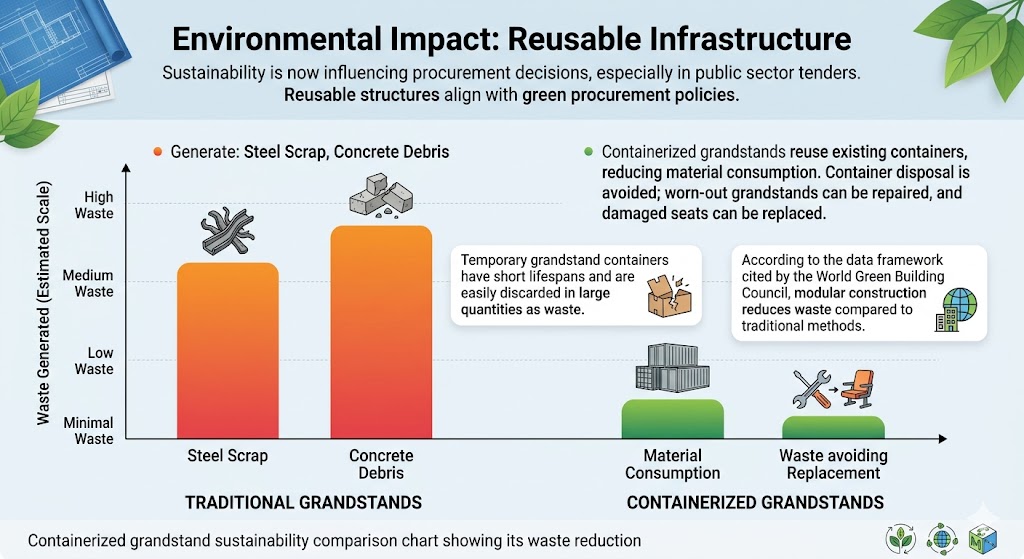
La durabilité influence désormais les décisions d'approvisionnement, en particulier dans les appels d'offres du secteur public.
Les tribunes traditionnelles génèrent :
Déchets d'acier
Débris de béton
Les conteneurs de tribunes temporaires ont une courte durée de vie et sont facilement jetés en grande quantité comme déchets.
Les tribunes en conteneur réutilisent les conteneurs existants, réduisant ainsi la consommation de matériaux. La mise au rebut des conteneurs est évitée ; les tribunes usées peuvent être réparées et les sièges endommagés remplacés.
Selon le cadre de données cité par le World Green Building Council, la construction modulaire réduit les déchets par rapport aux méthodes traditionnelles.
Texte alternatif : Graphique comparatif de la durabilité des tribunes en conteneur montrant leur réduction des déchets
Les structures réutilisables s'alignent sur les politiques d'achat écologiques.
Cas d'application : Avantages du nouveau système de tribunes
Les tribunes de stade traditionnelles sont utilisées moins fréquemment, généralement pour les concerts et les événements sportifs.
Les gradins temporaires sont souvent utilisés pour des activités intérieures telles que le volleyball et les répétitions.
Dans les scénarios nécessitant de la flexibilité, les tribunes en conteneur sont supérieures aux systèmes traditionnels :
9.1 Événements sportifs temporaires
Déploiement rapide, soutenant les événements saisonniers.
9.2 Plateformes d'observation pour festivals de musique
Offre des zones d'observation sécurisées et surveillées.
9.3 Événements publics et festivals
Facilement déplacées sur plusieurs sites.
9.4 Événements sportifs
Plusieurs tribunes peuvent être installées sur le périmètre pour augmenter la capacité d'accueil.
9.5 Diverses activités telles que les courses et l'équitation
Des gradins en conteneurs peuvent être installés au premier rang en tant qu’emplacements VIP.
Texte alternatif : Cas d’application du nouveau système de gradins, illustrant son utilisation lors d’événements sportifs, sur des chantiers de construction et dans des festivals.
Chaque scénario bénéficie de la rapidité, de la mobilité et de la réutilisabilité.

| Période | Gradins/Tribunes de stade traditionnels | Tribunes en conteneurs | Information clé |
|---|---|---|---|
| 1 an | -51 TP3T à 101 TP3T | 351 TP3T à 501 TP3T | Les gradins en conteneurs atteignent rapidement le seuil de rentabilité grâce à des coûts initiaux inférieurs de 60 à 70 % et à une utilisation immédiate. Les constructions traditionnelles subissent souvent des retards et un retour sur investissement initial négatif. |
| 3 ans | 251 TP3T à 451 TP3T | 1201 TP3T à 1601 TP3T | Les solutions en conteneurs offrent des rendements plus de 3 fois supérieurs. La réutilisabilité et les faibles frais généraux accélèrent l’amortissement. |
| 5 ans | 601 TP3T à 901 TP3T | 2501 TP3T à 3201 TP3T | À l’année 5, les gradins en conteneurs génèrent une valeur cumulée nettement supérieure, avec la flexibilité de les déplacer ou de les agrandir facilement. |
| 10 ans | 1501 TP3T à 2201 TP3T | 5501 TP3T à 7001 TP3T+ | Les gradins en conteneurs affichent le retour sur investissement à long terme le plus élevé — souvent 3 fois ou plus par rapport aux options traditionnelles — grâce à leur durabilité, leur entretien minimal, leur potentiel de revente et leur polyvalence multi-événements. |
Remarque: Le retour sur investissement réel varie selon l’emplacement, la fréquence des événements, les réglementations locales et les taux d’utilisation. Les gradins en conteneurs surpassent systématiquement les autres dans la plupart des scénarios en raison de leur moindre intensité capitalistique et de leur plus grande flexibilité.
Les gradins en conteneurs révolutionnent les sièges pour spectateurs avec plusieurs avantages décisifs :
Gradins temporaires.
| Aspect | Tribune traditionnelle | Gradins en conteneurs (alternative) | Méthode de construction |
|---|---|---|---|
| Charpentes en acier soudées sur site + fondations lourdes | Assemblage manuel sur surface plane | Production modulaire en usine utilisant des conteneurs maritimes modifiés | Environnement de production |
| Construction sur site | Sur site / Entrepôt | Usine contrôlée (découpe CNC et soudure standardisée) | Semaines à mois |
| Temps d'installation | Heures (manuel) | Heures (grue + boulons) | Fixe / Non déplaçable |
| Mobilité | Hautement portable | Excellent (Levage → Transport → Réinstallation) | Réutilisabilité |
| Moyenne (durée de vie courte) | Faible | Élevée (20-30 ans, facilement déplaçable) | Difficile et coûteux |
| Transport | Expédition en conteneur complet possible | Intégré à la logistique standard des conteneurs | Exigences de sol |
| Fondations lourdes requises | Surface plane | Flat surface | Nécessite uniquement une surface de sol plane et complète |
| Coût initial | Le plus élevé | Le plus bas | Modéré |
| Coût du cycle de vie | Élevé (en raison d’un usage unique et de délais longs) | Faible mais remplacement fréquent | Plus faible (réutilisable + longue durée de vie) |
| Durée de vie | Longue | Courte (facilement endommagée) | Longue (20 à 30 ans) |
| Dépendance à la main-d’œuvre | Très élevée (soudage et fabrication sur site) | Moyen | Faible (principalement en usine + intervention minimale sur site) |
| Personnalisation | Limitée (principalement la couleur) | Basique (matériau et conception extensible) | Élevée (logos, garde-corps, double étage, accès fauteuils roulants, etc.) |
| Performance structurelle | Capacité de charge élevée | Stabilité plus faible | Solide (acier galvanisé Q235, poteaux renforcés, normes ISO) |
| Résistance aux intempéries | Bonne (permanente) | Mauvaise (souvent uniquement en intérieur) | Bonne (le toit du conteneur protège du soleil et de la pluie) |
| Impact environnemental | Déchets élevés (déchets d’acier + béton) | Déchets élevés (durée de vie courte) | Faibles déchets (réutilisable, réparable, utilisation réduite des matériaux) |
| Meilleurs cas d’utilisation | Stades permanents et grandes installations fixes | Événements en intérieur, petites installations temporaires | Événements sportifs temporaires, festivals de musique, événements publics, chantiers de construction, zones VIP, événements itinérants |
| Potentiel de retour sur investissement | Récupération lente | Limité par une courte durée de vie et une faible durabilité | Le plus élevé (utilisation élevée, redéploiement rapide, revenus récurrents) |
Les gradins en conteneurs redéfinissent la manière dont les infrastructures d’assise sont livrées et utilisées, en passant d’une construction traditionnelle à une solution modulaire basée sur des produits. Au lieu de recourir à une fabrication sur site chronophage, ce système permet une production contrôlée en usine, garantissant une qualité constante, une livraison plus rapide et une réduction des risques du projet.
D’un point de vue achats, la solution répond directement à trois défis critiques : des délais longs, des coûts de main-d’œuvre élevés et une faible utilisation après événement. Grâce à une installation prête à l’emploi et à des exigences minimales en matière de terrain, les gradins en conteneurs peuvent être déployés en quelques heures, améliorant considérablement l’efficacité et la prévisibilité du projet.
Plus important encore, la mobilité transforme les gradins d’actifs fixes en outils générateurs de revenus. La capacité de déplacer, réutiliser et redéployer sur plusieurs événements permet aux acheteurs de maximiser les taux d’utilisation et d’obtenir un retour sur investissement plus rapide—ce que les structures traditionnelles ne peuvent offrir.
De plus, le système offre une performance structurelle solide, des options de personnalisation flexibles et une longue durée de vie, ce qui le rend adapté aux applications temporaires et semi-permanentes. Sa nature réutilisable répond également aux exigences croissantes de durabilité dans les achats mondiaux.
Dans l’ensemble, les gradins en conteneurs ne sont pas simplement une alternative—ils constituent une mise à niveau axée sur les solutions qui aide les entrepreneurs, les organisateurs d’événements et les équipes achats à réduire les coûts, accroître la flexibilité et débloquer une valeur à long terme.
Votre adresse électronique ne sera pas publiée. Les champs obligatoires sont marqués *
 Anglais