Container Grandstands vs. Traditional Temporary Grandstands: A Cost-Effectiveness Comparison When planning a sporting event, concert, festival, school competition, or outdoor public gathering, temporary seating is often one of the largest infrastructure investments. Event organizers need to consider not only the initial purchase or rental price, but also transportation, installation, labor, storage, maintenance, flexibility, safety, and […]
When planning a sporting event, concert, festival, school competition, or outdoor public gathering, temporary seating is often one of the largest infrastructure investments. Event organizers need to consider not only the initial purchase or rental price, but also transportation, installation, labor, storage, maintenance, flexibility, safety, and long-term reuse.
Two popular solutions are container grandstands and traditional temporary grandstands. While both can provide safe and efficient spectator seating, their economic characteristics are quite different.
For organizations that host recurring events or need a flexible spectator seating solution, understanding the total cost of ownership can make a significant difference.
This article compares container grandstands and traditional temporary grandstands from an economic perspective and explains which solution may provide better value for different event applications.
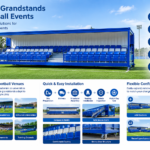
A container grandstand is a modular spectator seating system designed around shipping-container-style modules or container-compatible structural units. These modules can integrate seating, stairs, railings, access areas, storage spaces, hospitality areas, or other event facilities.

The key advantage of this concept is modularity.
Instead of treating the grandstand as a one-time temporary structure, container-based systems can be designed for repeated transportation, assembly, disassembly, and redeployment.
This makes them particularly attractive for:
Depending on the design, a container grandstand can also combine spectator seating with functional spaces such as storage, VIP rooms, changing rooms, ticketing areas, or hospitality facilities.
A traditional temporary grandstand is generally constructed from modular steel frames, aluminum components, platforms, beams, stairs, guardrails, and seating elements.
These structures are widely used because they are relatively flexible and can be adapted to different site conditions.
For a single short-term event, renting a conventional temporary grandstand can be an economical choice. However, when the same organization needs temporary seating repeatedly, the economics become more complex.
The real cost can include:
Therefore, the most important question is not simply:
Which grandstand has the lowest initial price?
A better question is:
Which grandstand provides the lowest total cost over its expected service life?
The initial investment is usually the first factor considered by event organizers.
Traditional temporary grandstands may have a relatively low initial cost when rented for a single event. Because the equipment is reused by the rental provider, customers do not need to purchase the entire structure.
Container grandstands, on the other hand, may require a higher initial investment if purchased outright.
However, comparing the purchase price alone can be misleading.
Suppose an event organizer needs spectator seating for several events every year.
A traditional temporary grandstand may require a rental fee each time it is used:
Rental cost × number of events × number of years
A container-based grandstand may require a larger initial investment but significantly reduce recurring rental expenses.
This means the economic advantage of container grandstands becomes more apparent as the frequency of use increases.
Transportation is another important component of temporary grandstand economics.
Traditional temporary grandstands consist of many individual structural components. These components may require multiple trucks, pallets, or specialized transport arrangements.
Every event can involve:
Container-based systems are designed around standardized modular units, which can simplify logistics.
Standardized container dimensions can make transportation planning more predictable and can allow organizations familiar with container logistics to integrate the grandstand into existing transportation systems.
For projects involving frequent relocation, this can create meaningful savings.
Labor is often overlooked when comparing temporary seating systems.
A conventional temporary grandstand may require a team of trained workers to assemble hundreds or thousands of structural components.
The installation process can include:
A container-based grandstand can potentially reduce the amount of on-site assembly because larger modules can be delivered substantially preassembled.
This can shorten installation time and reduce the number of workers required.
For venues with strict event schedules, this has an additional economic benefit: shorter installation periods mean less venue downtime.
The same principle applies when an event ends.
Traditional temporary grandstands need to be dismantled piece by piece. This process consumes labor hours and requires careful handling of components.
Container-based systems can be designed for relatively efficient disassembly and relocation.
For organizations operating a traveling event series, reducing installation and dismantling time can have a significant effect on annual operating costs.
Storage is another major difference.
Traditional temporary grandstand components are usually stored separately. A large seating system may require substantial warehouse or yard space.
The organization may need to manage:
Container-based systems offer an interesting alternative because the container itself can serve as part of the logistics and storage solution.
Depending on the design, some components or event equipment may be stored within the modules when they are not being deployed.
This can reduce handling and simplify inventory management.
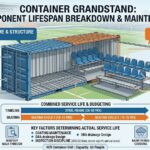
Economic performance also depends heavily on service life.
A grandstand that costs less initially but requires frequent replacement may ultimately be more expensive than a higher-quality system with a longer useful life.
Container-based grandstands can benefit from robust steel construction and modular engineering.
When properly designed, manufactured, installed, inspected, and maintained, these systems can be suitable for repeated deployment.
Traditional temporary grandstands can also have long service lives, especially when operated by professional rental companies and maintained correctly.
Therefore, durability should be evaluated based on:
Maintenance costs are another important part of the total cost of ownership.
Traditional temporary seating systems have many individual components and connections. Repeated assembly and disassembly can gradually increase wear on components.
Container grandstands may reduce the number of loose components involved in each deployment.
However, this does not mean maintenance can be eliminated.
All spectator seating systems should be regularly inspected for:
From an economic perspective, preventive maintenance is generally more cost-effective than emergency repairs or component replacement immediately before an event.
One of the strongest economic arguments for container grandstands is reusability.
A temporary seating structure may be needed in different locations throughout the year.
For example:
Spring: Football tournament
Summer: Music festival
Autumn: Motorsport event
Winter: Corporate or community event
A modular container grandstand can potentially be relocated between venues.
This allows the same capital investment to generate value across multiple events.
Traditional temporary grandstands are also highly reusable, particularly when supplied by rental companies. However, the event organizer normally pays rental, transportation, and installation costs every time the system is deployed.
For recurring events, cost per event is one of the most useful metrics.
A simplified calculation is:
Cost per Event = Total Lifecycle Cost ÷ Number of Events
For a purchased container grandstand:
Total Lifecycle Cost = Purchase Price + Transportation + Installation + Maintenance + Storage + Other Operating Costs
For a rented traditional temporary grandstand:
Total Lifecycle Cost = Rental Fees + Transportation + Installation + Disassembly + Other Event Costs
The actual numbers will vary considerably depending on seating capacity, location, event duration, labor rates, transport distance, and system specifications.
Nevertheless, the model demonstrates an important principle:
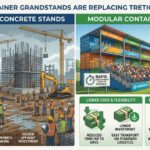
| Cost Factor | Container Grandstand | Traditional Temporary Grandstand |
|---|---|---|
| Initial investment | Usually higher when purchased | Lower if rented |
| Recurring rental fees | Low or none after purchase | Usually applies to each event |
| Transportation | Standardized modular logistics | Multiple component loads may be required |
| Installation | Potentially faster | Often more labor-intensive |
| Disassembly | Potentially faster | Component-by-component |
| Storage | Can be integrated into modular design | Requires dedicated storage |
| Reusability | Excellent for recurring events | Excellent, especially through rental |
| Customization | High | High |
| Long-term ownership value | Potentially high | Depends on ownership/rental model |
| Best suited for | Recurring events and long-term use | One-off or occasional events |
A container grandstand is particularly attractive when several of the following conditions apply:
If the grandstand will be used multiple times per year, purchasing a reusable system can reduce recurring rental expenses.
Organizations running events at different venues can benefit from modular transportation.
If venue access is limited, faster deployment can reduce labor and operational costs.
A container structure can potentially integrate seating with storage, hospitality, ticketing, or other spaces.
Instead of paying rental fees for every event, the organization owns a reusable infrastructure asset.
Traditional temporary grandstands can remain the better option in several situations.
If an organization only needs seating for one event, purchasing a container grandstand may not make financial sense.
For a short project lasting only a few days, renting an existing temporary grandstand can minimize upfront expenditure.
Organizations without suitable storage or logistics infrastructure may find rental services more convenient.
If seating is required only once every several years, rental can avoid the cost of owning and maintaining the equipment.
When evaluating grandstand solutions, buyers should avoid focusing exclusively on the initial quotation.
A professional economic assessment should consider the entire lifecycle:
Purchase/Rental → Transportation → Installation → Operation → Maintenance → Storage → Relocation → Disassembly → Reuse
This is known as Total Cost of Ownership (TCO).
For long-term projects, TCO can provide a much more accurate picture of the real economic performance of a grandstand.
Cost-effectiveness should never mean compromising safety.
Whether choosing a container grandstand or a traditional temporary grandstand, the system should be designed and installed according to the applicable local building codes, structural requirements, fire regulations, accessibility requirements, crowd-load requirements, and event safety standards.
Important considerations include:
A low-cost seating system that creates safety or compliance problems can become significantly more expensive in the long term.
There is no universal winner.
The most economical solution depends on how often the grandstand is used, how long it will be used, how far it needs to travel, and whether the buyer wants to own or rent the infrastructure.
集装箱看台与传统临时看台的经济比较不应仅仅基于初始价格。
对于一次性或偶发性活动而言,传统的临时看台可能非常经济实惠,尤其是在租赁服务方便的情况下。
然而,对于需要反复部署、搬迁、快速安装和长期拥有的组织而言,集装箱看台可以提供显著的长期经济优势。
关键在于评估整个生命周期成本,而不是简单地比较购买价格。
对于活动组织者、体育俱乐部、体育场运营商、学校、大学和其他计划举办定期活动的组织来说,设计合理的集装箱看台可以将临时观众席从经常性的租赁支出转变为可重复使用的基础设施投资。
Your email address will not be published. Required fields are marked *
 English