Why import Custom Covered Bleachers That Actually Fit Your Field? Type “custom covered bleachers” into Google and you’ll get two kinds of results: catalog pages selling vinyl covers you drape over an existing bleacher, and generic aluminum bleacher listings that mention “custom” in the title but offer no roof at all. Search a few sports […]
Type “custom covered bleachers” into Google and you’ll get two kinds of results: catalog pages selling vinyl covers you drape over an existing bleacher, and generic aluminum bleacher listings that mention “custom” in the title but offer no roof at all. Search a few sports facility forums and the complaints repeat themselves — a $400 vinyl cover that split down the seam after one windy season, a maintenance crew that has to pull the cover off before every home game and put it back after, parents asking the athletic director why there’s still no shade over the visitor side. None of that is really “custom covered bleachers.” It’s a workaround.
We build container grandstands for a living, so we’ve read a lot of these threads. Below is what buyers actually run into when they go shopping for real covered spectator seating, and where a container-based grandstand solves problems a vinyl cover or a standard aluminum stand can’t.
Two different products get lumped under the same search term. A bleacher cover is a tarp, usually PVC or vinyl, stretched over an existing frame to cut UV and rain exposure. It helps, but facility managers on r/AthleticDirectors and similar forums report the same failure points: grommets tearing out in gusts above 30 mph, covers that need to come down for winter storage, and a look that reads more “tarp over a truck bed” than permanent facility upgrade.
A covered grandstand is a different category entirely — a structure with an engineered roof that’s part of the build, not an accessory bolted on afterward. That distinction matters when you’re the one explaining the budget line to a school board or a municipal parks committee.
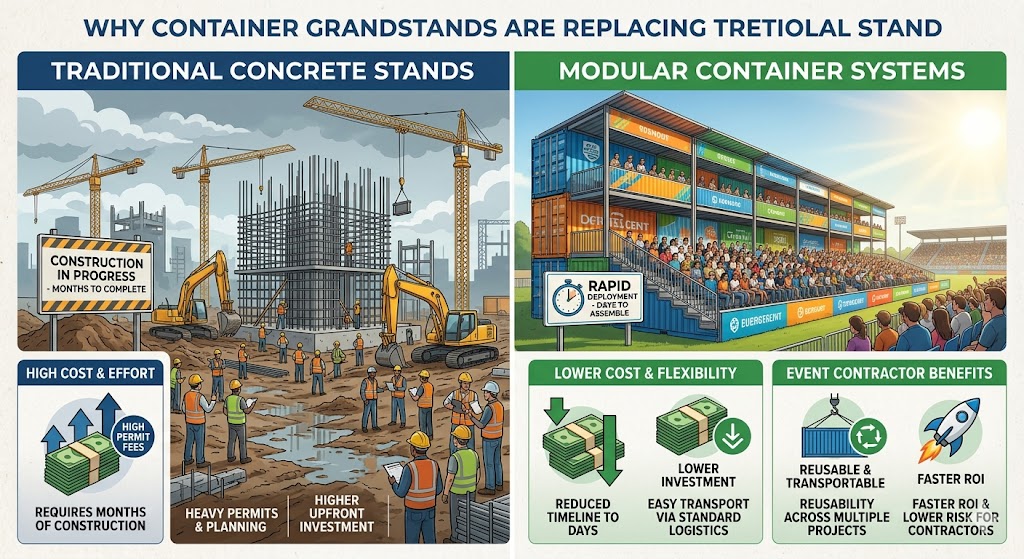
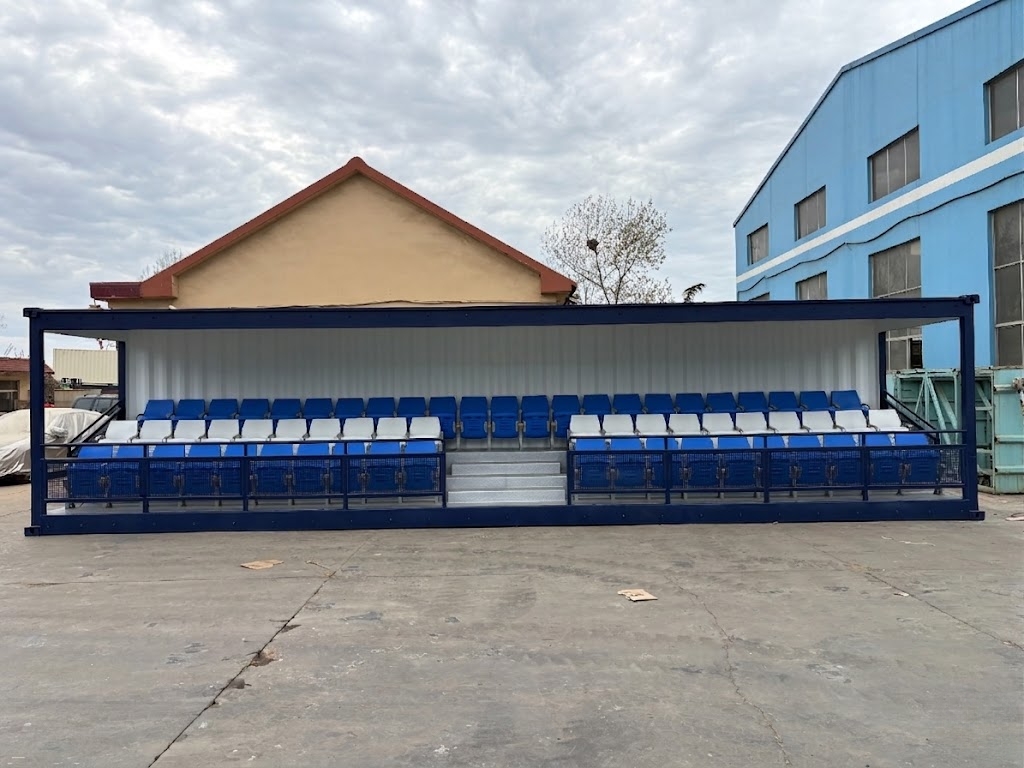
A container grandstand starts life as a standard ISO shipping container — 40ft in our case — that unfolds or extends into a tiered, roofed spectator stand on site. That single fact solves three of the pain points above at once.
Shipping is by ocean freight in a standard container slot, not oversized flatbed cargo, which is where most international buyers lose money on freight surcharges. The roof is structural, not an add-on tarp, so it’s engineered into the load calculations from day one rather than stapled on afterward. And because the unit travels and stores as a closed steel box, there’s far less exposed aluminum for anyone to walk off with between installations.
Our 40ft container grandstand seats 63 spectators, built to the standard 18-inch seat allowance the bleacher industry has used for decades, with a welded steel frame and a covered roof section engineered for wind and snow load rather than draped over as an afterthought. If you’ve ever stood under an uncovered grandstand at 2pm on an August game day, you already know exactly what that roof is worth to the people sitting under it.
The industry math is simple: 18 inches per seat, multiplied by row length, multiplied by row count. A 40ft container converts to 480 inches of usable seating run — divide by 18 and you get roughly 26–27 seats per row before you account for aisle breaks and end posts, spread across the tiered rows that give you 63 total. For a youth league sideline or a mid-size school event, that’s usually enough without needing the multi-unit sprawl a traditional bleacher project requires when you’re trying to hit the same number.
If your venue needs more, container units scale by adding sections — you’re not redesigning a custom structure from zero for every capacity change.
Facility standards bodies like the National Recreation and Park Association publish planning guidance for community sports facilities that’s worth cross-checking against any quote — it’s a useful gut-check on whether a supplier’s numbers are realistic for public-facility use.
| Category | Details |
|---|---|
| Product Type | ISO 40ft shipping container that unfolds into a tiered, fully roofed grandstand |
| Seating Capacity | 63 seats (standard 18″ per seat) |
| Seating Calculation | 480 inches usable seating run → ~26–27 seats per row (before aisles) |
| Roof | Integrated structural roof engineered for regional wind & snow loads |
| Shipping & Delivery | Standard ocean container shipping (cost-effective for international buyers) |
| Installation | Faster deployment from closed container box |
| Security / Theft Risk | Low – bolted steel containerized structure |
| Durability | Permanent welded steel frame with corrosion-resistant coating |
| ADA & Compliance | Custom ADA wheelchair & companion seating integrated before production |
| Engineering | Stamped engineering drawings & IBC-compliant load certifications provided |
| Customization | Scalable by adding multiple units; region-specific load adjustments |
| Best Use Case | Permanent covered spectator seating for schools, parks, and youth leagues |
| Key Advantages | Structural roof, secure shipping/storage, reduced maintenance, easier compliance |
Skip general bleacher retailers if covered, containerized seating is what you actually need — most of them are reselling standard aluminum stock and will quote you a vinyl cover as their “custom” option. Go directly to manufacturers who build container-based structures as a core product line, ask for factory verification and recent project photos, and request the engineering package up front rather than after deposit.
We build ours at GKC Pro specifically for export buyers who need a structure that ships cleanly, clears customs without oversized-freight headaches, and arrives ready to deploy rather than as a pile of parts and a hope the crew on-site can read the manual. If a 40ft, 63-seat covered grandstand is in the range you’re working with, that’s exactly the product we designed for this use case — worth a look before you settle for a tarp.
Your email address will not be published. Required fields are marked *

 English