What Is a Container Pool? The Complete Guide for Importers and Wholesalers For buyers sourcing swimming pool products for resale, hospitality projects, or residential developments, the “container pool” category has moved from a novelty to a serious line item in many catalogs. This guide explains what a container pool actually is, how it is built, […]
For buyers sourcing swimming pool products for resale, hospitality projects, or residential developments, the “container pool” category has moved from a novelty to a serious line item in many catalogs. This guide explains what a container pool actually is, how it is built, when it makes sense compared with a traditional in-ground pool, and what to check before placing a wholesale or import order.
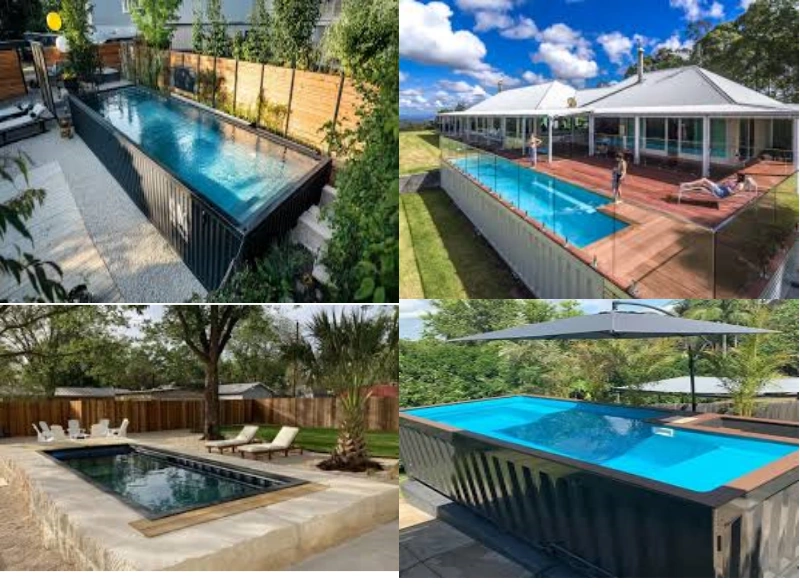
A container pool is a swimming pool built from a repurposed or purpose-built steel shipping container. Rather than pouring concrete or installing a fiberglass shell on site, the manufacturer converts the rigid steel box itself into the pool structure: cutting an opening in the top, reinforcing the frame, waterproofing the interior, and fitting a filtration and circulation system before the unit ever leaves the factory.
Most units are based on standard ISO shipping container sizes, most commonly the 20-foot and 40-foot lengths, with a fixed width of 8 feet and a height of either 8 feet 6 inches (standard) or 9 feet 6 inches (high-cube). A 20-foot container yields roughly 160 square feet of swimming surface, comparable to a large hot tub or compact lap pool, while a 40-foot unit doubles that length for a full-size lap pool. Because the containers already conform to ISO 668, ISO 1496, and ISO 3874 dimensional and structural standards, buyers can rely on predictable, repeatable specifications across suppliers — the same standardization that keeps intermodal shipping containers interchangeable also keeps container pools dimensionally consistent from one production run to the next.
The manufacturing process typically follows this sequence:
Because the pool arrives essentially complete, on-site work is limited to site preparation, crane placement, and utility hookup — a meaningfully shorter installation cycle than a conventional built-in pool.
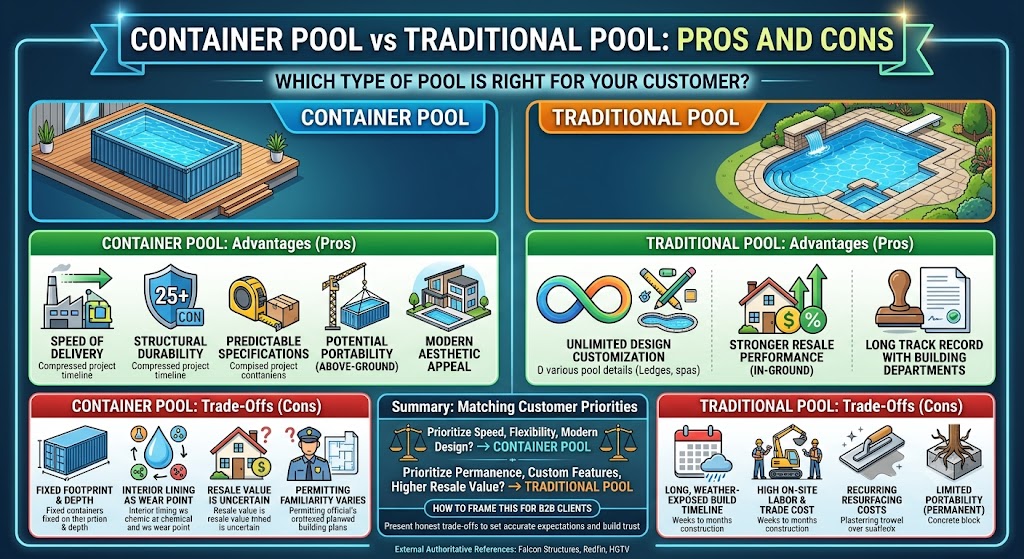
The right choice depends on the end customer’s site conditions, budget, and timeline rather than on which product is objectively “better.”
A container pool tends to suit projects where:
A traditional poured-concrete or fiberglass pool tends to suit projects where:
For wholesale and B2B buyers, this distinction matters for positioning: container pools are best marketed to customers prioritizing speed, portability, and a distinctive design statement, not as a blanket replacement for every pool project.
(Detailed comparison: Container Pool vs. Traditional Pool: Which One Do You Need? — Cluster Guide)
Advantages of a container pool
Trade-offs to disclose to buyers
(Full pros-and-cons breakdown: Container Pool vs. Traditional Pool: Pros and Cons — Cluster Guide)
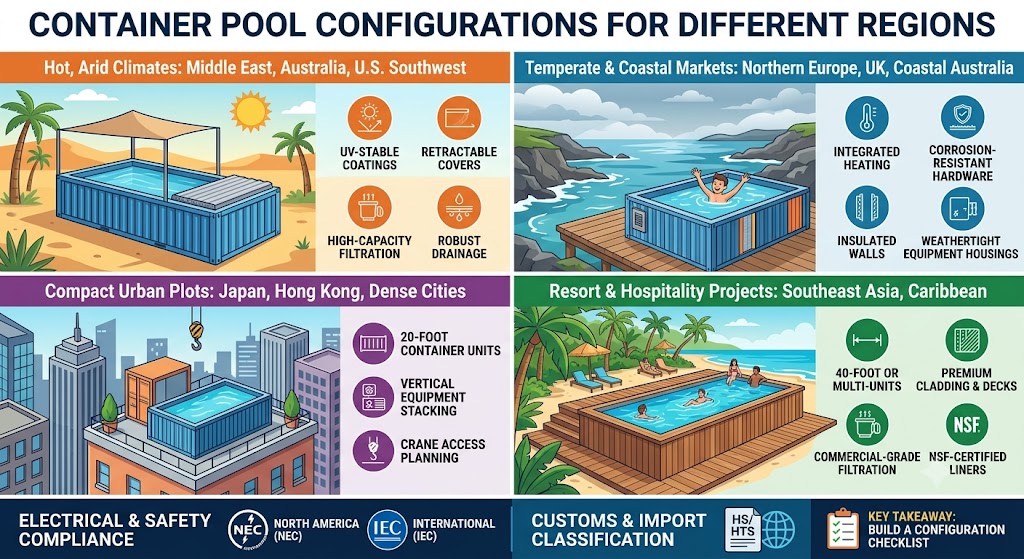
Buyers sourcing for different markets should expect regional variation in how container pools are specified and installed:
Freight and import compliance also vary by destination: buyers should confirm local electrical standards for pumps and heaters, water-treatment chemical import rules, and whether the destination country classifies the unit as a modified shipping container or as pool equipment for customs purposes, since this affects duty codes and required documentation.
(Region-by-region configuration detail: Container Pool Configurations by Region — Cluster Guide)
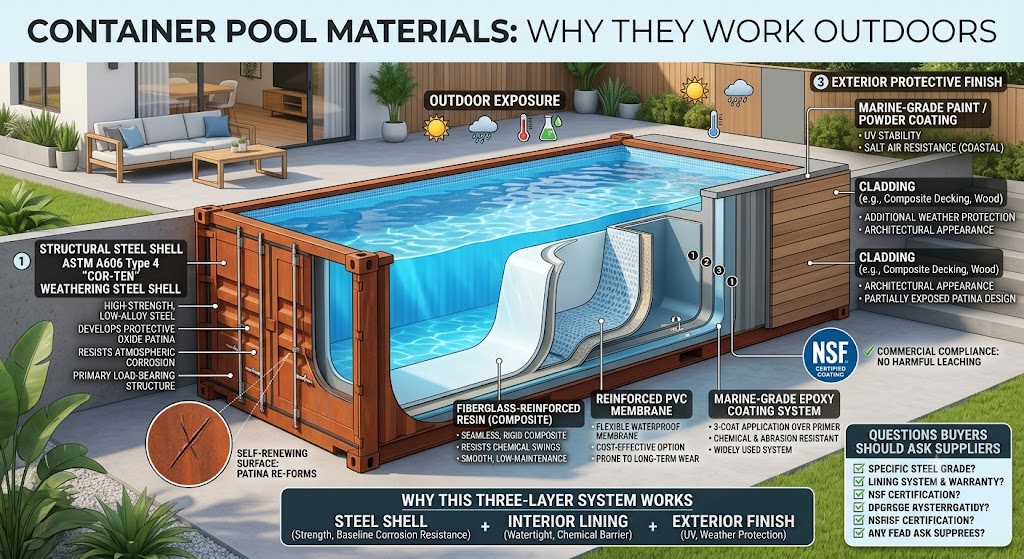
The core material in a container pool is Cor-Ten-type weathering steel, most commonly specified to ASTM A606. Unlike standard carbon steel, A606 weathering steel contains added copper, chromium, and nickel that allow the surface to form a stable, adherent oxide layer — a patina — when exposed to weather. That patina slows further corrosion rather than flaking away, which is why weathering steel is also standard in bridges, exposed structural steel, and outdoor architecture. Combined with a properly applied interior waterproof coating and correct drainage around the exterior, this is what allows a steel box designed for ocean freight to also function as a long-term outdoor pool shell.
Three material layers typically work together:
Buyers should ask suppliers for the specific coating system and warranty terms on the interior lining, since this — not the steel itself — is usually the component most exposed to long-term wear from pool chemicals and water contact.
(Full materials and coatings guide: Container Pool Materials: Why They Work Outdoors — Cluster Guide)
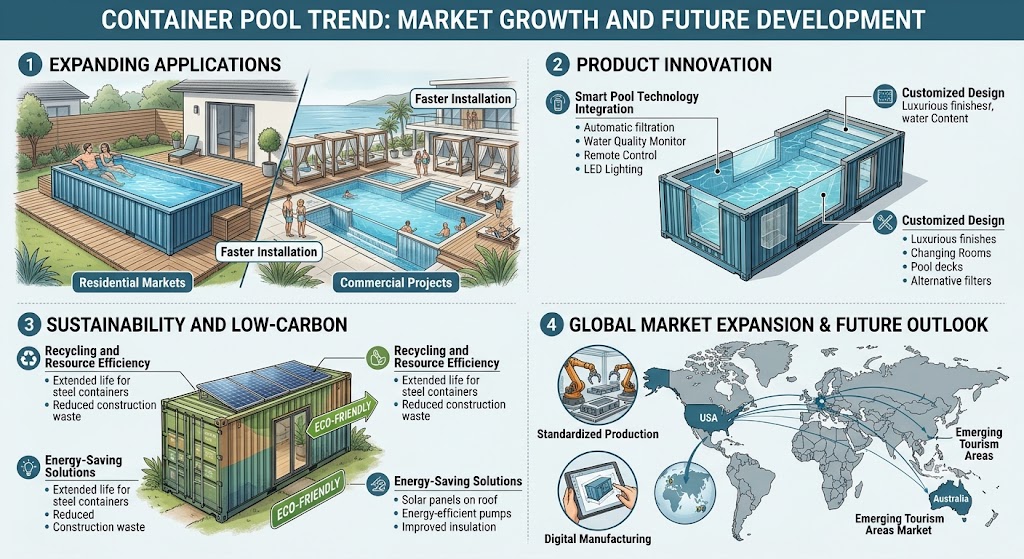
The container pool trend shows how modular swimming solutions are moving from a niche product into a growing category for residential, hospitality, and commercial applications.
In the past, container pools were mainly considered a creative alternative for homeowners looking for unique backyard designs. Today, demand is expanding because buyers are searching for faster installation, lower construction costs, and more flexible outdoor recreation solutions.
Several market changes are accelerating this growth. Residential customers are investing more in backyard leisure spaces, while hotels, resorts, campsites, and vacation rental operators are using container pools to create additional guest experiences without long construction periods.
At the same time, container pools are evolving beyond simple steel structures. Manufacturers are adding smart filtration systems, automatic water treatment, heating solutions, customized finishes, and modular designs to meet different regional and project requirements.
Sustainability is also becoming an important factor. As part of the wider modular construction movement, container pools support factory-controlled production, efficient material usage, and reduced on-site construction waste.
For international importers and distributors, the growing container pool trend represents a new business opportunity. Markets in North America, Europe, Australia, Southeast Asia, and the Middle East are showing increasing interest in products that combine mobility, speed of installation, and modern outdoor living design.
Regardless of construction method, container pools sold into markets such as the United States, Australia, the UK, and the EU are generally expected to meet the same residential pool safety expectations as conventional pools. In the U.S., for example, aboveground and onground residential pools fall under ANSI/APSP/ICC-4, and pool and spa drain covers must meet anti-entrapment requirements under the Virginia Graeme Baker Pool and Spa Safety Act, enforced by the Consumer Product Safety Commission. Importers and wholesalers should confirm with manufacturers which barrier, drain-cover, and equipment standards a given container pool model is designed to meet for the destination market, since requirements differ by country and, within the U.S., by state and local jurisdiction.
For B2B buyers evaluating factories or trading companies, useful qualifying questions include:
Container House Co., Ltd. works with international importers and wholesalers on steel container-based products for export, and can walk buyers through specification, compliance documentation, and shipping logistics for container pool orders. Visit our container pool product page for current specifications and MOQ.
Is a container pool as durable as a traditional pool? The steel shell itself is engineered to survive years of heavy handling and ocean transport, but the pool’s long-term durability depends heavily on the quality of the interior waterproof lining and exterior coating maintenance, not on the steel alone.To see how these materials hold up in various climates according to actual buyers, read our comprehensive Container Pool Reviews.
Can a container pool be relocated after installation? Above-ground installations can generally be relocated by disconnecting utilities and transporting the unit, though feasibility depends on the installation method and local logistics. In-ground or partially buried installations are far harder to move.
Do container pools need the same permits as traditional pools? In most jurisdictions, yes. Container pools are generally subject to the same building, electrical, and safety permit requirements as conventional pools, though some local building departments may request additional engineering documentation since the product type is less familiar to them.
What size container pool is most common for wholesale orders? The 20-foot container is the most widely ordered size for residential-scale projects, while 40-foot units are more common for lap-pool configurations and hospitality projects.
What steel grade should I ask suppliers about? Ask specifically whether the container is fabricated from ASTM A606-compliant weathering steel (often marketed as Cor-Ten), since this determines the shell’s baseline corrosion resistance before any interior coating is applied.
External authoritative references cited in this article:
Your email address will not be published. Required fields are marked *

 English