Container Grandstand MOQ: How Order Quantity Affects Your Unit Price and ROI If you’re sourcing container grandstands for a single stadium, a school sports ground, or a multi-venue rollout, one of the first questions you’ll ask is: what’s the minimum order quantity, and how does volume affect price? This guide breaks down our MOQ policy, the real […]
If you’re sourcing container grandstands for a single stadium, a school sports ground, or a multi-venue rollout, one of the first questions you’ll ask is: what’s the minimum order quantity, and how does volume affect price? This guide breaks down our MOQ policy, the real economics behind bulk ordering, and how to calculate the order size that gives you the best return.
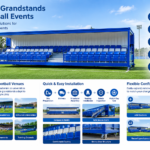
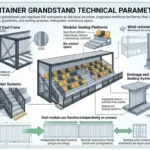
Unlike many manufacturers that require bulk commitments before they’ll even quote a price, we accept orders starting from a single 40FT container grandstand unit. This low-MOQ policy exists because our container grandstands are prefabricated, modular structures — each unit is fully self-contained (seating, structural frame, and container shell), so there’s no minimum batch size required to run production efficiently.
This makes container grandstands accessible to a wider range of buyers, including:
As a baseline reference, our standard 40FT container grandstand — configured with 63 seats — is priced at EXW $14,000 USD per unit at MOQ 1. EXW (“Ex Works”) is a standard ICC Incoterms® trade term meaning the buyer takes responsibility for freight, insurance, and export clearance from our factory gate — a distinction worth understanding before comparing quotes across suppliers. This figure gives buyers a starting point for budgeting, though final pricing depends on seating configuration, roofing, guardrails, branding, and certification requirements. For a full breakdown of what drives the quote up or down, see our pricing factors cluster article.
While MOQ 1 keeps the door open for small buyers, ordering in larger quantities meaningfully changes your unit economics. Three mechanisms drive this:
Structural steel cutting, welding jigs, and seating module assembly all have setup costs that get distributed across the batch. When we run 5, 10, or 20+ units in a single production cycle, the per-unit share of tooling, setup, and QC time drops — and that saving is reflected directly in your unit price.
Ocean freight is priced primarily by container/vessel space, not by product count. A single 40FT container grandstand ships as one 40FT unit — but when you consolidate multiple units into the same shipment or vessel booking, you gain leverage on freight rates and reduce per-unit logistics overhead. Container dimensions and structural classification for 40FT units follow the ISO 668 series of standards for freight container classification, which is useful reference when coordinating with a freight forwarder. For buyers importing to Australia, the EU, the Middle East, or Southeast Asia, freight can represent a meaningful share of landed cost, so this compounding effect matters at scale.
Because fixed costs (engineering review, documentation, export compliance checks) are largely quantity-independent, spreading them over more units directly improves your margin per seat sold or per venue equipped — particularly relevant if you’re a distributor, contractor, or rental operator reselling capacity rather than an end-user installing for a single venue.
| Buyer Profile | Recommended Order Size | Why |
|---|---|---|
| Single school/venue, first purchase | 1 unit (MOQ) | Test fit, installation process, and after-sales service before scaling |
| Multi-venue council or federation rollout | 5–10 units | Meaningful unit cost and freight savings begin to compound |
| Distributor / rental fleet operator | 10+ units | Maximizes margin per unit for resale or rental deployment |
| Large-scale stadium or multi-site project | 20+ units | Best achievable EXW pricing and consolidated shipping economics |
When evaluating order size, buyers should weigh three factors together rather than focusing on unit price alone: EXW unit cost, freight cost per unit, and expected utilization (seats deployed vs. seats sitting in storage). Whenever possible, increasing quantity improves your ROI — but only up to the point where deployment capacity keeps pace with delivery. We recommend phased ordering (e.g., 5 units now, 5 units in the next fiscal cycle) for buyers who want volume pricing without overcommitting capital upfront.
Because pricing scales with configuration and quantity together, we provide tailored quotes rather than a fixed volume price list. To get an accurate number for your project — whether that’s 1 unit or 50 — share your target seat count, delivery region, and timeline, and our team will return a formal quotation with EXW and shipping-inclusive options. For larger or multi-unit orders, we recommend arranging independent pre-shipment inspection through a third party such as Bureau Veritas inspection services before final payment release.
If this is your first time importing a container grandstand, our Container Grandstand Buyer’s Guide walks through the full procurement process step by step — including supplier comparison criteria and answers to the most common buyer questions.
Tell us your required quantity and destination port, and we’ll providecontainer grandstand EXW and CIF pricing within 24 hours.
Your email address will not be published. Required fields are marked *

 English