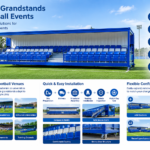
Modular Grandstand: Benefits, Applications and Design Options A modular grandstand provides a flexible way to create spectator seating for sports venues, temporary events, schools, clubs, festivals, and other public spaces. Unlike conventional permanent stadium structures, modular grandstands are made from prefabricated sections that can be assembled into different configurations, expanded when required, and in many […]
A modular grandstand provides a flexible way to create spectator seating for sports venues, temporary events, schools, clubs, festivals, and other public spaces. Unlike conventional permanent stadium structures, modular grandstands are made from prefabricated sections that can be assembled into different configurations, expanded when required, and in many cases dismantled or relocated.
As organizations look for more flexible alternatives to permanent construction, modular spectator seating has become an increasingly practical solution for both short-term and long-term applications.
From a small football club stand to a large temporary event structure, the modular approach allows capacity, layout, access, roofing, seating, and additional facilities to be adapted to the requirements of each project.
A modular grandstand is a spectator seating structure manufactured from standardized or customized components that can be assembled into a complete seating system.
Typical components include:
The main advantage of modular construction is that individual sections can be combined to create different lengths, capacities, and layouts.
For example, a sports club may begin with a relatively small grandstand and later add additional modules as attendance increases.
One of the biggest advantages of a modular grandstand is its ability to accommodate different spectator capacities.
Depending on the system, modules can be arranged to provide seating for:
This flexibility allows the seating capacity to be matched more closely to the actual needs of the venue.
Many modular grandstands use prefabricated components manufactured before arriving at the project site.
This can reduce on-site construction compared with building a conventional permanent spectator stand from scratch.
Installation may involve:
Actual installation time depends on the capacity, design, site conditions, and local requirements.
A modular grandstand can be designed for relocation when the venue or event requirements change.
This makes modular seating particularly useful for:
A relocatable structure can potentially be dismantled and reassembled at another location, subject to its design and applicable regulations.
Modularity makes future expansion easier.
Instead of constructing an entirely new grandstand, additional sections may be integrated into an existing system where the original design allows for expansion.
This can be valuable for growing:
Planning expansion during the initial design stage is important because structural connections, circulation, foundations, and access routes may need to accommodate future modules.
Prefabricated modular systems can simplify the construction process by moving much of the manufacturing work into a controlled factory environment.
This can improve consistency and reduce the amount of fabrication required on site.
However, modular does not mean that engineering requirements can be ignored. The completed grandstand still needs to be designed for its intended loads, environmental conditions, site, and applicable regulations.
Football is one of the most common applications for modular spectator seating.
A modular football grandstand can be used at:
Depending on the design, a football grandstand can include covered seating, accessible spaces, media areas, hospitality zones, storage, changing facilities, and club offices.
The modular structure can also be useful when an existing stadium is undergoing renovation and additional spectator capacity is required temporarily.
Athletics venues often require clear sightlines toward the track and field areas.
A modular grandstand can be configured along the long side of an athletics track or around selected sections of the venue.
The design can incorporate:
Schools and universities frequently require spectator seating for sports days, football, athletics, rugby, and other competitions.
A modular grandstand can provide additional seating without requiring the construction of a large permanent stadium.
For educational institutions, factors such as safety, accessibility, maintenance, storage, and long-term flexibility are particularly important.
Temporary tournaments can attract significantly more spectators than normal events.
A modular grandstand can be installed for:
After the competition, the structure can potentially be dismantled or reconfigured for another event.
Modular seating is not limited to sports.
It can also be used for:
In these applications, the grandstand can be positioned to provide elevated views of a stage, performance area, presentation zone, or central event space.
There is no single modular grandstand design suitable for every project. The structure can be customized according to capacity, site conditions, audience requirements, and event type.
An open grandstand is a relatively simple configuration without a permanent roof.
Potential advantages include:
This option can be suitable for short-term events or locations where weather protection is not a primary requirement.
A roof provides protection from rain and direct sunlight.
A covered modular grandstand generally requires additional structural engineering because the roof introduces additional loads and can affect wind behavior.
Roof options can include different:
For football and other outdoor sports, covered seating can provide a more comfortable spectator environment.
Container-based designs combine modular structural units with spectator seating.
The space beneath the seating area can potentially be configured as enclosed rooms.
Possible uses include:
This approach can create more than just spectator seating—it can provide a compact modular sports facility.
Some modular grandstands are designed specifically for repeated assembly, dismantling, and transportation.
These systems are useful when seating needs to move between different venues or events.
Important design considerations include:
The seating arrangement has a significant impact on spectator comfort and the appearance of the grandstand.
Распространённые варианты включают:
Bench seating provides a relatively simple and space-efficient solution.
It can be suitable for:
Individual seats can provide a more conventional stadium experience.
They may be selected for:
Different colors and seat configurations can also be used for club branding.
For larger venues, premium areas can be integrated into the modular design.
These may include:
The exact configuration depends on the project requirements and available space.
Good modular grandstand design must consider more than the number of seats.
Spectators need safe and convenient routes through the structure.
Important design elements include:
Accessibility requirements vary by country and project, so the final design should be checked against applicable local regulations and standards.
Safety is one of the most important considerations when selecting a modular grandstand.
The structure may need to account for:
In Europe, **EN 13200-6** addresses demountable spectator stands. Other countries may use different standards, codes, or approval procedures.
A professional supplier should be able to provide relevant technical documentation and identify the standards applicable to the project.
One reason businesses choose modular grandstands is the ability to customize the structure.
Customization can include:
The number of seats can be adjusted according to the expected audience.
The length, depth, and height can be adapted to the available site.
The roof can be added or configured according to weather and architectural requirements.
Different seating types, colors, and layouts can be specified.
Club logos, sponsor branding, signage, and color schemes can be incorporated into the design.
For more complex projects, enclosed rooms can be integrated beneath or beside the seating structure.
This is particularly useful for football clubs and sports facilities that need both spectator seating and operational spaces.
A modular grandstand and a permanent concrete or steel stadium structure serve different purposes.
| Характеристика | Modular Grandstand | Постоянная трибуна |
|---|---|---|
| Установка | Generally faster | Usually longer |
| Relocation | Possible with suitable designs | Generally difficult |
| Расширение | Modular systems can support expansion | Often requires construction work |
| Initial construction | Can be relatively simple | Более масштабная |
| Настройка | Высокий | Высокий |
| Long-term permanence | Depends on design | Designed for permanent use |
| Временных мероприятий | Well suited | Less flexible |
| Stadium development | Can supplement existing facilities | Suitable for permanent infrastructure |
The right solution depends on the intended service life, site, budget, planning requirements, and future development plans.
The cost of a modular grandstand depends on several variables rather than simply the number of seats.
Major cost factors include:
For this reason, suppliers normally provide project-specific quotations rather than one universal price.
If you are comparing modular grandstand suppliers, request a complete quotation that clearly identifies whether transportation, installation, engineering documentation, stairs, roofing, seating, and other components are included.
Before placing an order, consider the supplier’s experience with similar projects.
Ask about:
It is also useful to provide the supplier with as much information as possible, including the required capacity, site dimensions, location, event type, seating preferences, roof requirements, and expected period of use.
This allows the supplier to develop a more accurate proposal.
Modern modular grandstands are increasingly being treated as adaptable infrastructure rather than simply temporary seating.
A single modular system can potentially support several stages of a venue’s development.
For example, a sports club could:
This flexibility can be particularly valuable where long-term development plans are uncertain.
A modular grandstand provides a flexible approach to spectator seating for sports, events, schools, clubs, and temporary venues.
Its main advantages include modular capacity, adaptable layouts, potential relocation, faster installation, and a wide range of design options. From simple uncovered seating to covered football stands and container-based sports facilities, modular systems can be configured for very different applications.
When planning a modular grandstand project, focus on more than the number of seats. Capacity, viewing angles, accessibility, structural safety, ground conditions, transportation, installation, weather protection, and future expansion should all be considered during the design stage.
With the right configuration, a modular grandstand can provide a practical spectator seating solution while allowing the venue to adapt as its requirements change.
Ваш адрес электронной почты не будет опубликован. Обязательные поля отмечены *
 Английский язык