Expandable vs. Folding Container House: Which One is Right for You? When I first learned about the prefabricated building and container house market, I confused expandable container house with folding container house. I thought folding container house was the same as expandable container house, but in fact, these two different expressions represent different products. Follow […]
When I first learned about the prefabricated building and container house market, I confused expandable container house with folding container house. I thought folding container house was the same as expandable container house, but in fact, these two different expressions represent different products. Follow along to learn more about them to help you make better purchases.
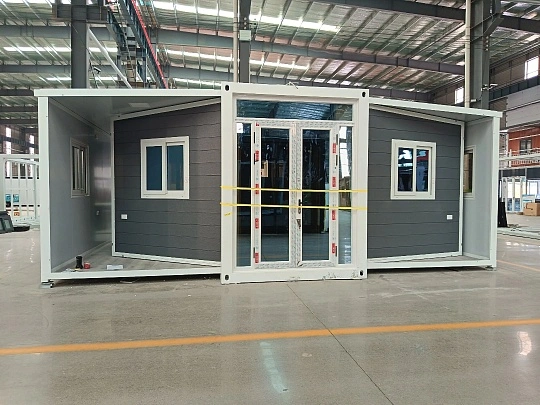
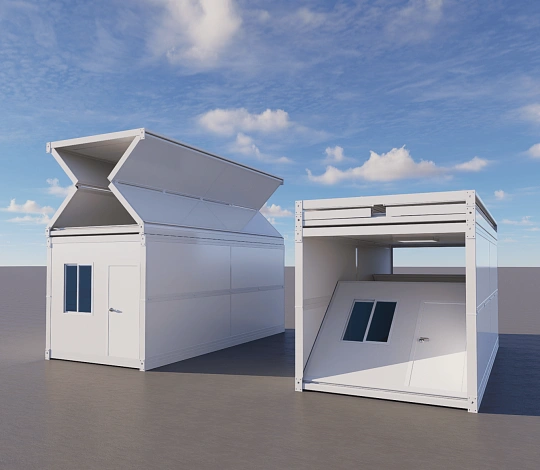
An expandable container house is a unit that can be expanded on both sides, increasing the internal space after installation.
The built-in 130mm galvanized heavy-duty hinges and linkage mechanism enable the synchronous and smooth deployment of both side wings. This ingenious design allows the product to maintain the extreme compactness of a standard container during transportation, and can be quickly transformed upon arrival at the site to release complete usable space, fundamentally overturning the limitations of fixed space.
Unpacking & Positioning: The unit arrives as a container, optimized for low-cost transportation and easy site handling.
Roof Expansion: The primary roof structures are unfolded and lifted into place. This stage defines the footprint of your new living space.
Wall Panel Deployment: Precision-engineered wall panels are tilted up and secured. These panels provide the essential thermal insulation and soundproofing required for a comfortable interior.
Final Assembly & Finishing: With the walls locked, the expandable container is fully deployed. A quick check of the seals ensures the unit is waterproof and ready for immediate use.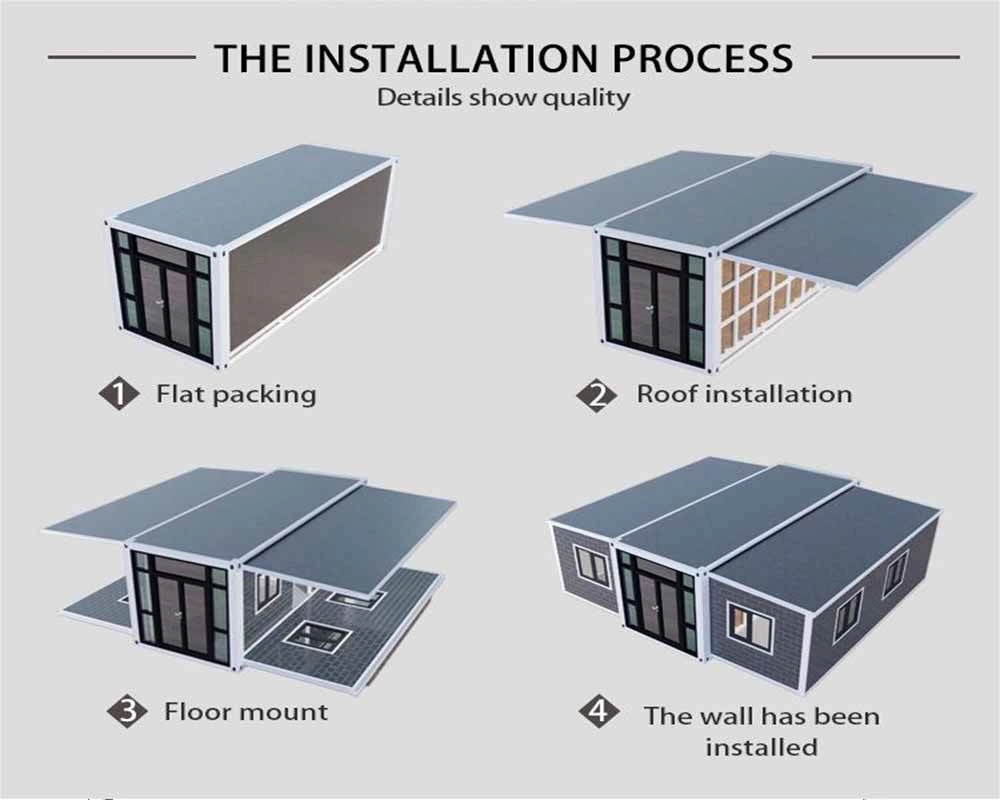
Foldable container houses consist of a base, left and right side walls, and a roof. The left and right side walls are connected to the base, roof, and walls by rotatable chain links, while the lateral walls are connected to the base and roof by movable chain links with pins. During normal stacking, the walls and roof are folded onto the support frame on the base. During assembly, the roof is first lifted, then the left and right side walls are pulled upright, followed by the front and rear walls, and finally, the walls are connected using movable chain links. Compared to traditional fixed containers, foldable container houses offer advantages such as smaller stacking area, lower transportation costs, and faster overall assembly, making them generally suitable for temporary construction projects with short construction periods.
Construction Process: Foundation Treatment → Layout and Positioning → Hoisting → Dismantling and Transportation.
(1) Foundation Treatment: Basic site leveling is required for temporary construction. Depending on specific requirements, this may include gravel paving, concrete hardening, etc.
(2) Layout and Positioning: Layout and position the temporary structure according to the site layout requirements to determine the container placement location.
(3) Hoisting: Use a crane to smoothly lift the container roof from four lifting points, simultaneously erecting the left and right walls. Simultaneously, push the front and rear wall panels from the inside out, pushing them in from both ends until they are in place and fixed to the left and right wall joists. Secure each node with screws.
(4) Dismantling and Transportation: After the temporary structure is used, dismantle it using the reverse hoisting process. Hoist the entire structure onto a vehicle, ensuring that no more than six are stacked horizontally.
| Feature | Folding Container House | Expandable Container House |
|---|---|---|
| Structure | Foldable (flat pack) | Expandable (side extensions) |
| Installation Time | 3–5 minutes | 1–2 hours |
| Transport Efficiency | Very high (10–12 units/40HQ) | Lower (2–4 units/40HQ) |
| Space After Setup | Fixed | 2–3 times larger |
| Layout | Simple | Flexible (can include full facilities) |
| Comfort Level | Basic | High |
| Best Use | Temporary projects | Long-term living / business |
| Cost per Unit | Lower | Higher |
| Shipping Cost | Very low | Higher |
Choose Folding Container House if:
You need fast deployment
Your project is temporary
You want to reduce shipping cost
You need large quantity delivery
👉 Typical buyers: contractors, government projects, emergency suppliers
Choose Expandable Container House if:
You need comfortable living space
Your project is long-term or commercial
You want higher rental or resale value
Appearance and layout are important
👉 Typical buyers: developers, resort owners, rental investors
In real projects, many buyers combine both types:
This strategy helps balance cost, comfort, and efficiency.
If you are planning a project, it’s important to check:
These factors will directly affect your final choice.
Your email address will not be published. Required fields are marked *
 English