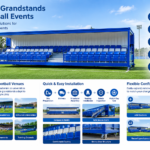
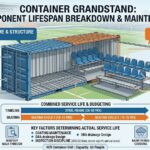
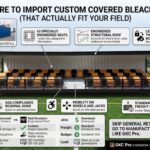
Our new container grandstand design provides a strong and affordable seating option for events and sports venues. It’s a practical solution for businesses needing durable and flexible seating that’s easy to set up and cost-effective.
“When you purchase a simple stand, but due to the poor quality of the chairs and the lack of a roof for shade, the occupancy rate decreases. When you purchase a large traditional modular grandstand, this type of grandstand requires a significant amount of time and financial resources.”
As a globally renowned supplier of stadium containers, we have been constantly observing and contemplating on how to design and manufacture a cost-effective, user-friendly temporary modular stadium enclosure that is convenient for spectators. This article will introduce our latest designed stadium container.
Procurement teams are facing tighter deadlines.
Shipping costs continue to rise while project timelines shrink.
You start noticing clear inefficiencies in traditional systems.
Welded structures demand long installation time and high labor input.
container grandstand new design enters as a practical shift.
It replaces rigid construction with flexible modular deployment.
Organizing events requires preparing a large number of grandstands in advance to ensure the smooth running of the event. Currently, container grandstands, with their unique design, can provide suitable grandstand solutions for event planners and procurement.

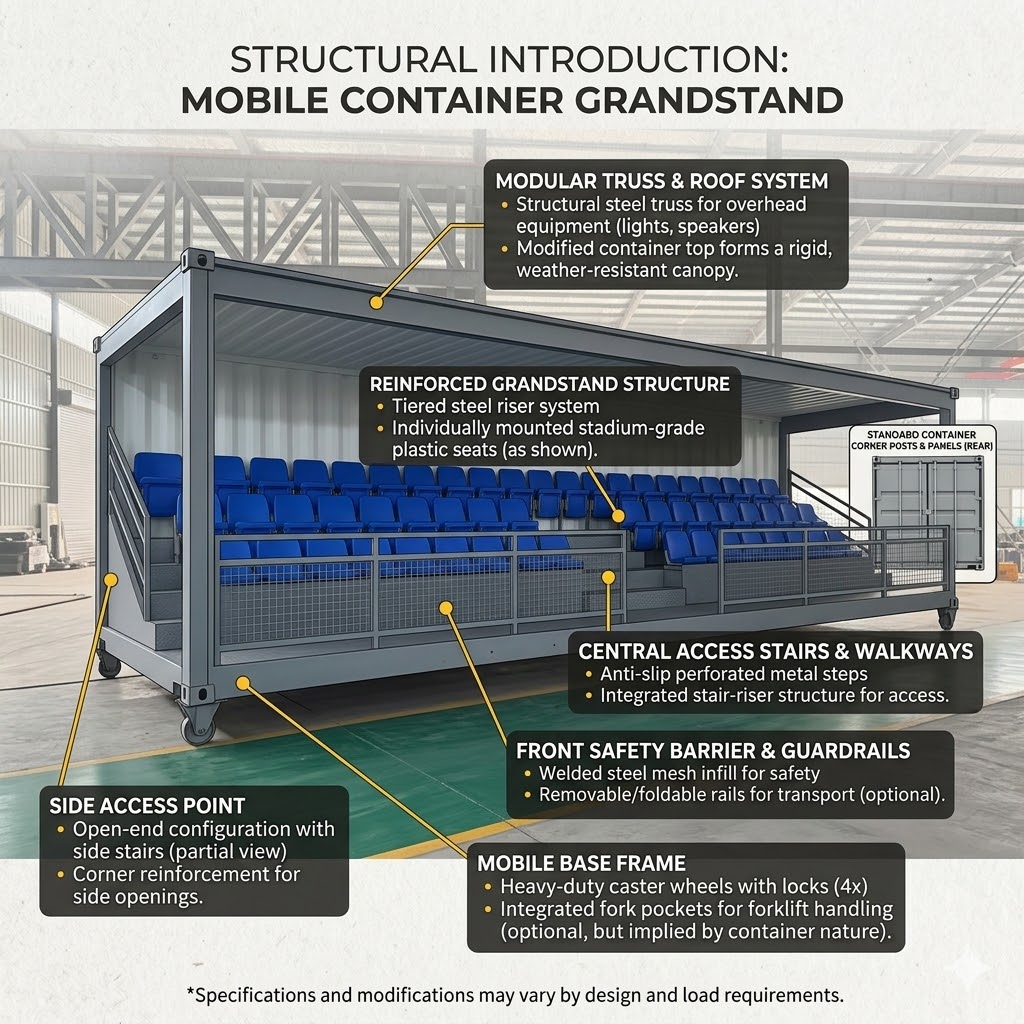
1.the top of the traditional shipping container was cut into a canopy to provide shade and shelter from the rain for spectators in the stands. This solved the problem of excessive glare from the sun for 90% of the spectators watching the game from the stands.
2.The sturdy container-like structure of the stands helps prevent strong winds from affecting the spectators.Compared to traditional stands, it offers over 30% wind resistance.
3.The seats we selected have comfortable backrests, allowing people over 180cm tall to sit comfortably.
4.The iron steps allow people to walk steadily to the top stands, preventing falls caused by loose stairs.
5.Our stands can be quickly moved to other locations using cranes, trucks, and other transport vehicles.
The structure defines everything.
Traditional grandstands rely on fixed steel frameworks.
Modular containers change that logic completely.
Each unit becomes a load-bearing structure with standardized dimensions.
container grandstand new design reduces on-site welding.
This creates faster assembly and more predictable results.
Container grandstands are converted from shipping containers, so they retain the storage function of shipping containers. When you order a grandstand container, we also support transporting some of your goods on the grandstand container, and we will pack and reinforce them.
Although we offer options such as custom seat color, custom box color, custom company logo, and wheelchair passage for the disabled, the best solution is for customers to design it themselves based on market demands.
Our Australian client Bob, based on the requirements of the local club, chose to conduct heat transfer printing on the seats to print the client’s name. This way, his clients could purchase the best seats available. This was something we hadn’t considered before. This operation increased the sales volume of our Australian customer Bob by 26%.
Installation defines project risk.
Traditional systems depend on skilled welders.
Modular systems simplify the process.
Teams can assemble units using basic tools.
Simply select a local installation team with experience in prefabricated construction, choose a stable foundation, and use trucks, cranes, or other transportation tools for rapid installation. The estimated time is within 3 hours.
| Aspect | Traditional Grandstands | New Container Grandstand Design | Main Benefits |
|---|---|---|---|
| Shade & Weather Protection | No roof / limited shelter, high sun glare | Top of container cut into a canopy for shade and rain protection | Solves glare for ~90% of spectators; provides shelter from sun and rain |
| Wind Resistance | Standard / lower resistance | Sturdy container structure offers over 30% better wind resistance | Enhanced safety and comfort in windy conditions |
| Seating Comfort | Basic chairs, often uncomfortable | Seats with comfortable backrests; suitable for people over 180cm tall | Better spectator experience and higher occupancy |
| Steps & Safety | Loose stairs, risk of falls | Solid iron steps for steady climbing | Prevents falls, safer access to upper rows |
| Mobility & Relocation | Fixed structures, difficult to move | Easily moved using cranes, trucks, or other vehicles | Highly portable for temporary or multi-venue events |
| Installation Time | Long, requires skilled welders and high labor | Quick assembly with basic tools; estimated within 3 hours using local prefab teams | Faster deployment, lower labor costs, reduced project risk |
| Shipping & Logistics | Separate transport needed | Retains shipping container function; can transport goods inside with packing/reinforcement | Dual-use (seating + cargo), improved shipping efficiency and cost savings |
| Customization | Limited options | Custom seat color, box color, company logo, wheelchair access; full customer-led design possible | Tailored to market needs; e.g., heat transfer printing on seats increased one client's sales by 26% |
| Overall Structure | Rigid welded steel frameworks | Flexible modular container units; load-bearing with standardized dimensions; minimal on-site welding | Faster assembly, predictable results, scalable and cost-effective |
| Market Focus | Standalone product | Evolving toward integrated project solutions (design + production + deployment) | Drives efficiency, scalability, and profit growth for event organizers |
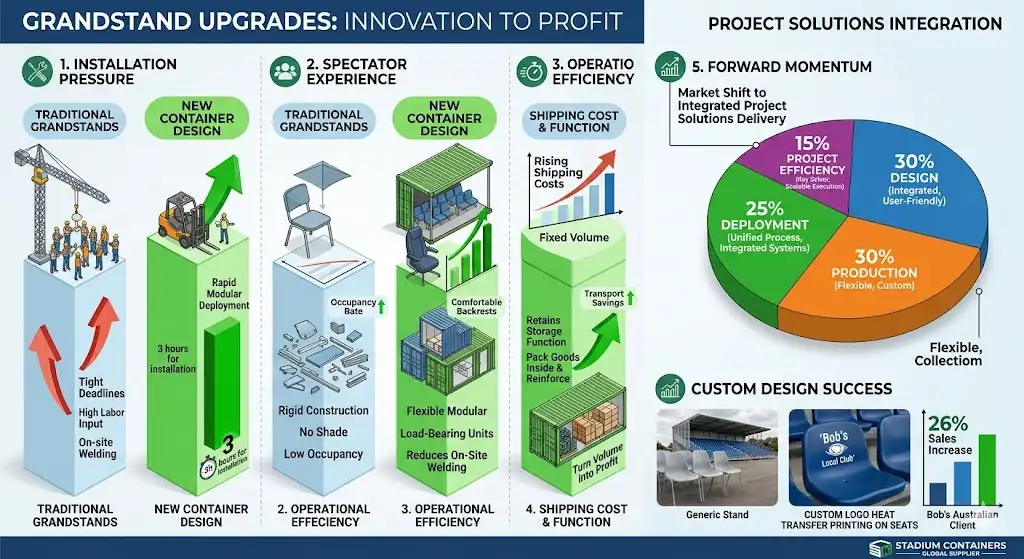
The market is shifting toward integration.
Standalone products no longer meet complex demands.
container grandstand new design continues evolving.
It is moving toward full project solution delivery.
You will see tighter system integration ahead.
Design, production, and deployment will form a unified process.
container grandstand new design is no longer a simple structure.
It is becoming a key driver of efficiency and scalable project execution.
Your email address will not be published. Required fields are marked *
 English