How to Choose the Right Refrigerated Container: A Buyer’s Guide Refrigerated shipping containers — commonly known as “reefers” — have become a backbone of the global cold chain, moving everything from citrus and salmon to vaccines and cut flowers across oceans and continents. But not all reefer containers are created equal, and choosing the wrong […]
Refrigerated shipping containers — commonly known as “reefers” — have become a backbone of the global cold chain, moving everything from citrus and salmon to vaccines and cut flowers across oceans and continents. But not all reefer containers are created equal, and choosing the wrong one can mean spoiled cargo, unexpected downtime, or a unit that simply can’t be serviced when something goes wrong far from home. Here’s what to look at before you buy.
It’s tempting to think of a reefer as just an insulated steel box, but the machine bolted to the front wall is really doing the work. This is the single biggest factor separating a good container from a risky one.
Look for units built by an established manufacturer — Brand-name compressors are engineered to hold precise temperatures across long ocean transits and fluctuating ambient conditions, and they tend to be considerably more energy-efficient, which matters whether the unit is running on shore power, a generator set, or diesel during transport. Just as important, they’re backed by a global network of parts and technicians, so a breakdown mid-route or at an unfamiliar port doesn’t leave you stranded waiting for an obscure spare part. Buyers, freight forwarders, and cargo insurers increasingly expect documented equipment from a recognized manufacturer too — for pharmaceutical and food cargo in particular, it can be a condition of both insurance coverage and customs clearance.
A general-purpose 40ft reefer typically covers a temperature range from around -30°C to +30°C, but different cargo has very different requirements, and it pays to know yours before you buy or rent:
If your cargo needs precise, auditable temperature control — as with medical supplies — insist on a unit with data-logging and remote monitoring, since buyers and regulators will often want proof the cold chain was never broken.
Standard 40ft reefers come in two configurations: standard height and high cube (HC), which adds extra internal height and cubic capacity. As a rough guide:
| Type | External (L×W×H, mm) | Internal Capacity | Tare Weight |
|---|---|---|---|
| 40′ | 12,192 × 2,438 × 2,591 | ~67.7 m³ | ~3,720 kg |
| 40′ HC | 12,192 × 2,438 × 2,896 | ~76.4 m³ | ~3,900 kg |
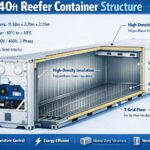
Beyond raw dimensions, look at build quality: high-density polyurethane foam insulation for thermal retention, stainless-steel interiors that resist corrosion, and a fully CSC-certified structure so the container is cleared for intermodal shipping between trucks, trains, and vessels without extra paperwork headaches.
Your budget and use case should drive this decision:
If refrigeration isn’t actually needed, some suppliers can remove the unit and seal the container with a thermal plug, turning it into an insulated (non-powered) storage box at a lower cost.
Reefer containers aren’t only for ocean freight. Businesses regularly repurpose them as standalone cold storage: a backup cold room for a restaurant or distributor, a walk-in freezer at a remote construction or mining camp, mobile cold storage for farms and fisheries, or even solar-powered vaccine storage in areas with unreliable grid power. If storage rather than transport is your main goal, ask suppliers about optional add-ons like extra shelving, lighting, ventilation, or PVC curtains.
Before committing, confirm the container carries relevant certifications (ISO, CSC, CE where applicable) and ask for documentation. Just as important is the supplier itself — look for a manufacturer or trader with an established export history, transparent quality control, and after-sales support, since a cold chain is only as strong as the equipment and the people standing behind it.
Choosing a refrigerated container comes down to three questions: What temperature range and precision does your cargo actually need? Is the refrigeration unit a trusted, serviceable brand? And does the size, condition, and certification of the box match how you’ll actually use it — for transport, storage, or both? Getting these right up front is far cheaper than discovering the answer after a container full of perishable cargo has already gone bad.
Your email address will not be published. Required fields are marked *


 English